June 20, 1852

Lemon

Sunday June 20th  Have been to meeting all day Mother

went this afternoon and returned home  Mr Sanger

of Dover preached  Since meeting have been to 

Alsons with Edwin & wife & Oakes Angier.

Called at Mr Pools  Was treated with strawberries

& ice cream at Alsons and with lemonade

at Mr Pools  Frank went to a sing at Cohassett

Father gave me quite a lecture on cooking stoves

says we have had a dozen and we have had four


No Mr. Whitwell at church today. Instead, Rev. Ralph Sanger of the First Church of Dover led the service. Dr. Sanger was an older minister in the area, having graduated from Harvard in 1808, a year before Evelina was born. He had spent his entire ministerial life in Dover where he was well regarded. He also served several terms in the Massachusetts Legislature and was the chaplain for the Massachusetts State Senate.

After church came an afternoon of sweet sensations. Strawberries, ice cream and lemonade were served at two different homes where Evelina, Oakes Angier, and the young Gilmore couple called. The fresh fruit was a seasonal treat, and the ice cream and lemonade no doubt delightful as well.

Not all was sweet at home, however. Old Oliver got cross with his daughter-in-law and gave Evelina “quite a lecture” about her cooking stove. She was about to get a new one in her kitchen, certainly with her husband’s approval, but her father-in-law had no patience for it.  He didn’t see the need to update the kitchen equipment. We might remember that Oliver had grown up watching his own mother cook over a hearth, a style of cooking that had served for generations.  And here was his daughter-in-law planning to install another stove under his roof.

Even the little bit of rain that fell around sunrise didn’t cheer Old Oliver up.

May 27, 1852

very_rare_miniature_19th_c_pennsylvania_stoneware_preserves_jar_perfect_cond_1_thumb2_lgw


Stoneware or “earthen” jar 

1852 Thursday May 27th  We have cleaned the buttery

to day and we have had a hard job of it.

I have scalded my preserves have several 

lbs of citron & some quince & peach and

this afternoon have given my chamber a

thorough sweeping and washed the paint where

needed.  Have set out some plants from the

house.  Mr Ames went to Canton

The buttery or pantry area off the cook room got cleaned today, and the cleaning wasn’t easy. The women surely had to contend with hardened spills, grease residue and hidden dust pockets. They also would have had to move every bottle, jar, bowl, plate and pan out of the way in order to properly clean the shelves.

In the midst of this domestic upheaval, the women inspected the store of preserves and found that “several lbs of citron & some quince & peach” hadn’t kept well. They were beginning to ferment. To be saved, they needed to be scalded.

Lydia Maria Child, a multi-talented and rather opinionated author, wrote about “Preserves &c” in her classic household guide, The American Frugal Housewife.*  To begin with, she disapproved of preserves, noting that “[e]conomical people will seldom use” them.  “Let those who love to be invalids drink strong green tea, eat pickles, preserves and rich pastry,” she scolded.

But while preserves (and jam and jelly) were expensive and unhealthy, Mrs. Child knew that housewives would persevere in making and serving them.  Preserving fruit with sugar was a practical way to extend the life of a favorite fruit after the crop had ended and to do it in a way that gratified the common human sweet tooth. Resigned to popular preference, she included instructions for dealing with preserves that were going bad:

“When you put preserves in jars, lay a white paper, thoroughly wet with brandy, flat upon the surface of the preserves, and cover them carefully from the air.  If they begin to mould, scald them by setting them in the oven till boiling hot.  Glass is much better than earthen for preserves; they are not half as apt to ferment.”* Evelina evidently disagreed with Mrs. Child about the value of preserves, but no doubt she followed a proper procedure for bringing the preserves back from the bad side of the pantry.


*Lydia Maria Child, The American Frugal Housewife, 1829, p. 59

April 12, 1852

$_35

Tin Dipper

Monday April 12th  have been making sausages.  Tried

lard salted pork &c &c  Went to the store and bought

large tins mixing pan two small and one larger pan and 

tin dipper.  Susan washed the dishes  She does not like

to work very well, though she improves some

I had 38 lbs sausage meat seasoned them with 3/4 lbs salt

4 1/2 oz sage & savory 3 1/2 oz pepper  Am going to

watch with Mrs Brett tonight.  Not very pleasant

Evelina gave us one of her own recipes today, for sausage seasoned with salt, sage, savory and pepper.  She “tried the lard,” too, meaning that she boiled it down somewhat. And she probably used some of her new cookware in the process, while young Susie Ames helped grudgingly with the dishes.

As usual, Evelina cooked on a grand scale, inviting speculation as to just how much food her family ate. With a husband, three grown sons and a still-growing little girl all at the dinner table, we can imagine that 38 pounds of sausage didn’t last long. A month, maybe?

Old Oliver, meanwhile, was in forward gear.  After noting the “cool” and “chilly” temperature, he seemed please to write that “we were a digging a cellar to day for a cariage hous –“  Perhaps the planning for the new stone shops had inspired him to add another building – a carriage house – to the list of new constructions.

January 27, 1852

TMM03FOOD10_a_237278c

1852

Jan 27  Tuesday.  Mrs S Ames & Frederick were to dinner  had a roast

goose.  This afternoon Mr & Mrs Whitwell, Mr & Mrs

John Howard & Miss Jarvis    Mrs Witherell Augustus

& Hannah came this evening    Frederick went after the

ladies. Oliver & George carried them all home this

evening.  Baked some tarts in the other house stove

Have sewed but very little  Mr Wm Brown was also here.

Quite a sociable day for the Ameses, full of company.  Midday dinner was attended by Sarah Lothrop Ames and her son Frederick. (The absence of Oliver Jr. and Helen Angier Ames suggests that the former might have been away on business while the latter had returned to school.) Fred, like Oliver (3), was home from the Ivy League; their conversation at the dinner table probably provided some fresh subject matter. Perhaps they entertained family members with a modified description of life on campus.

Evelina served a roast goose (that Jane McHanna had cooked), a dish that normally denoted a special occasion such as Christmas or New Year’s. Were they serving it in anticipation of Oliver (3)’s 21st birthday, or was it just a whim? Either way, serving roast goose on an odd weekday signified wealth behind the larder.

Sarah Josepha Hale offered a recipe for roast goose in her popular household guide, The Good Housekeeper, suggesting that it be stuffed and roasted on a spit over a “brisk” fire for at least two hours. Otherwise, she had a qualified opinion of the dish:

“Geese seem to bear the same relationship to poultry that pork does to the flesh of other domestic quadrupeds; that is, the flesh of goose is not suitable for, or agreeable to, the very delicate in constitution. One reason doubtless is, that it is the fashion to bring it to table very rare done; a detestable mode!”*

Mrs. Hale would likely have approved of the baked tarts, however, that Evelina served for tea later in the day to the Whitwells and others.  It’s a happy note that Sarah Witherell ventured over at the very end of the day; she must have been feeling better after the extraction of her teeth some days back.  She was comfortable enough to let Evelina’s nephew Augustus and his wife Hannah see her face, which had been swollen for days.


*Sarah Josepha Hale, The Housekeeper’s Guide, 1841, p. 52


December 19, 1851

Coal

Dec 19th Friday  After breakfast went to making

my citron made quite a long job of it nearly two before it

was all done had about 14 or 15 lbs  The coal

affected Jane so much that she nearly fainted 

and had to go to bed & I had to get dinner

After I got through with the citron I put

the things back into the store room from the

shed chamber & put it in order  Spent eve at Olivers

Coal was the fuel of choice at the Ames compound, but it had some negative aspects (beyond its environmental impact, a more modern concern.) Dust and smoke from burning coal was noxious, its particulates containing toxins like lead, mercury and arsenic.  Yet much of America was turning to coal for fuel to support the growth of manufacturing and the expanding rail traffic, and to replace the use of wood in homes.

While working in the kitchen making candied citron, Jane McHanna was overcome by the coal smoke and smell.  She went to bed to recover, leaving Evelina at the stove to finish up and make dinner. No doubt Evelina was concerned for the health of her servant, but no doubt she was somewhat peeved to be doing Jane’s job again.

Citron, meanwhile, was the fruit of choice for fruitcake.  Not as familiar to us nowadays as it was in 1850, it was cooked and candied and used for special baking.  Both Evelina and Jane would have known how to cook it down.


December 13, 1851

$(KGrHqJHJFMFJusCVdz8BSe+hz0oG!~~60_35

Sat Dec 13th  Have tried my lard cleaned hogs head

and fat and the meat ready choped & seasoned 

for filling  Have been to work all day on them

together with Jane & Mary.  Have 78 lbs meat

Mr Ames & Augustus have been to Boston.

Augustus got me some worsteds for hood

Frank & Oakes chopped my meat & Sarahs, she

had 28 lbs.

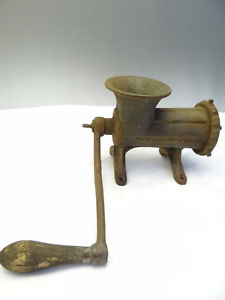
Sarah Witherell and Evelina Ames, sisters-in-law bent on taking care of some pork fresh from the slaughter of a few Ames hogs, had 106 pounds of pork between them to be turned into sausage. In addition to the capable hands of servants Jane McHanna and Mary, they had help from Evelina’s sons Oakes Angier and Frank Morton, who chopped the meat, and probably the fat, too,  into manageable chunks. Together with other ingredients – see below – the meat was forced into a grinder like the one pictured above.

Most likely, the women didn’t need to follow a recipe to make the sausage, having made it countless times before.  But if they did, they could have turned to Sarah Josepha Hale’s instructions in The Good Housekeeper.  They would have had to multiply the recipe times thirty or so:

“TO MAKE SAUSAGE MEAT. — Chop two pounds of lean with one of fat pork very fine – mix with this meat five teaspoonfuls of sale, severn of powdered sage, two of black pepper, and one of cloves.  You can add a little rosemary, if you like it”*

And sausage wasn’t the only product from the pork that Evelina, Sarah, Jane and Mary worked on.  They made lard and dressed a hog’s head. It was a most productive day in the Ames kitchen.

*Sarah Josepha Hale, The Good Housekeeper, Boston, 1841

November 20, 1851

OLYMPUS DIGITAL CAMERA

Thursday Nov 20  I had to get breakfast again this 

morning and do most of the housework  Jane

assisted some and ironed three fine shirts &

washed the dishes after dinner  Mrs Whitwell

came with Mr Brown when he came to school

and staid untill about three and Mr Whitwell

came for her,  after she left I prepared the

mince for pies  Jane chopped the apple

With Jane McHanna continuing to feel poorly, Evelina again cooked breakfast. As her grandson, Winthrop Ames later pointed out, “family breakfasts were promptly at six – and no sketchy affairs of orange juice and a bit of toast either, but substantial meals of mill-ground cereals, eggs and often meat.”* Evelina was cooking for five people, not counting Jane or any other help. She also would have had to prepare the main meal at midday, and tea later on. Today’s tea may have been a simple affair.

Jane felt a bit better as the day wore on and managed to iron shirts, wash dishes and chop apples for baking.  When Evelina wasn’t sitting with her afternoon visitors, Eliza Whitwell and Erastus Brown, she worked in the kitchen on her mincemeat. Thanksgiving Day was only one week away, and the preparing of food for the feast had begun. Pie time!


**Winthrop Ames, The Ames Family of Easton, Massachusetts, privately printed, 1937, p. 128

November 19, 1851

Barberries

Wednesday Nov 19th  Jane is not as well  I got the breakfast

this morning and have been scalding my barbaries

and put more apples to them and have been

about house all day  Painted some mustard

boxes &c  Mrs Wales & Williams called

Mr Whitwell called but I was busy up stairs

and he found no one below and he went

away without seeing any one

Evelina made breakfast as Jane McHanna, usually in the kitchen preparing coffee and the morning meal,  was ailing. Evelina stayed in the cook room for much of the day, “scalding my barbaries” to be put away.  Barberry was a common, woody, hedge shrub with a couple of domestic applications. Cultivated in the 17th, 18th and early 19th centuries, the fruit made “an agreeable, refreshing jelly,”** and the stems could also be used to make a yellow dye.  Evelina wouldn’t have needed the dye; she bought all her textiles.  But she used the fruit for jelly and pies.

Once Evelina got out of the kitchen, she picked up a paint brush to freshen up some mustard boxes. These were small to medium-sized wooden boxes for her pantry. Spices and other kitchen ingredients would have been stored in them. Evelina seemed to be getting her kitchen in perfect order for the Thanksgiving rush.

*Image of barberries courtesy of http://www.womenfitness.net/barberries.htm

** Mrs M. Grieve, A Modern Herbal, courtesy of http://www.botannical.com

November 15, 1851


SUGARLOF

1851

Sat Nov 15th  Another day I have been about house all

day, this morning helped the gardener weigh out

a box of sugar that we bought in Boston

got my bags of cloth of different kinds

in order in the shed chamber  It has been

very stormy all day Mr Ames and Oliver Jr

in Boston Oliver went yesterday He looked 

at carriages but did not purchase one

Bridget gone to housekeeping

At the rate Evelina used sugar in her fruit preserves, she needed many loaves of it. Unable to purchase it at the family store in the village, she bought what they needed in Boston at Faneuil Hall.  On this day, she appeared to be breaking at least part of a sugar loaf into usable bits for her kitchen.  The family gardener helped her, perhaps because the sugar loaf was so heavy to hold.

Sugar wasn’t the only commodity that Boston had to offer.  Evelina’s husband, Oakes, and his brother, Oliver Ames Jr., had gone to the city, the latter in search of a new carriage. He – or they – didn’t purchase anything, just looked.  Oliver Jr. would have been very careful about the cost and quality of such a big item.  Both men would have admired the various coaches, chaises, gigs and traps they must have seen.

It’s worth noting that Evelina reveals today where she kept her “bags of cloth,” when not working on them: in the shed. As she organized them today, folding cloth and perhaps tossing any textiles that couldn’t be used, she would have heard steady rain on the roof.


November 7, 1851

330px-Quince


Friday Nov 7th  Mr Bartlett left in the stage this morning

and George & Mrs Witherell went to Boston I have made

13 lbs Quince preserve 4 lbs jelly and a lot of marmalade

and painted my leaf for the table and it has

kept me busy all day.  Jane went to Mansfield

yesterday with Mrs H & Ames. Bridget is here yet

was taken with a bad pain in her stomach this

evening & sent for her husband & Dr Wales

Mr. Bartlett of Maine departed the house this morning, and Sarah Ames Witherell rode into Boston with her fourteen-year old son, George Oliver Witherell. Her guests, too, had departed, and she was free to go into town.

Without assistance from servants Jane McHanna, who was away, or Bridget O’Neil, who was sick, Evelina stood over her stove today turning at least a peck of quinces into preserves, jelly and marmalade. The store of fruit would be an important addition to the Ames’s dinner table over the winter.  A period recipe for making quince preserves, from The Young Housekeeper’s Friend; Or, A Guide to Domestic Economy and Comfort reminds us of the challenges 19th century cooks faced when preserving food:

“Weigh a pound of best sugar for a pound of fruit, pared and cored.  Boil the fruit in water until it becomes so soft that care is necessary in taking it out. Drain the pieces a little as you take them from the water, and lay them into a jar […] Stone jars will do very well, but if glass is used, it is easy to see whether fermentation commences, without opening them.  Quinces done in this way are very elegant, about the color of oranges, and probably will not need scalding to keep them as long as you wish.  If any tendency to fermentation appears, as may be the case by the following May or June, set the jar (if it is in stone) into the oven after bread has been baked, and the quince will become a beautiful light red, and will keep almost any length of time.” *

Quince is a fruit that we Americans don’t see much of in the 21st century, but it was commonly used in the 19th.  A poor eating fruit, too sour to consume raw, it was high in pectin and kept well, once cooked.  In fact, quince was one of the earliest fruits to be made into marmalade; the word marmalade derives from marmelo, the Portuguese word for quince.**


Mrs. Cornelius, The Young Housekeeper’s Friend; Or, A Guide to Domestic Economy and Comfort, New York, 1845.

** “Quince,” Wikipedia, November 5, 2014