November 1, 1851

OLYMPUS DIGITAL CAMERA

*

1851

Sat Nov 1st  This morning I patched the paper in the

bedroom that Mr Robinson papered last spring

Henrietta came about ten Oclock and left mother 

and her little girls at Augustus.  I went there this P.M.

and staid a couple of hours.  Mr & Mrs Peckham came

to the other part of the house  Mr Scott has finished

painting the parlour and has done here for the present

I paid him 12 dols, 25 cts for graining


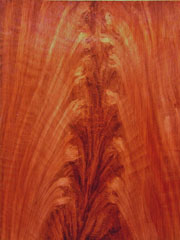
The graining of the woodwork and doors in the downstairs of the house was completed today. As noted earlier, graining is the painting of a surface to resemble wood.  In 1851, popular taste dictated that wood trim from simple pine or ash or other tree be grained to resemble a dressier wood such as mahogany, or curly maple. The illustration above, from a modern decorating company that offers “faux bois,” as graining is also known, shows a hand-painted example of flame mahogany.

The talented Mr. Scott finished his work today, for which Evelina paid him $12.25.  In today’s dollars, the “labor value” of that compensation is $2,680, according to one economic source.** That value is computed using a wage index for unskilled labor; the computation for a production worker compensation would be even higher. That Evelina made note of the expenditure in her personal journal suggests that she thought it was noteworthy – in her own opinion, she either paid too much or she got a good deal.  I suspect the former!

Social life went on as usual today. John and Susan Peckham were back in town and stopped in to see Old Oliver and Sarah Witherell. Evelina’s sister-in-law, Henrietta Williams Gilmore, came into the village from the farm and brought old Mrs. Gilmore to Mr. Torrey’s to visit Alson “Augustus” and Hannah Gilmore.  Henrietta also brought along her two youngest children, eight-year-old Henrietta Hall Gilmore and six-year-old Helen Jane Gilmore.  The two girls were actually half-sisters of 29-year-old Augustus. Their mutual parent, Alson Gilmore, had a spread of seven children from two wives.


Image of mahogany-style graining, Courtesy of http://www.statusfaux.com, Great Neck, New York.

** http://www.measuringworth.com/uscompare/relativevalue.php


September 29, 1851

330px-Open_drawers_-_Garments_for_girls

Monday Sept 29  Cut out three prs of cotton Drawers

for self for Ellen to make & have done some

sewing  Augustus came with his family about

4 Oclock are going to move into a part of Mr

Torreys house  Hector & Susan Orr came to

the other part of the house this afternoon.  Susan

will stop awhile  Not very pleasant has rained some

Rain arrived but the day, according to Old Oliver, was “pritty warm.” The wet weather and her cold must have kept Evelina indoors.  She may not have felt well, but as long as she could sit up, she would have found something useful to do.  Sewing some underwear for herself was the mundane chore waiting in her workbasket. Meanwhile, Jane McHanna, the family servant, washed the weekly laundry, perhaps doing her trick of letting the rain do the rinsing. She would have been challenged to figure out how to dry it, though.

Visitors arrived in the other part of the house; the Orrs, a family with whom the Ameses had been connected since early days in Bridgewater, came to visit. Susan Orr, a spinster, had known Oakes Ames when he was a baby. Today she and Hector – her brother, perhaps? – came to see Old Oliver and Sarah Ames Witherell.

On Evelina’s side of the family, nephew Alson “Augustus” Gilmore, his wife Hannah and their two sons, toddler Eddie and infant Willie, began to move into temporary quarters at Col. John Torrey’s building in the village.  Eventually, they would build a home, but for now they were going to rent.


September 14, 1851

87219f


*

Sunday Sept 14th  Have been to meeting to day,  At noon

brought Miss Eddy home with us.  She walked

with Augustus to church. It is communion day

and Oakes Mrs Stevens & I stoped to bring

Mrs Witherell home.  We rode up to the great

pond and beyond to get some grapes & afterward

called at Mr Torreys

The Ames family attended both morning and afternoon service this Sunday, but instead of staying near church for the intermission, they rode home for a midday break.  Another change in routine may have been that communion was served at the service, which seems out of keeping with modern Unitarian practice.  Does anyone know if Unitarians took communion in the mid-19th century?

After church some of the Ameses rode up to the Great Pond, stopping at Col. John Torrey’s in the village on their way home. Evelina says she, Oakes and Mrs. Stevens brought Sarah Witherell along, a generational grouping that suggests that the “Oakes” in the carriage was her husband rather than her son Oakes Angier. Yet Evelina has, to date, always referred to her husband as “Mr. Ames,” as was the custom.  Did she write his first name unconsciously, or was her son the one in the carriage?  Readers, do you have an opinion? Whoever was in the group, each seemed to have a pleasant late afternoon foraging grapes in the cooler air.

Elsewhere in America on this date, James Fenimore Cooper, author of the popular Leatherstocking Tales, died in Cooperstown, New YorkWhile his Leatherstocking novels secured him fame throughout the western world, Cooper wrote many other novels, some with political overtones to them.  He was not popular with the Whigs. One day shy of his 62nd birthday, he died of dropsy (edema.)

* Baumann’s Rare Books


August 31, 1851

28041868_121522694550

*

Sunday Aug 31st  Went to meeting and at noon Henrietta & Mrs

Stevens came home with us.  Mrs Stevens came with 

us from church at night and Alson carried Orinthia

home  Mrs Stevens & self called at Mr Torreys

The boys went to Dr Swans & Augustus’ to call on 

Miss Eddy who is stopping there  Oliver & wife & George

and family to Mr Lothrops & Pauline went into to stay

with Helen & talk about Warren


Socializing continued today after church, with Evelina welcoming her sister-in-law Henrietta Williams Gilmore and a mutual friend, Mrs Stevens, back to the house. She and the latter went to call on Col John Torrey while the Ames sons rode south to Dr. Caleb Swan’s to call on a Miss Eddy, who must have been special to warrant all three boys coming to visit.

Not forgetting that the Lothrop family had just been through the loss of Sarah Ames’s brother Clinton Lothrop, houseguest Pauline Dean called on young Helen Angier Ames, niece of the deceased.  Evelina was certain that Pauline only went to talk about a new love interest, however. Oliver Jr and Sarah Ames, meanwhile, went with another brother, George Van Ness Lothrop, and his wife Almira to call on their parents and their brother’s widow.

George Van Ness Lothrop, a North Easton son who had moved west a decade earlier, was, in 1851, serving his adopted state of Michigan as State Attorney General. Active in Democratic politics and a general counsel of the Michigan Central Railroad for nearly three decades, he ran unsuccessfully for U.S. Representative and U.S. Senate. He was a great supporter of Stephen Douglas, which would certainly have put him at odds with his brother-in-law, Oliver Jr., who was a Lincoln man. In 1885, he was appointed by Grover Cleveland to be U.S. Minister to Russia.

He died in 1897, and was honored with a road in his name in Grosse Pointe, Michigan, just outside of Detroit.

* George Van Ness Lothrop (1817-1897)

August 25, 1851

il_570xN.69597337

*

Monday Aug 25  Did not wash this morning on account 

of having so much company  Warren left in the stage

cousin Jerry went to Mr Thesis with Oakes Angier

and Frank on their way fishing.  Alson dined here.

We Ladies all called at Mr Torreys & on Elisha

at the Boot shop.  Mr & Mrs & Miss Kinsley & Miss

Billings from Canton were here to tea – came

about 6 Oclock went to the shop with them

Another Monday and for the second time that summer, washing day got deferred.  Tidying up from “having so much company” took precedence over routine. The young relatives, Jerry and Warren Lothrop, left in the morning.  Another visitor, Pauline Dean, remained.

Oakes Angier and Frank Morton Ames left to go fishing, a trip they had deferred from last week. They had waited then for the imminent death of Dewitt “Clinton” Lothrop, which hadn’t happened.  Clinton, though deathly ill with typhus, was hanging on. The boys decided to wait no further, and departed.

Evelina and “We Ladies” – which could only mean Pauline and probably niece Lavinia – went to see Col. John Torrey in the village and called on Elisha Andrews at the boot factory. Elisha, who was 27 years old and single, had started up the factory with Augustus Gilmore and Oakes Angier Ames. In recounting the visit to the boot shop in her diary, Evelina underlined Elisha’s name. Why? The visit was significant in some way; perhaps one of the women – Lavinia? – was romantically interested in Elisha.

More socializing continued late in the day when the Kinsley family visited.  Lyman Kinsley, his wife Louisa, daughter Lucy Adelaide and a Miss Billings (a niece of Louisa, most likely) came for tea. Mr. Kinsley ran an iron and machine shop in Canton, an enterprise that the Ameses would eventually own. After tea, they all walked over to the factory.

* Currier and Ives, “Starting Out,” print, ca. 1852

August 5, 1851

Haymaking

1851

August 5th Tuesday  Have been sewing part of the day

This afternoon took my work and went to Mr

Torreys with the intention of stopping an hour or two

Abby left this morning for Pembroke & I had a 

long chat with Mr Torrey heard all the news.

On my return called on Mrs Lake found her

about house & quite smart.  Heard that Mrs Holmes

was sick

Haying continued, as Old Oliver noted yesterday in his journal:

“in the morning the wind was south west + there was a verry little sun shine untill about 10 – O – clock when the wind shifted to the north east. + it raind in the afternoon but not butt little we mowd the thin part of the Flyaway and brought it home well. + put it out in small heaps”

Evelina worked on her sewing, as usual, and even carried it with her in the afternoon into the village where she visited Col. John Torrey for “a long chat.”  John Torrey was a widower twice over. He had been married first to an Abigail Williams who died quite young. They had no children. In 1828, Torrey married Evelina’s older sister, Hannah Howard Gilmore, and they had three children, of whom two survived infancy:  Abigail “Abby” Williams Torrey, named for the first wife, and Mary Malvina Torrey. Both girls were close to their Aunt Evelina who seems to have served as a maternal figure after Hannah died sometime in the 1840s.

Col. Torrey was a controversial figure in Easton of whom we know only enough to be curious, and not enough to have that curiosity satisfied. (He should not be confused with another John Torrey who was a prominent botanist in New York in the same era.) Listed as a “Trader” in the census, he earned the title of Colonel by years of service in the local militia. Somewhere along the way Torrey invoked the enmity of a local character and lampoonist named James Adams who wrote a derogatory poem about him. Historian William Chaffin recorded this information without including the piece in question.  Chaffin only said that “Our Hero: A Descriptive Poem,” was published in a sixteen-page pamphlet and was “not merely satirical, but derisive and scathing.”*

* William Chaffin, History of Easton, 1886, pp. 764-765


June 18, 1851

Black ticking-stripe-15

June 18th Wednesday  Worked again untill nine in the 

garden and then made the tick for the 

mattress.  This afternoon put the cotton in 

and tied it  Bridget was here a couple

of hours & picked over the curled hair

Towards evening called at Mr E Carrs, Dr Wales

and on Mrs J C Williams at Mr Torreys, Mrs S. Ames

called with me  Augustus gone to Boston

Mr Bartlett spent

last night here

Evelina was making progress on the mattress for her new lounge.  She “made the tick” for the cover and stuffed it with old cotton.  The final cover, to be made of horsehair, was still being worked on. Bridget O’Neil, a servant who usually worked next door, came over to help Evelina with the project.

The long-lasting light of day, as the calendar approached summer solstice, allowed for late socializing. Evelina and her sister-in-law, Sarah Lothrop Ames, went out calling.  They visited Esek Carr and, presumably, his wife, Ann; called on young Dr. Ephraim Wales and, again presumably, his wife Maria; and stopped at John Torrey’s to see Mrs. Joshua C. Williams.  Mrs. Williams, we might infer, was a boarder or renter at Col. Torrey’s apartment building, which Evelina called a tenement. Was Mrs. Williams possibly a widow?

A Mr. Bartlett had spent the night with the family.  He was from Maine, so likely had some connection to the shovel works and their ongoing need of wooden handles.


May 31, 1851

IMG_0004

*

1851

May 31st Saturday  This morning baked in Mrs Witherells oven

brown bread & cake  Mrs S Ames went to Boston

Returned to night with Harriet & a Miss Eaton

from Pittsburgh.  Miss Linscot Orinthia & I […]

have been walking & riding about all day.  have

been to all the shops, ponds, Mr Manley & Claps

flower gardens, & called at Mr Torreys

It has been a beautiful day, rather cold.  A A not here

gone to Boston

Evelina used her sister-in-law’s brick oven early this morning and afterwards ventured outside to enjoy the “beautiful day” with her young house guests. She gave them the standard tour of much that North Easton offered: shovel shops, large ponds, full streams, two farms with extensive flower gardens, and a stop at Col. John Torrey’s, in the village. The latter was probably a sociable occasion that included tea with Abby Torrey.

Sarah Lothrop Ames, meanwhile, went into Boston for the day and returned with Harriett Ames Mitchell and a friend from Pittsburgh, where Harriett had lately been living. There was still no sign of Harriett’s husband, Asa Mitchell, who was, presumably, yet in Pennsylvania on business. Oakes Ames would have been in Boston today, too, perhaps with Augustus Gilmore.

The Ames boys wouldn’t have been pleasuring about – they were at the shovel shops, working.

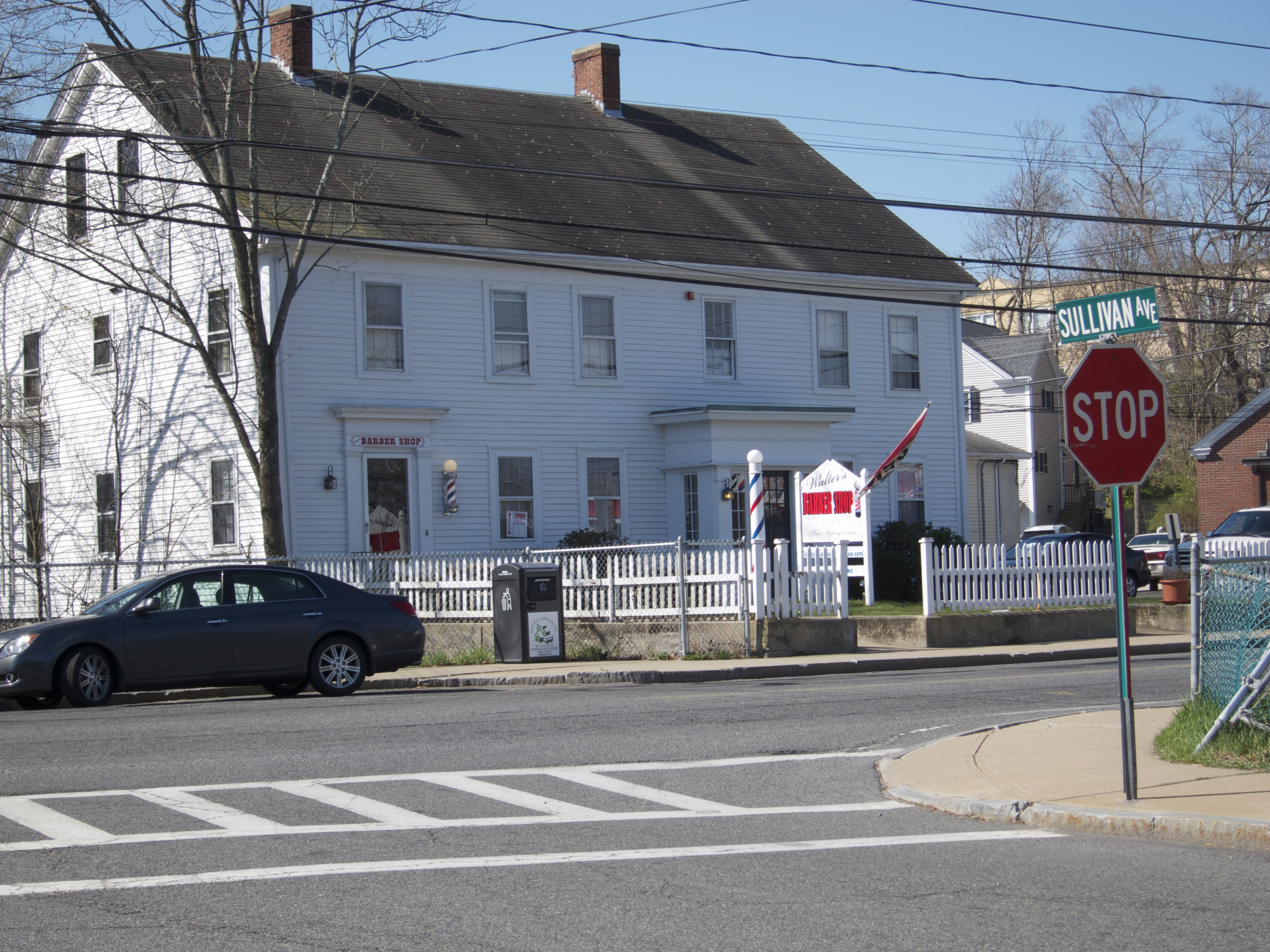
* Building in modern-day North Easton that once belonged to Col. John Torrey


March 27, 1851

0380042t

1851

March 27 Thursday.  Spent the day with Mother at A[u]gustus,

got home just before six Oclock and went

in the evening to the dancing school with Mrs S. Ames

Cut out and commenced a bleached shirt for

Mr Ames but have not done so much as to finish 

the sleeves.  Mrs. S. Ames has been to Boston from 

Sharon.  A fine day and very good travelling

the roads are quite dry.  Mother stopt at Mr Torreys.

After Evelina and her mother spent the day with, respectively, nephew and grandson Augustus, Hannah Gilmore left to spend the night at her son-in-law, John Torrey’s, house in the village, leaving Evelina briefly unencumbered from looking after the elderly woman. Evelina seized the opportunity to go out with her sister-in-law, Sarah Ames, to help chaperone a dance for the young people.

No doubt the Ames sons, Oakes Angier, Oliver (3) and Frank Morton were at the dancing school, as they had been for most of the previous Thursday evening assemblies. So, probably, was Fred Ames, making a rare appearance while home from school.  While adults from their parents’ generation were always present at these occasions, one wonders how the young men felt having their mothers among the group standing guard.

These assemblies were important social occasions that provided innocent pleasure and animation. They fostered acquaintances among the young people of the town who had few other opportunities to mingle.  Dance steps were learned, exercise was taken, manners were polished, courtships were sparked, hearts were engaged or disappointed, and perpetuation of the species forwarded in this important small town gathering. Surely both Evelina and Sarah Ames watched the proceedings with interest.

February 22, 1851

Rubbers

Feb 22nd  Saturday  This morning sat down to sewing

quite early to work on Susans apron.  Mr Torrey called 

to see about Augustus having his tenement.  Augustus

has engaged Mr Wrightmans house for the present.

Lavinia & myself passed this afternoon at Mr Torreys.

Called at the store, met Mrs. Peckham & Miss

Georgianna Wheaton there  Miss Foss came to night.  Mr

Ames has been to Boston brought Susan Rubbers.

Cleared off pleasant to night

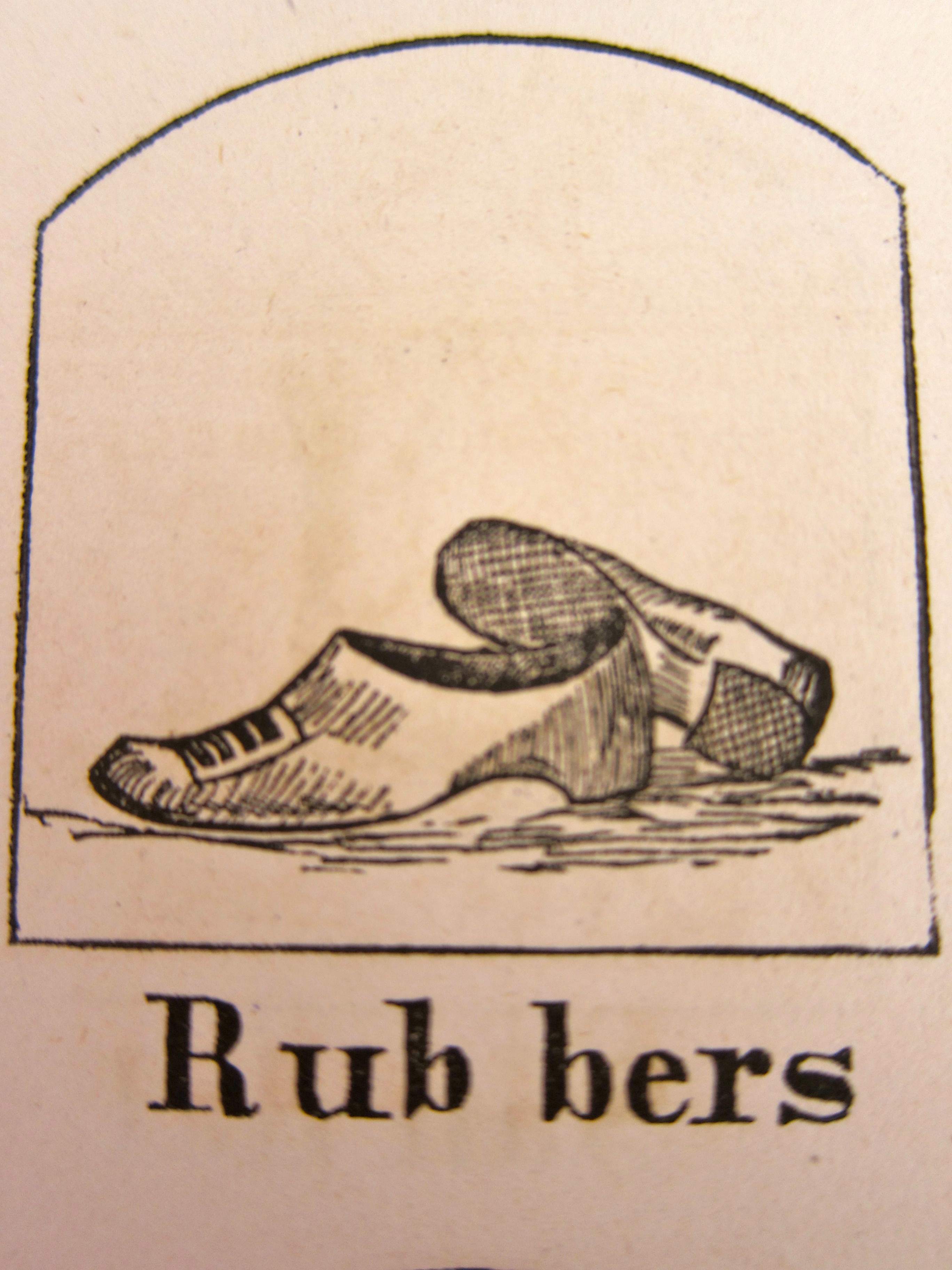
In his journal today, Old Oliver noted that “It’s pretty muddy now,” which explains why Oakes Ames returned from Boston with overshoes, known as rubbers, for his daughter.  Probably everyone in the household donned rubbers during this late winter wetness.

Evelina negotiated the streets just fine, it seems, as she and her niece traveled the short distance to the center of town to call at the company store and at her brother-in-law’s house.  Their mutual nephew, Augustus Gilmore, had decided not to rent from Col. Torrey and would be settling his family instead at a Mr. Wrightman’s house.  And at the end of the day, a new person entered the domestic scene.  Miss Orinthia Foss, the new schoolteacher, arrived from Maine.

February 22 is a date that people acknowledged in 1851 in a manner similar to the way people do in 2014, because it’s George Washington’s birthday.  In this year of Evelina’s diary, President Washington had only been dead for a little over fifty years.  People were alive who could still remember him; Old Oliver was one of them.  Old Oliver was born in 1779, while the Revolutionary War was being fought.  He was two years old when the British surrendered at Yorktown, and eight years old when representatives of the new states assembled in Philadelphia to write a constitution.  George Washington was elected to head that convention and became the country’s first president in 1789, when Old Oliver turned ten.  When Washington died in 1799, beloved and mourned, Old Oliver was a twenty-year old bachelor just making his way in the world.  Much about that world would change over Old Oliver’s lifetime, but the reverence that citizens of the United States felt for their first leader would hold strong.