September 10, 1852

Conductor

Friday Sept 10th  Mother Mrs Stevens Susan & self rode to

the shops this morning.  Mother seemed as delighted

as a child  we called on Mrs Shepherd also invited 

her to come here Saturday  Have passed the

afternoon at Mr Torreys Augustus & wife were

there  Mr Torrey very sociable & clever

Oakes A returned home from Burlington yesterday

and is looking much better

Oakes Angier Ames returned to Easton today, looking healthier than when he had left three weeks earlier. Family members would have hoped that the 23-year-old had recovered from his lung ailment in the fresh air of Vermont, that his indisposition hadn’t proved to be consumption. No doubt, he hoped that, too.

Another male relative also arrived in town; although not traveling together, both men must have arrived by train at Boston, then Stoughton or Taunton, and then traveled by carriage to North Easton. William Leonard Ames “came here from Minesota the 10th,”* bringing with him his five-year old son, Angier Ames. He had left his wife back in St. Paul with their older son, William Leonard Ames Jr., and their youngest child, Oliver Ames. William visited Easton periodically and always stayed with his father. He and Oakes Ames did not get on well, as we have seen before, and we can perhaps infer from Evelina’s failure to mention his arrival that she wasn’t keen on William, either.

With her friend Mrs. Stevens in tow, Evelina took her mother and daughter out on a number of calls. Her mother enjoyed the ride around the new shop, and all seemed to enjoy an afternoon visiting Col. John Torrey in the village. He was a widower of Evelina’s late older sister, Hannah. Evelina seemed to be planning a special tea for the following day, perhaps in honor of Mrs. Stevens.


*Oliver Ames, Journal, Stonehill College Archives, Arnold Tofias Collection
July 23, 1852

il_570xN.416155936_i0fm

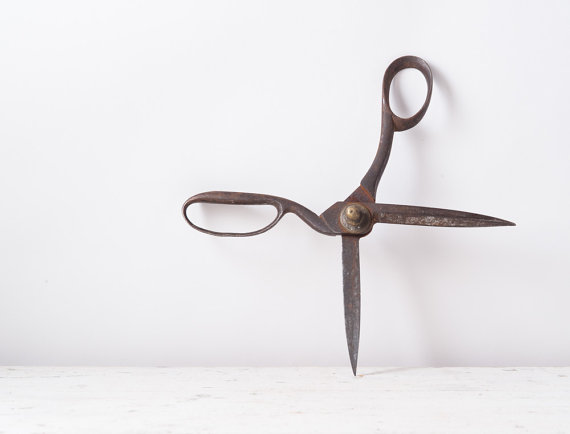
19th century tailor’s shears*

July 23d  Friday  Have cut the skirt & sleeves

& cape to my traveling dress and 

have set Mary to work on the skirt

and I have taken the sleeves

Mrs Stevens has sent me the lining

but not the trimming  Julia Mahoney

is at work at Olivers  Mr Torrey

and Abby called this morning

Evelina was back in good humor today. The thermometer was going down and she had a new project to work on. Shears in hand, she cut out the pieces for her new traveling dress, and probably the lining, too. Designed with a cape to fit over the shoulders, it would be a very fashionable outfit. She didn’t yet have the trimming she needed, and the dress would take longer to sew than she wished, but it would be finished in time for a trip she didn’t even know she would have to make.

Col. John Torrey, the widower of Evelina’s late sister Hannah, came to call.  As we have noted in earlier posts, Mr. Torrey lived in the village of North Easton in a building – a boarding house of sorts – whose spare rooms he rented out. Through Rev. William Chaffin’s history of the town, we learn that Mr. Torrey was a controversial character. Listed as a trader in the town census, and a one-time colonel of the local militia, he was considered laughable by some. Another local character, an erudite shovel-worker named James Adams, wrote a mock-heroic poem about him, the “derisive and scathing”* verses of which are lost. Yet Evelina appeared to enjoy her brother-in-law’s company and brand of humor, and she was devoted to his daughters Abby and Melvina.

*William Chaffin, History of Easton, Massachusetts, 1886, pp. 764-765


*Image courtesy of etsy.com

June 17, 1852

image004

June 17th Thursday  Have cut Susan a mantilla this

morning and basted it ready to make and 

have been mending some.  Mother is at Mr

Torreys to day staid there last night  It

is rather cooler to day and this afternoon

had a fine shower  Catharine Middleton

here but she is not worth much to sew

A new servant, Catharine Middleton, was proving a disappointment to Evelina. Catharine’s sewing skills were “not worth much;” Evelina wanted someone with more ability.  Evelina was hard to satisfy in the sewing arena. She was so very good at it herself that most young women of average ability would have fallen short, unable to survive the scrutiny of a woman famous for her buttonholes.

Outside the busy house, construction ran apace. Men moved stones for the new Long Shop across the street, and even closer to home, “Mr Arnold finishd sleighting the cariage hous to day.”* This new building would soon be ready to house the three or so carriages belonging to Ames family members.

The best news of all was the lowered temperature and arrival of a little rain “towards night when we had a shower of about a quarter of an inch .”* Every drop of water was needed.

April 29, 1852

images-1

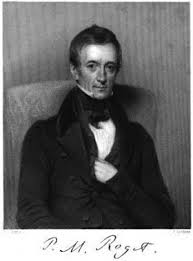
Peter Mark Roget

(1779 – 1869)

1852

Thurs April 29 Baked twice in the brick oven.

Mince pies, cake bread &c   Mr & Mrs 

Kinsley with their family made quite a long

call  They are very pleasant.  After they left went

to Mr Torreys  Augustus, wife & her sister  Augusta

& Rachel there, brought home some rose slips

The aroma of baking filled the Ames house today as Evelina produced pies, cakes, bread and more. Or should we say that the smell, or the scent, or the fragrance, or the odor of baking bread was apparent to anyone who stepped into the house? Roget’s Thesaurus would offer us any one of those synonyms for the word aroma.

The first edition of Roget’s Thesaurus was published on this date in 1852. Peter Mark Roget, a British physician, inventor and theologian, began to compile synonyms as a young man as one way of combatting the depression that plagued him for much of his life.  Beginning the work in 1805, not long after he had completed his medical studies, he spent nearly fifty years bringing the publication to fruition.  The first edition had approximately 15,000 words; it has been continually expanded, updated regularly ever since.

The Kinsleys of Canton came to visit in the afternoon and, no doubt, they could smell the fresh baked bread. Lyman Kinsley was an iron trader who had many dealings with the Ames family; within the decade, his business would be owned by the Ameses and overseen by Frank Morton Ames. That was in the future, however. On this day, he, his wife, Louisa, daughter Lucy and younger sons, perhaps, all came for “quite a long call.”  Evelina enjoyed their company, but after they left she bounced right out of the house to go into the village to visit relatives and bring home rose slips. The garden!


March 19, 1852

moms_white_cake_2

March 19th Friday  Have heat the brick oven baked

mince & dried apple pies & Jenny Lind cake  Amelia

went to Mr Torreys this morning and Orinthia

afternoon & self this evening, when we returned

found Edwin & wife here.  Mr Whitwell called

had called at Edwins for the first time

Jenny Lind, international opera star, was so famous at mid-century that many things were named in her honor: A street in North Easton, for one, and more. The “Swedish Nightingale,” young, pretty and gifted, was promoted to the hilt by master showman P. T. Barnum. Happy fans and clever merchandisers attached her name to a bed, a bonnet, a steamer trunk, a pudding, a saloon in Brooklyn and a gold-rush town on the Calaveras River in California. She also had a cake named after her.

Evelina baked a Jenny Lind cake today.  Perhaps she took the “receipt” from a popular cookbook by Mrs. A. L. Webster titled The Improved Housewife. The result was a real departure from the usual fruitcake:

Stir together 2 cups white sugar and 1 butter.  Add 10 egg-whites, well beaten. Just before setting in , add half a teaspoonful soda dissolved in cup of cold milk and 1 and half cream tartar mixed with 4 cups flour.  Flavor with vanilla, or to taste. Line pans with buttered paper, and bake in moderate oven fifteen or twenty minutes.  Frost it. – Or: the 10 yolks with the other ingredients as above, and the grated rind of 2 lemons for the flavoring, make a nice cake.”


March 4, 1852

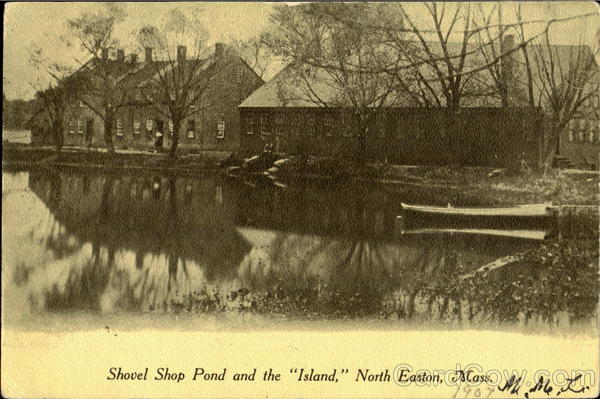
Shovel Shop Pond And The Island North Easton, MA

Replacement buildings on a section of the Ames shovel complex

1852

March 4 Thursday  Scott & Holbrook are setting glass at

the shop to day  They have the front entry partly

painted  I carried my work into Edwins this

forenoon  mended O Angiers shop coat  This afternoon

have been to Mr Torreys with Augustus & Lavinia

Called a few moments on Hannah  She has a 

sore mouth and is weaning her child

Evelina addresses her day calmly, as always keeping her distance from the goings-on at O. Ames & Sons. Most other residents of North Easton were still reeling, no doubt, from the huge fire that had burned down a majority of shovel factory buildings over the night of March 2. The sun was shining and the wind was out of the north west, pushing around remnant smoke still rising from the ruins of the complex of wooden buildings. Shovel shop employees had no regular job to go to and the owners had some serious decisions to make, fast.

Clean-up from the huge fire was underway, probably by the labor of the very men whose factory jobs had been temporarily eliminated. The men who had been painting and papering at the Ames’s house, for instance, were co-opted to set glass at the shop, suggesting that new panes of glass – the originals probably having been blown out by the fire – were going into the windows of the one or two buildings that had survived.

As town historian Ed Hands points out, “the Ames family and the neighborhood rebounded quickly.”*  Old Oliver and his sons Oakes and Oliver Ames Jr. made a two-fold decision. The first was to create temporary structures to house the manufacturing so that shovel making could resume as quickly as possible.  The second was to create “new, permanent stone shops,”* sturdy, nonflammable structures that could outwit any new fire.

There was insurance money to cover at least some of the rebuilding. Sources differ on the amount of damage that the fire inflicted, but suggest it was between $30,000 and $40,000. The amount of insurance coverage is also uncertain. Old Oliver “states that there was $3,000 worth of insurance on the buildings”** but, according to industrial historian Greg Galer, it’s likely that the Ameses had increased insurance coverage on the factory back in November, 1851. Whatever the actual dollar cost was, “[t]he company bounced back quickly from the devastation, and seemingly without significant financial trauma.”**

*Edmund C. Hands, Easton’s Neighborhoods, Easton, 1995, p. 163

** Gregory Galer, Forging Ahead, MIT, 1989, p. 249


February 24, 1852

img_0630-copy

A modern version of a mid-19th century specialty: Kossuth cakes*

Feb 24 Tuesday

1852  Heat the brick oven twice & baked Kossuth

plain & currant cake ginger snaps, mince &

dried apple pies  Afternoon Mrs Homan &

Ann Clarke came to the other part of the house

I went in to see them and staid to tea.  Spent

the evening at Willard Lothrops.  Called at Mr

Torreys & Augustus

It was a big baking day, with Evelina preparing a typical selection of pies, cakes – “plain and currant” –  and ginger snaps.  New to her repertoire was a Kossuth cake, a baked sponge cake with a creme center.

The Kossuth cake was named after the Hungarian political figure (and, briefly, president,) Lajos Kossuth, who was then taking refuge in the United States while trying to raise support for a return to power. During Kossuth’s visit to Maryland, a street vendor in Baltimore named a new baked confection after the hero, who was much feted as a champion of freedom.

The dessert became popular but is largely forgotten today, though the confection can still be found in parts of the south. Naturally, additions and variations to the recipe arose almost immediately, most involving the addition of chocolate poured over the top. A typical modern recipe looks more like a double sugar cookie filled with whipped cream and chocolate frosting than a creme-filled loaf cake.


*http://dwellinginmiddleburg.com/2014/05/06/kossuth-cakes/


February 3, 1852


playingcards

Union soldiers playing whist, circa 1861

1852 Feb

Tuesday 3d Have been looking over the boys shirts and 

have mended some of them.  Fred carried me

to call on Augustus’s wife, called at Mr Torreys

an[d] Mrs J Williams engaged her to make some shirts

for Oliver  Mr & Mrs Williams passed the evening

here.  Have done but very little sewing

The boys & Joshua played cards.

Chess wasn’t the only game that people played in the 19th century.  As Evelina noted today, her sons and a friend named Joshua played cards. Perhaps Fred Ames played, too. The game they preferred was whist, a precursor of today’s contract bridge.

Whist was played according to rules established by the accepted authority, Edmond Hoyle, an Englishman in the 18th century who had codified explicit guidelines for various card games.  Whist followed “a rigid set of rules, etiquette and techniques.”** Like bridge, it required four players, one deck of 52 cards (then known as a French deck), a bidding process, and trick taking.  Trump was determined by the last card laid down and, unlike bridge, there was no dummy hand.

The Ames family loved playing whist.  Oliver (3) often writes in his early journals of playing whist with his grandfather, Old Oliver. Night after wintry night, the men would play, the grandsons occasionally beating their grandfather.  Evelina seldom writes of playing herself; she and her sisters-in-law usually sat to the side, conversing, sewing or reading.


www13thmass.org/1861/williamsport

** http://www.kristenkoster.com/2012/02/a-regency-primer-on-how-to-play-whist/

January 3, 1852

OLYMPUS DIGITAL CAMERA

*

1852

Jan 3d Saturday 

Finished my old hood and ripped Susans

old one & washed the lining and have partly quilted

it once again  Have spent all the afternoon in 

mending Franks shop coat.  Sewed this evening

untill nearly ten have not read at all

Mrs Witherell received news last night that her

father Witherell is not expected to live and she has gone

to see him.

Three-and-a-half years earlier, Sarah Ames Witherell had lost her husband, Nathaniel Witherell, Jr.  Now, she had the sad duty of traveling to Boston to say goodbye to her husband’s father, Nathaniel Witherell, Sr. Someone must have written a letter to tell her he was ill and, ever dutiful, Sarah Witherell responded quickly to the news.  Off she went.

Better news was that today was the birthday of one of Evelina’s many nieces, Mary “Melvina” (or “Malvina” as Evelina spelled it) Torrey. The youngest daughter of Evelina’s late older sister, Hannah Howard Gilmore Torrey, Melvina turned 11. Her father was Col. John Torrey, a high-profile personage in North Easton, of whom Evelina often writes. Melvina and her sister, Abby Torrey, were great favorites of Evelina; Melvina is the niece to whom Evelina gave a bloomer hat the previous summer.

In another ten years, Melvina would marry an older man, Sanford Blake Strout, who also lived in the village of North Easton, on Center Street. She would bear two sons, Byron Howard Strout and Havilen Torrey Strout.


Illustration from Godey’s Lady’s Magazine, 1851


December 4, 1851

Clerk

Dec 4th  Thursday.  Returned from Boston to night

Have got the greater part of the things

I wanted.  could not suit myself in all.

Mother spent yesterday with Augustus & to day

at Mr Torreys returned here this evening

Left Mr Orrs this morning did not dine there

it takes so much time  Julia is at home

It is three weeks [entry ends here]


After seeing her husband off on his business trip to New York, Evelina spent yesterday and today shopping in Boston. She seemed satisfied with her purchases, though she confessed that she “could not suit myself in all.” Was she buying cloth or ribbon or other fashion accessories, or decorative items for the refurbished parlor, or foodstuffs for the pantry? It was early December, a time in our own culture when we modern folks are apt to be out (or online) shopping for Christmas presents. Evelina may have been buying Christmas gifts for her family, although that is unlikely, as the Ameses barely recognized Christmas, let alone celebrated it.

Although public opinion in New England was changing, a poor opinion of Christmas prevailed among the Yankees of Evelina’s generation, and certainly of Old Oliver’s. It was based on a Puritan tradition that considered Christmas as “an emblem of popery.”  Yankees “were strongly influenced by the traditions of Calvinism and the routine of the established Congregational church, honoring a certain stoicism, hard work, and stern independence.”  Instead of Christmas, “Thanksgiving was the most important day of the year.”* That would change.

But Evelina must have caught the train back to Stoughton, or the stage home to Easton, empty-handed of the kind of Christmas plunder that her favorite author, Charles Dickens, so famously described.


*Jane Nylander, “Our Own Snug Fireside,” 1993, New Haven, p. 8