December 15, 1851

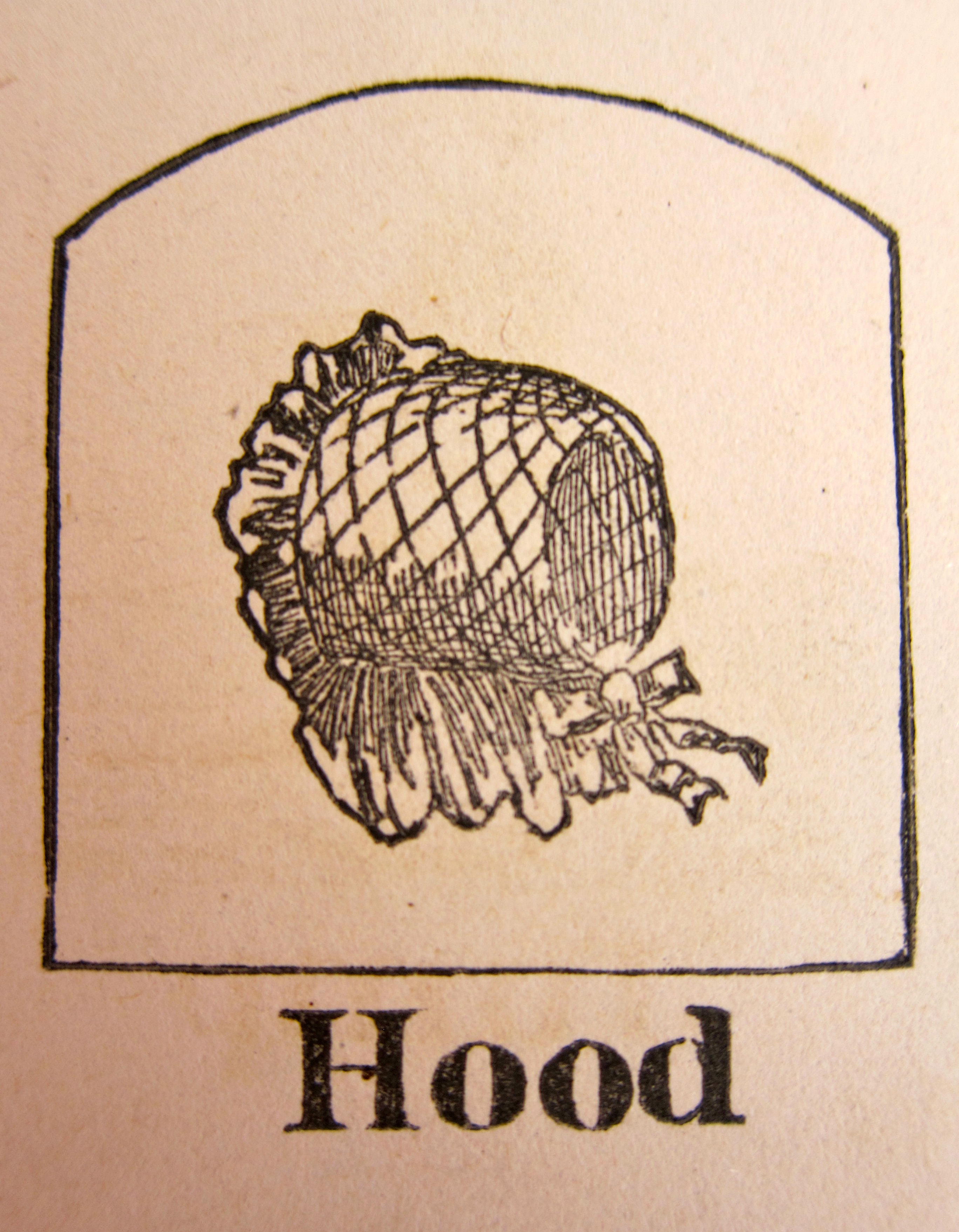
Hood

Monday Dec 15  The girls have both been washing to 

day but it was so windy they could not put their clothes

out  Jane has sewed this afternoon the bags for the

sausages  I knit on Susans hood this morning

and this afternoon commenced knitting on a little

hood for the fair  Mrs Witherell & Ames have been

in awhile and are to work for it

While her servants Jane and Mary struggled with the Monday laundry, Evelina began to knit. Her nephew, Augustus Gilmore, had fetched some yarn – or worsted, as she called it – for her on Saturday while in Boston, and she was finally able to get to it today.

Evelina “knit on” two hoods, one for her daughter Susan and another for a church fair that was coming up. A hood might take a few different shapes, from a fitted piece that covered the top, sides and back of one’s head to one that covered the top and sides only, as in the period illustration above. The one above – which isn’t knitted, but sewn – is really just a variation of a bonnet.

Jane McHanna, too, worked with a needle today once the washing was done. She sewed some cloth bags for the pounds and pounds of sausage that had been produced on Saturday.  Sausage was usually forced into casings made from pig intestines, and this may have been the case with the pork that Evelina and Sarah Witherell produced.  But it may be that an additional cloth covering was desirable for storage or identification.  Hard to know.  Any thoughts from readers who have made their own sausages?
 

December 14, 1851

330px-Mayor_B_Seaver

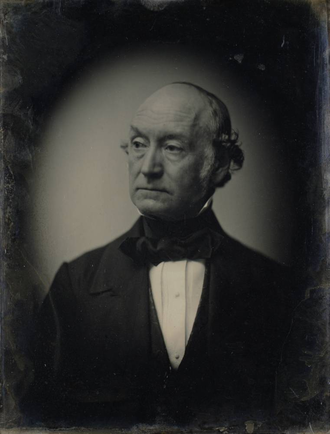
Benjamin Seaver

Mayor of Boston, 1852 – 1854

Sunday 14 Dec  Have not been to meeting to day on

account of my cough.  Jane went to meeting 

at eight Oclock got breakfast before she went.

I have been writing and reading

Mr Swain & wife have spent the evening here

Mr Swains brother has been there a week or two

I have not seen him  The babe grows very 

fast and is a great wonder

In an unusual occurrence for a Sunday in New England in the 19th century, an election – or an announcement of the results of an election – was held on this day.  A new mayor, Benjamin Seaver, was elected to govern the City of Boston, a post he would hold through 1853. He was a Whig, one of that dying breed whose successful election surely gave the Ames men a lonely branch to cling to in the swirling flood of new political parties.

According to modern historian Jim Vrabel, Seaver won with 3,300 votes and defeated Dr. Jerome Smith and Adam Thaxter. (Only men voted in the election, of course.) Seaver was noteworthy for his interest in erecting a public library for the city. During his administration, a committee would be formed, plans (some already in the works) developed, a first librarian hired, and private funding obtained for the project.

At the same time that Seaver came in, “the entire Board of Aldermen” were voted out, “reportedly for refusing Daniel Webster” – a hometown favorite – ” use of Faneuil Hall because an abolitionist group had earlier been denied its use.”* Webster had advocated for passage of the Fugitive Slave Act, something for which abolitionists never forgave him. Just goes to show that the issue of slavery informed all levels of political intercourse in this decade before the Civil War.

On the home front, besotted new parents Ann and John Swain spent the evening with Evelina and Oakes, talking about their son.  Evelina seemed smitten, too, writing that the baby boy was “a great wonder.” Like the new mayor and the Board of Aldermen, however, she and that baby’s parents couldn’t know what sorrow lay ahead.


Jim Vrabel, When in Boston, Boston, p. 157

December 7, 1851

Locomotive

Dec 7th Sunday.  This has been an uncomfortable stormy

day but we have all been to meeting  Mother

was expecting to go home but none of Alsons

family were out and she came back with us

Edwin called this evening.  We passed the

noon very pleasantly though there were but 

few ladies out.  We are to meet Wednesday

at Mr Wm Reeds to quilt


A snow storm today did not keep Evelina or her children home from church. Her husband, Oakes, may have been away and thus not present to drive the carriage, but anyone of Evelina’s three grown sons would have driven it for her. Propriety and patriarchy aside, she herself could have driven it, former farm girl that she was.

Not many others ventured to the Unitarian church in the bad weather, including her brother Alson, who was to have taken elderly Mrs. Gilmore back home to the farm. There were “but few ladies,” but those who did attend got the word that the Sewing Circle would reconvene the following Wednesday. Evelina herself felt a cold coming on as she traveled through the falling snow, which Old Oliver reported eventually accumulated to “about an inch + a half of snow southerly but cold.

Exactly ninety years from this quiet day, on another ordinary Sunday, an American navy base on a Hawaiian island was bombed by Japanese planes. Evelina could never have imagined such an event. Although she was certainly familiar with the U. S. Navy and, too soon, would become familiar with war, she had probably never heard of Pearl Harbor.  Nor could she have fathomed the flying machines that attacked it.  A speedy carriage ride along an unpaved road behind Old Kate or a trip into Boston on a train car moving maybe 20 miles per mph was about as fast as she ever went. How things changed in the century ahead.

November 30, 1851

Church


Nov 30th Sunday  We have all been to church except

Susan. She did not get ready in season

and I did not hurry her to break her of being so

tardy.  Mother Henrietta & self went to Mr Whitwells

at noon.  Mrs Whitwell insisted on our taking a

cup of tea, squash pie, &c &c  Mother came home

with us from church  Augustus & wife have passed

the evening here


Punctuality is a trait much prized by the Ames family; as it is in 2014, so it was in 1851. Evelina liked to be on time. She was probably familiar with the proverb that “People count the faults of those who keep them waiting.”

Susan Eveline Ames, nine-years-old, was often tardy.  In particular, Susie wasn’t fond of going to meeting, something her mother tried vainly to cure her of.  On this Sunday in 1851, Susie dawdled and missed the carriage, so to speak. The family left for the morning service without her. Evelina clearly saw this as a good punishment for her daughter, but it’s entirely possible that Susie enjoyed staying behind.

The lesson about tardiness, or, at least, the importance of going to church, didn’t stick. Ten years later, circa 1861, Susie was still finding ways to escape going to meeting. According to Winthrop Ames:*

“[M]y grandmother [Evelina] notes with suspicion in her diary that the headaches of her nineteen-year-old daughter, Susan, seemed to occur rather oftener on Sundays than on other days, especially when there was to be a second sermon in the afternoon.”*

“In season”, by the way, was a 19th century phrase meaning “in time.”


*Winthrop Ames, The Ames Family of Easton, Massachusetts, privately printed, 1937, p. 130

November 23, 1851

1850-shawl2

*

Sunday Nov 23d  Jane with Michaels sister got the

breakfast this morning but after breakfast Jane 

went to bed  I could not go to church this morning

Augustus came home at noon and brought Mr

Davidson  Mrs Meader Hannah & self went

back with him  This evening sat with my shawl

& bonnet on from 6 to 8 Oclock waiting for Mr

Ames to go to Mr Swains and then took them off did not go


For the second time this month, Oakes Ames forgot to take his wife somewhere. On this occasion, they had planned to visit Ann and John Swain.  Evelina had missed the morning meeting and although they had company at noon, and she made it to the afternoon service, she was still eager to get out and socialize. As night fell, she put on her “shawl & bonnet” and waited for her husband to pick her up. He didn’t show. She “did not go.”

Evelina had been disappointed two weeks earlier when Oakes had forgotten her, but the tone of her diary entry on that day had been tolerant. This time, she was likely less forgiving. Once Oakes finally walked in the door, more than two hours late, Evelina must have let him have it. Surely she got mad. Surely they argued.

Oakes’s excuse would’ve been that he’d been off electioneering, just like the last time he forgot to fetch his wife.  The next day was another town meeting and, in anticipation, he’d obviously gotten sidetracked, probably with friends. At least Evelina could be certain that he hadn’t been out drinking; Oakes was a teetotaler. But she would have been left to wonder what the outcome would be of her husband’s absorption into politics, and how it might alter their relationship.

Jane McHanna, meanwhile, was still sick.  Evelina was not having a great week.

*Image courtesy of wwwVictoriana.com


November 16, 1851

IMG_0017

Modern photograph of house in North Easton built by Edwin Williams Gilmore, 1851


Sunday 16th  We have all been to meeting all day

Went to Mr Whitwells at noon with mother

rode with our new horse do not believe he

is any great affair  Edwin took tea with 

us and I went into his house with him  Wrote

a letter to Oliver.  Oakes A went to North

Bridgewater to see Mr French about selling

some hogs for father.  I asked once to let me go but

he went without me


The Ameses went to meeting today, naturally, and Evelina visited with her mother at the parsonage during intermission.  The Ames family often rode in tandem if not together to church; Evelina perhaps rode in a carriage with Old Oliver and Mrs Witherell.  She certainly seemed underwhelmed by the new horse that Old Oliver had recently acquired.

Edwin Williams Gilmore, Evelina’s nephew, stopped by for tea at the end of the day.  He was building a house in North Easton, barely a stone’s throw away from the Ames compound. Although he may have worked at the shovel factory at this time, he would soon embark on a business of his own: a hinge factory that would be a successful enterprise for decades to come. He wasn’t interested in working and living on the family farm; that job would fall to his younger brother, Francis.

For now, Edwin was an ambitious twenty-three year old who wanted to live in the village.  The house, which his father, Alson, had been helping him build, was almost ready. His next step would be to marry, and he evidently had a wife in mind: twenty-two year old Augusta Pool, his neighbor near the farm. Evelina may have been privy to Edwin’s plans; if not, she surely enjoyed looking in on the new property so close to her own. Her visit with Edwin perhaps made up for not going with her son Oakes Angier to North Bridgewater.


November 9, 1851

Nurse


Sunday Nov 9th  Did not go to meeting to day on account of

Bridgets being sick.  Expected Mr Ames home at noon to carry

me this afternoon but he went off electioneering and 

forgot all about it.  This evening have been to Mrs

Swains with Mr Ames & Susan  Her nurse is there

and her brothers wife and daughter of about Susans

age  Mr & Mrs Meader returned home about a week since


Not only did Oakes Ames stop in Canton for a Whig meeting on Saturday, but he spent Sunday afternoon “electioneering” and forgot to go home at noon to take Evelina to church for the afternoon service.  In personal terms, this was not an auspicious beginning to his political career, but it was certainly indicative of the wholeheartedness and zeal with which he approached politics.  If Oakes and Evelina had, in fact, reached an understanding about his getting into politics – about which we can only conjecture – we have to wonder if that understanding had already been violated.  Yet Evelina’s diary is not particularly dispirited; she writes matter-of-factly and without obvious annoyance.  Perhaps she already understood and forgave her husband’s capacity for preoccupation.

After missing church in the morning because of a sick servant and in the afternoon because of an absent-minded husband, Evelina must have been pleased at last to go out in the evening. She, Oakes and their daughter Susie paid a call on Ann and John Swain, a younger couple who were relatively new in town.  New parents, their infant son was being tended by a nurse, while two relatives, the last remainders of a crowd who had arrived to tend at the birth, were still visiting.  Ellen Meader, a little girl about Susie’s age, was there with her mother, Sarah Bliss Meader, wife of Ann Swain’s brother, Reuben Meader.

November 2, 1851

IMG_0540

1851

Sunday Nov 2d  This has been a stormy day, but this evening

has cleared off pleasant  I have been to meeting all

day & went to Mrs John Howards at noon with

Lavinia & Mother  Mr Ames came home at noon and it rained

so hard that he did not go back.  Mr Whitwell

gave us two fine sermons.  Mr Ames & self passed

the evening at Augustus.  Have made an agreement

which I hope we shall both be careful to keep.

At the end of this rainy, chilly Sunday at the start of November, “the most disagreeable month in the whole year,” according to the fictional Margaret March, eldest of Louisa May Alcott’s four sisters in “Little Women,” our non-fictional Evelina and her husband, Oakes, reached an important decision.  Unfortunately, we don’t know what that decision was.

Surely this entry is one of the most tantalizing in Evelina’s diary. She and Oakes “made an agreement” that she hoped they’d “both be careful to keep.”  What did they decide? What promises did they exchange? Oakes had been away from home a great deal lately; did their discussion stem from that? Was this the moment when Oakes determined to become involved in regional politics? Would he have needed Evelina’s approval?  If this was the case, what might he have asked of her, or offered her in exchange?

Or was the decision less historic and more pedestrian? Did their discussion have anything to do with domestic arrangements or the recent spending on the house? Were they going to exercise more prudent care of their “accounts,” as Evelina calls them? Did their agreement have something to do with their children? Did it stem from something Reverend Whitwell said in one of his “fine sermons”? What was this agreement?

And were they able to keep it?


October 26, 1851

1421516038_22078acff3

*

Sunday Oct 26.  John Ames from Springfield is here at

fathers came last night.  We have all been

to meeting  Mr Whitwell preached two

excellent sermons.  Went at intermission

into Mr John R Howards with Mother and several

others  The first time I have called since

they moved.  It has rained since eleven this

morning, quite hard.

For the first time since September 21, Evelina attended church; even the “hard” rain couldn’t keep her away. She surely was pleased to be back in the family pew, head tilted up to listen to Reverend Whitwell’s “excellent” sermons, happy to visit with friends and acquaintances at intermission. The opportunity to congregate at church was central to Evelina’s social life, and she was quick to catch up.  Her visit at intermission with John and Caroline Howard was her first visit to their new home.

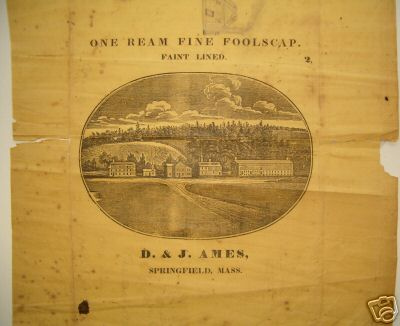
A cousin from Springfield, John Ames, was visiting in the other part of the house. There were several relatives named John Ames with close ties to Old Oliver, including his father and a brother. This John Ames was, most likely, a nephew of Old Oliver, the son of Old Oliver’s much older brother David. His dates were 1800-1890. He was famous for certain inventions pertaining to the manufacture of paper and with a brother, also named David, ran the Ames Paper Company in Springfield. According to one 20th century historian, “[f]rom the outset the firm, which became known as D. and J. Ames, prospered wonderfully, making money rapidly and growing until it was one of the largest and most powerful in the country.”**

A life-long bachelor, John Ames lived with a sister, Mary, and the two managed the family farm well into their old age. Oliver Jr. writes of visiting them in Springfield in 1871. The families stayed in touch.Yet Old Oliver made no mention of his nephew’s visit.  Instead, in his journal, he noted only that “it was cloudy all day to day + raind some in the day time + in the evening + night ther was considerable.” He was more interested in the rain which, given the fact that rain meant more water and more water meant more power for the factory, was perhaps understandable.

Image courtesy Benjamin L. Clark, Massachusetts Book Trade

**Lyman Horace Weeks, The History of Paper-manufacturing in the United States, 1690-1916, New York, 1916, p. 125

October 19, 1851

OLYMPUS DIGITAL CAMERA

Sunday Oct 19  Last night was very stormy, rained very fast

and heavy wind.  This evening is very pleasant

but it has rained all day so that none of the 

family went to meeting  Alson came after Lavinia

about three Oclock  I have been reading most

all day “Olive”  It is rather interesting but wish 

I had spent the day more profitably

Evelina’s father-in-law, Old Oliver Ames, also recorded the day’s bad weather in his daily journal: “it began to rain last night + this morning there is a north eas[t] storm + the wind blows verry hard. it stormed nearly all day but was clear at night – there was an inch + a half of water fell”

According to the weather record for 1851 – the first year that Atlantic hurricanes were officially tracked – the storm that Evelina and Old Oliver describe was Tropical Storm #6. It made landfall in Rhode Island, thus its impact on nearby North Easton would have been severe. Despite the rain and wind, the buildings in the Ames complex appear to have come through fine. Old Oliver would have mentioned it otherwise.

For the fourth week in a row, Evelina missed church. One Sunday, there had been no service; on two other Sundays, she had been ill and today, weather prevented attendance. She was probably missing her weekly dose of religious direction from Reverend Whitwell and social interaction with her fellow Unitarians.  She occupied herself by reading “Olive,” which was most likely a domestic novel in the genre that she often read.  It would have been the kind of book that Old Oliver called “love trash.”