March 7, 1852

Ruin


/52

March 7th Sunday  It has been a beautiful day and we 

have all been to meeting except Frank

When we came from meeting we rode down to

the ruins. They have cleared away a great deal 

but it looks dismal enough  Mr & Mrs William

Reed spent the evening  Mrs Witherell & Mrs

S Ames came in awhile & Father Ames

No work was done today at the site of the shovel factory fire, for it was Sunday, a day of rest – a day of rest that everyone in town must have welcomed after the shock of the fire and the subsequent hard work of clearing the debris.

The Ames family rode down Centre Street to church, the weather “beautiful.” At the intermission between sermons, they must have been approached by fellow parishioners expressing concern and curiosity about the fire. In a town of 2,500 citizens, such a huge event would have been on everyone’s mind. Is it too far-fetched to imagine that Reverend Whitwell might have alluded to it from the pulpit?

After the services, the family drove by the factory site on their way home. The wintry sunlight hid nothing; the “ruins” were “dismal.” Later in the day, several family members gathered at Evelina’s and Oakes’; even Old Oliver came over from the other part of the house, which he seldom did, perhaps to greet guests William and Abigail Reed or to discuss the plans for rebuilding, to begin the next day.

February 22, 1852

georgewashington

1852

Feb 22nd Sunday Quite a snow storm this morning but

most all went to church.  I came home at noon on

account of a violent tooth ache and did not return.  Mrs

S Lothrop & son spent this afternoon, Frank carried

Orinthia home after meeting. Read in Grahams

Magazine  Mr Ames & self passed the evening at Edwins

It has cleared off very pleasant this evening

“It was a snowing this morning + all the forenoon and fell 2 or 3 inches deep wind southerly + thawd some  was clear at night,” according to Ames patriarch, Old Oliver. Yet the family rode through the snow to get to church. Poor Evelina got “a violent tooth ache” and had to go home after the first service. She must have felt better as the day progressed, for in the evening she and her husband, Oakes, went across the way to visit newlyweds Edwin and Augusta Gilmore.

Today was George Washington’s birthday. Born in 1732, he died in 1799, when Old Oliver was twenty years old. After Washington’s death, the young Congress of the day, whose partisanship between Federalists and the Jeffersonian Democrat-Republicans rivaled the divide we see in our modern Congress, came together to pass a resolution honoring the first president’s birthday. February 22, 1800 was dedicated to him and by 1832, the centennial of Washington’s birth, some type of observance of the holiday was customary.  The holiday did not become federal law until the 1879, and at the time was qualified as a “bank holiday.”

Old Oliver would have remembered the hero of the American Revolution and probably revered him, as most Americans did. Old Oliver was a child when the Constitution was written and ratified, and lived to see 16 presidents take office. For his generation, no American leader would be more heroic than General Washington.


February 15, 1852

 lilliam_wald2

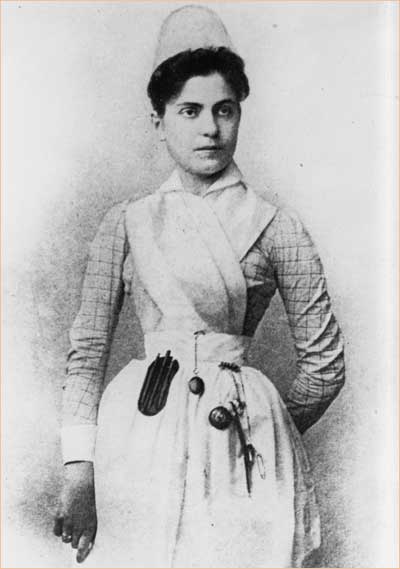
Nursing uniform from the late 19th c.*

1852

Sunday Feb 15th  Have been to church and at

noon went to Mr Baileys to see sister Amelia

who is nursing there  Mother went with me

Have been reading since meeting  Edwin & wife came

in to spend the evening but Mr Ames & self were

just going to Mr Swains and they would not let 

us stop for them so they went to Augustus  Had a 

pleasant call or rather visit at Mr Swains  came away

about nine Oclock  Very pleasant

The sun came out today, so despite it being “pritty cold,”** the Ames family went to church. During the intermission between morning and afternoon services, Evelina and her elderly mother, Hannah Lothrop Gilmore, rode out to visit Amelia Gilmore.  Amelia was the widow of Evelina’s brother, Joshua Gilmore, Jr. Joshua had died three years earlier, at age 35, leaving Amelia with two sons to raise.

In order to support herself and her boys, Amelia hired out as a nurse.  In this instance, she was looking after a Mr. Bailey, who must have lived near the Unitarian church. He may have lived alone, been ill and needed paid help; otherwise the convention of the day would have meant his female relatives looked after him. When Amelia wasn’t working, she and her youngest son, Samuel, lived with the Alger family near the Gilmore farm. The older son, Charles, had hired out somewhere but would soon come to reside with his uncle Alson Gilmore.

In 1852, nursing was not a formal profession.  Women (nursing was considered the exclusive province of women at the time) undertook nursing because they needed to work and this was one of very few avenues open to them. They based their protocol on personal experience in caring for ill members of their own families. There were no training programs or certification venues available, in no small part because there were so few hospitals. People were cared for at home. It would take the Crimean War in Europe and the Civil War in the U.S. to change attitudes and formalize medical care.

*Courtesy of http://www.nursinglink.monster.com

**Oliver Ames, Journal, Stonehill College Archives, Arnold Tofias Collection


February 8, 1852

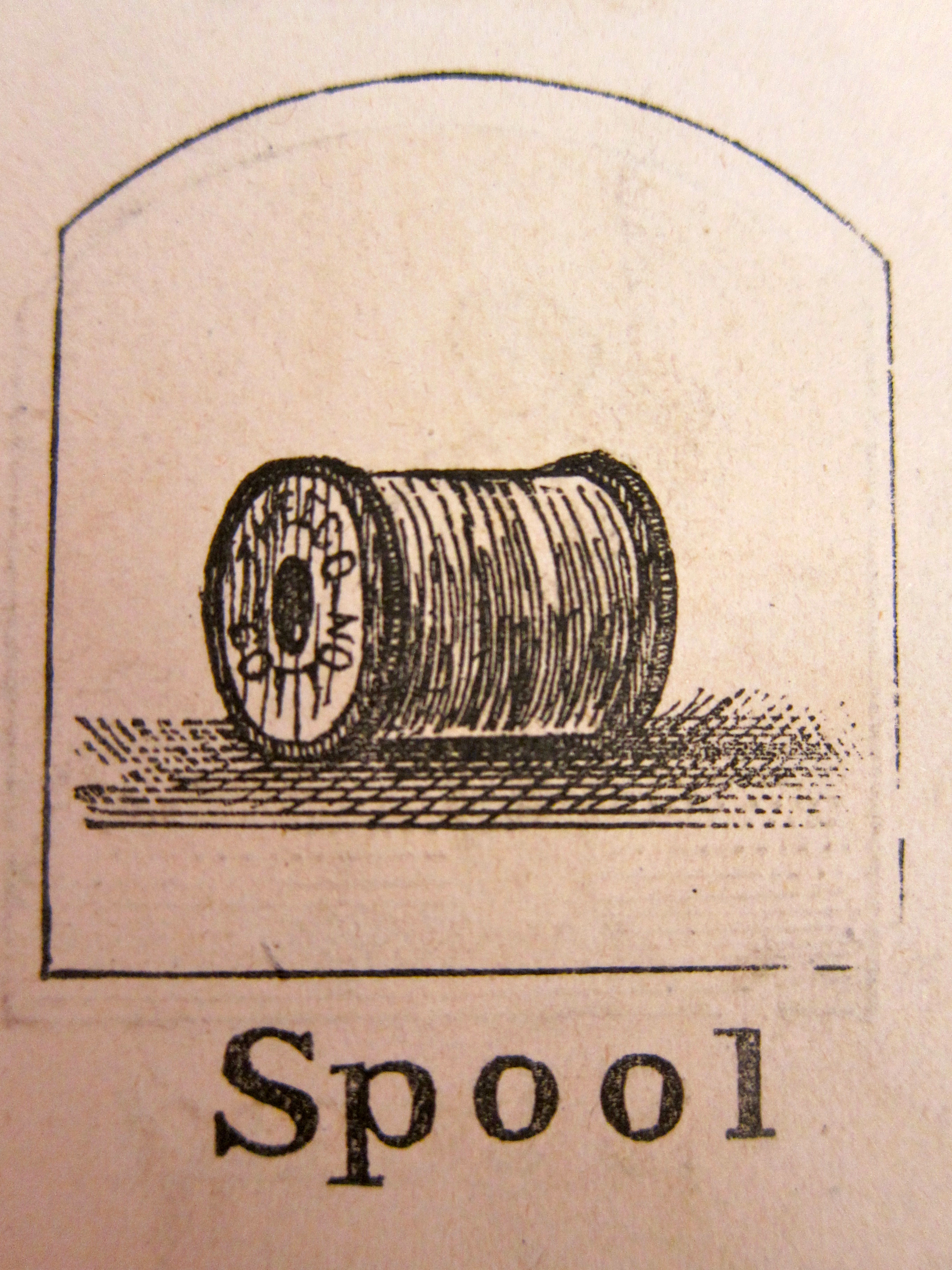
Spool

1852

Feb 8th  Sunday,  Have been to meeting to day and at 

noon went into Mrs J Howards with Mrs E Howard &

others  had a pleasant call   Augustus called this evening

and staid untill quite late and I have

not read but very little to day  Mr Ames

came in about eight but too late to go out as 

intended  Mr Ames brought me 12 spools of cotton

yesterday

It was an ordinary winter Sunday for the Ames family. They went to church and visited with friends during the intermission between the morning and afternoon services. Back home, Evelina’s nephew Augustus came to call and seems to have overstayed his welcome; Evelina barely got to read. She probably sat looking at the new spools of cotton thread that Oakes had brought her the day before and wished that she could at least do some sewing. But sewing and other work was forbidden on the Sabbath.

The laws that the Puritans had established in the 17th century that forbid work or play on the Sabbath still held sway in Massachusetts in 1850. Businesses weren’t open, mail wasn’t delivered, and many people wouldn’t travel. People in Evelina’s generation had been taught to put down their daily work – except for chores which were essential, such as milking the cows – and spend Sundays quietly, at church and at home in contemplation and worship. No sewing, no housework, no shovel-making was permissible.

As the tempo of 19th century life picked up, however, that restrictive pattern was changing. Rail travel, for instance, was impossible to harness to a Puritan timetable. Many of the old ways were beginning to break down, and the advent of the Civil War would effectively demolish most of the lingering vestiges of Puritanism. The “blue laws,” however (so named by Connecticut preacher Samuel Peters) would continue to influence state laws, especially around commerce.  For much of the 20th century, retail stores could not open on Sundays, and in many places, alcohol couldn’t be sold.  Even today, in 2015, several states – Maine and Colorado, for two – forbid car dealerships to operate on Sundays.


I


January 25, 1852

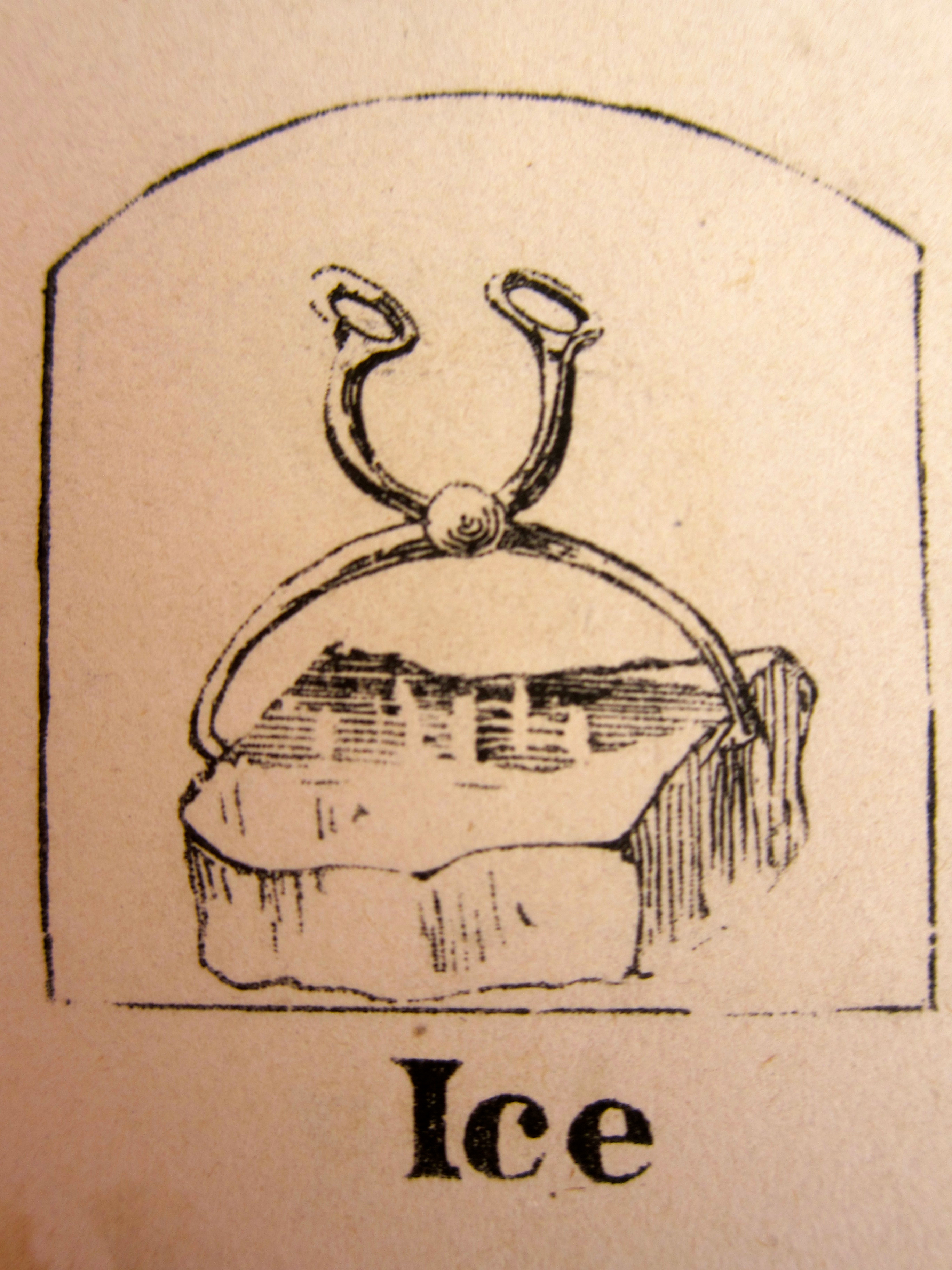
Ice

1852

Jan 25  Sunday  Have had a lovely day although it is somewhat

cold.  The first pleasant sabbath we have had for

a long while  We have all been to church except

Mrs Witherell who still stays at home on account

of her teeth being out. Mother came with us

from church to night. We have had fine sleighing

for a long time  Mr Whitwell gave us a fine 

sermon this afternoon

Old Oliver, too, appreciated today’s weather: “this is a fair pleasant day wind south west + thaws some   it is the first fair Sunday we had for a long time…” He also noted with satisfaction that “we began to fill our new ice hous yesterday,”* much of it with the ice that his grandsons Oliver (3) and Fred Ames had harvested on Friday.

The ice house was built right next to the pond** from which the ice was harvested. It was probably lined with sawdust for insulation; when the ice was removed, block by block, the sawdust absorbed some of the moisture and kept the building cool.  Even if the temperature outside rose, the temperature inside stayed relatively low. The ice was crucial to the storage and preservation of food in those days before refrigeration.

Today’s fair weather enticed everyone to church except Sarah Ames Witherell, who preferred to remain somewhat hidden while she recovered from recent dentistry.  The group drove the sleigh (or sleighs) to the meeting house, which was a couple of miles south of their family compound. Evelina sat in the family pew and enjoyed herself; she always liked hearing what Reverend Whitwell had to say.  She and her family brought her mother, Hannah Lothrop Gilmore, home for a visit.

*Oliver Ames, Journal, Stonehill College Archives, Arnold Tofias Collection

** Thanks to information from James Carlino, Dwight MacKerron and John Ames, we believe the ice pond in question may be Monte Pond, on the north side of Elm Street, just east of Rte. 138 in the northeastern corner of Easton. John also remembers an ice house next to French Pond on Union Street, also just east of Rte. 138, north of and parallel to Elm Street.  He bought some old ice tools there in the 1970s that he used in making sculpture.

January 18, 1852

$T2eC16JHJHQE9nzEyP!zBRVGZ!!IT!~~60_35

/52

Jan 18 Sunday  Has snowed quite hard all day.  The

gentlemen all went to meeting & Mrs S Ames & Emily,

Mrs Witherell staid at home because she looks so bad

& Susan & self on account of a cold & cough  Have

read The Vale of Cedars by Grace Aguilar & have

written a letter to Pauline Dean.  Made a long

call in the other part of the house this evening.  Mrs

S Ames there with me

Feeling under par, Evelina and her daughter stayed home from church today while the men of the house pushed through the “fine cold dry snow”** to get to meeting. Sarah Witherell stayed home, too, still recovering from having had her teeth pulled.  It was a luxurious opportunity for Evelina – and Susie and Sarah, perhaps – to sit and read in relative quiet.

Evelina’s choice (which she probably read in serialized form in a periodical, as the tale wasn’t published in book form until 1853) was The Vale of Cedars or The Martyr’s Tale by Grace Aguilar. It was a tale of a Jewish father and daughter trying to hide from the Spanish Inquisition in 1479. The “Vale of Cedars” was their hideout. Eventually discovered and imprisoned, the daughter resisted the church’s demand that she convert to Catholicism.  Thus, the “Martyr’s Tale.”  The dramatic plot with its medieval overtones, exotic location, and anti-catholicism probably captivated Evelina, just as the author meant it to. Aguilar included these words from Byron’s [Oh! Weep for Me] in her introduction to the book:

“The wild dove hath her nest – the fox her cave –

Mankind their country – Israel but the grave.”

George Gordon, Lord Byron

**Oliver Ames, Journal, Stonehill College Archive, Arnold Tofias Collection

January 11, 1852


images-1


Jan 11  Sunday  Have been to meeting although it has

been stormy  Mrs Witherell did not go which is

unusual  Henrietta Mrs Clarke & self called on

Mrs Witherell at noon.  She burned her foot and

cannot go out but it is getting better.  Have written

a letter to Oliver this morning and have been reading

Sarah Witherell burned her foot and couldn’t go to church, probably because she couldn’t put her shoe on. How had she burned it?  Fallen against a coal stove? Stepped on a live ember? Spilled hot tea or scalded it stepping into a tub? If the possible sources of the burn are multiple, so were the potential remedies.

“Cotton wool and oil are the best things for a burn,” declared Lydia Maria Child in The American Frugal Housewife.* Dusting a burn with flour and wrapping it in cotton flannel was another common practice. Like today, the application of a salve was soothing.  We might apply cold water; they might have applied butter, assuming they had any on hand to spare. Home treatments for minor burns are still variable, despite today’s over-the-counter ointments and sprays.

Sarah Witherell, we learn here, always went to meeting.  Her absence today surprised even Evelina, who came back from church at intermission to check on her sister-in-law.  Evidently reassured that Sarah would be fine, Evelina settled into her more normal routine for Sunday, which included reading after church and, today, writing a letter to her middle son, Oliver, who was away at college.


*Lydia Maria Child, The American Frugal Housewife, 1846, p. 17

December 28, 1851

CEM2250808_135321565571


Sunday Dec 28th A very stormy day but all went to meeting

except Oakes A & self, came home at noon so few

there that Mr Whitwell thought best not to have one in the afternoon.

Mr Swains brother went with them  Capt Johnathan Pratts wife

was buried this afternoon  Have written to Miss Foss and

partly written a letter to Lucy Norris


The “stormy day” kept most folks home from church; it had snowed overnight and the snow had turned to rain.  According to the family’s indefatigable weather man, Old Oliver, it “raind by spells all day but there was not more than ½ an inch fell.”

It was dreadful weather for a burial, but the frozen ground and cold precipitation didn’t prevent the funeral of Sophia Pratt, who had died the day before of consumption. Fifty-seven years old, she was the mother of four sons and the wife of Capt. Jonathan Pratt, a farmer and former member of the local militia. The Pratt family had been settled in Easton for several generations; their farm was not very far from the Gilmore spread in the southeastern section of town.

In common with any human community, the people of Easton had ceremonies for dealing with death. Protestant or Catholic, a dead person’s body was placed in a coffin and buried as soon as practicable, for reasons of hygiene, convenience and respect. As historian Drew Gilpin Faust explains: “Redemption and resurrection of the body were understood as physical, not just metaphysical realities, and therefore the body, even in death and dissolution, preserved ‘a surviving identity.’ […][T]he body and its place in the universe mandated attention even when life had fled; it required what always seemed to be called ‘decent’ burial, as well as rituals fitting for the dead.”*

As her coffin was lowered into a plot in Pine Grove Cemetery, Sophia Pratt would have received a fitting funeral.


*Drew Gilpin Faust, This Republic of Suffering, New York, 2008, p. 62


December 21, 1851

Toasted rice blancmange


Sunday Dec 21st  My cough and cold is much better but not

well enough for me to go to meeting  Oliver is sick

with the rheumatism there was no one to meeting

from there  All the rest went.  I spent the forenoon

in making ice cream, blanc mange &c  have written

a letter to Brother John & wife.  About 8 Oclock went

into the office with Mr Ames   Mr Swains brother came 

in awhile  Checked over our account since May

A “pritty cold,” quiet Sunday, which Evelina spent productively. She missed church; her cold was better, but her cough wasn’t.  Next door, her brother-in-law Oliver Ames, Jr., was ill with rheumatism.

Evelina had some milk or cream on hand that she needed to use up, so she made not one but two dairy desserts: Ice cream, which seems ill-calculated to please on such a cold day, and blancmange, which was also served chilled.  Blancmange is a traditional, simple dessert made with milk, flour and sugar, poured into a mold to set. Sometimes used medicinally for sore throats, it was a popular treat in the 19th century.

Once the desserts were put away in the coldest area of the house (the shed? the buttery?), Evelina went to her desk and wrote a letter to her oldest brother, John Gilmore, and his wife, Eliza.  She hadn’t seen them since their brief visit back in June.

In the evening, Evelina walked across the yard to the office, where her husband and his brother usually met in the evening to go over the day’s business. On this occasion, however, with Oliver, Jr., under the weather, Oakes Ames was likely there by himself. Husband and wife sat together in rare, private companionship before being joined by an acquaintance.


December 16, 1851

OLYMPUS DIGITAL CAMERA


From Godey’s Lady’s Book, October, 1851, Outfits for the Fair 

Tuesday Dec 16  Have finished the hood for the fair

Mrs Witherell has made a Dolls hood & half

dozen linen collars.  Mrs Ames a hood & childs apron

Mr & Mrs Reed called on Mrs Witherell for the 

things and made a long call  Mrs S Ames

& self went to see her.  She brought some

things she made such as dolls comforters bonnets &c

Mrs Howard & Miss Jarvis made eight straw hats

How productive the Unitarian women had been lately.  Sarah Witherell, Sarah Ames, Abigail Reed and others had sewn or knitted many small items like collars and doll clothes to sell at what must have been a church fair. Both Sarahs were planning to work, or perhaps preside, at the event.  Why wasn’t Evelina going to work at it? Had she been asked? Had she declined? Did she care particularly?

For whatever reason, Evelina was less involved in the church fair than either Sarah.  Her sisters-in-law had sewn a number of articles between them to donate, while she herself only made one small hood.  Was her small contribution a reflection of disinterest in the event?  Was she too busy at her domestic responsibilities to take the time?  Was it against her inclination to make things to give away?

Evelina admired the pieces that others had made, but it would seem that either the fair itself didn’t interest her or she felt left out of the goings-on. She never mentioned the fair again, which suggests that she didn’t even attend it.