December 30, 1851

SwedishRunnersC

*

Tuesday Dec 30th  This forenoon worked about the house

again. Have put the drugget down in the 

parlour and dusted the room thoroughly.

Made Susan the second pair of sleeves to her blue

cotton & wool Delaine  Finished the letter to Lucy Norris

Commenced knitting the border to the bottom of my hood

It is a beautiful warm sunny day like the spring of the year


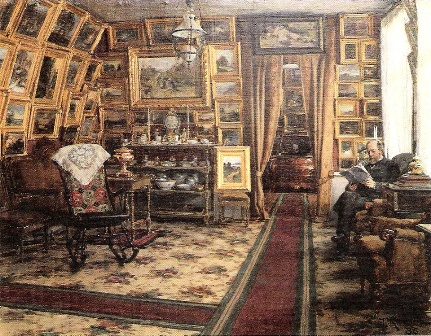
Nor surprisingly, the carpet that Evelina used in the house was inexpensive. Drugget, as it was known, was “a sort of cheap stuff, very thin and narrow, usually made of wool.”**  Drugget is an English term for “a coarse fabric having a cotton warp and a wool filling,” ** the kind of quick carpeting one might have found in a first class railway carriage. It probably had a design or a border printed on it.

Evelina has written here and elsewhere of putting carpeting down, taking it up and outside to clean, and putting it down again. She has written of stitching the carpeting together, which suggests that she may have used drugget runners side by side to make an over-all covering for her parlor floor. She may have been more conventional, though, and placed the drugget as runners on top of an area rug, or on top of a bare floor. Whatever she did, the work was repetitive and dusty.

It’s a shame that Evelina spent so much time indoors today when the weather was “fair warm + pleasant,” as Old Oliver reported. She herself made note of its similarity to spring; she should have known it wasn’t going to last.


** Wikipedia, “Drugget”, as of December 26, 2014


Scandinavian Room with drugget runners “Bibliotekarien Segersteen i sitt hem,” 1886, by Johan Fredrik Krouthen, Courtesy of http://www.burrows.com

 

December 29, 1851

1_f5848b408e8936030e8b62e01d05ba09

Thomas Valentine Sullivan (1800-1859)

Monday Dec 29th  Have been at work about the house all

day  Helped Susan wash the dishes this morning

cleaned the dining room swept & dusted the

parlour & sitting room chambers entry &c  This

evening have spent in Olivers quilted the lining

to Susans hood  Helen has a bad cold and has

come home  It has cleared off very pleasant

It was an average Monday at the Ames’s house. Jane McHanna washed clothes and linens in big tubs in the kitchen while Evelina swept and dusted all around the house.  Susie Ames worked, too, helping her mother with the breakfast dishes.  After the chores and meals were over, Evelina visited next door with some sewing in hand.

In Boston, however, the day was more noteworthy. An iconic American institution – so familiar to most of us in the 21st century that it seems to have always existed – was formed today. Borrowed from London, where the original organization had been founded six years earlier, a Young Men’s Christian Association was formed at the Old South Church. The “Y” was born in the U. S. A.

The driving force behind the creation of an American YMCA (another had just opened in Canada) was Thomas Valentine Sullivan, a sea captain who had chosen to spend his retirement working as a missionary on the Boston waterfront. According to the Y’s own history, Sullivan noted a “need to create a safe ‘home away from home’ for sailors and merchants.”*  Young men who found life on the street too dangerous or unsavory could take refuge at the Y for “Bible study and prayer.”*

Among her dishrags and dustmops, Evelina wouldn’t have known about Capt. Sullivan and his new work. Yet the small, hopeful gathering at the Old South Church would grow into a major, caring resource for millions of people.


*http://www.ymca.net


December 24, 1851

new-england-for-web

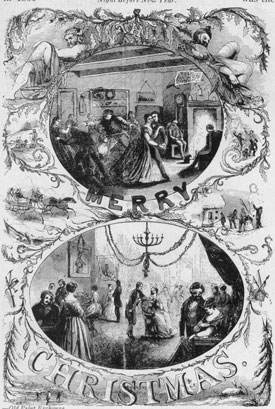
Christmas illustration from Godey’s Lady’s Book, December 1851

Wednesday Dec 24th  This morning gave the sitting room stairs

bedroom &c a thorough sweeping and was about the 

house at work a greater part of the forenoon

knit on my hood when I seated myself at work

read some in Ladys Book which I have

commenced taking for another year.  Emily brung

me a linen collar that her mother made for a

Christmas present


Emily Witherell delivered a Christmas gift from her mother, Sarah Witherell, to her Aunt Evelina, a gesture that may have caught Evelina off guard.  In practice, the Ameses had not been in the habit of observing Christmas, finding this religious celebration too festive for their Puritan-derived tastes. Yet times were changing and, in future years, Evelina would become both a recipient and giver of Christmas presents.

Evelina’s transition from being suspicious of Christmas to celebrating it was stimulated by various factors, not the least of which was its promotion in her favorite magazine, Godey’s Lady’s Book, the same magazine whose subscription Evelina renewed today. The periodical recognized and encouraged the holiday’s appeal to its well-heeled readers, many of whom would have read Charles Dickens’ A Christmas Carol, published less than a decade earlier. Unlike Unitarian (and one-time Congregationalist) Evelina, a growing number of Godey’s readers were less hide-bound to a doctrine devoid of celebration. The influx of Irish Catholics, who did honor the holiday, influenced some of this change, too.

While many in the nation made preparations for Christmas, a terrible fire at the Library of Congress in Washington, D. C., resulted in the destruction of nearly two-thirds of their holdings. Included in the loss was most of Thomas Jefferson’s original library.**

**http://www.accessible-archives.com/2013.01/the-other-fire


December 17, 1851

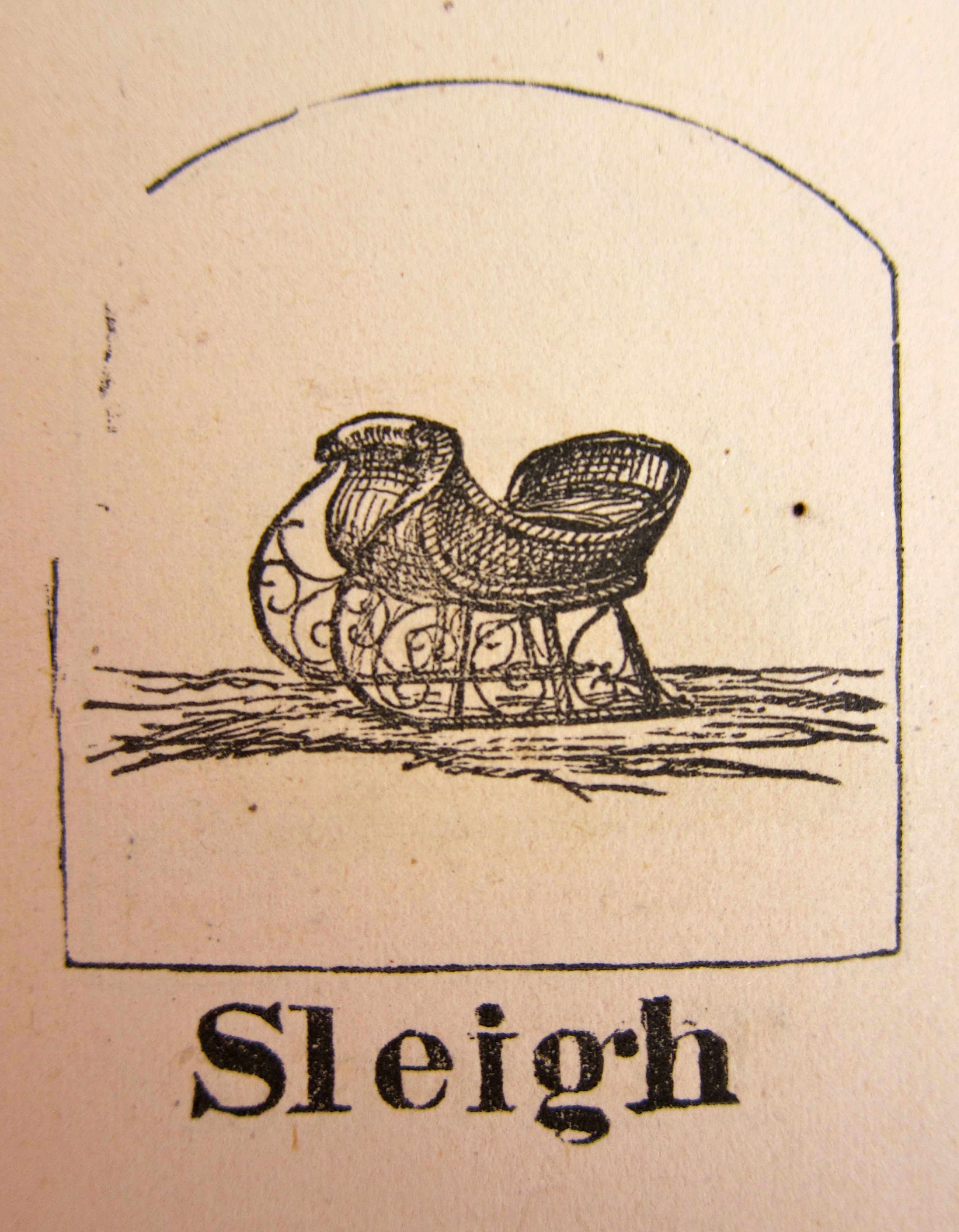
Sleigh

Dec 17th  Wednesday.  Mary went to ironing this

morning and Jane did the housework and I have been

knitting on Susans hood have got the front done and 

commenced the back  Abby spent the afternoon

& Malvina came in past eight  Jane ironed 7

shirts this afternoon  Very cold weather

Old Oliver Ames didn’t always agree with his senior daughter-in-law, but on this day he and she shared the same opinion about the temperature outside. “[T]he coldest day we have had this winter,” he wrote in his journal. Not surprising that Evelina and her servants stayed inside and focused on their indoor domestic responsibilities. All three women seemed to have recovered from their recent colds and illness and they probably wanted to keep it that way.

Some people went outside, though.  Evelina’s nieces, Abby and Malvina Torrey, spent part of their day with her.  They must have walked over from the village – a short walk, fortunately, in the windy, freezing sunshine.  Other Eastonians who were out and about would have moved around best in their sleighs, as a buildup of snow had hardened into a smooth, slick surface on the roadways.  Old Oliver himself may have gotten around that way.  He noted that “light slays run pritty well now.”


November 25, 1851


kitchen

*

Tues Nov 25th  Mary has done the ironing to day except

the fine clothes and they look much better than usual

Jane is rather better to day and has washed the dishes

and assisted some about the housework.  I have made a

dickey for Mr Ames. Passed the afternoon at Father Ames

with Mr & Mrs Swain & Mrs Meader  Mrs S Ames,

Fred & Helen came home to night

Family members began to gather in anticipation of Thanksgiving. Fred and Helen Ames came home from their respective schools in Cambridge and Boston, adding animation to the quieter house next door.  Surely their parents, Sarah Lothrop and Oliver Ames, Jr., were pleased to see them.  Oliver (3), away at school in Providence, was getting ready for his travel home.

No one was making merry yet, however.  Everyone still had work to do. The new girl, Mary, did some ironing, evidently better than Jane McHanna usually did.  Jane herself, still recovering from an illness that had laid her low for almost ten days, was able to wash dishes and help out a bit. Evelina, after supervising Mary and Jane, was finally freed up to sew and socialize.  She was in a happier state of mind.

The men of the family were working as well.  While Oakes, Oliver Jr, Oakes Angier, and Frank Morton were at the shovel shop, Old Oliver and some of his men began “a building an ice hous.”**

“About sunsett,” it began to snow.


*Image of a mid-19th century kitchen, Courtesy of http://www.victorianpassage.com

**Oliver Ames, Journal, Courtesy of Stonehill College Archives, Tofias Collection


November 14, 1851

Moby-Dick_FE_title_page


Tuesday Nov 14th  Bridget has cleaned the store room

and I have been working about in the chambers

have put Franks chamber in order papered

a little trunk &c &c  Have been working about

the house all day  I can scarcely tell what 

Im about all the time but I find something 

to keep me busy and I scarcely sew at all

Frank has been making a fuss about a robin to wear

The American edition of Herman Melville’s Moby-Dick or The Whale was first published on this date in New York, by Harper & Bros.  It followed a British edition that had come out about one month earlier.  Neither edition was a commercial success.

Today may have been a milestone for American literature, but the occasion went unnoticed by Evelina and most readers, discerning or otherwise. Evelina was focused, as usual, on domestic concerns “about the house,” including putting the bedroom or “chamber” of her youngest son, Frank Morton Ames, in order.  He, meanwhile, was complaining about an item of clothing that he needed to wear. Does anyone know what a “robin” is?

Old Oliver was, as usual, paying a farmer’s attention to the weather:  “this was a cloudy day most of the time the wind got round south west and was warmer than it has bin for several days past”.

November 8, 1851

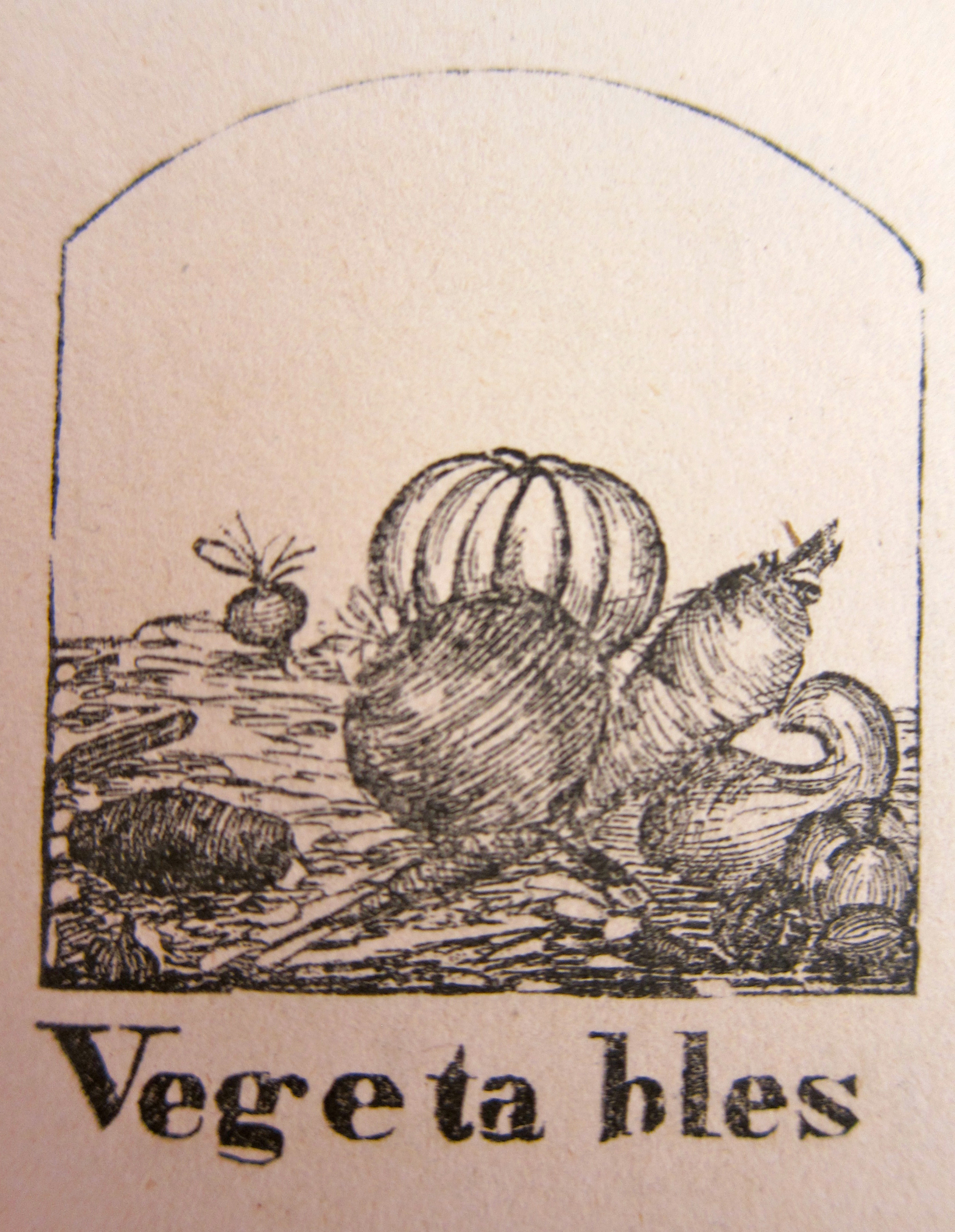
Vegetables

Sat Nov 8th  Jane is still in Mansfield and Bridget

sick consequently I have to do the housework and

I have scarcely sat down for one moment  Alson

came up with a load of vegitables and Hannah

called and I left my work while they stopped

Mrs Witherell came home this evening and I have been

in there  Mr Ames went to Boston stopt at Canton to a

whig meeting.  Oakes & Frank brought him home.

Not only was the dependable Jane McHanna away, but the Ames’s second servant, Bridget O’Neil, was sick.  Dr. Ephraim Wales had checked in on Bridget the previous evening but she was still laying low.  Evelina, capable if disinclined, was faced with doing her own housework. She spent most of the day choring, as she called it.

Her brother, Alson Gilmore, drove a wagon up from the Gilmore family farm to deliver a “load of vegitables” to the Ameses. His daughter-in-law, Hannah Lincoln Gilmore, who lived right in the village, came to call and for those visits, Evelina paused to chat.  Once they left, however, she must have plunged into sorting and storing the vegetables that Alson had brought. By this time of year, they would most likely have been root vegetables such as turnips, parsnips, carrots and potatoes. She would have stored them somewhere cool, dry and varmint-free: the cellar, if it wasn’t too wet, or the buttery or even the shed. Sharp-eyed housewife that she was, Evelina would have made sure everything was put away safely.

Oakes Ames, meanwhile, went to Boston as usual on this Saturday, but also “stopt at Canton to a whig meeting.”  The following Monday was Election Day and the party faithfuls were gathering in anticipation. This is the first mention in Evelina’s diary of Oakes’s participation in local politics. Their son, Oakes Angier, had shown interest earlier in the year, running unsuccessfully for the Easton school superintending committee, and attending the Whig convention in Springfield.  But her husband’s interest, although it had probably existed prior to this moment, had not drawn comment. Evelina mentions the meeting most likely because of the impending vote, but the statement coming so close on the heels of an undisclosed agreement she and Oakes had made only one week earlier gives creedence to the possibility that their agreement had something to do with Oakes’s waxing interest in politics.

October 30, 1851

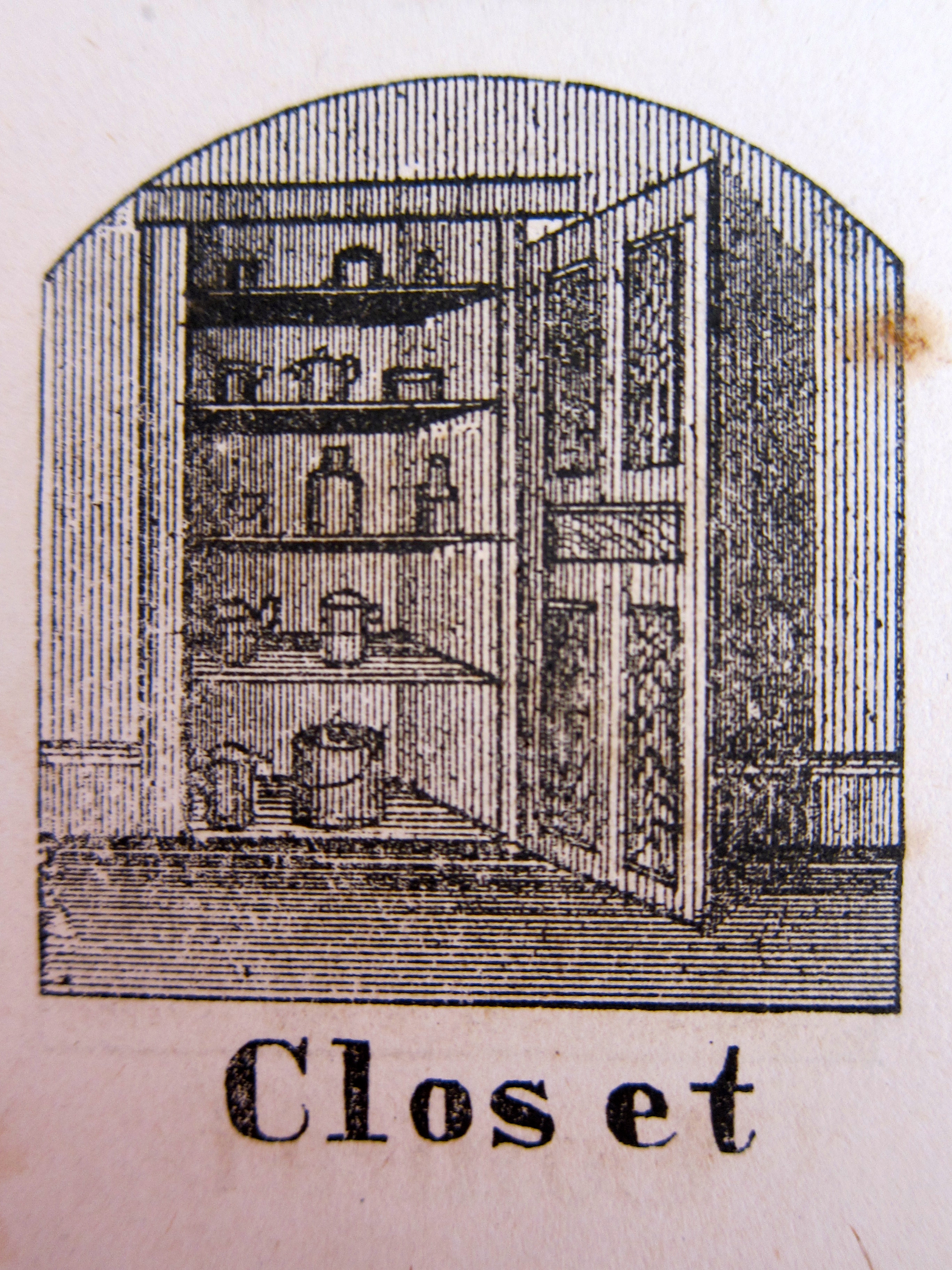
Closet

1851

Thursday Oct 30th  Mr Scott finished papering the 

parlour this morning and has painted some drawers

to be grained, and has drawn some of the windows

in the parlour  I have been doing a little of every

thing but cannot tell what.  Have got the carpet

down in the sitting room and the dishes into the

closet and we begin to look more comfortable


The redecorating of the downstairs began to wind down and the house became “more comfortable.” Getting the sitting room back in order was a big deal, for that was Evelina’s main domain for her daily sewing. It was her office, so to speak, more so than the kitchen.  She surely had missed her sewing routine while the house was disordered.

Putting the dishes back into the sitting room closet was also an accomplishment.  Jane Nylander, modern historian of 19th century domestic life, has written of the role of that closet:

“In most substantial households, parlors, sitting rooms, and dining rooms were furnished with a closet in which were stored cups and saucers, decanters of wines, glassware, and loaves of rich fruitcake, which was prized for its lasting quality as well as its flavor.  The shelves of these closets were grooved so that the small serving plates called ‘twifflers’ could be stood against the back wall and make a handsome show when the door was opened. ”  Twifflers – great name! – were about 9 1/2″ in diameter.

While Evelina set her house to rights, her father-in-law was busy about the factory. “began to work on the Flyaway Dam to day I went to Bridgewater + caried Clark + Keith to help Mr Phillips about fixing th bellows”** What had happened to the bellows? They were key to the manufacturing process.


*Jane Nylander, Our Own Snug Fireside, New York, 1993,  pp. 236 – 237.

**Oliver Ames Journal, Courtesy of Stonehill College Archives


October 24, 1851

pantry-shelves-vintage-650-225x300

*

Friday Oct 24th  Jane & Bridget have cleaned the buttery

and I have had some paint put on the 

shelves  Mr Smiley worked here about three

hours, he went to Mansfield and came here 

about two Oclock.  Scott & Holbrook have finished

the first coat to the sitting room & parlour

I have been about house most of the day.  Sit awhile

with Susan Orr.  Capt Isaac Lothrops wife buried this P. M.

Much cleaning was going on at the Ames’s house in tandem with major redecorating. Evelina the housewife was impelled to tidy everything up before and after various workmen came through to scrape, dismantle, build, paint and/or paper the downstairs rooms. Her servants, Jane McHanna and Bridget O’Neil, scurried around with her, clearing shelves so that the men could follow and do their work.

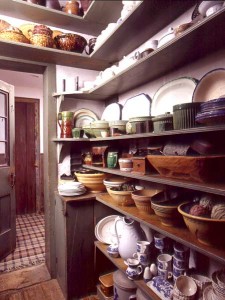
The buttery that Evelina mentions was, in fact, a shelved area off her kitchen that served pretty much as a pantry.  She had food storage “down cellar”, of course, but the buttery, being close by and on the same floor as the kitchen, would have been more accessible for daily use.  She would have stored everyday items like coffee or tea there, for instance. If the Ameses had kept dairy cows, milk would have been poured into pans there, to be skimmed for cream.  Yet the term buttery derives not from its use for dairy products, but from an archaic British term for the room where large caskets of wine, known as butts, were stored. (One butt was the equivalent of two hogsheads or four barrels of wine.) There was no storing caskets of wine at the Ames’s.

Oakes Ames was away during yesterday and today’s disruption, though sons Oakes Angier and Frank Morton and daughter Susan Eveline were home and had to sidestep the disarray. Oakes was away on shovel business, most likely.  No one from Evelina’s household appeared to attend the funeral of Isaac Lothrop’s wife.


* 19th century pantry, courtesy of http://www.oldhouseonline.com, photo by Gross & Delaney


October 20, 1851

Cheese

Monday 20th  Susan washed the dishes again this

morning and I took up the parlour carpet and cleared

the room  Mr Healy has taken out the door

where the closet used to be and getting it ready for

the masons  I have been to work getting of[f] the 

paper and to night feel quite lame.  Mr Smiley

has varnished the chairs that he painted last week

Received 6 cheeses and a tub of butter from Mrs Mower

The calendar may have said it was October, but the domestic commotion at the Ames’s suggested spring cleaning.  In order to redecorate, Evelina pulled up the carpet (which had been laid down in pieces), emptied the parlor of furniture, and spent the better part of the day scraping off the old wallpaper. A local carpenter, Henry R. Healy, was also in the house, removing a closet door and preparing a wall for masonry. Were they putting in a new fireplace?  A coal stove would be more likely. Further, another worker, Mr. Smiley, finished varnishing some chairs.  All this went on over and around the usual Monday washing of clothes by servant Jane McHanna.

Scraping wallpaper off of horsehair plaster is hard work and by night time, Evelina was smarting from the day’s exertion. She couldn’t have been unhappy, though. Much had been accomplished and, moreover, her housewifely self must have been pleased to add “6 cheeses and a tub of butter” to the larder.  Louisa J. Mower, a friend from Maine, sent the dairy items to her.  As gifts? As a purchase?

It was a day of accomplishment for Evelina.