November 16, 1851

IMG_0017

Modern photograph of house in North Easton built by Edwin Williams Gilmore, 1851


Sunday 16th  We have all been to meeting all day

Went to Mr Whitwells at noon with mother

rode with our new horse do not believe he

is any great affair  Edwin took tea with 

us and I went into his house with him  Wrote

a letter to Oliver.  Oakes A went to North

Bridgewater to see Mr French about selling

some hogs for father.  I asked once to let me go but

he went without me


The Ameses went to meeting today, naturally, and Evelina visited with her mother at the parsonage during intermission.  The Ames family often rode in tandem if not together to church; Evelina perhaps rode in a carriage with Old Oliver and Mrs Witherell.  She certainly seemed underwhelmed by the new horse that Old Oliver had recently acquired.

Edwin Williams Gilmore, Evelina’s nephew, stopped by for tea at the end of the day.  He was building a house in North Easton, barely a stone’s throw away from the Ames compound. Although he may have worked at the shovel factory at this time, he would soon embark on a business of his own: a hinge factory that would be a successful enterprise for decades to come. He wasn’t interested in working and living on the family farm; that job would fall to his younger brother, Francis.

For now, Edwin was an ambitious twenty-three year old who wanted to live in the village.  The house, which his father, Alson, had been helping him build, was almost ready. His next step would be to marry, and he evidently had a wife in mind: twenty-two year old Augusta Pool, his neighbor near the farm. Evelina may have been privy to Edwin’s plans; if not, she surely enjoyed looking in on the new property so close to her own. Her visit with Edwin perhaps made up for not going with her son Oakes Angier to North Bridgewater.
 

October 30, 1851

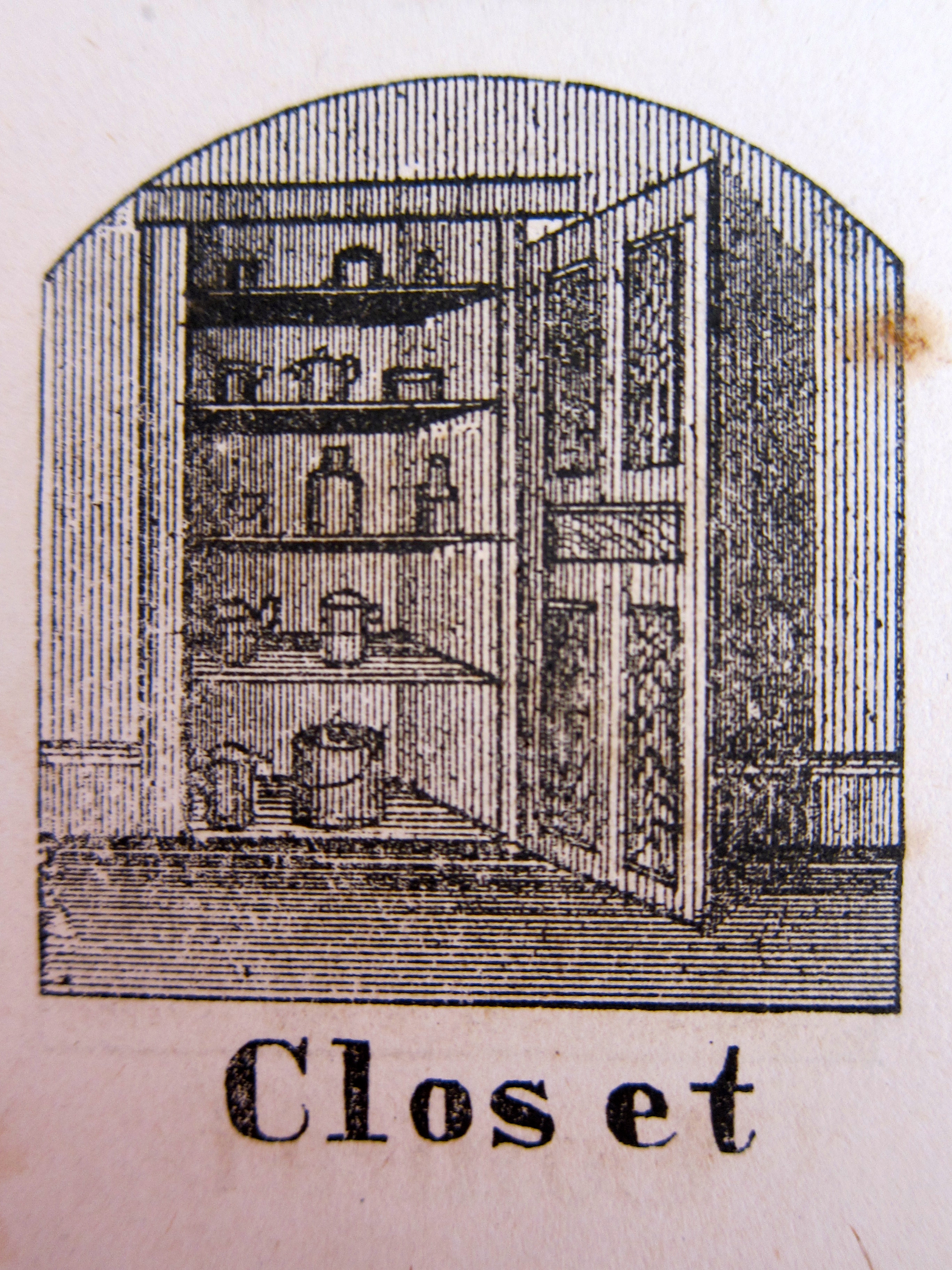
Closet

1851

Thursday Oct 30th  Mr Scott finished papering the 

parlour this morning and has painted some drawers

to be grained, and has drawn some of the windows

in the parlour  I have been doing a little of every

thing but cannot tell what.  Have got the carpet

down in the sitting room and the dishes into the

closet and we begin to look more comfortable


The redecorating of the downstairs began to wind down and the house became “more comfortable.” Getting the sitting room back in order was a big deal, for that was Evelina’s main domain for her daily sewing. It was her office, so to speak, more so than the kitchen.  She surely had missed her sewing routine while the house was disordered.

Putting the dishes back into the sitting room closet was also an accomplishment.  Jane Nylander, modern historian of 19th century domestic life, has written of the role of that closet:

“In most substantial households, parlors, sitting rooms, and dining rooms were furnished with a closet in which were stored cups and saucers, decanters of wines, glassware, and loaves of rich fruitcake, which was prized for its lasting quality as well as its flavor.  The shelves of these closets were grooved so that the small serving plates called ‘twifflers’ could be stood against the back wall and make a handsome show when the door was opened. ”  Twifflers – great name! – were about 9 1/2″ in diameter.

While Evelina set her house to rights, her father-in-law was busy about the factory. “began to work on the Flyaway Dam to day I went to Bridgewater + caried Clark + Keith to help Mr Phillips about fixing th bellows”** What had happened to the bellows? They were key to the manufacturing process.


*Jane Nylander, Our Own Snug Fireside, New York, 1993,  pp. 236 – 237.

**Oliver Ames Journal, Courtesy of Stonehill College Archives


October 29, 1851

1157676_l

*

Wednesday Oct 29.  I have been what I call puttering

about house most all day and have accomplished

but very little.  papered the fireboard and pasted

the loose places in Franks chamber  Mr Scott

has painted the sitting room & closet

Mrs Hubbel & Ames came from New York this morning

H O A Orr came for Susan this afternoon  Mr

Walton is there. Mrs Holmes and Abby called

Mr Ames came home from Boston to night

Many comings and goings in North Easton today, under a cloudy sky.  Almira Ames, widow of George, an Ames cousin, arrived from New York with a Mrs. Hubbel in tow. They came for a visit with the obliging Sarah Witherell and Old Oliver Ames in the other part of the house.

Susan Orr, meanwhile, who had been staying with Sarah Witherell and her father for almost a month, was picked up this afternoon by her brother, Hector Oakes Orr. Susan, age 53, and Hector, age 51, were first cousins of Sarah Witherell and her siblings on the Angier side of the family.  Susan and Hector were two of five children of Susanna Angier Ames’s sister, Mary and her husband, Dr. Hector Orr, of Bridgewater. Their shared grandparents were Oakes and Susanna (Howard) Angier.

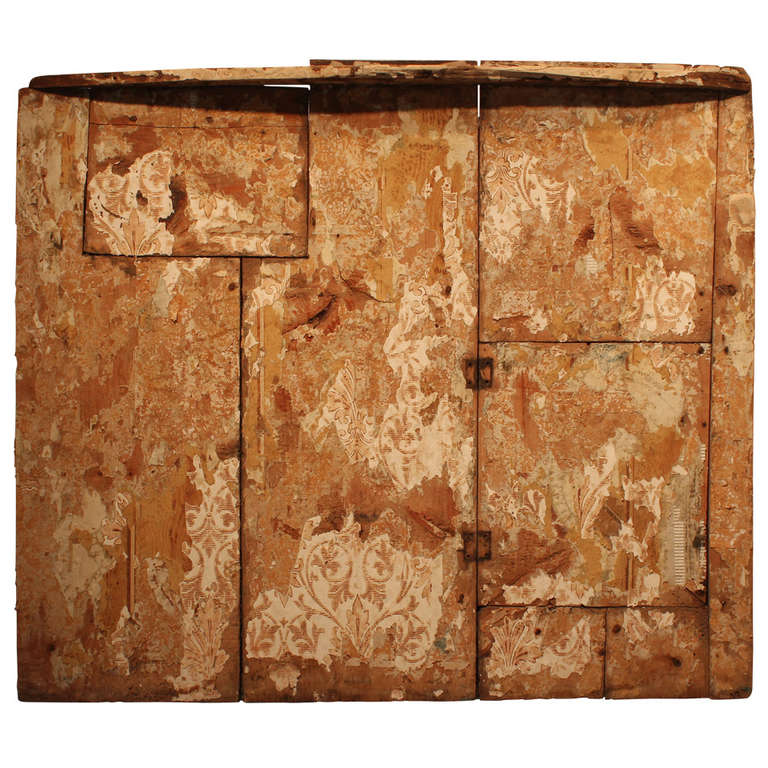
Evelina’s niece on the Gilmore side, Abigail Williams Torrey, paid a call with Harriet Holmes (the neighbor who had been so ill back in August). A Mr. Walton floated somewhere in the picture; Evelina’s inclusion of his name is a bit vague. And chugging along in the background of the various calls was Mr. Scott painting the woodwork in the sitting room. Evelina concentrated on papering a fireboard when she wasn’t attending to the influx of visitors. For readers who don’t have fireplaces, a fireboard was a piece of wood, textile or ironwork fitted to the opening of a fireplace for periods when the fireplace wasn’t being used.  Fireboards made from wood, most common in the countryside, were often decorated with wallpaper or painting.


* 19th century papered fireboard, Pennsylvania, courtesy of 1stdibs.com.


October 28, 1851

fig7

*

Tuesday Oct 28.  Have been assisting Mr Scott about papering

again to day and have painted over some things

and places about the house. Finished papering the

sitting room and little entry just after dinner

Hannah called with Eddy a few moments

Mr Ames is still in Boston passed last

night there.  I spent the evening in the other

part of the house.


Yesterday’s unseasonable snow storm departed and left behind “a fair day**”  Evelina seemed not to notice the difference, focused as she was on the repapering and repainting of the downstairs of her part of the house. She was helping with the actual papering. Her husband, Oakes, was away in Boston, so her only responsibility was making sure that meals were on the table for sons Oakes Angier and Frank Morton and daughter Susan Eveline, a task she typically delegated to her servants.

Hannah Lincoln Gilmore, who was married to Evelina’s nephew, Alson “Augustus” Gilmore, paid a call with her older son Eddy. Edward Alger Gilmore was a toddler who had fidgeted more than once in his great-aunt’s parlor. He was only two years old, and probably couldn’t yet pronounce his name.

Eddy’s middle name came from his maternal grandmother, Rachel Howard Alger (1802-1823), the first wife of Alson Gilmore and mother of Hannah’s husband, Augustus.  Rachel died less than a year after Augustus was born; Augustus couldn’t have remembered her, but he clearly wished to honor her by naming his own first-born after her. The Alger family was settled in Bridgewater, Taunton, and Easton, all descendants of a Thomas Alger in the 17th century. Both Evelina and Sarah Lothrop Ames were among the hundreds of descendants in the Thomas Alger line.


* Illustration in “Scientific American”, ca. 1880, of machine production of wallpaper, New York, Courtesy of National Park Service, http://www.cr.nps.gov/history/online_books/tpsd/wallpaper.

** Oliver Ames Journal, courtesy of Stonehill College Archives


October 5, 1851

Letter

Oct 5th Sunday  Mr Whitwell has gone to Philadelphia and

we have no meeting and Mr Ames self & Susan

staid at home  Oakes A & Charles Mitchell went

to N Bridgewater to meeting  Wm & Mr B Scott

came to the other part of the house this morning.

Mrs Latham & Aaron Hobart this afternoon.  I have

been writing most all day  Am not at all well

It has been a beautiful day.

Feeling as poorly as she did, Evelina was probably grateful not to attend church. Her rash was so irritating that she had trouble sitting still, yet lacked the vigor to move around much. Too, she had worked hard the day before putting up fruit preserves and may have felt tired from the effort. She wasn’t “at all well.”

Letter writing occupied her, and probably helped take her mind off her discomfort, just as playing with dolls had distracted little Susie when she was ill. Evelina often corresponded with several female friends and relatives, like Louisa Mower and Orinthia Foss in Maine, cousin Harriet Ames in Vermont and Pauline Dean, whose home address we don’t know. Which friends did she write to today?

Other family members were more active, despite the cancellation of the usual church service. Son Oakes Angier Ames rode over to North Bridgewater with Charles Mitchell (a younger brother-in-law of Harriett Ames Mitchell) to attend meeting there. Old Oliver and Sarah Ames Witherell, in the other part of the house, received several visitors, including Aaron Hobart.  Susan Orr was still visiting there, and may have been the draw for some of the new visitors.

September 29, 1851

330px-Open_drawers_-_Garments_for_girls

Monday Sept 29  Cut out three prs of cotton Drawers

for self for Ellen to make & have done some

sewing  Augustus came with his family about

4 Oclock are going to move into a part of Mr

Torreys house  Hector & Susan Orr came to

the other part of the house this afternoon.  Susan

will stop awhile  Not very pleasant has rained some

Rain arrived but the day, according to Old Oliver, was “pritty warm.” The wet weather and her cold must have kept Evelina indoors.  She may not have felt well, but as long as she could sit up, she would have found something useful to do.  Sewing some underwear for herself was the mundane chore waiting in her workbasket. Meanwhile, Jane McHanna, the family servant, washed the weekly laundry, perhaps doing her trick of letting the rain do the rinsing. She would have been challenged to figure out how to dry it, though.

Visitors arrived in the other part of the house; the Orrs, a family with whom the Ameses had been connected since early days in Bridgewater, came to visit. Susan Orr, a spinster, had known Oakes Ames when he was a baby. Today she and Hector – her brother, perhaps? – came to see Old Oliver and Sarah Ames Witherell.

On Evelina’s side of the family, nephew Alson “Augustus” Gilmore, his wife Hannah and their two sons, toddler Eddie and infant Willie, began to move into temporary quarters at Col. John Torrey’s building in the village.  Eventually, they would build a home, but for now they were going to rent.


August 28, 1851

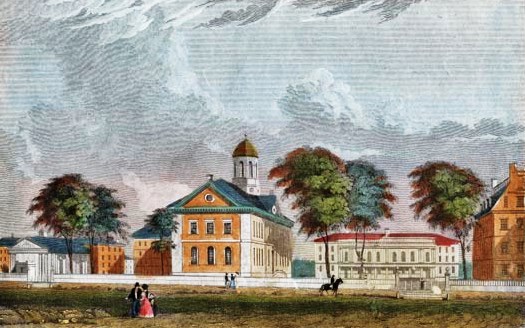
17 Alexander Jackson Davis (American architect, 1803-1892),  Harvard University, Cambridge, Mass. 1850

*

Thursday Aug 28th  Have done but very little sewing to day.

Mrs Fullerton Abby & Malvina here to tea.  Mr & Mrs

Whitwell called.  Mr Whitwell walked up and sent

Mr Tilden with a carriage for his wife.  Mrs Hyde

Mrs James Mitchell & Mrs Watson came from E Bridgewater

& Mrs Watson & Peckham to the other part of the house

to tea. Alson here to dinner & tea

Frederick left for Cambridge this morning

There was much socializing in North Easton today, but it paled in importance when compared to the departure of Frederick Lothrop Ames for college. Though only 16 years old, Fred  was entering Harvard College as a sophomore, making him a member of the class of 1854.

A notable nineteenth-century commentator would arrive at Harvard just after Fred had graduated.  Henry Adams, Class of 1858, would have this to say about the college in Cambridge before the Civil War:

“Harvard College, as far as it educated at all, was a mild and liberal school, which sent young men into the world with all they needed to make respectable citizens, and something of what they wanted to make useful ones. Leaders of men it never tried to make. Its ideals were altogether different. The Unitarian clergy had given to the College a character of moderation, balance, judgment, restraint, what the French call mesure, excellent traits, which the College attained with singular success, so that its graduates could commonly be recognised by the stamp, but such a type of character rarely lent itself to autobiography. In effect, the school created a type, but not a will. Four years of Harvard College, if successful, resulted in an autobiographical blank, a mind on which only a water-mark had been stamped.”**

Was Fred Ames stamped by his time at Harvard? He certainly appreciated his years there, and became “warmly interested in everything that pertained to the welfare of Harvard, as evinced by his well-known liberal gifts to several of its departments.”***


* Alexander Jackson Davis, “Harvard University,” Cambridge, Massachusetts, 1850

** Henry Adams, Education of Henry Adams

*** Harvard “Report for Class of 1854,” 1894

August 18, 1851

Churn

Monday Aug 18th  Jane washed this morning and had Ellen

to assist so I sat down quite early to sewing

cut out a chimise for Ellen to make

This afternoon went to Mr Whitwells to tea

Mr Ames was going to Bridgewater and I

rode there with him.  Called at Mr Harveys

to try to get some butter but she had none

to spare.  Hurried home expecting Pauline she did

not come  Mr & Mrs George Lothrop came to Olivers 

The new servant, Ellen, helped Jane McHanna with the laundry today. Evelina stayed out of the way and concentrated on her sewing, setting work aside for Ellen to do later. She needed another chemise.

In the afternoon Evelina went to the Whitwells’ for tea.  She had just been there the day before during the intermission between church services. Today Oakes accompanied her and the two went on from there to Bridgewater.  Evelina was hoping to buy some butter from a Mr or Mrs Harvey, but had no luck. Evidently no longer producing butter herself, she’s had to travel this summer to find it. Oakes, meanwhile, was on his way to Bridgewater on shovel business – or Whig politics.

Not yet alluded to in Evelina’s diary is the illness of one of Sarah Lothrop Ames’s brothers, Dewitt Clinton Lothrop. Clinton, as he was known, was deathly ill with typhus fever. Another Lothrop brother, George Van Ness Lothrop and his wife, Almira Strong Lothrop, had come back to town from Detroit on Clinton’s account.


August 16, 1851

Tub

Sat 16th Aug  Have been to work on my white loose dress

that Julia cut out some time since and it is ready for

the washtub  Frank and Oliver came from Bridgewater about

three and brought home Charles Mitchell & Sister Harriet

Mr Brett two Miss Tolmans from New Bedford Jane & William

Howard & Orinthia came & went to the shop about 5 Oclock

The party at Robbins Pond in Bridgewater may have ended, but the festive mood continued.  Oakes Angier Ames headed into Boston, but his brothers Oliver (3) and Frank Morton returned from Bridgewater with their Aunt Harriett and her brother-in-law, Charles Mitchell and, perhaps, others. At the same time or maybe just a short while later, Orinthia Foss and a spill of friends to whom Evelina had been introduced only a few days earlier arrived and went to the factory.

Why this sociable group visited the shovel factory at the end of the day is a mystery. Were they delivering the Ames brothers back to work? Were they visiting someone else there? Did Oakes or Oliver Jr. find it amusing? Was Old Oliver privy to this after-party?

Evelina, meanwhile, was working on her wardrobe and was ready to put a new dress into the washtub.  She might have looked up from her sewing to see the young people drive by.


August 15, 1851

Vintage Ames Shovel

Vintage Ames Shovel

Friday 15th Aug  Julia here to work to day cutting me

a purple loos dress & cutting a pink french

calico for Susan.  Made a childs waist to it.

Oakes Frank & Oliver went this afternoon

to Robbins pond in E Bridgewater to a party.

Oakes A is to go from there to Boston tomorrow

I have passed the afternoon at Mr Peckhams

had a pleasant visit

Robbins Pond, where the Ames sons and their Aunt Harriett went today for a party, is in Bridgewater and is known today for its bass fishing.  Who hosted the party there in 1851 isn’t known, but all the Ameses, including Evelina, were invited.  Evelina declined, however, suggesting yesterday that she might enjoy herself too much if she went. She went to call on the Peckhams instead.

On a much more serious note, today marks the one year anniversary of a terrible accident at the shovel factory. According to Old Oliver, an employee named William Loftis “was hurt so bad yesterday by leting a shovel catch in the polishing wheel that he dyed.” Loftis was an illiterate laborer in his late twenties. Like the Middleton and Maccready families with whom he lived, he had immigrated from Ireland.

Old Oliver seemed to blame Loftis for getting caught in the machinery, perhaps through inattention or carelessness. He doesn’t suggest that the factory was at all at fault, or that the machinery could be reconfigured in a way to make it less dangerous. As far as Old Oliver and most factory owners at the time were concerned, employment carried a certain level of risk, risk that was assumed by any man who received a pay check.

It’s doubtful that the Ames family was indifferent to the fate of William Loftis, however. It’s likely that Evelina or one of her sisters-in-law sewed a shroud for the body for a proper burial. Knowing Oakes Ames’s instinctive kindness to strangers and employees, he probably would have reached out to Loftis’s family. The absence of a widow and children, however, suggests that Loftis was simply buried and simply forgotten.