August 21, 1851

PINEAPPL-h

*

Thurs 21st Aug  This morning sat down to work quite early

finished my purple morning dress and 

Susans pink print that was made over

Pauline is not willing that I should work

much  She has had the offer of marriage

from a Mr Stowe of Concord Mass & the same

is an offer from John Reed, an old man of

70 years  She is very fascinating  Mrs Witherell

& Mitchell went to Boston for paper for parlour

Evelina had a houseguest who wasn’t interested in sewing, but that didn’t prevent her from finishing two dresses she’d been working on. She was caught up with the romantic dilemma of her friend, Pauline Dean, who was considering two offers of marriage. Evelina’s daily life was so far from being romantic that she found Pauline’s tales “very fascinating.”

We don’t know much about Pauline Dean, except that she corresponded with Evelina and visited periodically. We don’t know where or how Pauline lived, but we can surmise that she was originally from the Easton area. She was familiar with the town and several of its inhabitants; perhaps she was related to one of the Dean families in the area.

While Evelina and Pauline visited, sisters Sarah Witherell and Harriett Mitchell went into the city in search of wallpaper. Sarah was looking to replace the wallpaper she had only recently put up in her parlour; she didn’t like it or the way it had been hung. The wallpaper in the illustration above is circa 1845 and demonstrates the prevailing ornate taste of the time.

Adelphiapaperhanging.com 

August 20, 1851

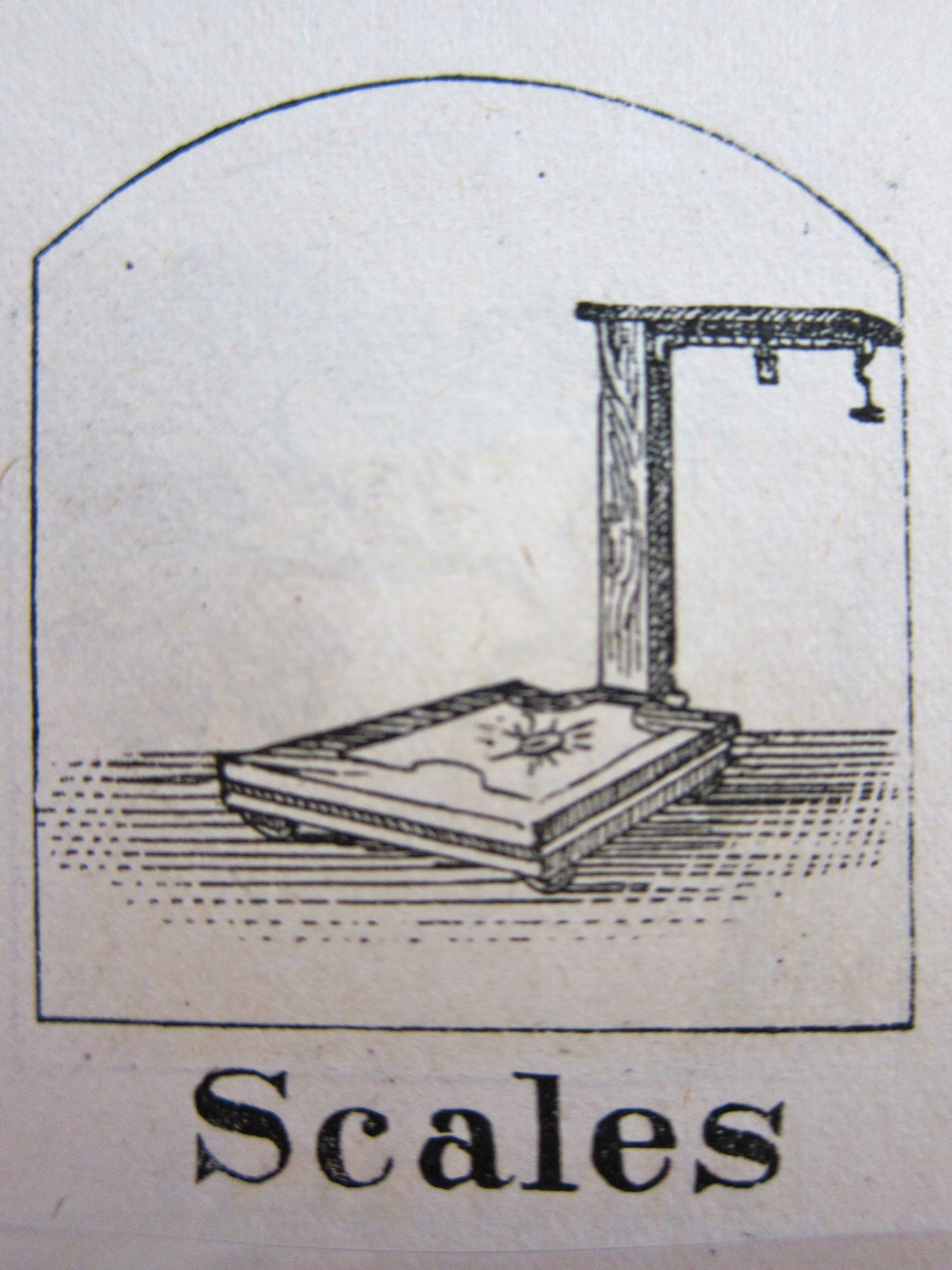
Scales

Weds 20th Aug  Rachel, Lavinia and Augusta Pool spent

the day here  Mr Ames and Augustus went to Boston

Pauline Dean came to night in the stage

appears the same as she did when she left

Went to the store & was weighed  148 lbs

called at the factory to see Edwin work and he came to

tea  Mr Whitwell called while we were gone

Not shy, Evelina stepped on the scale at the company store.  Fully clothed in the voluminous fashion of the day, she weighed 148 pounds. Given that her dress was full-skirted and worn over a chemise, undersleeves and petticoats, and that she wore a bonnet and most likely kept her hose and shoes on, her actual weight was probably several pounds less than she reported.  She likely weighed closer to 140.

Evelina missed a visit from Reverend Whitwell today, as she was out and about with young female company.  Two nieces, Lavinia Gilmore and Rachel Gilmore Pool, came over with Rachel’s sister-in-law, Augusta Pool.  They were ages 19, 21, and 22, respectively. They visited the store, shopped, perhaps, and watched their aunt get weighed. Perhaps they got weighed themselves. It might have been a lively time as they chatted and moved back and forth.

From the store the group traipsed to the shovel factory to watch Evelina’s nephew and Lavinia and Rachel’s brother, Edwin Williams Gilmore, work – an unusual visit to say the least, and one that could only have been accomplished in the company of the boss’s wife. What did the workmen think?

Edwin, nearly 23, would not work at the shovel shop for long. By 1854 he would be manufacturing hinges along with business partners Oakes and Oliver Ames Jr., whom he would eventually buy out. All that was in his future; today he would join his sisters and their friend Augusta for tea at his aunt’s.

August 2, 1851

65eb3ab64b1e3e383ab7982a18ea85a1

*

/51 

Saturday Aug 2d  Mrs James Mitchell, Cousin & sister Harriett

Mitchell came to the other part of the house to day

Sister Harriet returned to E Bridgewater with them

Frank went to Boston to see a Dr about his

throat got him a white hat.  We were all 

invited into Mr Bucks to see Miss Lothrop from

Boston  Orinthia & Helen went  Mrs Witherell

& I called after tea the boys went in the evening


Evelina felt better. She was back in the social swing today, going out after tea with her sister-in-law Sarah Witherell to meet a Miss Lothrop. Earlier in the day, Sarah Witherell had entertained two or three women named Harriet in her parlor in “the other part of the house”: sister Harriett Ames Mitchell, friend Harriet Angier Mitchell (Mrs. James Mitchell) and, possibly, cousin Harriet Ames. It’s also possible that Evelina, in writing the word “cousin,” meant to identify Harriet Angier Mitchell as a cousin which, by a stretch of several “removeds,” she was. In the latter case, there was no cousin Harriet Ames present. Confusing to us, certainly, and, perhaps, confusing to them.  Who was visiting in the parlor?

Old Oliver, meanwhile, was in the thick of haying season.  He noted that “this was a fair good hay day wind south west and we got in all the hay we had out some of it had bin out over a week and all of it since last Monday –“

One young man who was neither outside with a pitchfork helping his grandfather nor inside the factory fashioning a shovel was almost-eighteen year old Frank Morton Ames. Frank had been suffering from a sore throat that he evidently couldn’t get the better of, so he took off to Boston to have it looked at. When he returned to Easton, he reported nothing alarming.  Rather, he arrived with a startling new white hat, looking perhaps like one of the young men in the illustrated daguerrotype above. According to some sources, white beaver hats enjoyed a short vogue at this period. Frank must have stood out in the gathering at the Bucks’ house that evening.


* Image from Daguerreian Society, Mark Koenigsberg Collection

July 31, 1851


images

Thursday 31st July  Was out shopping most all day but

did not purchase a great deal.  Got one of my cuff

pins & marked it at Bigelows  Returned home through

Jamaica plains & by the pond.  passed a number of 

fine place among other[s]  Mrs Greens is a beautiful

situation but Kate went so fast so I could 

not see much of it.  Im told she was a widow Emery

& that her first husband left her the property


Bigelow Bros. & Kennard was a successful store in Boston that ran from ca. 1824 until 1971. Evelina and Oakes were familiar with it, as many of their children, grandchildren and great-grandchildren would be as well.  Evelina took a cuff pin – a women’s version of a cuff-link – to Bigelow’s to be marked.

As the crow flies, the distance from Boston to North Easton is approximately 21 miles. The distance on the available roads was closer to 23 miles. Given the speed at which a wagon might travel along a nineteenth century road with a predictable distribution of hills and curves, a journey in 1851 from one location to the other could conceivably take all day. As already proven yesterday, however, when Oakes and Evelina made the trip in from North Easton in time to shop before lunch, the Ames’s horse Kate could move right along.

Kate (also spelled Cate) was well-known in North Easton. She had a sense of purpose and style all her own.  Oakes had taught her to respond with speed when someone tried to rein her in, and he enjoyed tricking the occasional wagoneer who tried to slow Kate down with a normal tug on the reins. Kate would simply go faster, especially if she were headed for home.

Thus, Evelina wasn’t exaggerating when she wrote that Kate was going too fast for her to see everything.  Evelina wasn’t able to properly scrutinize the fine homes along the road in Jamaica Plains, some of which were quite big and beautiful.


July 30, 1851

mUF4Adnn5IAX7hTvTfWXQXg

*

Wedns 30 July  Went to Boston with Cate & waggon had

a fine ride got to Mr Orrs about ten, went out

shopping untill dinner time  After dinner took Mrs

Orr with us to Mt Auburn and we rode & walked most

all over the grounds & went into the chapel  As we were

going through Brookline we stoped at the reservoir

and saw some fine situations in & about Brookline

Finally, Evelina got to go into Boston, a trip she had been trying to make for days now. She and Oakes rode into town in a wagon behind his horse Cate.  They trotted up today’s Route 138, past farms, fields and woods, through Stoughton, along Canton, into Milton and on into the city, approaching it by way of Washington Street. It was “a fine ride.”

After a little shopping and midday dinner with the Orrs, Evelina, Oakes and Melinda Orr drove to Mt. Auburn Cemetery, a new-style burial ground on the Cambridge side of the Charles River. Fashioned somewhat after the Pere Lachaise Cemetery in Paris, the twenty-year old cemetery had been the brain child of, among others, a Boston physician named Jacob Bigelow who felt that the practice of burying the dead under and right next to churches and meeting houses was unhealthy.  With the encouragement of the Massachusetts Horticultural Society and a designation of 70 acres from the Massachusetts legislature, Mt. Auburn Cemetery was created.

By carriage and on foot, Oakes, Evelina and their friend Melinda were able to go “most all over the grounds,” seeing paths, plantings, monuments and the Bigelow Chapel. They saw other landscapes of greater Boston today as well, including the brand new Brookline Reservoir.

*Pilgrim’s Path, Mt. Auburn Cemetery, 1851.


July 29, 1851

HD_Boston1851Z.preview-1

*

Tues 29 July  Mr Ames Susan & self were going to Boston

to day but it rains pouringly.  I am glad to see

it rain hard so that we know what to do about

going  I do not feel as disappointed as I did last 

week when it cleared off so pleasant  Have been

sewing and mending

Another trip to Boston called off by weather. Not only were Evelina’s plans put aside, but Old Oliver’s plans must have been challenged, too.  Haying had begun the day before and the rain not only obviated any further haying today, but also endangered the hay that had already been cut.

Evelina experienced an odd satisfaction today, pleased that the weather proved to be as bad as she had anticipated because it justified her choice not to go to town. Perhaps she wasn’t pleased so much as vindicated. As she had done last week, she turned to sewing and mending to fill the time that otherwise would have been spent in Boston.  Oakes Ames, meanwhile, presumably went on into the city to conduct business with various store owners who sold Ames shovels.

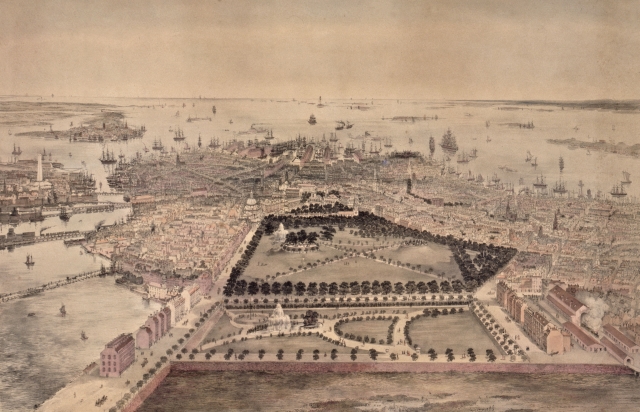
As the illustration above shows, Boston at this time had a much smaller perimeter than the city we know today. Back Bay was still a small bay of water, and the line of trees at the bottom of the illustration formed the western edge of the city, along the line that is now Arlington Street. The filling in of the water that would create the Back Bay grid of streets wouldn’t begin for another five or six years.

* Birds-eye view of Boston, 1851 


July 16, 1851


Shovel Storage_1 Nov 2010

*

1851

July 16th  Wednesday  Mrs H Ames left this morning.  Will stop

a day or two at Mr Hinckleys and then venture

home  Gustavus was to meet her in Boston

Have been to work on my silk muslin dress

Julia has been here cutting the waist and it

is so near done that it will not take long 

to finish it.  Edwin & Oliver went to S. Bridgewater

to get patterns for shovel press & Back strap Machine

Evelina seldom referred to the shovel business in her diary.  The factory, the employees, the machines, the products, the day-long sounds that emanated from the shovel shops right across the street from her home went essentially unmentioned. Despite the fact that six days a week, life in North Easton revolved around O. Ames and Sons, the factory that her husband, father-in-law, and brother-in-law owned, and at which her three sons worked, Evelina was mum about the business.

Instead, she kept her attention on the domestic and social events of her own life, recording the tame goings-on of the household, which was, naturally, her sphere of interest and influence. Her focus begs the question, however, of how much of her record was consciously restricted to the quotidian. Did she hear about events at the shovel shop and choose not to include them, or were business details never discussed at the dinner table?  Were shovels excluded from pillow talk at day’s end? Or was she so familiar with the many facets of the shovel business that she took them for granted, dismissed them and looked solely at her own concerns? Was she disinterested or discrete?

That aside, shovel-making slipped into Evelina’s record today.  Her middle son, Oliver (3), and his cousin, Edwin Williams Gilmore, headed to South Bridgewater to fetch patterns and a back-strap machine for the shovel factory. The patterns were probably “dies used in a drop hammer/press that give the curved shape to the previously flat, partially formed blade.”**  The back strap was an object that facilitated the process of attaching the handle to the blade. Oliver and Edwin must have used a wagon to tote the goods back to North Easton.

* Ames shovels, Stonehill College Archives, with thanks to Nicole Casper, CRM, Director of Archives and Historical Collections

** Per Gregory Galer, PhD.

July 12 1851

54-02

*

July 12 Saturday  Have been very much engaged to day

in putting my house in order & have been to work

on the cushion to the lounge, and put the cover

on to the arm.  called in Olivers awhile.  Mrs

H Ames and Mrs Mitchell spent the day there

Mr Norris came in the stage to night & Mr & Mrs

Harris Mrs Norris from Bridgewater, Miss Foss

came with Oakes A who had been that way on an errand

Company! From Boston by way of Bridgewater came the Orr daughters and their husbands. Melinda Orr Norris with her husband Caleb, who had visited Easton just the other day, and Julianne Orr Harris and her husband, Benjamin Winslow Harris, arrived for an overnight stay with the Ameses.  Evelina spent much of the day “very much engaged” in getting the house ready for the two young couples, although she did manage to slip next door to sit with her sisters-in-law. The whole Ames property was full to the rafters.

Everyone had tasks to do today, which wasn’t unusual in that hard-working family. Old Oliver and a crew were outdoors:

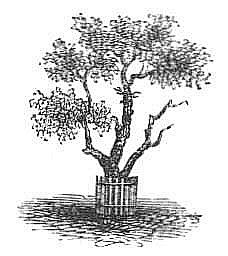
“it was cloudy half the fore noon but the afternoon was pritty fair wind north part of the time + south west a part we mowd the high land back of the Factory pond and that on this side of the old pair trees. to day”  Was this mowing a forerunner of haying season?

* Pear tree


June 28, 1851

Grapes

June 28th Sat  Have been to Boston to day met Alson

& wife at the depot  Went into the horticultural

exhibition  Saw many fine roses and […]

quite a variety of other flowers a very fine

dish of peaches and beautiful bunches of grapes

Henrietta & I dined at Mr Orrs.  We walked

a great deal   went into Hanover St  Whites bonnet

rooms & Mellons Merchants Row

Evelina traveled into Boston today and met her brother Alson and his wife Henrietta. She may have ridden in with Oakes, who usually went to Boston on business on Saturdays. If he was present, however, he didn’t spend the day with her; he would have had his customers to meet.  She, on the other hand, along with Alson and Henrietta, attended a horticultural exhibition. They saw plantings and all sorts of flowers, including “fine roses,” and displays of fruit that were also “very fine.”

It’s possible that this particular exhibition was that year’s annual presentation by the Massachusetts Horticultural Society. Established in 1829, and going strong today, the society, then as now, offered lectures and presented an annual exhibition in order to further their mission to educate the public about “the science and practice of horticulture.”

After midday dinner at the home of friends, Robert and Melinda Orr, Evelina and Henrietta walked around the city.  They looked into the shops along Hanover Street and Merchants Row, the latter a street that bisected Faneuil Hall and Quincy Market. The two women window-shopped for bonnets at White’s store and, given the horticultural theme of the day, they may have poked their heads in Joseph Breck’s floral emporium, too. They had much to think about on their ride back to Easton that evening.

June 18, 1851

Black ticking-stripe-15

June 18th Wednesday  Worked again untill nine in the 

garden and then made the tick for the 

mattress.  This afternoon put the cotton in 

and tied it  Bridget was here a couple

of hours & picked over the curled hair

Towards evening called at Mr E Carrs, Dr Wales

and on Mrs J C Williams at Mr Torreys, Mrs S. Ames

called with me  Augustus gone to Boston

Mr Bartlett spent

last night here

Evelina was making progress on the mattress for her new lounge.  She “made the tick” for the cover and stuffed it with old cotton.  The final cover, to be made of horsehair, was still being worked on. Bridget O’Neil, a servant who usually worked next door, came over to help Evelina with the project.

The long-lasting light of day, as the calendar approached summer solstice, allowed for late socializing. Evelina and her sister-in-law, Sarah Lothrop Ames, went out calling.  They visited Esek Carr and, presumably, his wife, Ann; called on young Dr. Ephraim Wales and, again presumably, his wife Maria; and stopped at John Torrey’s to see Mrs. Joshua C. Williams.  Mrs. Williams, we might infer, was a boarder or renter at Col. Torrey’s apartment building, which Evelina called a tenement. Was Mrs. Williams possibly a widow?

A Mr. Bartlett had spent the night with the family.  He was from Maine, so likely had some connection to the shovel works and their ongoing need of wooden handles.