October 4, 1851

Pick

Oct 4th Sat.  Preserved 25 pounds of peaches and 16 lbs

barbaries & about 23 lbs Apples with them.  Have

been about sick all day  Expect I have taken

the nettlerash from Susan have been troubled

with it three or four days.  Called this afternoon

at Augustus find them quite comfortably settled

Harriet trimmed my Bonnet with the ribbon I

wore last fall  Charles Mitchell came to see Mrs Mitchell


Evelina hadn’t felt very well for several days and began to feel even worse today. She believed she had “taken the nettlerash from Susan,” meaning that she now had hives, just as her daughter had had a week earlier. It made her feel “about sick” yet she stayed upright and worked in the kitchen most of the day. The fruit they had picked or gathered from friends and family wouldn’t keep, so the cooking had to get done.

In the kitchen, Evelina, probably with significant help from Jane McHanna, put up 64 pounds of fruit. She didn’t make jam, which would have consisted of cooked fruit pulp, nor did she make jelly, which would have been made from fruit juice.  She made preserves, which in this instance were pared peaches and apples, the latter mixed with barberries, that were placed whole or in chunks in sugar – lots of sugar – and then boiled down. And because “ingredients in […] loaf sugar are not always very clean,”* most cookbooks of the day strongly urged that the sugar be clarified.

Mrs. Cornelius, in her 1846 The Young Housekeeper’s Friend,* noted that “[t]he chief art in making nice preserves, and such as will keep, consists in the proper preparation of the syrup.  All sugars are better for being clarified.”* Mary Tyler Peabody Mann, more than ten years later in her cookbook, Christianity in the Kitchen, agreed with the necessity of clarifying the sugar The process was labor intensive; even with the help of Jane McHanna, Evelina would have had hours of work if she followed Mrs. Mann’s “receipt”:

“Put half a pint of water to every pound of sugar.  Stir in the white of an egg for every five pounds of sugar, and let it boil; when it rises, put in half a teacup of water and let it boil again, and repeat this process two or three times.  Set the kettle aside for fifteen minutes, then take the scum from the top.  Pout off the syrup; wash the kettle, and put in the fruit you wish to preserve.”**

After sitting at the kitchen table paring the fruit, or standing over the stove clarifying the sugar, or placing the fruit into the stoneware or glass jars, Evelina needed a break. She took a walk to the village to see her nephew Augustus and his family. Even if she wasn’t feeling well, the fresh air must have felt good after the heat and bustle of the kitchen.


Mary Hooker Cornelius, The Young Housekeeper’s Friend, 1846

** Mary Peabody Mann, Christianity in the Kitchen, 1858

August 19, 1851

4gbhistory


*

Tues 19th Aug  Sat down quite early to fix some work for

Ellen, about 11 Oclock Mrs Norris and a Mr Young from

Bridgewater came  Dined here and left about three

they wanted the boys to go Fishing Thursday but Clinton Lothrop

is not expected to live through the day and they

thought it best to defer going untill Monday

Mrs Witherell & Mitchell & myself went into

school this afternoon  Very warm

Melinda Orr Norris and a Mr. Young had midday dinner with the Ameses, during which they invited the Ames sons to go fishing. The boys accepted but deferred the trip to the following week.  Clinton Lothrop, their Aunt Sarah Lothrop Ames’s younger brother, was deathly ill and they wanted to wait until after his anticipated passing.

It was a hot summer day, with no such thing as air conditioning or window fans. In their full-skirted dresses, the Ames women surely were hot as they chored around the house or sat with visitors. They possibly opened their parlor windows to let in some air, but would have let in the insects, too, if they did so.  “Wove wire” had appeared here and there on the market as an alternative to horsehair weaves, but wouldn’t be commonplace until the Civil War. Around 1861, Gilbert & Bennet, a sieve-making firm in Georgetown, Connecticut, lost its southern customers and began to manufacture window screens as a way to use its surplus wire mesh cloth. Window screens took off. Before then, how did people cope?

Evelina and her sisters-in-law, Sarah Witherell and Harriett Mitchell, left the closed air of their homes and went to the local school house in the afternoon. Evelina doesn’t explain the purpose of the trip. Surely the hot sun beat down on them outdoors, but their bonnets kept their heads protected, at least.

* Gilbert & Bennet’s Red Mill on the Norwalk River where woven wire cloth was first developed as a commercial substitute for horsehair. Photo from historyofredding.com.  

July 1, 1851

P1010044-4

*

Tues July 1st  Worked in the garden a long while

this forenoon weeding & transplanting.

This afternoon trimmed Susan a straw and

horsehair bonnet that I purchased at Boston

Sat  Asa & Charles Mitchell came to 

the other part of the house this morning

Charles left this afternoon  I have not seen

Asa as yet

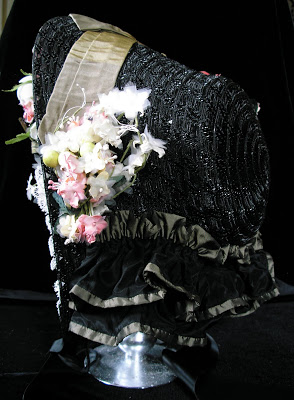
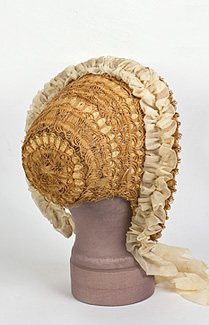
The wound on Evelina’s finger and thumb seemed better today; she spent most of her morning in the flower garden and, after dinner, trimmed a new bonnet for her daughter, Susan.  Straw bonnets were worn in the summer, naturally, and horsehair was a reinforcing fabric that could be used year round. Evelina had to be an expert by now on using horsehair, so adding ribbon or cloth flowers to it would be pretty easy for her, even with a sore hand.

Old Oliver, who seldom took note of the comings and goings of his children or his in-laws, reported in his journal that “Asa Mitchell came here to day from Sharon Pennsylvania.”  Asa was the husband of his youngest daughter, Harriett, who had been staying in Easton and Bridgewater by herself with her three children since the middle of April.  Asa worked in coal, an occupation that seemed to lead him – and his family – around western Pennsylvania and northern Ohio.

Evelina took note of Asa’s arrival; her curiosity was almost palpable as she awaited her turn to see him.  He and his brother Charles visited with Old Oliver and Sarah Witherell first thing.  What did they discuss?

* Horsehair and straw bonnet, modern construction from 1860s design; blog.historicalfashions.com, June 12, 2010, “Couture Historique” by Lindsey Slaugh

June 7, 1851

images-1

1851

June 7th Saturday  We have had a powerful

rain all day  Orinthia & self have been sitting

sewing most of the time  Orinthia has made a

pair of overalls for Frank  I have trimmed &

lined or rather Harriet trimmed the bonnet

and I feel very well satisfied about it.  The

school did not keep to day or yesterday

Susan has turned a sheet  Horatio Ames Jr &

Mr Scoval came to father Ames.  Mr Ames

brought a lobster that weighed 15 lbs.


No gardening today, but it wasn’t a bad day, despite the rain.  Evelina and Orinthia got to visit for hours over sewing, Oakes Ames brought home lobster – a big lobster – from Boston and, best of all, Evelina was finally “very well satisfied” about her bonnet.

Harriett Ames Mitchell visited, too, and trimmed Evelina’s bonnet. She might have used ribbons or cloth flowers or even a feather or two to adorn the summer headdress. Nine-year old Susie sewed as well.  Either the bad weather kept her indoors, or her mother finally made good on her threat from a few weeks ago to make Susan play less and learn to sew.  Susie “turned a sheet,” which means she did some hemming.

Old Oliver had a rare visit from one of his grandsons, Horatio Ames, Jr., who must have travelled up from Connecticut with a Mr. Scoval.  Horatio Jr. was a first cousin to Oakes Angier, Oliver (3), Frank Morton, and Susan.  The eldest son of Horatio and Sally Hewes Ames, and a recent student at Rensselaer Polytechnic Institute, he would prove to have a difficult life.  Closer to his mother than to his father, he was incensed when his parents divorced. According to some sources, he actually tried to kill his father during an argument in 1856.* His father, who was no saint himself, described his eldest son as “the worst hardened villain I have ever seen.”*

Still, Horatio Jr. was family, and Old Oliver welcomed him to his home more than once over the course of Evelina’s diary.


*John Mortimer, Zerah Colburn: The Spirit of Darkness, 2005

June 6, 1851

images

*

1851

June 6 Friday  Worked in the garden an hour or two this morning

mended some cotton stockings swept & dusted &c

About three or four Oclock went with Olivers wife

& Mrs Mitchell to North Bridgewater called at

Mr Summers to take Frank Mitchell home & at Mrs

Carrs & Susan Copelands to get my bonnet  The bonnet

is done well  When I returned home found Orinthia

here.  Jane Howard brought her up. 

At last, a bonnet to take home and trim.  Evelina was clearly pleased.  She picked it up in North Bridgewater (today’s Brockton) with her sisters-in-law Sarah Lothrop Ames and Harriett Ames Mitchell.  The ladies retrieved Harriett’s eldest son, Frank Ames Mitchell, in the process. Not yet ten years old, whom had he been visiting?

Otherwise, Evelina’s day was full of quotidian activities: mending, sweeping, dusting. Nothing out of the ordinary popped up in the domestic department. Gardening, too, continued. On this day, Evelina may have planted the asters she picked up yesterday at the Howards’, compliments of a Howard daughter, Louisa.

Joseph Breck in his Breck’s Book of Flowers, 1851, admired the China Aster: “The varieties are now very numerous, and possess exceeding beauty, some of them being almost as large as a small Dahlia, and much more graceful.”

Breck warned against letting the asters “degenerate in to inferior flowers,” and recommended sowing the seeds in May, “in patches,” and transplanting them to “a bed well prepared the last of June.” It may be that Evelina was transplanting the seedlings a little early.  Time would tell.

* Image from edenbrothers.com


May 23, 1851

Road

May 23d Friday  Have finished putting the sitting room in

order and it looks very much better with my new

carpet  About 11 Oclock Mrs S Ames & I started

for North Bridgewater & returned at four.  Called

at Susan Copeland to get her to sew over my straw

bonnet.  It looks like a fright but I shall have

to wear it two weeks more as she cannot do it any

sooner  Mr Whitwell called.  Last night it rained very hard

Various members of the Ames family were on the road today.  Evelina and her sister-in-law, Sarah Lothrop Ames, rode to North Bridgewater on errands.  Sarah seemed to be feeling better after being sick for much of the spring, and Evelina seemed still to be focused on finding a summer bonnet.  She’d have to content herself with looking “like a fright” for a while longer.

Old Oliver Ames, meanwhile, rode home from Plymouth, where he had been since Wednesday on a court matter.  He wrote, “I went as evidence, in a case betwen thomas Ames and Dwelly [illegible]*.” Thomas Ames was a distant cousin, but what the case was about and what Oliver’s role in it isn’t known. Whatever Oliver’s testimony, people on both sides of the case would have paid attention to him. Old Oliver wasn’t known to prevaricate or equivocate.  What he saw or thought, he said.

The rain of which Evelina spoke was probably part of a front that had moved across from the midwest, depositing heavy rain in its path.  Des Moines, Iowa, in fact, was suffering from “The Great Flood of 1851,” an historic deluge that would go on for days. Today anyone can turn on a television or check an app to see what the weather is, but citizens in 1851 could only learn about flooding as it arrived in their area or, if it happened elsewhere, by reading about it a few days later in the newspapers.  We might think we are still at the mercy of the weather, and we are, but at least nowadays we can generally anticipate what might be coming our way in the immediate future.  Not so in 1851.

* Possibly “Goward”

May 21, 1851

faneuil-hall


May 21

Wednesday  This day have been to Boston and had a hard days

work but accomplished very little  Had a green silk

bonnet made for me which fitted […] no better than the

other that I sent back. Mr Remick paid back the four

dollars and I was glad to get off so well after all my 

trouble.  Spent most of the time with Sarah [and] Oliver in

looking for her things.  Bought me a pair of cuff pins

Called at Martin Halls store about some sugar

The search for the perfect bonnet continued today. It was back to Boston, to Alfred Remick & Co. to pick up a bonnet that Evelina had ordered – green silk this time instead of blue plaid – and it still didn’t fit. She had left the instructions up to her husband, Oakes.  Had he gotten it wrong or was the milliner once again at fault? So much for “all my trouble.”

Like yesterday’s diary entry, the tone of this one is self-deprecatory, even grumpy. Gone is the light-hearted pleasure she had expressed earlier in the month when gadding about buying plants for the garden in the company of Orinthia Foss or her nieces. Evelina couldn’t seem to get things to go her way. Her inability to find a bonnet was proving irksome, and the best she could manage was to tag along with her sister-in-law, Sarah Ames, and brother-in-law, Oliver Ames Jr., while they did some shopping. She did buy a pair of cuff pins, however, which was consolation of a sort.

While they were at Faneuil Hall, Evelina purchased or ordered or, at the very least, inquired about some sugar from a grocer there. Faneuil Hall was – and is – a prominent, historic building in Boston. In the middle of the 19th century, it featured a spreading marketplace, called Market Square, where merchants such as Martin Hall sold their wares.  Upstairs there was a large hall for civic gatherings. The illustration above, by Winslow Homer, shows Faneuil Hall in 1861, at the very start of the Civil War, ten years after Evelina bought sugar there. The image of a regiment of Massachusetts volunteers famously marching off to Washington was published in Harper’s Weekly, a periodical to which Evelina and Oakes subscribed.


May 10, 1851

7411thumb2

Sat May 10th  My bonnet does not fit me at all.  Mr Ames

called to see if they would take it back & make

me another I shall have another journey into

Boston for a bonnet. I have not felt like

doing much to day and never do after being

in Boston. Orinthia came home to night in

fine spirits. feels rather better satisfied with

her purchases that I do. The weather tolerably pleasant.

The bonnet that Evelina ordered from Alfred Remick & Company in Boston didn’t fit, so Evelina asked her husband Oakes to return it for her while he was in Boston.  He always went into the city on business on Saturdays.  The idea of Oakes Ames, a tall, large-chested man with a charismatic but somewhat rough-hewn manner, standing at a millinery counter negotiating the fine points of his wife’s headware, is a mental image to be treasured. This man, who could build shovels, advise a president, and imagine a continental railroad, could also cajole a store clerk and convince him or her to take back the hat his wife just bought. Oakes Ames was a force to be reckoned with, a force who also loved his wife.

Evelina, having dispensed her husband on that important errand, puttered around the house in desultory fashion as she was wont to do after a trip to Boston.  Schoolteacher and boarder Orinthia Foss returned to the house from the city happy and light-hearted, pleased with her shopping.  She must have brightened Evelina’s flagging spirits – or made her more disappointed with her own acquisitions.

May 8, 1851


image


Thursday May 8  Went to Boston and walked around

all day trying to find a bonnet but could not get

one to fit me ready made. Engaged to have one

made of blue plaid silk at Alfred Remick & Co.

Went with Oakes Angier to call on Mrs Stevens

She spent the night with me at Mr Orrs

Julia was at home and a Miss Orr a cousin or hers,

was there & Miss Foule dress making


Evelina left off gardening today to go bonnet-hunting in Boston, for it was the season to switch from winter to summer headware.  She searched from store to store and must have visited a range of establishments running from small millinery shops to larger dry goods stores.  She would have seen bonnets displayed on mannequin heads such as the one in the illustration above.  Try as she might, however, she couldn’t find one she liked, so she ordered one instead.

Alfred Remick & Co was one of many dry goods merchants in the city. In 1851, Boston was a premiere center for the dry goods trade, according to the Boston Board of Trade, which reported years later that “according to our extensive New England domestic manufactures, Boston was from 1830 to 1850 the chief Dry Goods market of the country.” * Boston had lost that dominance by the outbreak of the Civil War and, with the ongoing and rapid settlement of the west, the competitive reach of rail freight traffic, and the impetus to widespread manufacturing brought on by the war, Boston never regained its preeminence.

Such concerns were not in Evelina’s mind, however, because she needed a new bonnet and couldn’t find one. After finally placing her order, she and Oakes Angier, the eldest son who carried her into town, called on a family friend, Mrs. Stevens.  As usual when staying in Boston, Evelina spent the night at the Orrs’ house.

*Annual Report of the Boston Board of Trade, Merchants Exchange, 1881, Vol. 128

February 5, 1851

OLYMPUS DIGITAL CAMERA

Feb 5th Wednesday  This forenoon made a head dress trimmed

with cherry colour, ribbon & flowers.  Cannot say

much for my days work.  Have been doing a little

of everything & not much of any.  Jane has done

part of the ironing  Oakes Angier has been to Canton

to mark Iron  have been reading in David Copperfield

this evening.  I have been looking over my accounts

It is very warm for the season but cloudy

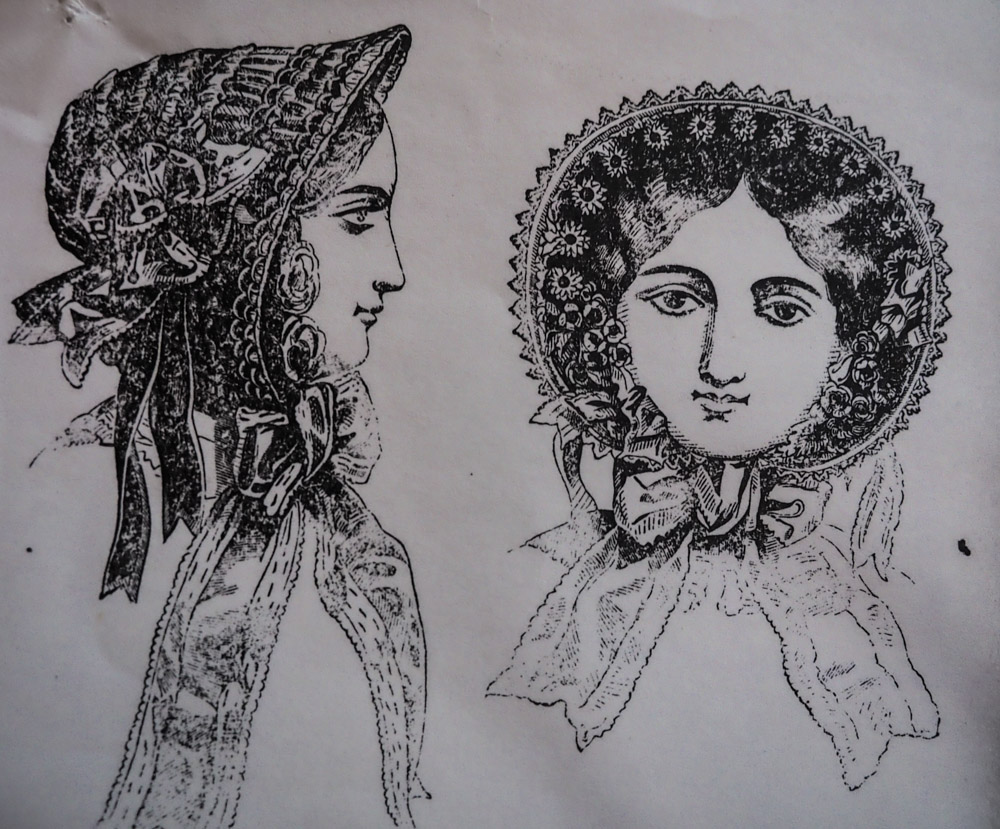
A ho-hum day for Evelina, warm but gray, and she still partly sidelined by a sore foot.  Small wonder that she chose a colorful project for the morning: trimming a head-dress, more commonly referred to as a bonnet.  She used red ribbons and fabricated flowers and although she deprecated her own handiwork, the task must have been a nice change of occupation.

In the 19th century, no lady’s outfit was complete without a bonnet; it played the accessorizing role that shoes and purses play today in women’s fashion.  Given that a woman’s form was covered from neck to toe by a voluminous dress or cloak, the bonnet was an inevitable point of interest atop the whole outfit.  Not only did it stand out like the star on a Christmas tree, it also served to cover hair that was seldom washed.  It rarely kept a head warm, however – that’s what cloaks with hoods were for.

Most women had at least two bonnets, one for winter and one for summer.  Winter bonnets were made of wool, silk or even horsehair, while bonnets for warm weather were typically made of straw or “chip,”  a fine wood splint.  As the 19th century progressed, the transition from winter to summer bonnet solidified around Easter, thus introducing the notion of the Easter bonnet and competition for the prettiest headdress on that important Sunday.

In other news of the day, Oakes Angier Ames rode to Canton on shovel business to “mark Iron.”  Does this mean he looked through a supply of smelted ingots to select the best for the Ames shovels? Anyone out there care to elaborate on what Oakes Angier did?  Was the Kinsley Iron Company the forge that he visited?  Certainly probable.