July 25, 1851

Wine glass

Friday 25th July  Was expecting to go to Boston with

Mr Ames & Susan in the wagon but it was

misty & cloudy and we gave up going.  It cleared

up very pleasant about nine  I pick[ed] some 

currants for some wine.  Jane strained them

About ten Oclock Augustus carried me up to

see his new heir, found mother & babe comfortable

Evelina was disappointed not to travel into Boston today; the possibility of bad weather put her off the jaunt. However, she got to see William Gilmore, her new great-nephew.  Her niece-in-law, Hannah Lincoln Gilmore, and the baby seemed to be doing well, which must have been a relief. In an era when childbirth could be dangerous for mother and infant, Hannah and Willie were doing fine.

But what was going on in the kitchen at the Ames house? Evelina and servant Jane McHanna were making wine from the currants off the bushes in the back yard. Why did they do this? Alcohol was never served at the Ames house. As Sarah Josepha Hale, author of The Good Housekeeper, a popular cook book, stated emphatically, “t]here is one rule for drinks which no woman should violate – never make any preparation of which alcohol forms a part for family use!”

Yet here was alcohol being prepared in Evelina’s own kitchen.  Rather than being made to be served as a beverage, however, it was being prepared for culinary and medicinal purposes and, for such cases, it was evidently permissible. In cooking, wine or cider could be used as a preservative in mincemeat pies, for instance.  An even more viable use was as medicine for the sick.  In Little Women, Mr. March stores away some wine bottles for his invalid daughter, Beth. In Evelina’s kitchen, the homemade wine would probably be served to someone who became ill and needed a tonic. A drink called wine whey, made from strained wine and milk, was a common treatment for fever and other ailments. Wine had its uses; distilled liquors did not.

* Sarah Josepha Hale, The Good Housekeeper, 1841


July 21, 1851

Baby

1851

July 21st Monday  Worked about house all the forenoon 

This afternoon have been to work on the

lounge.  Put some tufts on the side of the

matress & nailed some haircloth on the inside 

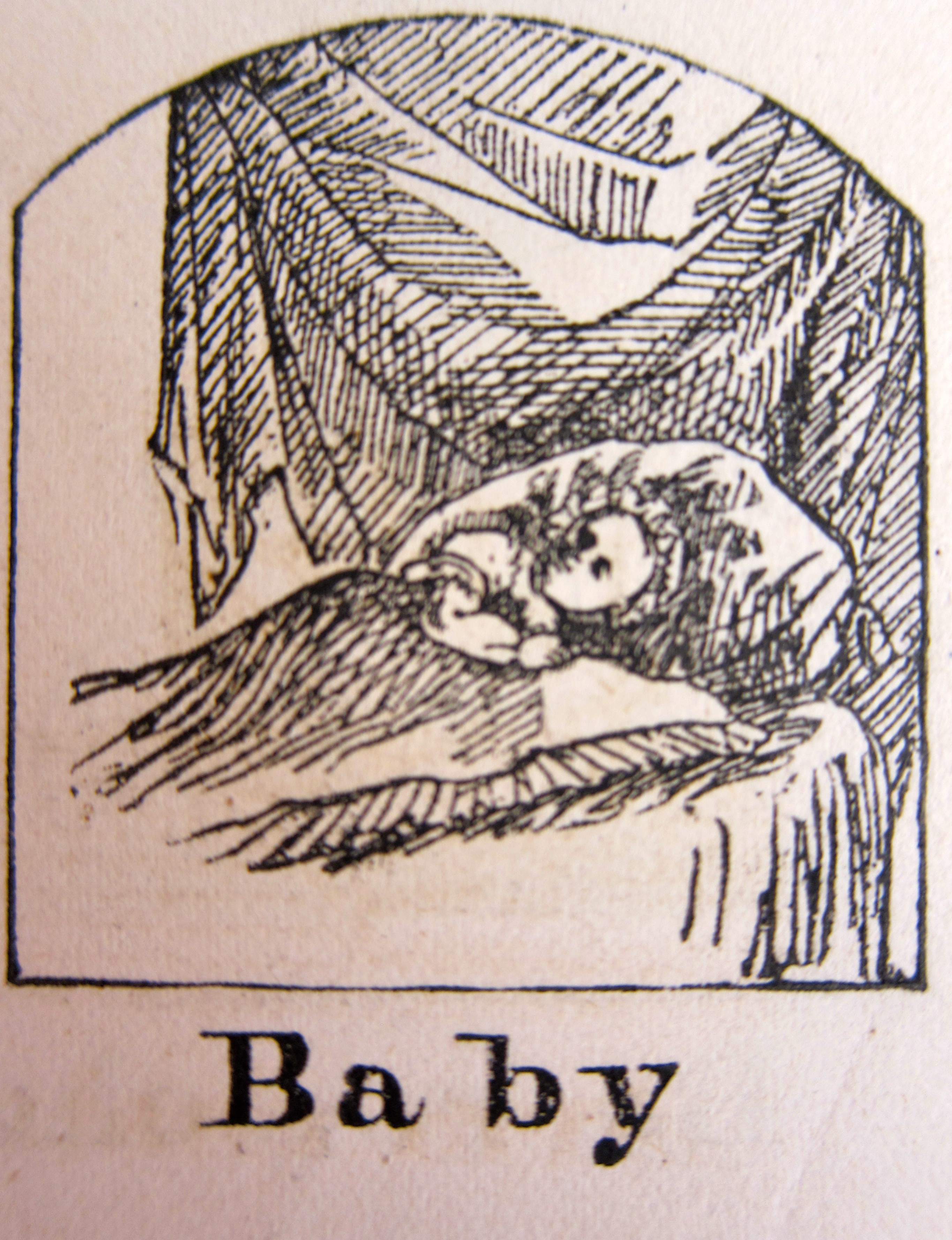
of the lounge  Augustus has another son

born to day  He called here about four

Oclock to tell me the news.


Hannah Lincoln Gilmore, wife of Alson Augustus Gilmore, gave birth today to her second child, a baby boy soon to be known as Willie. This was good news.

We shouldn’t be surprised that Evelina noted only the arrival of the little boy and said nothing of Hannah’s labor and delivery. Most middle- and upper-class people at that period would have avoided explicitly describing childbirth. At most, if mentioned in public, the delivery would have been referred to simply as the mother’s “sickness.” Elizabeth Cady Stanton, describing the easy birth of her fourth child in 1851, wrote “I was sick but a few hours.”*

Most women, especially in small towns and the countryside, delivered their babies with the help of a midwife, who was often assisted by female relatives; this was still true in Easton.  A new trend, however, especially in urban areas among the wealthier population, was to request the attendance of a physician at delivery. As a modern historian notes, “Fear of pain, permanent injury, or death, willingness to defer to the demands of fashion, the belief that birth posed special dangers to affluent, well-bred women, and the availability of doctors, private nurses, and new medical technology all contributed to changing attitudes.”*  Doctors began to appear bedside as women – especially rich women – gave birth.

We don’t know if Hannah got through her “illness” with the help of a physician. But as reported by her husband Augustus,  she and little Willie were resting by the end of the day.


*Sylvia D Hoffert, Private Matters: American Attitudes toward Childbearing and Infant Nurture in the Urban North, 1800 – 1860, Chicago, 1989, p. 69 and 63

June 18, 1851

Black ticking-stripe-15

June 18th Wednesday  Worked again untill nine in the 

garden and then made the tick for the 

mattress.  This afternoon put the cotton in 

and tied it  Bridget was here a couple

of hours & picked over the curled hair

Towards evening called at Mr E Carrs, Dr Wales

and on Mrs J C Williams at Mr Torreys, Mrs S. Ames

called with me  Augustus gone to Boston

Mr Bartlett spent

last night here

Evelina was making progress on the mattress for her new lounge.  She “made the tick” for the cover and stuffed it with old cotton.  The final cover, to be made of horsehair, was still being worked on. Bridget O’Neil, a servant who usually worked next door, came over to help Evelina with the project.

The long-lasting light of day, as the calendar approached summer solstice, allowed for late socializing. Evelina and her sister-in-law, Sarah Lothrop Ames, went out calling.  They visited Esek Carr and, presumably, his wife, Ann; called on young Dr. Ephraim Wales and, again presumably, his wife Maria; and stopped at John Torrey’s to see Mrs. Joshua C. Williams.  Mrs. Williams, we might infer, was a boarder or renter at Col. Torrey’s apartment building, which Evelina called a tenement. Was Mrs. Williams possibly a widow?

A Mr. Bartlett had spent the night with the family.  He was from Maine, so likely had some connection to the shovel works and their ongoing need of wooden handles.


June 12, 1851

photo

Alson Augustus Gilmore

June 12th Thursday  Jane quite unwell and went off to

bed after breakfast, after dinner quite smart

Bridget came about nine & we finished our

ironing  Howard & Clark sent over my cottage

bedstead &  put Castors on the bedroom chamber

bedstead  I have made my front chamber 

bed clean & put clean window curtains &

valance  Mr Whitwell called.  I called at Mrs Lakes


Evelina did housework today, with qualified help from an ailing Jane McHanna and a big hand from Bridget O’Neil, who had been working for Evelina quite a bit lately.  On the social scene, reliable Mr. Whitwell paid a visit, and Evelina went out to see a friend, Mrs. Lake.

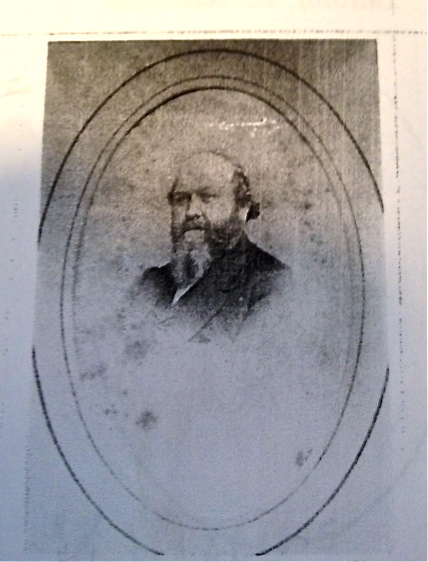
This day marked the birthday of Alson Augustus Gilmore, son of Alson Gilmore and his late, first wife, Rachel Alger Gilmore. Known as Augustus, the 29-year-old was a frequent visitor to the home of his Aunt Evelina and Uncle Oakes. As we have seen throughout this winter of 1851, he had worked periodically for the Ames brothers – Oakes and Oliver Jr. – and taken many a midday meal at Evelina’s dining room table.

In 1851, Augustus appeared to be settling back into life in Easton, after having taught school elsewhere for several years. He brought with him his expectant wife, Hannah, and two-year old son, Eddie; the family settled into temporary quarters while Augustus scouted for some property on which to build a house.  He, his cousin Oakes Angier Ames, and another man, Elisha Andrews, started a boot-making factory.

A successful small-town life lay ahead for Augustus. Not only would he be involved for twenty years in the shoe-making trade, but he would continue to work for his Uncle Oakes as well.  A valued ally, he would courier important documents and mail for the Ames enterprises. Well known around town, Augustus served as a “model moderator […] in twenty-four annual town meetings, and seventeen special town meetings, besides other public assemblies.”*  He was also active in the Unitarian Church and remained close to his Ames cousins throughout his life.

* William Chaffin, History of Easton, 1886

June 11, 1851

images

June [11]  Wednesday  Mended

Oakes Angiers coat put on new

buttons  Then made the button holes in 

the waist of Mrs Sarah Ames dress. Cooked

a calfs head for dinner  This afternoon

about three Mrs Witherell, Mitchell & Miss

Eaton & self went to call on Mrs Whitwell.

Called at Mr Wm Reeds  Mrs Reed was from

home.  Called at Dr Swans.  Bridget here.

A[u]ugustus gone to Boston.


Evelina’s activities today were quintessentially nineteenth-century.  She mended her son’s coat, made button holes for her sister-in-law, rode out in the carriage with her other sisters-in-law to call on the parson’s wife, and served a calf’s head for dinner.

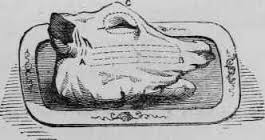
Perhaps there is a reader out there who has been served calf’s head, or cooked it.  Most 19th century cook books carried a “receipt” for it, right next to recipes for calf’s feet, sheep’s head, and roasted sweetbreads.  Calf’s head could be roasted or boiled; the recipe below from Mary Peabody Mann’s 1858 Christianity in the Kitchen opts for the latter.  What follows is not for the squeamish:

To Dress a Calf’s Head

Soak the head for ten minutes in lukewarm water, powder it well with rosin, dip it into a large quantity of scalding water, and holding it by the ear, scrape off the hair with the back of a knife.  When clean, take out the eyes, cut out the tongue, remove the jawbone with teeth, saw lengthwise through the skull without injuring the brains, which must be carefully taken out, and put for a few hours into lukewarm water, to disgorge, [that is, to rinse out the blood.]

Make a stock by putting into the brazing pan two or three carrots and onions, six cloves, a pint of cream, a bouquet of parsley, thyme, and bay-leaves, and after stirring this together for twenty minutes over the fire, add a pint of water.  When this is warm, mix a quarter of a pound of flour with a gallon of water, slice a lemon, add a quarter of a pound of salt, and lay the calf’s head into the stock.  Let it be entirely covered, else the uncovered part will have a dark look, and simmer it gently till it is tender.


June 5, 1851

e_gg_hook_organ2-291x440

*

1851

June 5th Thursday  To day I have been to Mothers, stoped at Orinthias

school and staid about an hour, left Susan there

and got to Mothers about noon.  Met A Augustus & wife

and her sister Elizabeth, John Pool & wife.  On my way

home stoped to Miss Louisa Howards & got some Asters

and at the meeting house to hear Elizabeth Clark play

Met Oliver & wife & Harriet, Mr Clark and

two daughters  A beautiful pleasant day


Several Ameses gathered this afternoon with others for a concert at the meeting house. Presumably, the new organ was featured again, played this time by a more proficient organist than Mr. Rotch from a few Sundays ago. Miss Elizabeth Clark, daughter of Daniel and Elvira Clark and barely 19 years old, treated the listeners to a recital. The Clarks were Unitarians, and Daniel was a capable carpenter who did occasional work for the Ames family. Elizabeth was evidently a fine pianist.

The new organ was possibly made by E. G. and G. Hook of Boston, whose factory was later in Weston, Massachusetts. Known by 1885 as Hook and Hastings, their firm was prominent in the 19th century in the production of church organs. Their first concert hall organ, no longer extant, was installed in the Tremont Temple across from the Boston Common. Their largest was placed in Boston’s Cathedral of the Holy Cross.  More common were smaller organs such as the one in the illustration that were installed in more modest meeting houses, like the Easton one used by the Unitarians in 1851.

The occasion for this particular recital is unknown, and how it came to be held on a weekday afternoon is also a puzzle.  It made sense to the townspeople, however, who turned out in full for the occasion.

*E. G. and G. Hook organ, Boston, Mass., circa 1848.  Athol Historical Society

May 31, 1851

IMG_0004

*

1851

May 31st Saturday  This morning baked in Mrs Witherells oven

brown bread & cake  Mrs S Ames went to Boston

Returned to night with Harriet & a Miss Eaton

from Pittsburgh.  Miss Linscot Orinthia & I […]

have been walking & riding about all day.  have

been to all the shops, ponds, Mr Manley & Claps

flower gardens, & called at Mr Torreys

It has been a beautiful day, rather cold.  A A not here

gone to Boston

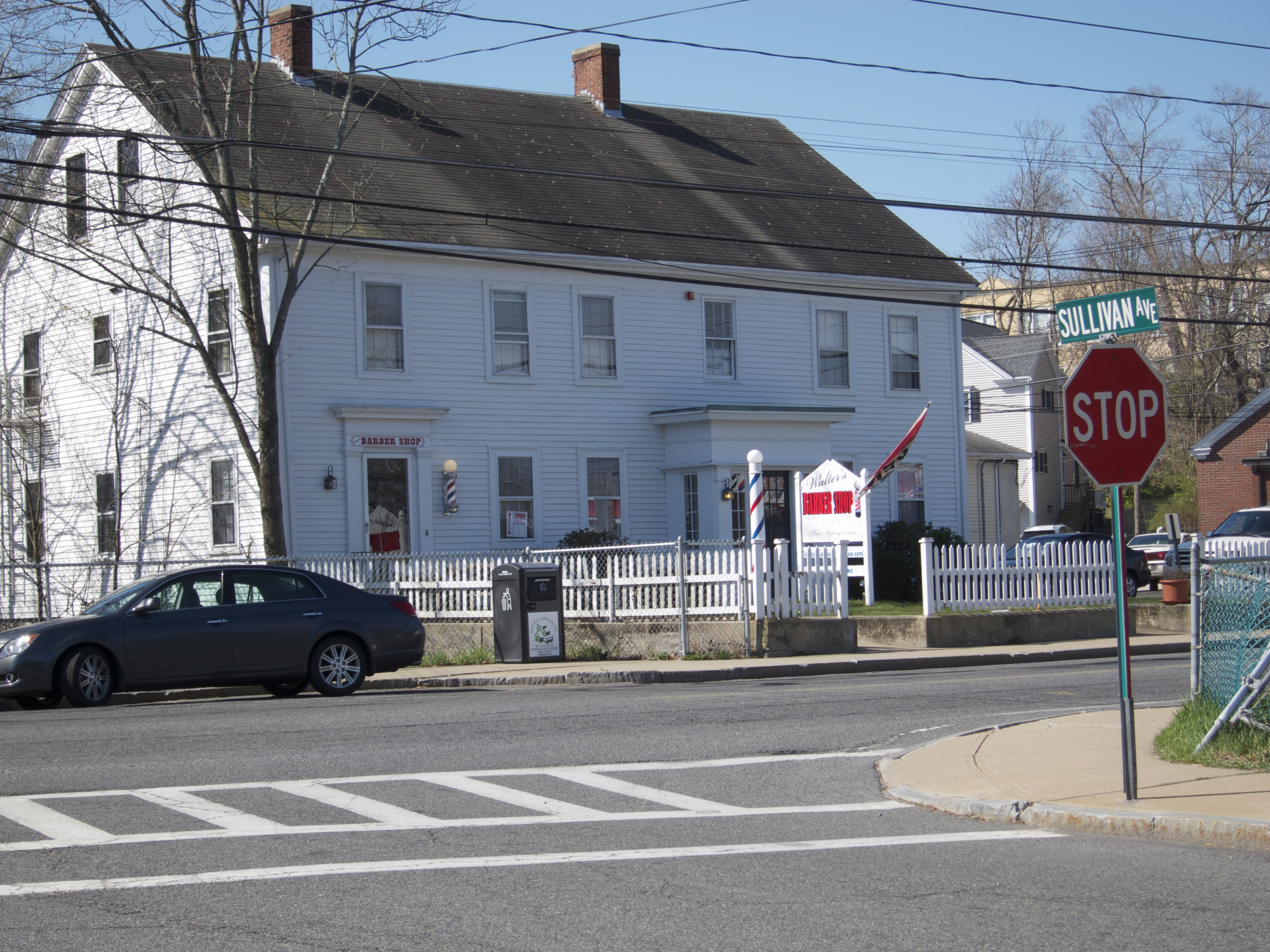
Evelina used her sister-in-law’s brick oven early this morning and afterwards ventured outside to enjoy the “beautiful day” with her young house guests. She gave them the standard tour of much that North Easton offered: shovel shops, large ponds, full streams, two farms with extensive flower gardens, and a stop at Col. John Torrey’s, in the village. The latter was probably a sociable occasion that included tea with Abby Torrey.

Sarah Lothrop Ames, meanwhile, went into Boston for the day and returned with Harriett Ames Mitchell and a friend from Pittsburgh, where Harriett had lately been living. There was still no sign of Harriett’s husband, Asa Mitchell, who was, presumably, yet in Pennsylvania on business. Oakes Ames would have been in Boston today, too, perhaps with Augustus Gilmore.

The Ames boys wouldn’t have been pleasuring about – they were at the shovel shops, working.

* Building in modern-day North Easton that once belonged to Col. John Torrey


May 26, 1851

maternity_5

Monday May 26  After washing the dishes this morning sit

down to work on the carpet for the sitting

room chamber and had but just got seated

when Augustus & wife & her brother & wife from

east Boston came. Hannah staid here while 

the others went to the shop  They left about 

ten Oclock.  Have put the carpet down and 

room ready for the new bedstead.  School commenced


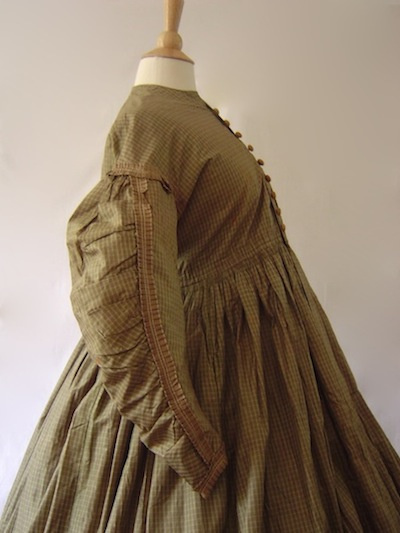
Housework and laundry, presumably, went on as usual today except for a social interruption in the morning.  Augustus Gilmore and his wife, Hannah, stopped in with Mr. and Mrs. Lincoln, Hannah’s brother and his wife. Evelina described them as coming from East Boston, although Hannah had grown up in Hingham. After some brief socializing with his aunt, Augustus took his in-laws across the street to show them the shovel factory.

Hannah Gilmore didn’t accompany her husband, probably because she was about seven months pregnant. She and Evelina sat together in the parlor or sitting room, perhaps using the opportunity to discuss female matters, perhaps not. Such conversations were not considered polite, but surely two mothers together in a room could share information without being intrusive or indelicate. Given that Hannah was already the mother of a two-year old boy, Eddie, Evelina may have shared some tips on raising sons. Certainly, Evelina was a woman to whom younger women turned for advice and companionship.

The day must have been a fine one; school recommenced, carriages were out and about and, most exciting of all, Old Oliver reported that he “began to plant our corn.”  It was a time to sow.


April 30, 1851

Boot

1851

April 30 Wednesday  Hannah came with Augustus in the stage

and Eddy came with them  I fear she did not 

have a pleasant visit Eddy was not well and very

troublesome. We called at the shoe shop and

at Mr. Torreys.  Abby came home with us to tea

I have sewed some on Susans borage dress but

have not been able to do much. The weather is

pleasant but rather windy


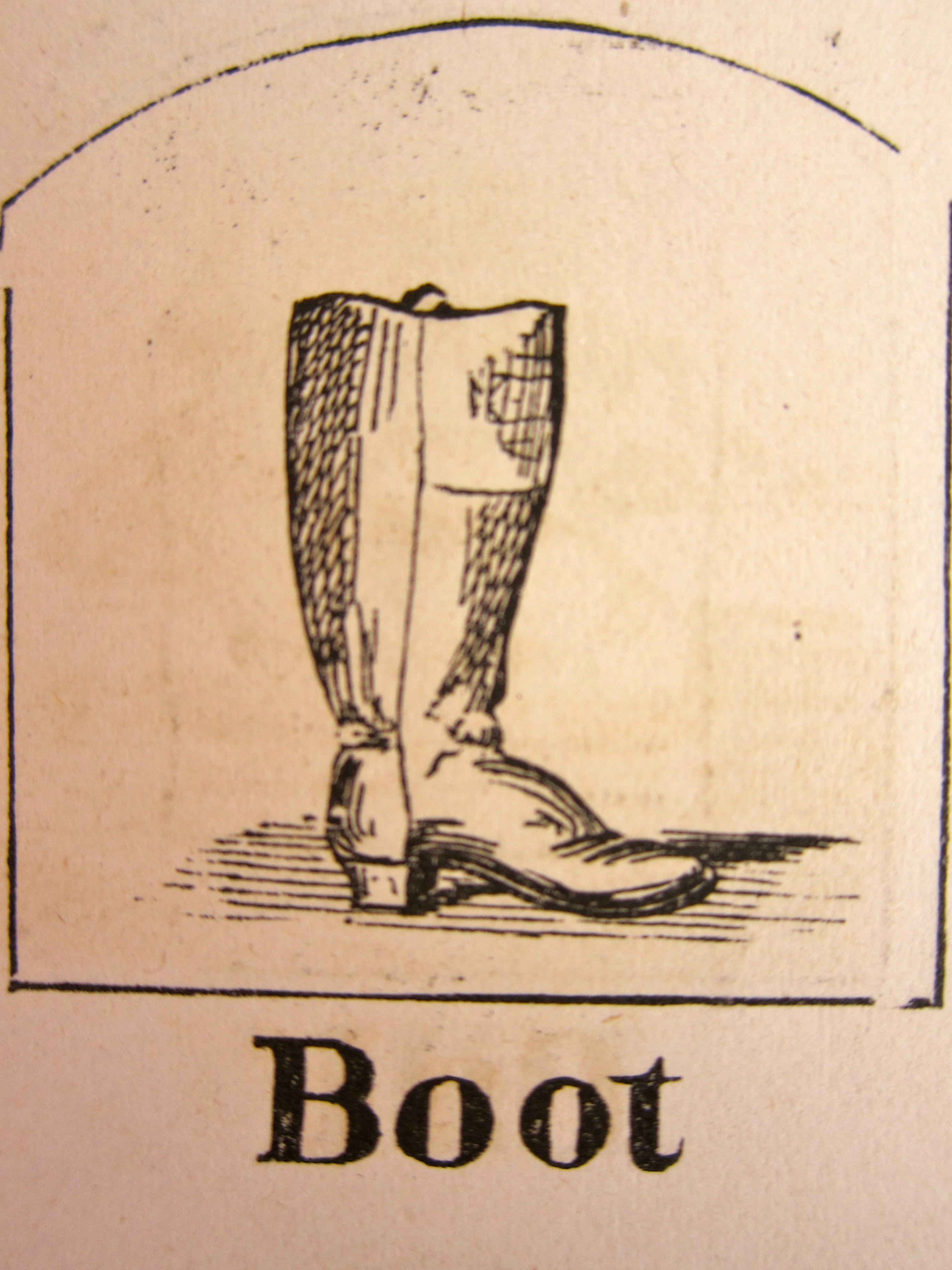
The reason for Augustus Gilmore’s continued presence at the Ames home became clearer today. The boot factory (or shoe shop, as Evelina called it) that Augustus had been working to establish was now up and running. Oakes Angier was an original partner, according to Chaffin’s History of Easton:

“In 1851 there was organized in North Easton the firm of A.A. Gilmore & Co., the other members of the firm being Elisha T. Andrews and Oakes A. Ames. They manufactured fine calf-skin boots in a building owned by Cyrus Lothrop. Oakes Ames succeeded to the interest first owned by Oakes A. Ames. In 1870, Messrs Gilmore and Andrews bought out Oakes Ames. This firm, which for some time did quite an extensive business, gave up the manufacture of boots in 1879; but the firm did not dissolve until death broke up the long partnership, Mr. Andrews dying in 1883.” *

The manufacture of shoes was an important industry in southeastern Massachusetts, particularly in the nearby towns of Randolph and North Bridgewater (soon to be known as Brockton). One theory is that shoe-making grew out of a cottage industry begun in the late 18th century, a thrifty, small, household-by-household effort to augment the meager income from subsistence farming by making shoes. It was one way to use the leather from the farm animals who were slaughtered.

New England as a whole was a major producer of shoes throughout the nineteenth century, “with Massachusetts alone responsible for over 50% of the nation’s total shoe production through most of the period.”** The trade continued well into the 20th century, with organizations such as the New England Shoe and Leather Association and the Boston Boot and Shoe Club championing the industry. Some leather manufacturing continues today in the region.

It only made sense that Easton, bustling as it was with the manufacture of goods such as shovels, mathematical instruments and, soon, hinges, would participate in the regional trade of shoe-making. That members of the Ames family were involved seemed to make sense, too.


* p.598

**http://www.albany.edu/history/ej/origins.html


April 24, 1851

Slave_kidnap_post_1851_boston

1851 Thursday  April 24th  Julia here to finish Susans dresses

She is very slow We have got the waist done

to her Delaine & finished the print dress & cut

the lining to my dress This afternoon called 

at Augustus’ & Mr Whitwell with Mrs Peckham

A[u]gustus returned from New York this morning

and is here again to dine Hannah went to

Alsons while he was gone Pleasant weather


Evelina and Julia Mahoney sewed today, perhaps trying to make up for time lost yesterday. Evelina’s nephew, Augustus, returned to the Ames’s dinner table after a business trip to New York. Meanwhile, his expectant wife, Hannah Lincoln Gilmore, and son Eddie were staying out at the Gilmore farm with his parents, Alson and Henrietta.

Had Augustus run into any abolitionist fervor while in New York?  Probably not as great as in Boston, where controversy continued in the aftermath of the Fugitive Slave Act and the capture and rescue of Shadrach Minkins. While some of the most prominent abolitionists of the day, like William Lloyd Garrison, lived in Boston, the city was nonetheless home to many citizens who were less adamant about the issue.  They might not have liked slavery, but they feared the radicalism of the anti-slavery rhetoric more.  They were law-abiding, and the law said that slaves were property and had to be returned to their owners. Daniel Webster had decreed it, and they supported the law accordingly. The controversy pulled at everyone.

When another escaped slave, Thomas Simms, was caught in Boston, the Mayor of Boston, John P. Bigelow, ordered him sent back south. The aldermen and the police supported the move, and the black population of the city became even more nervous than before, as the poster above illustrates. Have TOP EYE Open!