July 14, 1852

1852

P1070606-X2

High water (flood level) mark in canal in Lowell, Massachusetts


Wedns July 14th  Julia came again this morning

but we have not got along very fast

on my dress  Have no trimming for the

sleeves have written for Mrs Stevens to

get me some   There is a great deal to

do to finish my dress  Hannah & Mary 

have both been ironing all day and 

have it all done

Evelina was indoors, sewing a new dress with the help of dressmaker Julia Mahoney. Old Oliver was out haying, “jawing” orders at local men gathering up this year’s meager crop. Oakes Angier, Frank Morton and probably Oliver (3), now that he was home from college, were each posted in some area of the factory, making shovels alongside the workers. Oakes and Oliver Jr. were supervising, perhaps striding around the shovel complex watching the new building go up or sitting in the office looking at accounts.

If we modern readers want to find a day that typifies life in North Easton in the middle of the 19th century, we couldn’t do better than this ordinary summer day in 1852. In other years and in other places, July 14th has hosted more momentous events: the storming of the Bastille, the first ascent of the Matterhorn, the shooting of Billy the Kid, the day Jane Goodall arrived in Tanzania to study chimpanzees. Nonesuch in North Easton; according to Old Oliver’s record, July 14, 1852 was simply a “warm good hay”* day. Routine ruled.

This is not to say that history wasn’t happening. It was. Yet as Evelina noted, “we have not got along very fast,” a phrase that is applicable to so much of history. Change often quietly accumulates, transforming what we know in a stealthy fashion. Evelina’s hand-sewing, Old Oliver’s oxen-driven hay-wagons, Oakes’ and Oliver Jr.’s water-powered shovel machinery: all have since disappeared, replaced by modern equipment invented over time. The life that the Ameses lived was already altering, irrevocably, bit by bit.

Oliver Ames, Journal, Stonehill College Archives, Arnold Tofias Collection


July 5, 1852


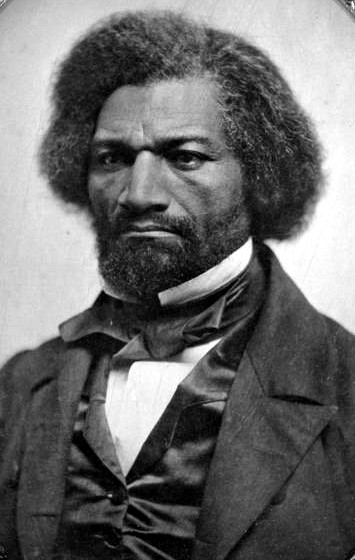
Motto_frederick_douglass_2

Frederick Douglass

(1818 – 1895)

1852 July 5th Monday  Orinthia & Lavinia went to Boston with

lots of others this morning  Orinthia is going to Maine 

on a visit  Mary came to sew or to see what she

can do. I have been sewing some to day and hope 

now that I shall be able to [do] more than I have

Have finished my brown muslin.  Augusta

has been here in this afternoon and this evening

we have been to see the fire works at Mr Russels

The nation was 76 years old. The Fourth of July having fallen on a Sunday, however, the celebration of it was deferred to Monday. Thus Evelina and Oakes and, no doubt, their sons and daughter went to Mr. Russell’s tonight to watch some fireworks. Others traveled into Boston, perhaps to see the fireworks there.

Mr. Russell may have been Edwin Russell, a shoemaker. The Ameses knew the family, certainly, as all three sons had attended a funeral back in January for Edwin’s father, Frank. If it was Edwin who hosted the fireworks, his may not have been as elaborate as those that would be seen in Boston, but he was following a tradition established by John Adams at the very beginning of the republic.

In a letter to his wife, Abigail Adams, on July 3, 1776, John Adams described his grand vision for a commemoration of the nation’s birthday.  It was to be celebrated “with Pomp and Parade, with Shews, Games, Sports, Guns, Bells, Bonfires and Illuminations from one End of the Continent to the Other from this Time forward forever more.” His vision was realized by 1777 when both Philadelphia and Boston – and other cities or towns, perhaps – set off Fourth of July Fireworks. A tradition was born.

Not everyone celebrated the nation’s birthday, however, as Frederick Douglass, probably the country’s most prominent African-American, pointed out on this date* in a speech now famously known as “What to the Slave is the Fourth of July?”  He said:

“I am not included within the pale of glorious anniversary! Your high independence only reveals the immeasurable distance between us.  The blessings in which you, this day, rejoice are not enjoyed in common. The rich inheritance of justice, liberty, prosperity, and independence, bequeathed by your fathers, is shared by you, not by me.  The sunlight that brought light and healing to you, has brought stripes and death to me. This Fourth July is yours, not mine.  You may rejoice, I must mourn.”**

Douglass eloquently  described the fissure between white lives and black, yet he did “not despair of this country. There are forces in operation which must inevitably work the downfall of slavery…” ** He rightly predicted its elimination, but even he could not have predicted the carnage and destruction that the end of slavery would cost.

Frederick Douglass, “What, to the Slave, is your Fourth of July?,” various dates cited for this speech: July 5, 1852 or 1854.


June 15, 1852

LongShop

Recent image of Long Shop 

June 15th  Tuesday  Julia here and I have been sewing

some but have not had much time […] I

t’s very hot weather mother spent the

day at Edwins I called there awhile and 

ripped my green gingham dress to have 

it made over.  had quite a heavy shower 

this morning which was needed very much

Everyone agreed that this day was “verry warm” and that rain was needed.* Evelina, looking up from her sewing, reported that they had “quite a heavy shower.” Her father-in-law, however, described the rain as “a small shower in the forenoon about an eighth of an inch.” Her glass was half-full, his was half-empty when it came to considering the benefit bestowed by this particular rainfall.

Such quick rain wouldn’t have been enough to interfere with the building of the new stone shops at the factory. Workers had begun to arrive on Saturday and, surely, some initial construction was already underway.  Old Oliver would have made sure of that. This first building on the new site, which was much closer to where the Ames family lived, was dubbed the Long Shop.

Industrial historian Greg Galer describes the Long Shop as “a simple, narrow, gable-roofed, two story building 525 feet long and 35 feet wide with a 60 by 50 foot ell and an additional 30 by 10 foot engine house. “**  This sturdy, less flammable facility would be up and running by the end of the year, and soon include a 60 hp steam engine.

Residents of North Easton today know the Long Shop as one of several shovel factory buildings repurposed for residential use. Along with others, Mr. Galer was instrumental in the successful effort to preserve the historic character of the Long Shop as the site was developed.

* Oliver Ames, Journal, Stonehill College Archives, Arnold Tofias Collection

** Gregory Galer, Forging Ahead, 2002, p. 150

June 14, 1852

FullSizeRender

June 14th

1852 Monday  Am 43 this day quite an old woman

Julia Mahoney came to work on my dresses

Hannah Murphy commenced working for me

this day & Mrs Patterson is here and it

has been about as much as I can attend to

to wait upon the rest  If I had two or 

three more it would be all I could attend to


Hannah Murphy, replacing the departed Jane McHanna, donned an apron this morning and “commenced working.”  Mrs. Patterson was still on the premises and the three women proceeded with the Monday chores, laundry included. Evelina was very busy tending to it all.

Yet today was Evelina’s birthday and she felt old.  We in the U.S. might scoff at the notion that 43 feels old; our current life expectancy for females is 81.  In Massachusetts in 1850, however, it was no more than 45. Who knew how long Evelina would live?  While she had the hopeful example of her hardy, octogenarian mother to emulate, she also would have remembered her two older sisters, both dead in their thirties. She may have considered the possibility that, like her mother, she could live to an advanced age. In fact, she would live to be 73; on this birthday, she had thirty more years in front of her.

At the shovel factory, Oliver Ames took his mind off his concern for the crops and focused instead on the arrival of Clark S. Manchester, who “came here to day from Fall River to build our stone shop.”* Mr. Manchester, 37 years old, was a native of Little Compton, Rhode Island, who had only recently moved to Fall River with his wife and two children. His expertise with stone work had led him to the Ameses, or they to him.

So the new building began, on the west side of Shovel Shop Pond. This location was different from the original and recently rebuilt factory, which sat at a lower edge of the pond in order to maximize the drop in water level. Water still powered the factory machines, and the new location to the west would still rely on water power from “just above where the Queset entered Shovel Shop Pond.”** But different from the old factory, this new Long Shop would accommodate a modern steam engine, a huge advance in technology. A new era in production was waiting to begin, and the stone buildings would reflect the change.

Oliver Ames, Journal, Stonehill College Archives, Arnold Tofias Collection
** Gregory Galer, Forging Ahead, 2002, p. 250


May 26, 1852

Bird

1852

Wedns  May 26th  Jane has done part of the ironing  I have

put down the carpet in the front chamber & sitting

room and the bedroom carpet partly down and 

got the rooms in pretty good order  Mr Scott

& Holbrook commenced painting in the other

part of the house yesterday   Mrs Patterson

staid at home to do her washing & ironing

Mr Ames went to Bridgewater West


Spring cleaning continued; Evelina laid carpet today, often one of the last chores on the list. She could almost check the sitting room off the list, and seemed pleased that the house was “in pretty good order.”

Another spring ritual, this one involving bird hunting, may or may not have taken place on this date; by 1852, it may have been outlawed.  But the hunt, which always took place on the last Wednesday in May, was recent enough to have included various Ameses, if we assume they chose to participate.  Town historian William Chaffin describes the ritual in his 1886 History of Easton:

“At different times in the history of the town rewards were offered for killing crows and blackbirds, which were supposed to be very destructive to corn […]

“Scarcely two generations ago [which would place the event somewhere as late as the 1840s] the custom prevailed of young men choosing sides, and each side on a given day starting out and killing all the birds they could. The day chosen was the old ‘Election day’ so called, the last Wednesday in May, once the time for the convening of the State Legislature, and which came to be known as ‘Nigger ‘lection.’  It was one of the greatest holidays of the year for the boys. […] [T]hose taking part in the shooting started out at daybreak and killed as many birds as possible.  They usually met at some appointed place before dinner, to count the birds and see which side had won the victory.  In North Easton, the rendezvous was at Howards’ store […]

“The understanding was that only harmful birds should be killed; but it was easy to include nearly all birds in this category, because, it was argued, bobolinks and swallows destroyed bees, and robins stole cherries, etc. In some places the party beaten paid for the dinner and drinks of all.”*

In the 21st century, it’s difficult to fathom both the wanton waste of this offensively-nicknamed holiday, and the glee that evidently accompanied it. That hunting has an appeal, we don’t question, but that songbirds were the quarry is hard for modern folks to accept. **


William Chaffin, History of Easton, Massachusetts, 1886, pp. 776-777

** This editor freely confesses to being a birder and particularly fond of bobolinks.

May 17, 1852

180px-Beekman_greenhouse

Mid-19th century American Greenhouse*

1852

Monday May 17  Finished planting my flower seeds

Mr Blodget here to dine from Boston

This afternoon have been to Mr Kinsley with

Mr Ames.  Miss Nevill there from Salisbury.

Brought home twelve pots of flowers from

their green house.  The grapes & flowers look

finely  Had a very pleasant visit got home

about dark

Evelina enjoyed herself today. It was lovely outside, for “the sun shined about half the day + was pritty warm wind west + south west.”** She gardened for much of the morning and in the afternoon, rode with her husband, Oakes, to Canton to call on the Kinsley family.

Lyman and Louisa Kinsley, whom we’ve heard of before in Evelina’s diary, were about the same age as Oakes and Evelina. They had two children, Lucy Adelaide and Edgar Lyman, who were twelve years apart, suggesting that there may have been other children born between the two. Lucy was close in age to Oakes Angier, and Edgar was a year or so younger than Susie.

The Kinsleys were prosperous; Mr. Kinsley ran an iron business that had been started by his father and had long supplied material for Ames shovels. The Kinsley Iron and Machine Company would eventually be bought by the Ameses and managed by Frank Morton Ames. That being some years in the future, the Ameses could sit and admire the Kinsley place with little thought of acquisition – perhaps. Certainly, Evelina was much taken with the Kinsley greenhouse and the “twelve pots of flowers” she got to take home.

Greenhouses such as Mr. Kinsley’s were becoming more popular in the mid-19th century, particularly in England after the government there did away with the heavy tax on window glass. Hothouses had been known previously on this size of the Atlantic, also, appearing in the colonies as early as 1737, when wealthy Bostonian Andrew Faneuil built one. George Washington, too, had one built at Mt. Vernon to grow pineapple. Greenhouses would increase in size, status, and grandeur as the century progressed. Easton would see its share when the next generation of wealthy men reached maturity. Frederick Lothrop Ames, Edwin Williams Gilmore and probably others would raise orchids and more in the glass-walled wonders.

*Greenhouse from Beekman Estate in Manhattan, circa 1850

**Oliver Ames, Journal, Stonehill College Archives, Arnold Tofias Collection

April 20, 1852

Freshet

Tues April 20th

1852  Storms again to day and nearly as hard

as yesterday.  rained poringly last night

Mr Packard came at half past three and Mr Ames

went to the hoe & knife shop to raise planks 

the water being very high  The highest that

has been known for years  Augusta spent

the afternoon  Worked all the forenoon cleaning

out grease from the buttery

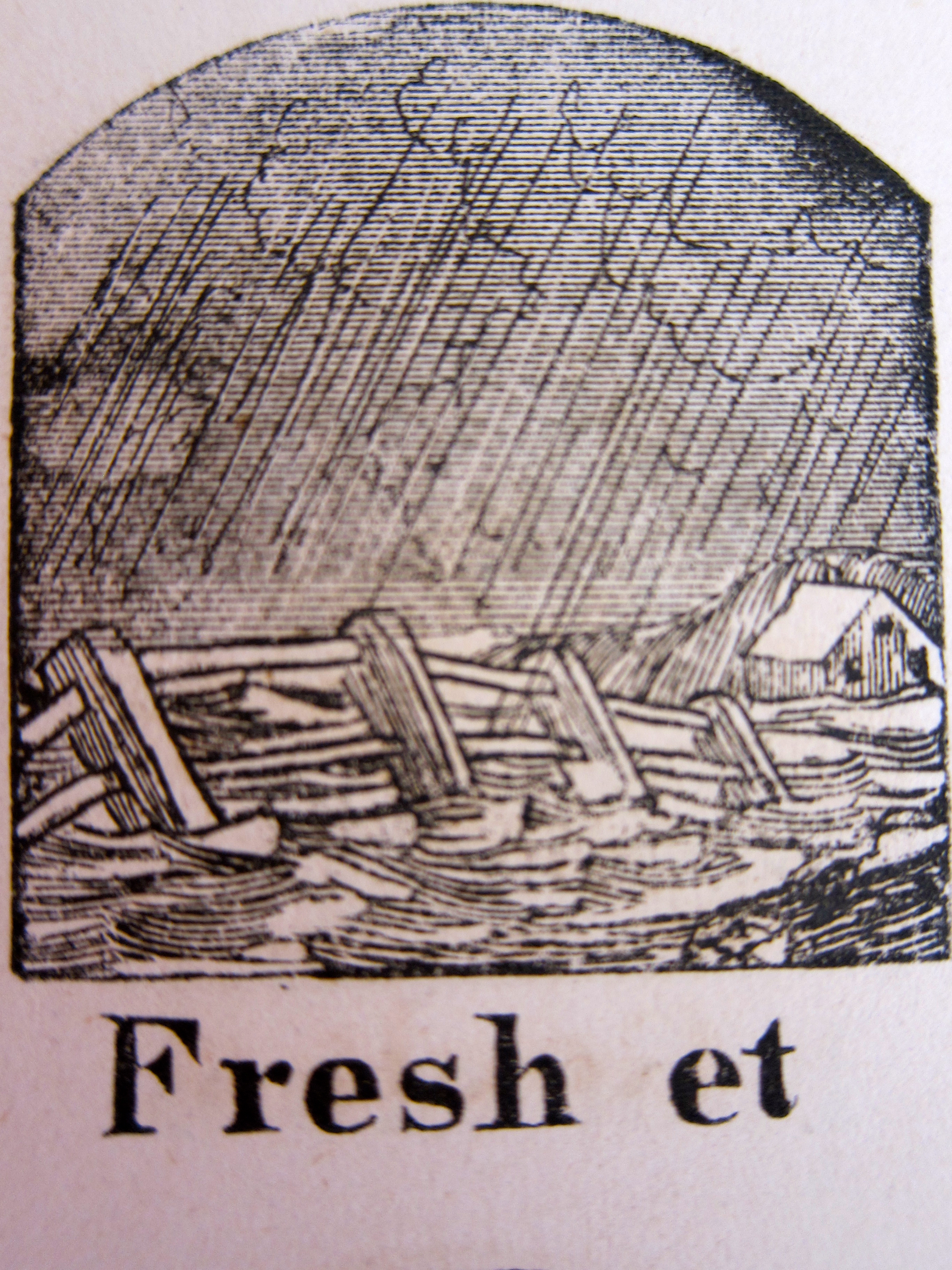
The Nor’easter continued.  The Queset Brook, which ran behind the Ames compound, the Shovel Shop Pond and other local bodies of water threatened to overflow under the deluge of rain. The water came down “poringly” and, according to Old Oliver, “it raind about all day.”* To use a word that is not often encountered in the 21st century, a freshet was imminent.

A freshet is a sudden overflow of a creek or stream brought on by a heavy rain and/or the sudden melting of snow. It was a potential hazard that people who lived near waterways worried about every spring, and on this day the fears of such folks in Easton came close to being realized.

The water rose “the highest that has been known for years,” threatening to flood the hoe and knife shops. The men, led by Oakes Ames, responded quickly to adjust the wooden planks at the site of the dams on the pond. Local historians Dwight MacKerron and Frank Mennino corrected this editor’s initial misinterpretation that raising planks meant lifting machinery off the floor, the latter suggesting instead that:

“raising the planks referred to actually allowing water to leave the ponds under a controlled flow via a secondary sluiceway that was employed in most dams just for that purpose. In the case of the hoe shop there was a man made canal that would serve that purpose. It takes pressure off the dam, and might avert a catastrophic failure which would certainly have severe consequences.”

Sydney Packard may have been the man who came to assist Oakes. He was a 40 year-old father of eight and long-time employee of O. Ames & Sons.  Some twenty years later, Packard would be one of the pallbearers at the funeral of Oakes Ames.

So far in 1852, the Ames family had endured first fire and now flood, and their troubles were not over.

Thank you, Dwight MacKerron and Frank Mennino for your input on the workings of waterways of North Easton.

April 16, 1852

 women sewing*

1852

April 16th Friday.  Julia here again to day and we have

been to work on my dresses  Mrs S Ames & Witherell

helped some time this afternoon and we have

got along nicely  Hannah & Augusta called

Augusta brought her work and Hannah finished

Susans stocking.  Susan has the other stocking about

half done.  The first pair that she ever attempted to knit.

Stormy again to day.

The day before had rained “pritty fast” all day long, and today opened in much the same vein, with “snow squals + rain + a high wind.”***  The women stayed indoors and focused on fashion.  Dressmaker Julia Mahoney came over to work on new outfits for Evelina. Sisters-in-law Sarah Ames and Sarah Witherell helped for a time, too, both of them as accomplished at sewing as Evelina. They all “got along nicely,” a phrase that suggests good progress was made on Evelina’s dresses, although the women’s sociability quotient was also probably pretty high.

Others joined the hum.  Nieces-in-law Hannah Gilmore and Augusta Gilmore, a younger set of eyes and hands, arrived with work in hand. Hannah helped her little cousin, Susie Ames, knit a pair of stockings.

The sewing of new dresses – as opposed, say, to the mending of men’s shirt fronts – was the favorite expression of the women’s collective talent with needle and thread. As Winthrop Ames noted, “An immense amount of sewing went on in every family.”** We’ve certainly learned that from Evelina’s diary.  In 1852, they still made their own dresses. “[T]he materials and trimmings, after much consultation about their style and quality, were made up in the house with the help of the town seamstress and pictures from the fashion magazines.”

Things would change. By the start of the Civil War, the Ames women began to have their dresses made up in Boston. But on this day in North Easton, needles flew.


*Image courtesy of nhdsewingmachine.weebly.com

** Winthrop Ames, The Ames Family of Easton, Massachusetts, p.126

*** Oliver Ames, Journal, Stonehill College Archives, Arnold Tofias Collection
 

April 11, 1852

article-2606221-1D23CB0C00000578-490_964x613


Sunday April 11th  Mr Whitman of E Bridgewater preached

He gave us two good sermons but he is very dull and

I was very sleepy. Came home at noon  Alson & wife

came to Augustus’ After meeting went into Edwins

Augustus & E Andrews came there.  Susan staid

at home from everything  It has been very pleasant

In the tradition of their Puritan ancestors, Evelina and her family did not celebrate Easter. No hidden eggs or little bunnies or even new bonnets appeared in the Unitarian homes of Easton on Easter Sunday, 1852. Many of the Catholic families in town, however, would have celebrated this significant Christian holiday, further underscoring the strong cultural differences between the new Irish and the old Yankees of Massachusetts.

Other parts of the country celebrated this holiest of Christian remembrances. It was the German community of the mid-Atlantic states, better known as the Pennsylvania Dutch who, some say, introduced the Easter bunny to America in the 1700s. The rabbit and the egg were symbols of the Germanic fertility goddess Eostre, whose pagan festival was eventually taken over by early Christians as a celebration of Christ’s death and resurrection.

It being Sunday, the Ameses went to meeting, at least, for both an afternoon and a morning service. Reverend Whitwell, the usual minister, was replaced today by Mr. Whitman from East Bridgewater who was, unfortunately, “very dull.” Evelina struggled to stay awake.


April 6, 1852

330px-Harriet_Beecher_Stowe_c1852

Harriet Beecher Stowe

(1811 – 1896)

1852

April 6th  Tuesday  We have had one of the driving

snow storms of the season  the snow is very

much banked.  We have been reading Uncle

Toms Cabin  Susan has read to us most of the

time  have been sewing & mending.  Orinthia hemmed

a black cravat for O Angier and sewed some

on Susans pink apron.  Have made a little needle

book for mother

Yesterday, Evelina and Orinthia had been in Evelina’s garden planting flowers. Today the two women sat indoors “sewing & mending” because the unstable spring weather had brought on “one of the driving snow storms of the season.” According to Old Oliver, the snow “was all in heaps and the wind blowing verry hard from northeast” *

Yet the women weren’t disconsolate. While they sewed, Evelina’s daughter Susan read aloud to them from Uncle Tom’s Cabin, a popular new novel. Originally published in serial form in the National Era, an abolitionist periodical out of Washington, D. C.,  the full book had just been published in Boston by John P. Jewett and was on its way to becoming the best selling work of fiction of the 19th century.

Written by Harriet Beecher Stowe, Uncle Tom’s Cabin, or a Tale of Life Among the Lowly tells the story of two Kentucky slaves, Tom and Eliza, who are forced to leave their home plantation and make their way in a hostile society, one sold south, the other escaping north. It was a tale that gripped readers north and south, within the country and abroad, and provoked various imitations, interpretations and theatrical iterations. It has never been out of print.

Mrs. Stowe was not only an author, mother of seven children and wife of a Biblical scholar and educator; she and her husband were also active abolitionists. For a number of years they had lived in Cincinnati, Ohio, an active depot for escaping slaves, where they were participants in the Underground Railroad and personally helped hide slaves on the run. When the Fugitive Slave Act was enacted in 1850, Mrs. Stowe was distraught. She wrote Uncle Tom’s Cabin in protest.

How might Evelina have liked Uncle Tom’s Cabin?  Very much, one suspects. Though hardly an active abolitionist, Evelina was sympathetic to the slaves. After the Civil War, she even tried to hire some freed black women to come work for her but, according to her grandson Winthrop Ames, the plan never worked out.

*Oliver Ames Journal, Stonehill College Archives, Arnold Tofias Collection