February 15, 1852

 lilliam_wald2

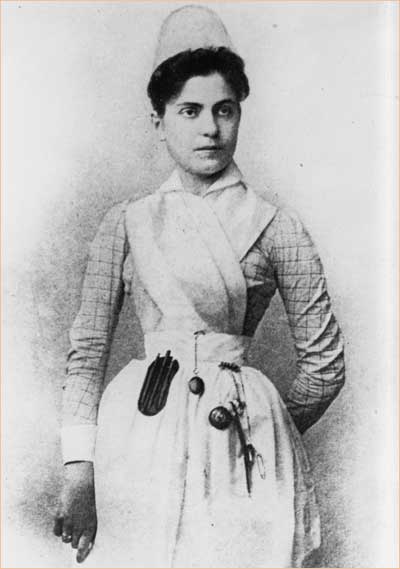
Nursing uniform from the late 19th c.*

1852

Sunday Feb 15th  Have been to church and at

noon went to Mr Baileys to see sister Amelia

who is nursing there  Mother went with me

Have been reading since meeting  Edwin & wife came

in to spend the evening but Mr Ames & self were

just going to Mr Swains and they would not let 

us stop for them so they went to Augustus  Had a 

pleasant call or rather visit at Mr Swains  came away

about nine Oclock  Very pleasant

The sun came out today, so despite it being “pritty cold,”** the Ames family went to church. During the intermission between morning and afternoon services, Evelina and her elderly mother, Hannah Lothrop Gilmore, rode out to visit Amelia Gilmore.  Amelia was the widow of Evelina’s brother, Joshua Gilmore, Jr. Joshua had died three years earlier, at age 35, leaving Amelia with two sons to raise.

In order to support herself and her boys, Amelia hired out as a nurse.  In this instance, she was looking after a Mr. Bailey, who must have lived near the Unitarian church. He may have lived alone, been ill and needed paid help; otherwise the convention of the day would have meant his female relatives looked after him. When Amelia wasn’t working, she and her youngest son, Samuel, lived with the Alger family near the Gilmore farm. The older son, Charles, had hired out somewhere but would soon come to reside with his uncle Alson Gilmore.

In 1852, nursing was not a formal profession.  Women (nursing was considered the exclusive province of women at the time) undertook nursing because they needed to work and this was one of very few avenues open to them. They based their protocol on personal experience in caring for ill members of their own families. There were no training programs or certification venues available, in no small part because there were so few hospitals. People were cared for at home. It would take the Crimean War in Europe and the Civil War in the U.S. to change attitudes and formalize medical care.

*Courtesy of http://www.nursinglink.monster.com

**Oliver Ames, Journal, Stonehill College Archives, Arnold Tofias Collection


February 14, 1852

 history

Detail of Cover of Gleason’s Pictorial, February, 1852

Sat Feb 14th  Finished Olivers shirt before dinner and did

some mending  About three went into Edwins and trimmed

a black silk cravat for Oliver  Mrs S Ames & Frederic

returned from New Bedford to night where they have been

since Tuesday  I spent most of the evening there

Evelina’s favorite periodicals, such as Gleason’s Pictorial, Godey’s Lady’s Magazine, and Graham’s, were full of allusions to Valentine’s Day this week. Gleason’s featured a valentine on its cover, in fact.  And while commercial Valentine cards hadn’t yet developed in the United States – that would happen in the 1870s – special letters and personal poems were popular on February 14. Yet Evelina makes no mention of receiving or sending a valentine, nor does she suggest that any of her children did, either.

Perhaps when Evelina went over to see Augusta Pool Gilmore, young bride of Evelina’s nephew Edwin Williams Gilmore, she found evidence of a valentine exchange between the newlyweds. Besides being in love and – presumably – open to sentimental expression, Augusta and Edwin were young enough to adopt new approaches to holidays that older Yankees like Evelina and Oakes ignored.

Meanwhile, winter was still very much present. As Old Oliver noted: “there was about half an inch of snow last night and it is cloud[y] + cold to day wind north west”

February 13, 1852


Fire engine

1852

Feb 13th  Friday  Have been to work on Olivers shirt

that I was intending to finish last week and have not

got it done yet  have scarcely got over my

Boston jaunt.  Carried my sewing into the other

half of the house awhile  Brother Oliver returned

from Boston to night & says the large machine

shop just back of Mr Orrs was burned last night

Mrs Witherell here about two hours this evening

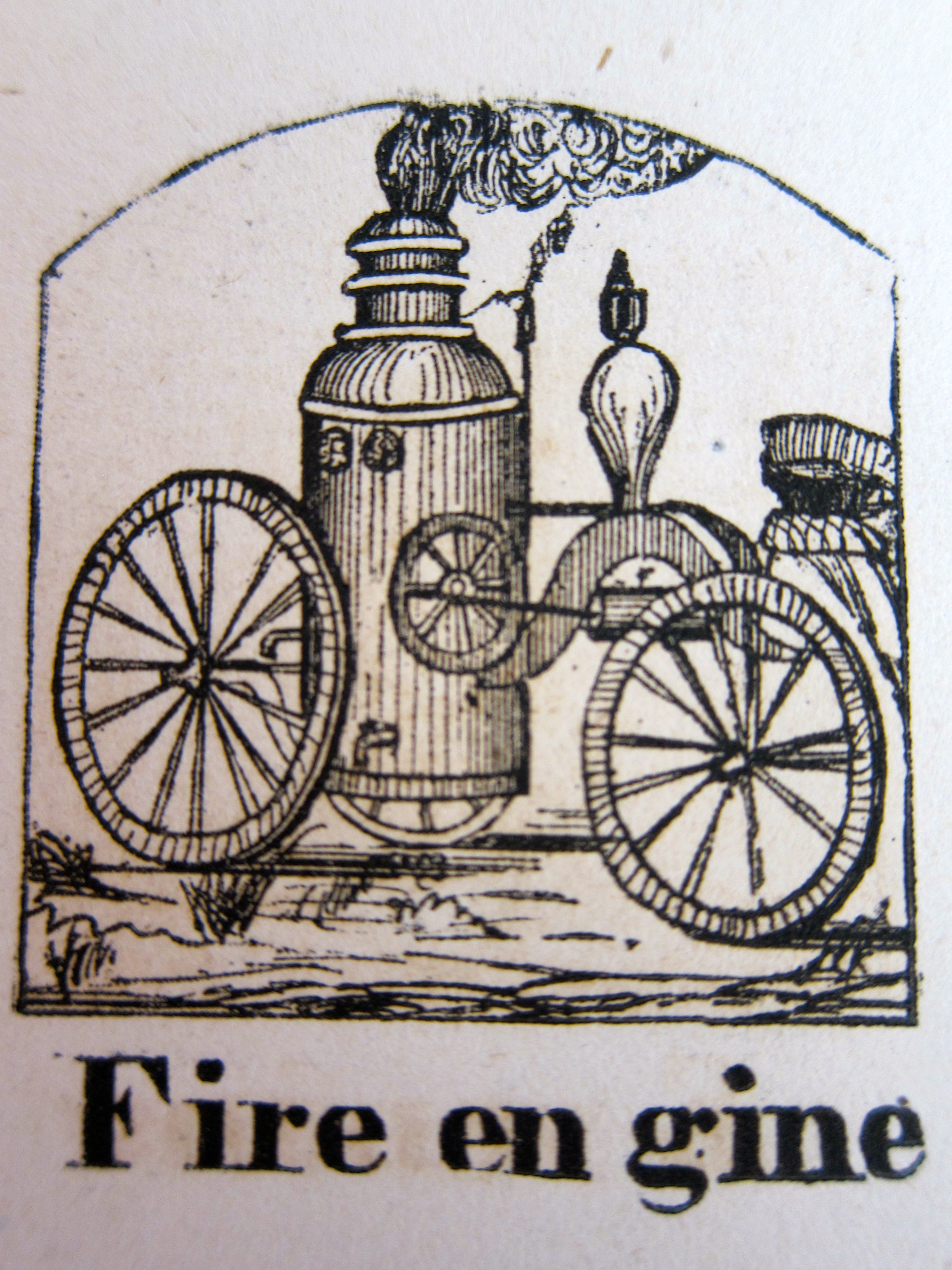
A serious fire happened in Boston, as Oliver Ames Jr. reported when he got home. The family probably read about it in the city newspapers, including The Boston Atlas:

“FIRE. – Firemen Injured. – About 10 o’clock last night a fire was discovered in the upper part of a five story brick building, in the rear of No. 24 Kingston street. The fire broke out upon the upper floor, used for chair painting. The flames spread rapidly, and in a few minutes the roof fell in, pressing portions of the walls over the sides, the falling bricks injuring five firemen who were upon ladders directing the streams upon the fire, two of them very badly indeed. The third story was improved by the “Boston Laundry,” and was burnt out. The second story, occupied as Fox’s machine shop, and the first by Horace Jenkins, mason, were thoroughly drenched with water. The building, a sham built concern, is owned by Willard Sears. The wind was quite high and the weather freezing cold at the time, and the firemen deserve great credit for their well directed and energetic efforts in subduing the devouring elements, – and it is with pain and regret that we have to record injury to so many of their number: – John Smith, of Hydrant No. 2, very severely in the back and shoulders; Christian Karcher, Engine C. No. 1, badly bruised; Abraham Ross and James McCullis, of Hydrant Co. No. 3, bruised. Charles Ricker, of same company, received a severe injury in the back. It was reported that Smith’s and Ricker’s injuries are of a very serious nature. They were all carried into houses nearby, and medical aid procured.”

Then as now, fire was deadly serious.  John Smith died of his injuries three days later, Boston’s first modern fireman to suffer a Line of Duty Death.**

*The Boston Atlas, February 12, 1852

**http://www.bostonfirehistory.org, accessed Feb. 11, 2015

February 12, 1852

Abraham_Lincoln_by_Byers,_1858_-_crop

Abraham Lincoln (1809 – 1865)

ca. 1858

Feb 1852

Thursday 12th Had a number of calls quite early

Augustus Edwin & August[a] came to look at

the engravings and I began to think I never

should get the room in order.  This afternoon Oliver

hung the pictures.  Augusta came in and we called 

on Mrs J Wms about Olivers shirts that she is making

and at Augustus.  Mrs Lake called.  William returned home.

William Leonard Ames, brother of Oakes and Oliver Jr., “went home to day”*after a ten-day visit. William had most likely stayed with his sister Sarah Ames Witherell and father, Old Oliver, in the other part of the house. Yet today was the first day that Evelina mentioned his presence, suggesting, as before, that relations between Oakes and William were cool.  The men had had a parting of the ways over the demise of William’s iron company, and William had migrated to Minnesota.

Another person considerably west of North Easton was former U.S. Representative Abraham Lincoln who turned 43 today. He was practicing law. He had recently declined the offer of the Governorship of Oregon, and was beginning to settle back into a life away from politics. Future events – most notably, the passage of the Kansas-Nebraska Act in 1854 and his ongoing opposition to slavery – would reinvigorate his interest.

Evelina, meanwhile, concentrated on hanging her new engravings in the parlor, and showed them off to her nephews. She also checked on the status of some shirts she had ordered sewn for Oliver (3).

*Oliver Ames Journal, Stonehill College Archives, Arnold Tofias Collection
 

February 11, 1852

Rain

Feb 11th Wednesday  Returned from Boston to night very

much fatigued  It has rained poringly all

day and I was out shopping and most horrible

walking in the streets  Went to Doe & Hazleton

and bargained for a looking glass  bought an

all wool Delaine of Mr Norris  Mrs Witherell

was here some time this morning

Boston in February is subject to terrible weather, as Beantown residents in 2015 know all too well from recent record-breaking snow.  In 1852, heavy precipitation was also the rule, although on this particular day it didn’t snow, but “rained poringly.” Shopping suddenly wasn’t as much fun as it had been the past two days. Evelina found the going “most horrible,” but still managed to chase down some good buys.

She treked to an area of the city known as Cornhill – not Cornhill Street, or Lane, or Road, but just plain Cornhill.  This area of the city is now irrevocably altered, having been turned into Government Center, a modernistic architectural complex, in the 1970s.  Only a small portion of the original Cornhill known as Sears Crescent now remains. In the 1840s and 1850s, Cornhill was known as a center for Boston’s intelligentsia. Writers, poets, and book publishers gathered there.

In 1852, at number 42 to 48 Cornhill, there were also several retail shops, including one called Doe & Hazleton. Owned by Joseph Doe and J. M. Hazleton, the store specialized in “Decorative Furniture.” It was there that Evelina went and “bargained for” a mirror, to be delivered to North Easton in the near future.  She also bought some wool cloth from another Orr son-in-law, Caleb Norris, and probably had that delivered, as well.

By day’s end, Evelina was back in North Easton, “much fatigued” from her shopping.

February 10, 1852


thetouc2

Physician-assisted childbirth, mid-19th century

Feb 10th, Tuesday

1852  Went out shopping about 11 Oclock staid untill

that time with Mrs Harris who was confined with

a daughter born about two Oclock.  looked at engraving

again today purchased Allhalloween  Oliver returned 

home to night but I did not get through with my

shopping and concluded to stop another night

Mr Harris came in the cars this afternoon heard of her

sickness just in time to take them  Oliver Jr called at Mr Orrs

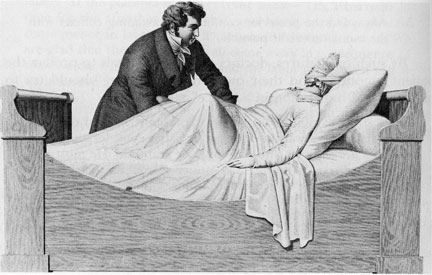
While shopping for art in Boston with her son Oliver (3), Evelina had another memorable day. Per usual, she stayed with the Robert Orr family in the city. While there, one of the Orr daughters, Julianne Orr Harris, went into labor and gave birth to a girl.  Evelina stayed with Julianne for a time, which would have been normal in the older tradition of a “circle of women” being present at childbirth. Evelina’s timetable is a bit confusing, but it sounds as though she was there for much of the labor – or “sickness” –  if not at the actual delivery.

It’s likely that a male doctor presided at the birth, because by this period, especially in urban areas, physician-assisted births had become the rule rather than the exception. Midwives were phased out, although they never entirely disappeared. One result of this change was that strict propriety in the birthing room prevailed over medical accuracy, at least in the 19th century. Modern historian Jack Larkin notes:

“Embarrassment and constraint became part of the birth process; physicians were greatly hindered, as midwives had never been, by firmly established canons of female modesty. Men could not look directly at their patients’ genitals, but had to examine them only by touch while they remained fully clothed.Often deeply uncomfortable with a bedchamber full of women looking on – sometimes critically – doctors tried to persuade expectant mothers to clear them out of the birthing room.”

Julianne’s husband, Benjamin Winslow Harris, was away when his wife went into labor, but got a message, somehow, and just made the train home. He would not have participated in the birth itself, but he may have had a hand in the naming of his first child: Mary Harris, after his own mother.


*Jack Larkin, The Reshaping of Everyday Life,New York, 1988, p.97.


February 9, 1852


Boston_art_club_design_wm_emerson

Architectural Rendering of Boston Art Club, ca. 1882

Feb 9th  Monday  Went to Boston with Oliver  spent

the forenoon in looking at pictures.  dined at

Mr Orrs.  Afternoon Mrs Stevens & Mrs Morse

went with us to look at pictures.  purchased 

two engravings one of them painted  returned to

Mr Orrs and spent the evening in playing 

cards  Very fine weather

Evelina’s boring Sunday in North Easton gave way to a few fun days of shopping in Boston. Leaving Jane McHanna to manage the house in her absence, she traveled into the city accompanied by her middle son, Oliver (3), the only son who wasn’t working. The two of them spent the day looking at “pictures” – prints and paintings, probably – and ended up buying two engravings. That one was “painted” meant that it had been hand-colored.

Where did they shop? At a gallery? At an artist’s studio? Amory Hall on Washington Street was one facility that accommodated artists at the time.Who was selling engravings in 1852? Readers, do you know?

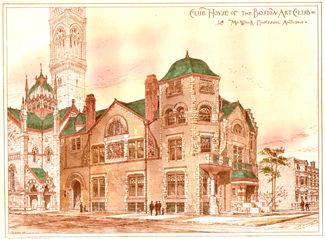
It’s hardly arbitrary that Oliver (3) was the son who shopped for art with his mother. Besides being the only male in the family at liberty to take his mother into town, Oliver (3) loved art. He would collect paintings, prints and sculpture all through his life, in fact, especially after he and Anna C. Ray had married and built their large homes in North Easton and Boston. Before becoming governor, Oliver (3) traveled a great deal as a salesman for O. Ames and Sons and, in the process, bought art for himself at galleries in New York City and elsewhere. In the 1880s, he was also president of the Boston Art Club, an artists’ consortium begun in 1854 – 1855 that expanded to include wealthy patrons such as Oliver Ames.

February 8, 1852

Spool

1852

Feb 8th  Sunday,  Have been to meeting to day and at 

noon went into Mrs J Howards with Mrs E Howard &

others  had a pleasant call   Augustus called this evening

and staid untill quite late and I have

not read but very little to day  Mr Ames

came in about eight but too late to go out as 

intended  Mr Ames brought me 12 spools of cotton

yesterday

It was an ordinary winter Sunday for the Ames family. They went to church and visited with friends during the intermission between the morning and afternoon services. Back home, Evelina’s nephew Augustus came to call and seems to have overstayed his welcome; Evelina barely got to read. She probably sat looking at the new spools of cotton thread that Oakes had brought her the day before and wished that she could at least do some sewing. But sewing and other work was forbidden on the Sabbath.

The laws that the Puritans had established in the 17th century that forbid work or play on the Sabbath still held sway in Massachusetts in 1850. Businesses weren’t open, mail wasn’t delivered, and many people wouldn’t travel. People in Evelina’s generation had been taught to put down their daily work – except for chores which were essential, such as milking the cows – and spend Sundays quietly, at church and at home in contemplation and worship. No sewing, no housework, no shovel-making was permissible.

As the tempo of 19th century life picked up, however, that restrictive pattern was changing. Rail travel, for instance, was impossible to harness to a Puritan timetable. Many of the old ways were beginning to break down, and the advent of the Civil War would effectively demolish most of the lingering vestiges of Puritanism. The “blue laws,” however (so named by Connecticut preacher Samuel Peters) would continue to influence state laws, especially around commerce.  For much of the 20th century, retail stores could not open on Sundays, and in many places, alcohol couldn’t be sold.  Even today, in 2015, several states – Maine and Colorado, for two – forbid car dealerships to operate on Sundays.


I


February 7, 1852

dickens12_2084187b


Charles Dickens, ca. 1852

(1812 – 1870)


1852  Sat  Feb 7th  Orinthia Miss Burill Susan & self called this

morning on Mrs J Howard, Whitwell & E Howards

left Susan at Mr Howards, came home with Frank

from a sing this evening.  Abby Augusta & Helen were

here awhile this afternoon  Helen went out to Bridgewater

last night and came up with Mr & Mrs James Mitchell this

forenoon  Orinthia went home about five and this

evening we have been into Olivers.  Mr Mitchell returned at nine.


This was a non-stop sociable Saturday for Evelina; she, her daughter Susan, dear companion Orinthia Foss, and another young schoolteacher, Miss Burrell, made calls all morning long. In the afternoon, she entertained three of her nieces and in the evening, visited next door at Oliver Jr and Sarah Lothrop Ames’s house. Chat, chat, chat.

In the larger world of letters, Charles Dickens turned 40 years old today. Even at mid-career, he was known as “The Inimitable,” so great was his talent, so voracious his readers. Evelina loved his work and benefited from his prolificacy.

By this point in Dickens’ life, among the books he had already published were The Pickwick Papers, Nicholas Nickleby, various Christmas novellas including A Christmas Carol, Dombey and Son, and David Copperfield, which Evelina had read the previous year. At this time he was composing Bleak House which, like most of his novels, was published in serial form over many months. Its first episode would come out in March, 1852, and run through September, 1853.

Still waiting to be born were future classics such as Hard Times (which targeted Unitarianism, among other entities), Great Expectations, A Tale of Two Cities, Our Mutual Friend – and more. Dickens wrote articles, made speeches, toured, and even acted. He was a high-profile tour de force with a fertile imagination and a thirst for success. Ralph Waldo Emerson, who heard Dickens speak in Boston, compared the author’s ability to “a fearful locomotive to which he is bound and can never be free from it nor set to rest.”*

*Ralph Waldo Emerson, quoted in Annie Field’s diary, 1868.


February 6, 1852

Write

Feb 1852

Friday Feb 6  Jane has baked some mince to day of

meat that was left last week and has done

very well.  Cut out a shirt for Oliver to day

and intended to finish it tomorrow but this

afternoon Miss Foss came and Miss Burrell

from W Bridgewater  We called at Edwins

this evening  commenced raining about five

Domestic tranquility reigned today as Jane McHanna made some fine mincemeat and Evelina cut cloth for a shirt, until interrupted by the arrival of Orinthia Foss and her friend Miss Burrell. For Evelina, chores gave way to social intercourse.

Besides keeping a record of various domestic details such as her sewing, Evelina often lists in her daily diary entries the names of the friends and relatives who come to call – in this case, Orinthia Foss and Miss Burrell. She writes of the women with whom she spends time, in fact, more often than she is apt to describe interactions with her immediate family (unless, of course, her husband forgets to pick her up to go out on a social call.) She includes the names of female friends, including her sisters-in-law, as much if not more often than she mentions the names of her children. Her social life, as in “We called at Edwins this evening,” is terribly important to her. She narrates it to her diary in order to remember it and savor it. It doesn’t mean that she doesn’t care about her family; she does. But looking after her almost-grown children is not noteworthy.

Evelina’s diary is simple, even for the nineteenth century, when the “practice” of keeping a diary was “to record personal feelings and explore intellectual growth.”* Eveline doesn’t concern herself with external events the way Mary Chesnut of South Carolina did in her diary of the Civil War, nor does she describe or question the secondary status of women as other Bostonians such as Caroline Healey Dall did in her diary. The intellectual pursuits and considerations of the brilliant Margaret Fuller never interested her – it was beyond her ken.  Evelina was literate and engaged in her life, but in a diffident and unsophisticated way. She wrote in a manner that more closely resembled her father-in-law, Old Oliver; her brother-in-law, Oliver Ames, Jr.; and, eventually, her son, Oliver (3). She simply wrote down whom she saw and what she did.


Steven Stone, Making Sense of Letters and Diaries, http://www.historymatters.gmu.edu

Other resources for information about diaries in the nineteenth century:

Schlesinger Library, Harvard University, http://ocp.hul.harvard.edu/ww/diaries.html

http://www.victorianpassage.com/2007/02/19th_century_diaries_and_scrap.php