March 6, 1852

Whitewash

1852

March 6th Saturday  Mr Scott whitewashed the parlour

& sitting room chamber this morning and I

varnished the front entry oil cloth.  Lavinia

came at eleven and Augusta this afternoon

Alson came after Lavinia and stopt to tea

Charles Pool came up and carried Edwin

and Augusta home to stay till Monday

I have been to work on a stiched pink apron

for Susan

A full moon shone down on North Easton this night, highlighting the charred ruins of the shovel factory.  Before it rose, however, Old Oliver took the opportunity of “a fair day”* to travel to Bridgewater, quite probably on shovel business.  He and his sons were developing plans to rebuild the factory, and some help for that would be found in Bridgewater.

Evelina’s way of coping after the devastating fire appears to have been to keep the domestic front moving smoothly. Redecorating continued, social calls were made and enjoyed, and sewing continued without a blink of an eye. Daughter Susan would soon have a new pink apron.

Years later, Evelina and Oakes’s grandson, Winthrop Ames, would credit his grandmother and other Ames wives with exerting a positive influence on his male ancestors. “They made the homes, reared the many children, saved their husbands’ money, encouraged their undertakings, and steadied them in failure and misfortune,”** he said. Evelina’s evident steadiness during this challenging period is one such instance of positive influence. Oakes Ames had come home from the fire “more cheerful” than Evelina had expected; she seems to have behaved with equal optimism. Though naturally sanguine, Oakes’ bright outlook and ability to cope in the aftermath must also have been bolstered by his wife’s unflappable focus on home and (redecorated) hearth. Together, they maintained continuity.

Charles Pool, Augusta’s eldest brother, drove up from southeastern Easton today and fetched his sister and her husband, Edwin Williams Gilmore, “home to stay” for a few days. Perhaps this visit had been prearranged, or perhaps it was an effort by the young couple to get out of the way of remnant smoke and disruption from the fire.

*Oliver Ames, Journal, Stonehill College Archives, Arnold Tofias Collection

**Winthrop Ames, The Ames Family of North Easton, Massachusetts, 1937, p. vi.



March 5, 1852

charred-wood-texture_61-1902

Charred Wood

1852

March 5th Friday  Have been mending pants most all

day that were worn at the fire  Lavinia

went to Augustus’ this forenoon and Augusta

went this afternoon.  Mr Scott & Holbrook have 

finished painting the entry and chamber

got through about four Oclock.  I was in

Olivers about an hour this afternoon.  This 

evening received another letter from Harriet Ames


The women of Easton had work to do, too, in recovering from the factory fire.  Surely Evelina wasn’t the only housewife in North Easton who had to repair or clean clothes worn by their husbands, brothers or sons the night of March 2. Needles were out and laps were full as women all over town tended to the rips, tears and soot. Conversation probably centered on the fire as they worked.

The day itself was cloudy and cold, the smell of the charred buildings dampened by a light snow that fell overnight. Yet the cleanup continued. As the men worked at the site, hauling timbers and shoveling up debris, their blackened soles left ashy footprints in the snow, footprints that quickly turned into grime. Many a man was made to wipe or remove his shoes before entering his house for midday dinner.

Evelina stayed focused on her domestic responsibilities. Mr. Scott and Mr. Holbrook were back on task in her parlor, painting and papering, and finished up at the end of the afternoon. Evelina spent some time next door with Sarah Lothrop Ames, and got a letter from cousin Harriet Ames, with whom she had been corresponding lately. And perhaps under her direction, her niece Lavinia and niece-in-law Augusta were looking after their sister-in-law, Hannah Lincoln Gilmore, who was laid low with a mouth infection and a weaning baby. Fire or no fire, life was moving forward.


March 4, 1852

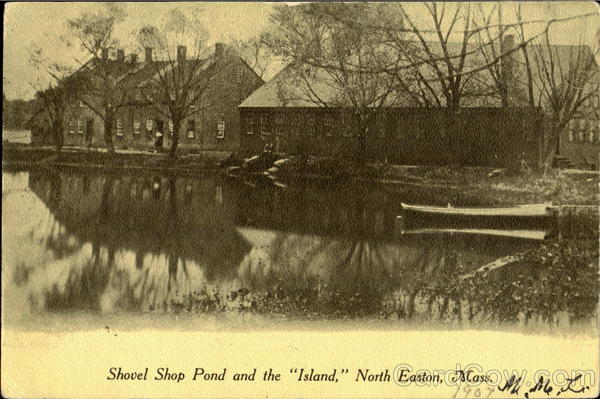
Shovel Shop Pond And The Island North Easton, MA

Replacement buildings on a section of the Ames shovel complex

1852

March 4 Thursday  Scott & Holbrook are setting glass at

the shop to day  They have the front entry partly

painted  I carried my work into Edwins this

forenoon  mended O Angiers shop coat  This afternoon

have been to Mr Torreys with Augustus & Lavinia

Called a few moments on Hannah  She has a 

sore mouth and is weaning her child

Evelina addresses her day calmly, as always keeping her distance from the goings-on at O. Ames & Sons. Most other residents of North Easton were still reeling, no doubt, from the huge fire that had burned down a majority of shovel factory buildings over the night of March 2. The sun was shining and the wind was out of the north west, pushing around remnant smoke still rising from the ruins of the complex of wooden buildings. Shovel shop employees had no regular job to go to and the owners had some serious decisions to make, fast.

Clean-up from the huge fire was underway, probably by the labor of the very men whose factory jobs had been temporarily eliminated. The men who had been painting and papering at the Ames’s house, for instance, were co-opted to set glass at the shop, suggesting that new panes of glass – the originals probably having been blown out by the fire – were going into the windows of the one or two buildings that had survived.

As town historian Ed Hands points out, “the Ames family and the neighborhood rebounded quickly.”*  Old Oliver and his sons Oakes and Oliver Ames Jr. made a two-fold decision. The first was to create temporary structures to house the manufacturing so that shovel making could resume as quickly as possible.  The second was to create “new, permanent stone shops,”* sturdy, nonflammable structures that could outwit any new fire.

There was insurance money to cover at least some of the rebuilding. Sources differ on the amount of damage that the fire inflicted, but suggest it was between $30,000 and $40,000. The amount of insurance coverage is also uncertain. Old Oliver “states that there was $3,000 worth of insurance on the buildings”** but, according to industrial historian Greg Galer, it’s likely that the Ameses had increased insurance coverage on the factory back in November, 1851. Whatever the actual dollar cost was, “[t]he company bounced back quickly from the devastation, and seemingly without significant financial trauma.”**

*Edmund C. Hands, Easton’s Neighborhoods, Easton, 1995, p. 163

** Gregory Galer, Forging Ahead, MIT, 1989, p. 249


March 3, 1852

Fire


1852

March 3  Wednesday  Last night the finishing shops

were burned to the ground by Quinns letting 

his lantern fall into the varnish  Oakes came

home from the fire about 4 Oclock much

more cheerful than I expected to see him and 

went to bed  OA and Frank came home to put

on dry clothes & went back and staid untill morning

Lavinia & Augusta were here awhile this afternoon


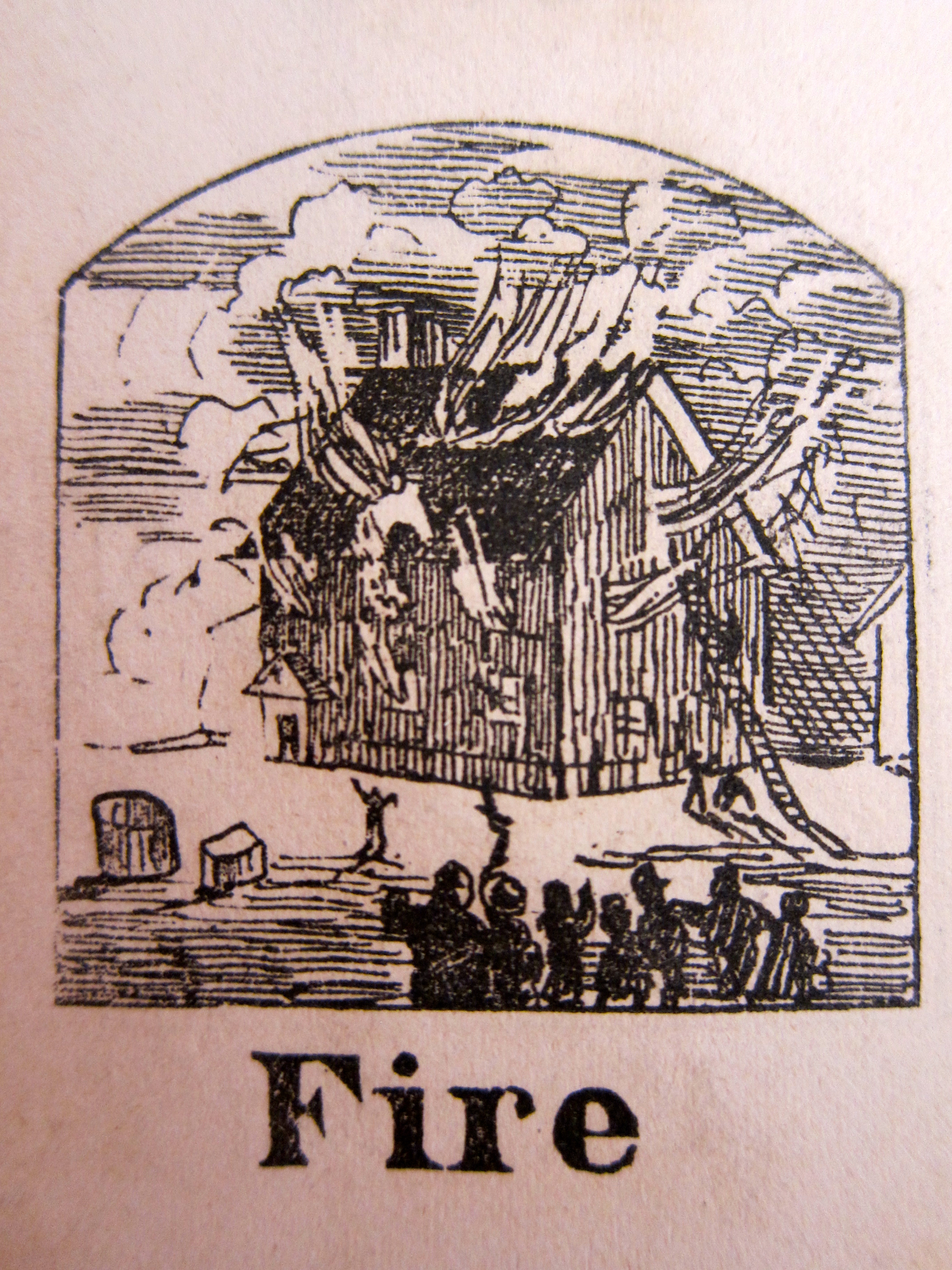
Fire! Most of the shovel company’s buildings, situated in”the most centralized areas of Ames production, ‘the island’ at the outfall of Shovel Shop Pond,”* caught fire and burned to the ground. On his nightly round, Patric Quinn, the watchman, dropped his lantern into the varnish. The subsequent explosion must have been quick and, given the nature of the combustibles, uncontainable from the outset.

Naturally, Old Oliver recorded the event as well: “last night about eleven O clock the finishing shop took fire and the shops adjoining it were burned down – Bisbes shop and the small one made out of the cole hous that was mooved from the hoe shop was saved – the fire took from the varnish …”**

O. Ames & Sons had caught fire before, once in 1844 and again in 1849.  After the 1844 fire, the family “had bought a used fire engine,”** which was brought to bear on the 1849 fire. In that case, Old Oliver credited the engine with saving the day, noting that “if we had have had no engoin I think it would have burnt up.” **

This latest conflagration was different. As modern historian Gregory Galer points out, “luck was not on their side…[the used fire] engine was no match for the blaze, fueled in part by 12,000 well-dried, ash shovel handles; oil and varnish used to protect completed shovels; and the wooden building itself.”*  The shovel shop was in ruins.

Evelina didn’t attend the fire, but she would have been able to see the flames from their front windows. The fire went on all night, her husband, sons and other townspeople present for most of it. There is no record of any injuries.


Gregory Galer, Forging Ahead, MIT, pp. 248-249

** Oliver Ames, Journal, Stonehill College Archives, Arnold Tofias Collection


March 2, 1852

Brush

March 2nd Tuesday

1852 March  Have been assisting Mr Scott paper[ing]

again to day  Worked untill past nine

and feel very tired.  The paper is all on

except a patch or two here & there  Francis brought

Lavinia up to Edwins this afternoon  Mr Holbrook

has finished the first coat of paint in 

the sitting room chamber

To begin with, the day was normal. Winter weather continued: “there was a little mist this morning + it froze as it fell and the ground was slipery, wind north East. it was cloudy and a little stormy all day – it cleard of[f] in the evening.”* Evelina was not tempted to go out.  She stayed indoors, focused on redecorating the downstairs.

With Mr. Scott in the lead, Evelina helped put wallpaper up in her parlour.  She must have had to take down the framed prints and new looking-glass in order to do this. The sitting room, too, was being repainted.

Evelina stayed up late, becoming “very tired,” and evidently ready to go to bed as she wrote this entry.  Yet a good night’s sleep would elude her. Indeed, few people in the village of North Easton would be able to sleep through the night of March 2, 1852.

*Oliver Ames, Journal, Stonehill College Archives, Arnold Tofias Collection

March 1, 1852

1397811276


1852

March 1st Monday March has come in like a lamb.

It has been a very busy day with me.  Mr

Scott & Holbrook came to paper the front entry

And I have been waiting on them & trimming

paper &c this afternoon have assisted Mr Scott

about papering & Holbrook has commenced

painting the sitting room chamber

Apropos of much of Northern hemisphere weather this time of year, a common saying is “March comes in like a lion and goes out like a lamb.” Evelina knew this old, English saw and seemed happy to have it proved wrong. She was getting the jump on spring, too, as workmen arrived to paper the entry and paint the sitting room. She was redecorating again.

Victorians had many sayings and proverbs, including quite a few that mentioned animals. The lion and lamb of March had plenty of company in the proverb department:

When an ass is among monkeys, they all make faces at him.

A wild goose never laid a tame egg.

When the cat is away, the mice will play.

Like the cat/mouse saying, other adages are still familiar to us in the 21st century, if phrased differently:

If wishes would bide, beggars would ride.

None are so deaf as they that will not hear.

When poverty comes in at the door, love flies out at the window.

Surely, the next one was dear to Evelina’s heart:

Spend not where you may save; spare not where you must spend.

This list of sayings, found in an almanack from 1851, goes on and on. Just a few more:

Woe to the preachers who listen not to themselves.

Say well is good, but do well is better.

Whether you boil snow or pound it, you will have but water from it.

A soldier, fire, and water, make room for themselves.

All truths must not be told at all times.


*Moss Valley Almanack, Courtesy of rootsweb.ancestry.com


February 29, 1852

Ink

Feb 29

1852 Sunday  It was quite windy and mother

was unable to attend meeting all day so

I staid at home with her this morning.

This afternoon have been with mother & Augusta

& mother returned home. Since meeting

have written a letter to cousin Harriet Ames

but feel rather doubtful about sending it

1852 happened to be a leap year, which, as most of us know, is so named because the addition of the extra day of February 29 causes days of the week, which normally advance by a single weekday from one year to the next, to “leap” ahead by two.

Leap year is known in more scientific circles as a bissextile or intercalary year. Charles Dickens knew that.  He also knew about a tradition that allowed ladies to propose marriage during Leap Year, a custom otherwise accorded to the male of the species. In 1840, when Queen Victoria announced her “intention” to marry Prince Albert , he commented – tongue-in-very-British-cheek – accordingly:

“That the present is Bissextile, or Leap Year, in which it is held and considered lawful for any lady to offer and submit proposals of marriage to any gentleman, and to enforce and insist upon acceptance of the same, under pain of a certain fine or penalty; to wit, one silk or satin dress of the first quality, to be chosen by the lady and paid (or owed) for, by the gentleman.

“That these and other horrors and dangers with which the said Bissextile, or Leap Year, threatens the gentlemen of England on every occasion of its periodical return, have been greatly aggravated and augmented by the terms of Her Majesty’s said Most Gracious communication, which have filled the heads of divers young ladies in this Realm with certain new ideas destructive to the peace of mankind, that never entered their imagination before.

“That a case has occurred in Camberwell, in which a young lady informed her Papa that ’she intended to ally herself in marriage’ with Mr. Smith of Stepney; and that another, and a very distressing case, has occurred at Tottenham, in which a young lady not only stated her intention of allying herself in marriage with her cousin John, but, taking violent possession of her said cousin, actually married him.

That similar outrages are of constant occurrence, not only in the capital and its neighbourhood, but throughout the kingdom, and that unless the excited female populace be speedily checked and restrained in their lawless proceedings, most deplorable results must ensue therefrom; among which may be anticipated a most alarming increase in the population of the country, with which no efforts of the agricultural or manufacturing interest can possibly keep pace…”

Evelina may have read Dickens’ playful screed on the dangers of Leap Year, probably without taking offense.  She had her own letter to write today to a cousin, one that seemed to trouble her.


* Charles Dickens, Sketches of Young Couples, courtesy of http://www.authorama.com


February 28, 1852

image059

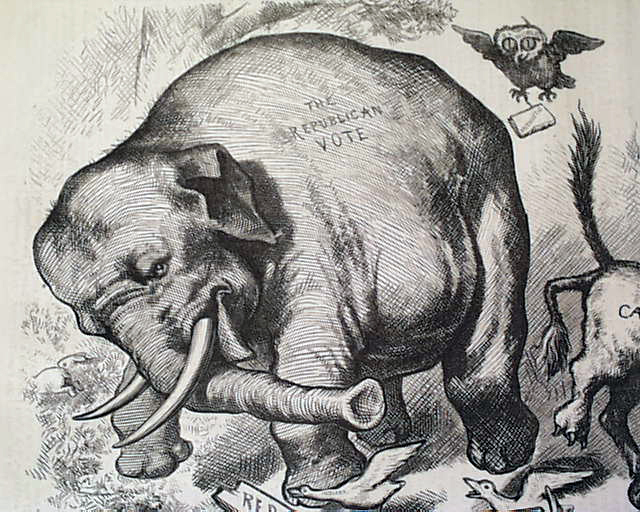
Thomas Nast’s first rendition of the Republican party’s symbol, early 1870s

1852

Feb 28th Saturday  It has been a stormy uncomfortable 

day  Mother is quite unwell & rather homesick

Mrs Witherell spent two hours here this

forenoon  I have finished the flannel

skirt that I commenced Jan 30th and put

a cape top to an old one  Mr Ames has

been to Boston as usual says the slab will be here Monday

Evelina stayed indoors today, sewing, of course, but also tending to her elderly mother, who seemed fretful and “unwell.” The whole town was subjected to what modern weather forecasters would call ” a wintry mix.”  According to Old Oliver, the day began “a snowing this morning wind south east but the snow is dry – it snowd + haild untill about 4 O clock + than began to rain + raind pritty fast untill some time in the night when it cleard of[f] with the wind north west and + cold and the wind blew verry hard”*

In another section of the country also known for its harsh winters, this date in history (plus two years) marks the genesis of our country’s Republican party. According to political historian Robert Remini, “[o]n February 28, 1854, a number of Free-Soilers, northern Whigs and antislavery Democrats met in Ripon, Wisconsin, and recommended the formation of a new party to be called “Republican.”**  Several months later, on July 6, after Congress passed the controversial Kansas-Nebraska act, the nascent group met again in Jackson, Michigan, where they “formally adopted the new name and demanded the repeal of the Kansas-Nebraska and Fugitive Slave Acts and the abolition of slavery in the District of Columbia.”

It wouldn’t take long for the Ames men, former Whigs, to join the new political party.

*Oliver Ames, Journal, Stonehill College Archives, Arnold Tofias Collection

Robert Remini, The House: The History of the House of Representatives, 2006, p. 150  

(NB: A source cited in Wikipedia in February, 2015, says that the date for this meeting in Ripon was March 20)

February 27, 1852

Tea kettle


Feb 27

1852  Friday  this morning I invited Mrs Lothrop here

but she went to Mrs Jason Howards to spend the day

came here this evening  Mrs S Ames & Fred dined

here  Mrs & Mr Horace Pool  Mrs W Williams  Abby

Edwin & wife Oliver & wife & Fred & Mrs Witherell

were here to tea  All came unexpectedly.  Had 

a very pleasant visit from them.

Many folks came to call today.  Sarah Ames Lothrop and her son, Frederick Lothrop Ames, joined the Ameses for midday dinner. (Although Oliver (3) had returned to Brown, Fred hadn’t yet gone back to Harvard.) A real crowd arrived “unexpectedly” for tea.  Sarah and Fred returned, bringing Oliver Ames Jr. with them. Sarah Ames Witherell came in from the other part of the house, resulting in all three sisters-in-law being together. Newlyweds Edwin and Augusta Gilmore walked over from their nearby home, and old Mrs. Gilmore – Evelina’s mother – was already on the premises. The family gathered.

From farther away came Horace and Abby Avery Pool, uncle and aunt to the bride, Augusta.  A Mrs. W. Williams arrived, as did Abby Torrey, Evelina’s niece. Abby’s head must have been full of the previous evening’s entertainment, that of Willard Lothrop’s visit and trance. It’s likely that some of this evening’s conversation turned on spiritualism.  One wonders what Oakes and Oliver Jr. thought of the topic.

Perhaps Evelina served some ginger snaps or currant cake from Tuesday’s baking. The tea itself could have been one of any number of types. Lydia Maria Child published her opinion on the subject: “Young Hyson is supposed to be a more profitable tea than Hysons; but though the quantity to a pound is greater, it has not so much strength. In point of economy, therefore, there is not much difference between them. Hyson tea and Souchong mixed together, half and half, is a pleasant beverage, and is more healthy than green tea alone.  Be sure that water boils before it is poured upon tea  A tea-spoonful to each person, and one extra thrown in, is a good rule.  Steep ten or fifteen minutes.”*

*Lydia Maria Child, The American Frugal Housewife, 1846


February 26, 1852

seance-circle-2


Feb 1852

Thursday 26  Mrs Solomon & Mrs Willard Lothrop spent

the afternoon here.  Willard & Abby Torrey

came this evening  He went into a trance

and preached  told Abby she was a sympathetic

medium  Mother & self had a nice quiet

time in the forenoon  Mrs Witherell

came in awhile  Altered some dickeys

After a quiet morning of sewing, Evelina and her mother were entertained at the end of the day by an unusual event in the Ames parlor.  Willard Lothrop, self-proclaimed Spiritualist, visited at the Ames home where he “went into a trance and preached.”  If it wasn’t a seance, it was close. Lothrop believed he could communicate with the departed. Was there a particular person from the past – a Gilmore relative, for instance – whom Lothrop was trying to reach?

According to historian William Chaffin, “modern Spiritualism” developed in upstate New York around 1848, and spread from there. As noted previously, Easton produced its own adherents who “displayed mediumistic powers,” including Willard Lothrop. “Circles were held.  There were knockings and table-tippings and experiments in the production of musical sounds, etc.  It was not found necessary to import trance speakers, for native talent in that direction was soon developed.”** Abby Torrey, Evelina’s twenty-one year old niece, was in the parlor, too, for this session. Lothrop reached out to her, believing that she had a gift for spiritual telepathy.

Meanwhile, the previous day’s thaw “turnd cold last night + froze the ground up rough”* Carts, wagons and carriages had bumpy roads to traverse.

*Oliver Ames, Journal, Stonehill College Archives, Arnold Tofias Collection

** William L. Chaffin, History of Easton, Massachusetts, 1866, p. 370