May 25, 1852

6089c8280037ff67c6d0be6ce3396045

Tuesday May 25th   Hannah Maccomber spent the day

Miss Kinsley  Billings & Scovill called about eleven

a very short call.  Hannah & sister called for a 

few moments  We have cleaned the sitting room

& bedroom  Mrs Patterson did the greater part

Mr Scott has finished painting the dining room

and put a coat of green paint between the

shelves in the sitting closet  Abby came after tea

Evelina managed to entertain visitors today even as spring cleaning cantered along in her half of the house. Her sister-in-law Hannah Lincoln Gilmore, and Hannah’s sister Elizabeth Lincoln, dropped by “for a few moments” to say hello. Hannah, being a housewife herself, knew enough to keep the visit short. Hannah and Elizabeth were “old shoe,” as the saying goes, and Evelina probably felt no compunction to impress them or be other than what she was: a housewife in the throes of cleaning.

The other surprise visit would have been less easy to accommodate. No doubt Evelina was pleased to see Miss Lucy Kinsley of Canton and her two young friends, especially after being so well entertained by the Kinsley family only a week earlier. Yet Evelina might have wished that the young ladies had come to call at another time when her home had been been more presentable.  Perhaps, too, the young ladies might have wished to catch a glimpse of the handsome Ames sons, who were more than likely at the shovel works. The awkward timing and mutual, if slight, disappointment of the call may explain its “very short” nature.

Mrs. Patterson did the lioness’s share of labor in cleaning the sitting room and bedroom, even as Mr. Scott finished the dining room and painted some closet shelves. Evelina worked alongside them both, when she wasn’t called away, and managed to oversee their work and plan ahead as well. It could be that the extra energy she was using to put her home in order was, in one respect, a way to channel her grief for her nephew, so recently deceased. Her body was busy all day long, getting things done, and her mind occupied with domestic necessities. All this may have helped her sleep at night.


May 24, 1852

Chimney

May 24th 1852

Monday  We have carried on a large stroke of business

to day  Mr Healy helped put the oilcloth in the 

dining room plained the floor & fitted the blinds

for the side lights  Mrs Patterson & Jane washed

and we have taken up the sitting room & bedroom

carpets & cleaned the clothes closet  Mr Scott

had partly painted the dining room & Mr Burnham

had built the chimney higher in the cook room

After a day off for the Sabbath, the women in the Ames house went back to spring cleaning. Today there were men on hand to help.  Henry Healey, frequent carpenter for the Ameses, planed the floor in the dining room and laid down the new oilcloth that Evelina had just bought in Bridgewater. He also fitted the blinds for the sidelights of the front door; perhaps they had been damaged in the fierce nor’easter back in April, when water beat into the house. That, or he just put up something new over those side panels.

In the dining room, Mr. Scott was painting and in the kitchen, Mr. Burnham was raising the chimney, perhaps repointing some of the older bricks in the process.  How Jane McHanna and Mrs. Patterson managed to do the weekly laundry around that activity is a mystery. Perhaps they worked outside in the yard. It was indeed a “large stroke of business.”

May 23, 1852

Preach

Sunday May 23d  Mr Rogers of Canton preached to day

I did not like him any better than Mr Whitwell

Alson Mother & Helen came home with us

at noon.  Oakes A carried Miss Foss to the 

sing and home  Ellen H & Rebecca White went

with them  Mr Ames & self made a long call

at Mr Swains  Mr Rogers made a short call

as he was going to church

Robert P. Rogers, the Unitarian pastor from Canton, led the service in Easton today, presumably switching places with the regular minister, William Whitwell, as the clergy often did in those days. Rogers was only twenty-seven or twenty-eight years old; his post in Canton was his very first.  As yet unmarried, and certainly younger and less seasoned than Mr. Whitwell, Rogers did not impress Evelina. He paid her the compliment of making “a short call” before church, but she was partial to the Whitwells.

Young Mr. Rogers would soon leave Canton for a pulpit in Gloucester where he would serve as minister for the remainder of his ministerial life.  He must have done well there, or they wouldn’t have kept him around for so long. Decades later, however, Mr. Rogers would return to Canton to live out his last days.

Between and after today’s services, folks were moving around town quite a bit. Old Oliver noted that it was “some cloudy” but also “pritty warm,” so it was pleasant to visit.  The dry roadbeds, though dusty, would have been relatively smooth. Evelina brought her brother and mother home after the morning service, Oakes Angier carried three young women to a sing after church, and Evelina and Oakes went over to see John and Ann Swain in the late afternoon. Everyone socialized.


May 22, 1852

large-1057

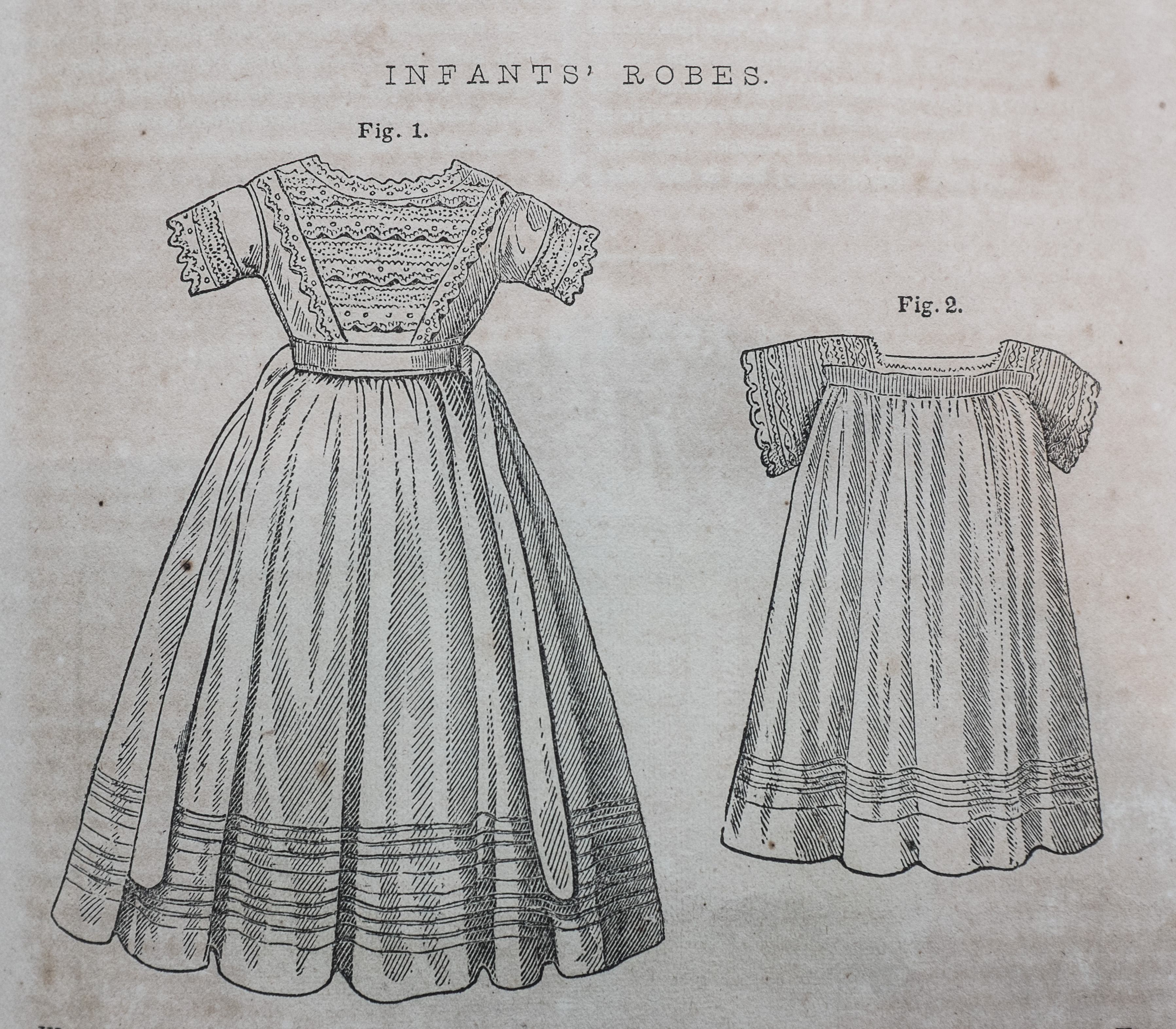
Infant wear from Godey’s Lady’s Magazine, 1851

Sat May 22d

1852  Mrs Paterson here again to day and has cleaned 

Susans chamber, windows & doors in Franks and

taken up the carpet and cleaned the front

chamber except the floor  Lavinia & Orinthia

came about eleven,  Edwin & Augusta here to tea

and went home with Lavinia  Mrs McHanna stood

godmother for McCabes child


Spring cleaning continued.  Mrs. Patterson returned to help Evelina clean, and the two women worked hard. Windows, doors, carpets and more were scrubbed, wiped or beaten, as appropriate.

Jane McHanna, the Ames’s regular servant, must have had time off today. She attended a baptism, presumably at the little Catholic church on Pond Street, to act as a godmother for a child of the McCabes. About this time, there was an Irish family in Easton, Bernard and Hannah McCabe, who had young children. Perhaps Jane became a godmother for three-year old William McCabe or, more likely, a younger sibling. There were several McCabe families in Bristol and Plymouth counties at this time, however, so we can’t be certain who this young child was.

The baptism or christening of infants was an important rite for both Catholics and Protestants. They had different approaches, certainly, but the intent was the same: to bless a child and erase its original sin. Unitarians differed from the Catholics and Calvinist-based Puritanism on this latter issue, as Unitarians didn’t accept the notion that children were born depraved. It was a critical doctrinal point. Jane McHanna would have accepted the more traditional view, and probably considered it an honor to have been selected as godmother.

May 21, 1852

67

*

1852

Friday May 21st  Mrs Patterson came to help clean house

to day and has done very well.  We have

cleaned the boys chamber and put down the

carpet & the store room,  all […] that is necces-

sary for painting the dining room.  have put

some clean paper on part of the dining room.

Have not changed my dress to day and have not

had a chance to sit scarcely a moment.  Have a

trellis from Lucius Clapp

“[T]his was a fair day neither verry cold or warm,” recorded Old Oliver in his journal; he was beginning to look for rain for his crops, as the spring was turning dry.

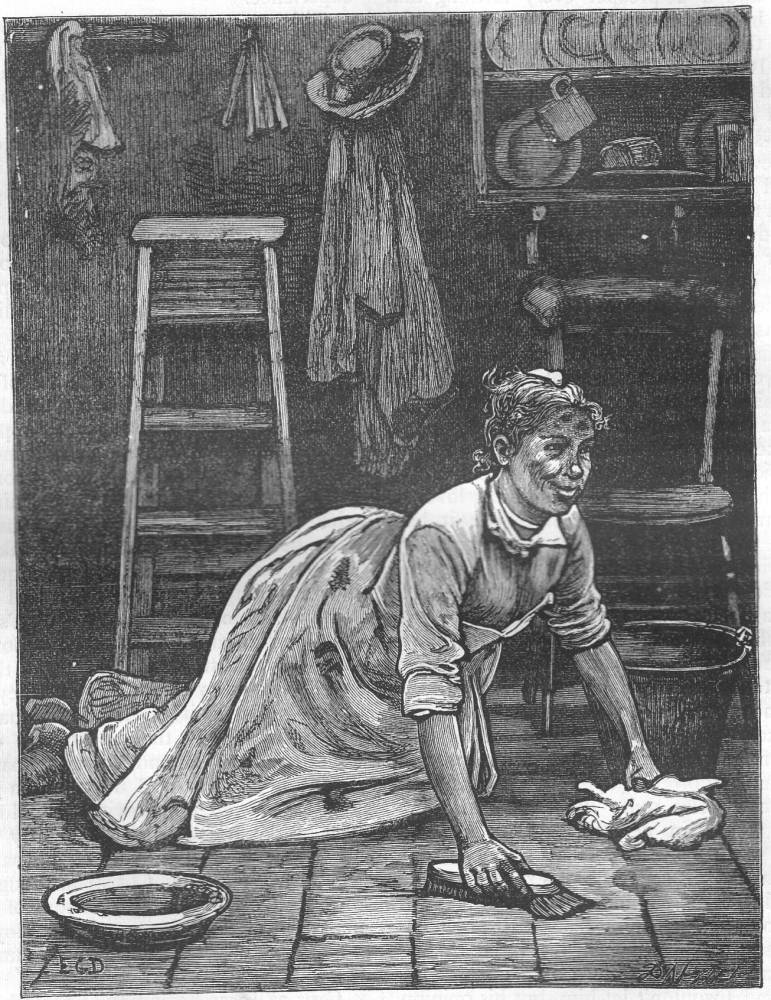
Evelina probably paid less attention to the weather than her father-in-law, because she was focused on the ritual spring cleaning. She hired extra help in the form of Mrs. Patterson, who may have been Mary Patterson, the forty-ish wife of Thomas Patterson, a farmer in Bridgewater.

Whoever she was, Mrs. Patterson proved a boon to Evelina. The two women were busy all day cleaning, washing the floors, putting down carpet, and putting up new wallpaper. Evelina never changed out of her work dress, as would have been customary in the afternoon, and barely sat down. Meanwhile, the regular servant, Jane McHanna was preparing the meals and tending to the ordinary chores of the house.

The trellis that Evelina and Oakes ordered from Lucius Clapp arrived today, and was most likely placed, free-standing, somewhere in the yard. It could well have been a centerpiece for Evelina’s flower garden.

*Illustration from “Mrs. Lirriper’s Lodgings,” 1863, published in Charles Dickens’ periodical, All the Year Round

May 20, 1852


Mattress

1852

Thursday May 20th  Went to Bridgewater quite early this

morning and did not get back until

after four Oclock  Bought an oilcloth

carpet for the dining room,  Straw carpet

for O Angiers chamber and engaged some

husk mattress  Called into Edwins after 

I returned  Have a bad head ache.  Very pleasant

Today’s shopping objective: new floor coverings for the dining room and a bedroom, as well as “some husk mattress.”  At least one of the mattresses of the house was due to be restuffed or entirely made over.

By the mid-nineteenth century, mattresses were stuffed with various materials, including cotton batting, wool, horsehair or corn husks. As they had been for centuries, mattresses were placed within a wooden bed frame and set atop a latticed support of rope or leather or wire. The box-spring that we use today would come along a few decades later.

It’s a little curious that Evelina “engaged some husk” for a mattress, when she could have selected cotton or something finer, like down. Feathers would have required poultry, however, which the Ameses didn’t keep, and were expensive to purchase. The husks, probably harvested the previous fall from a corn harvest and dried over the winter, would have been less expensive.

By the end of the day, Evelina had a headache. Perhaps her long day of shopping or a bumpy ride to and from Bridgewater set her off.  With so much time spent outside, a high pollen count could have been the culprit, too, and might also account for Susie Ames’s recent nose bleeds.

May 19, 1852

a57b960ef05c59d007f70efe1b8f5f79


Wednesday 19th May  Washed the windows in the 

parlour and cleaned it   all that is necessary this spring

Was about house until about four Oclock

when Mrs Swain came and spent the 

afternoon  Mr Swain came to tea  Worked

on the garden about an hour  Susan has

the nose bleed almost every day.  This afternoon

came home before the school was done


Spring cleaning was late this year, as the women’s attention had been given over to family illness. The kitchen had been repainted some weeks earlier, but other rooms hadn’t been dealt with. Evelina set out to rectify the delay and, probably with support from Jane McHanna, donned her apron to tackle the best room in the house, the parlor, much of which had been redecorated back in February, so needed little attention beyond its windows and a basic cleaning.

One imagines Evelina and Jane in working clothes as they went about with their brushes, rags and mops. But what did Evelina wear under her apron, or after she changed out of her choring dress? Was she wearing any mourning attire? Did her outfit signify at all the recent loss of her nephew George?

In the 19th century, “[m]ourning was particularly a woman’s affair,”* perhaps because of a societal norm that women were sentimental and emotional, and men were not. There were rules about attire to be followed after the loss of a loved one. At the beginning, black crepe dresses, black veils or headgear, and even black jewelry – onyx, usually, or pins netted with a lock of hair of the departed – were expected to be displayed in some manner. After a certain period, black was put away and lavender, grey or purple dresses were acceptable. The closer the relative was to the deceased, the more exacting the expectation.

In her fine book about death in the Civil War, This Republic of Suffering, Drew Gilpin Faust notes:

“By convention, a mother mourned for a child for a year, a child for a parent the same, a sister six months for a brother. A widow mourned for two and a half years, moving through proscribed stages and accoutrements of heavy, full, and half mourning, with gradually loosening requirements of dress and deportment. A widower, by contrast, was expected to mourn only for three months, simply by displaying black crape on his hat or armband.”**

By these calculations, Sarah Ames Witherell had been dressed in black or lavender too often before. Her husband had died in August, 1848, her young son Channing in May, 1849 and now her son George. Sad to say, she would have had a black dress or two, plus the appropriate accessories, in her cupboard. But what was Evelina obliged to wear? Perhaps not a black dress – although she had one – but an armband? Or a black ribbon in her bonnet? What was the expectation for an aunt?


Jack Larkin, The Reshaping of Everyday Life, New York, 1988, p. 102

**Drew Gilpin Faust, This Republic of Suffering, New York, 2008, p. 147


May 18, 1852

Dianthus.2474433_std

Pinks


1852 Tuesday 18 May  Have accomplished but a very little work

to day  Made a long call in Olivers & the other

part of the house talking over my visit yesterday

Set out some pink slips &c that I got there

About three started for N Bridgewater met

Alson & wife turned about and came back

Spent the rest of the afternoon at Edwins.  called

at Augustus,  her sister Elizabeth there

The visit to the Kinsley family that Evelina had made the day before lingered in her mind. She talked about it with both sisters-in-law, no doubt describing the family, the conversation, and the twelve pots of flowers she got to bring home. Was she bragging or sharing? Were Sarah Ames and Sarah Witherell interested or only tolerant? The Kinsleys were well-to-do, prominent citizens of Canton, so one suspects that both sisters-in-law had some curiosity about them. Yet it had only been a week since George Witherell had died, so Sarah Witherell may have had limited attention for Evelina’s gadding about.

After her “long call” with her relatives, Evelina spent time in her garden planting “some pink slips &c” that she got in Canton.  Pinks are bright little flowers that we know better as carnations and more formally as dianthus.  The name comes from the “pinked” or serrated edge of the petals, as if trimmed with pinking shears. Pinks are a traditional flower for a cottage garden; botanist Joseph Breck declared that “There is no flower more desirable in the flower-garden that the Carnation. A well-grown, superior variety, cannot be surpassed, in elegance, beauty, or odor, by any other flower.”*

The pretty little flowers in Evelina’s garden must have brightened up the yard of a home whose occupants needed cheering up.


Joseph Breck, The Flower Garden or Breck’s Book of Flowers, Boston, 1851, p. 111


May 17, 1852

180px-Beekman_greenhouse

Mid-19th century American Greenhouse*

1852

Monday May 17  Finished planting my flower seeds

Mr Blodget here to dine from Boston

This afternoon have been to Mr Kinsley with

Mr Ames.  Miss Nevill there from Salisbury.

Brought home twelve pots of flowers from

their green house.  The grapes & flowers look

finely  Had a very pleasant visit got home

about dark

Evelina enjoyed herself today. It was lovely outside, for “the sun shined about half the day + was pritty warm wind west + south west.”** She gardened for much of the morning and in the afternoon, rode with her husband, Oakes, to Canton to call on the Kinsley family.

Lyman and Louisa Kinsley, whom we’ve heard of before in Evelina’s diary, were about the same age as Oakes and Evelina. They had two children, Lucy Adelaide and Edgar Lyman, who were twelve years apart, suggesting that there may have been other children born between the two. Lucy was close in age to Oakes Angier, and Edgar was a year or so younger than Susie.

The Kinsleys were prosperous; Mr. Kinsley ran an iron business that had been started by his father and had long supplied material for Ames shovels. The Kinsley Iron and Machine Company would eventually be bought by the Ameses and managed by Frank Morton Ames. That being some years in the future, the Ameses could sit and admire the Kinsley place with little thought of acquisition – perhaps. Certainly, Evelina was much taken with the Kinsley greenhouse and the “twelve pots of flowers” she got to take home.

Greenhouses such as Mr. Kinsley’s were becoming more popular in the mid-19th century, particularly in England after the government there did away with the heavy tax on window glass. Hothouses had been known previously on this size of the Atlantic, also, appearing in the colonies as early as 1737, when wealthy Bostonian Andrew Faneuil built one. George Washington, too, had one built at Mt. Vernon to grow pineapple. Greenhouses would increase in size, status, and grandeur as the century progressed. Easton would see its share when the next generation of wealthy men reached maturity. Frederick Lothrop Ames, Edwin Williams Gilmore and probably others would raise orchids and more in the glass-walled wonders.

*Greenhouse from Beekman Estate in Manhattan, circa 1850

**Oliver Ames, Journal, Stonehill College Archives, Arnold Tofias Collection

May 16, 1852

lclapp-1

1852

Sunday 16th May Mr Whitwell preached a funeral sermon

and very good  At noon mother Henrietta

and self spent at Mr Whitwells  After meeting

Mr Ames Susan & I rode to Mr Clapps made

quite a long call  he has but a very few 

flowers in blossom, pansys were very pretty

Have engaged a trellis of him

The last formal recognition of the death of fourteen year old George Witherell took place in the Unitarian church this Sunday when the minister “preached a funeral sermon.”  Different from the ritual text that probably defined the graveside service just three days earlier, the sermon was presumably a collection of thoughts about death in general and the death of the young man in particular.  Reverend Whitwell knew the family well and, being an articulate and thoughtful wordsmith, must have offered the family some personal comfort and consolation.

Evelina appeared to be recovering her strength. With her husband and daughter, she rode to Stoughton after church to visit Lucius Clapp, where they made “quite a long call.” Evelina discussed flowers and a trellis. Was this trellis ordered in place of the one at the front door that was being built only ten days earlier?  Or was this a new trellis entirely, designed perhaps for the garden?  Was this the year of the trellis?

One imagines that Oakes Ames offered less direction about the trellis than his wife.  What he might have preferred to discuss with Lucius Clapp was their shared interest in the Whig party, or their mutual respect for temperance.  According to one nineteenth century historian, Mr. Clapp was a “kind-hearted”* man with a “modest and retiring nature.”* His politics were informed and liberal:

Formerly a Whig, Mr. Clapp has been identified with the most progressive political creeds. He was one of the original Free Soilers, and chairman of the first Free-Soil meeting held in Stoughton. Since its organization he has supported the Republican party. He has been [a] member of school committees several years, and selectman of Stoughton seven years, and now (1883) holds that position. He has always been pronounced in advocacy of temperance, and has been connected with every movement for the betterment and advancement of his native town. He is an attendant and supporter of the Methodist Episcopal Church.”*

Mr. Clapp and Mr. Ames would have had much to talk over.


*D. Hamilton Hurd, History of Norfolk County, Massachusetts, 1884, pp. 424-425