November 20, 1851

OLYMPUS DIGITAL CAMERA

Thursday Nov 20  I had to get breakfast again this 

morning and do most of the housework  Jane

assisted some and ironed three fine shirts &

washed the dishes after dinner  Mrs Whitwell

came with Mr Brown when he came to school

and staid untill about three and Mr Whitwell

came for her,  after she left I prepared the

mince for pies  Jane chopped the apple

With Jane McHanna continuing to feel poorly, Evelina again cooked breakfast. As her grandson, Winthrop Ames later pointed out, “family breakfasts were promptly at six – and no sketchy affairs of orange juice and a bit of toast either, but substantial meals of mill-ground cereals, eggs and often meat.”* Evelina was cooking for five people, not counting Jane or any other help. She also would have had to prepare the main meal at midday, and tea later on. Today’s tea may have been a simple affair.

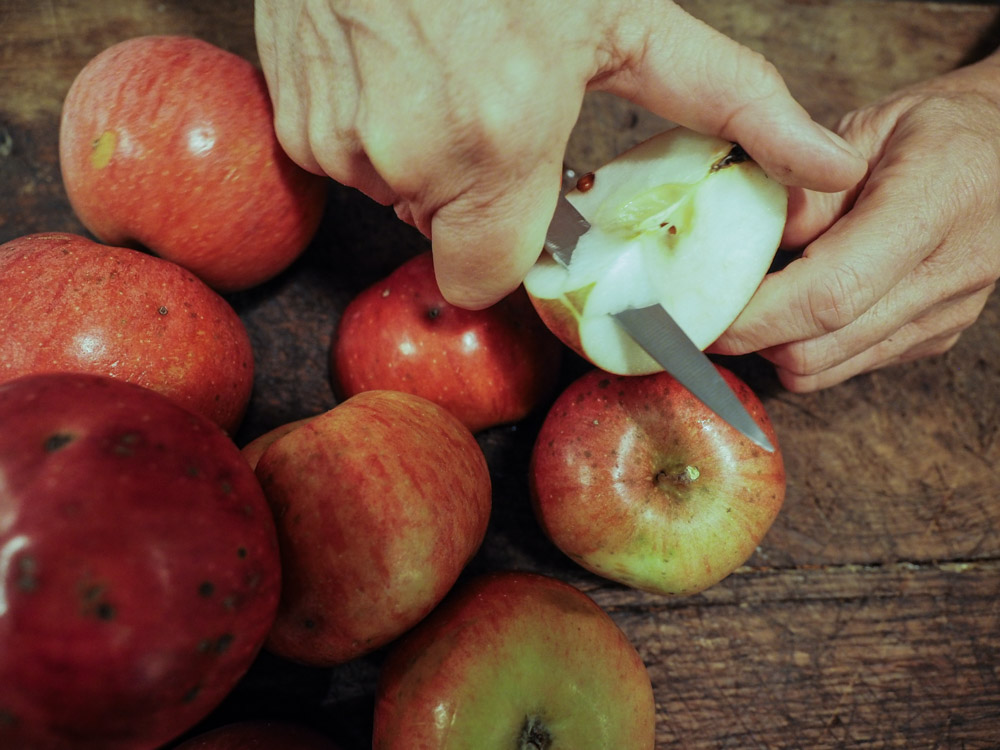
Jane felt a bit better as the day wore on and managed to iron shirts, wash dishes and chop apples for baking.  When Evelina wasn’t sitting with her afternoon visitors, Eliza Whitwell and Erastus Brown, she worked in the kitchen on her mincemeat. Thanksgiving Day was only one week away, and the preparing of food for the feast had begun. Pie time!


**Winthrop Ames, The Ames Family of Easton, Massachusetts, privately printed, 1937, p. 128

November 19, 1851

Barberries

Wednesday Nov 19th  Jane is not as well  I got the breakfast

this morning and have been scalding my barbaries

and put more apples to them and have been

about house all day  Painted some mustard

boxes &c  Mrs Wales & Williams called

Mr Whitwell called but I was busy up stairs

and he found no one below and he went

away without seeing any one

Evelina made breakfast as Jane McHanna, usually in the kitchen preparing coffee and the morning meal,  was ailing. Evelina stayed in the cook room for much of the day, “scalding my barbaries” to be put away.  Barberry was a common, woody, hedge shrub with a couple of domestic applications. Cultivated in the 17th, 18th and early 19th centuries, the fruit made “an agreeable, refreshing jelly,”** and the stems could also be used to make a yellow dye.  Evelina wouldn’t have needed the dye; she bought all her textiles.  But she used the fruit for jelly and pies.

Once Evelina got out of the kitchen, she picked up a paint brush to freshen up some mustard boxes. These were small to medium-sized wooden boxes for her pantry. Spices and other kitchen ingredients would have been stored in them. Evelina seemed to be getting her kitchen in perfect order for the Thanksgiving rush.

*Image of barberries courtesy of http://www.womenfitness.net/barberries.htm

** Mrs M. Grieve, A Modern Herbal, courtesy of http://www.botannical.com

November 18, 1851

IMG_2477

Horatio, Oakes, and Oliver Ames, Jr.*

Tuesday Nov 18th  Jane is not well at all she has done

the housework and starched the shirts and

ironed a little. I have swept the house most

all over except the parlour and been doing

little here and little there, have not sewed

at all.  I begin to think I never shall.

This evening have cut some more apples to put

to the barberries and picked over the mince pie meat


Evelina’s domestic concerns were disrupted by Jane McHanna’s illness. Although Jane tried to help a little, Evelina did most of the work, and sounded annoyed about it. She wanted to be sewing, not choring.

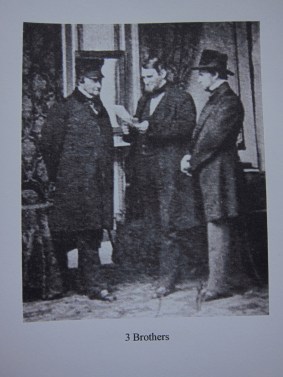
Today was the birthday of Horatio Ames, second son of Old Oliver and Susannah Ames.  Born in 1805, he had grown up in Easton to become a “towering”** man, yet was considered by most to be less capable than his powerful older brother, Oakes, or his next-youngest brother, Oliver Ames, Jr. Staying close to home, they prospered. Horatio and another brother, William Leonard, on the other hand, left home to find fortune and were less successful.

Horatio’s personality was part of his problem. His behavior could be crass, his attitude pugnacious. Modern historian, Gregory Galer, has noted:

“One obstacle Horatio Ames faced his entire life was others’ negative reaction to him personally.  Horatio was a large man, apparently with a high-pitched voice, and his physical features may have emphasized his irritating tendencies.  However, his direct, aggressive, and often foul-mouthed manner instantly limited his ability to gain supporters.  He seems to have had little tact and poor social skills.”***

As an adult, Horatio married an Easton girl and settled into a house in the village built for him by his father. Soon, however, he and his young family moved away, first to Albany and then to Fall River, Connecticut, where, with others, Horatio established a family-backed ironmaking enterprise.  Over the years, the business would be innovative, the iron it produced would be of better quality than other iron from the area, yet the business would never quite take off. Horatio would strive and struggle, yet never achieve the success of his two brothers back in Easton.

His personal life didn’t fare much better.  In 1853, his wife Sally Hewes Ames divorced him “on grounds of adultery with ‘divers women in New York.'”**** He was estranged from all three of his children, especially his two “miserable boys,” as he described them.  His eldest son, Horatio, Jr., was accused of attempting to murder him. His daughter Susan disobliged him by marrying a physician named Philander P. Humphrey, of whom Horatio didn’t approve. They moved west to Minnesota, where she, her husband and two of their three children were killed in an uprising on a Sioux reservation.

Horatio remarried in 1856. His second wife, Charlotte Langdon Ames, was sharper than his first wife. She tried to help manage the failing company and, after Horatio died from gangrene early in 1871, she maneuvered to keep his assets for herself.  She was bested by Oliver Ames, Jr., however, in a contentious court battle. Horatio’s business had been built with Ames money, and whatever money was left when he died was going to go right back home to Easton.

In her diary, Evelina seldom mentions Horatio or his wife at the time, Sally. Their families were not close.


*Courtesy of the Fall River, Connecticut Historical Society

**William Chaffin, History of Easton, Massachusetts, 1886, p. 345

***Gregory Galer, Robert Gordon, Frances Kemmish, Connecticut’s Ames Iron Works, New Haven, 1998, p. 157.

****ibid., pp. 158-159
November 17, 1851

Hoof

Monday Nov 17th  Jane has not been at all well to day

but she has done the washing and went to

bed early in the evening  I did the housework

to day and was about all this forenoon  This

afternoon have been to Mr Nahum Williams

with Mrs S Ames  Mr Seth Williams died

Friday night and is to be buried tomorrow at

ten Oclock.  We drive the new horse for the first.


The stalwart Jane McHanna, now the only house servant at the Ames’s, did the Monday washing today despite feeling not “at all well.” By evening she was in bed. Evelina picked up the slack and did the rest of the housework herself, something she was fully capable of doing.

Despite the extra choring that she did, Evelina and her sister-in-law, Sarah Lothrop Ames, found time to ride out of the village to call on Nahum and Amanda Williams.  Nahum, who lived in Furnace Village, was most likely the son of the Seth Williams who had just died. As was customary, the Ames wives helped tend the dead, the dying, and their families in their community.

A little more than twenty years later, on September 1, 1873, Nahum Williams himself died, and Sarah Lothrop Ames and her husband, Oliver Ames, Jr. along with her brother, George Van Ness Lothrop and his wife, Almira Strong Lothrop, would attend his funeral. Clearly, Nahum had a long-standing relationship with the Lothrop family, if not the Ameses, too.

November 16, 1851

IMG_0017

Modern photograph of house in North Easton built by Edwin Williams Gilmore, 1851


Sunday 16th  We have all been to meeting all day

Went to Mr Whitwells at noon with mother

rode with our new horse do not believe he

is any great affair  Edwin took tea with 

us and I went into his house with him  Wrote

a letter to Oliver.  Oakes A went to North

Bridgewater to see Mr French about selling

some hogs for father.  I asked once to let me go but

he went without me


The Ameses went to meeting today, naturally, and Evelina visited with her mother at the parsonage during intermission.  The Ames family often rode in tandem if not together to church; Evelina perhaps rode in a carriage with Old Oliver and Mrs Witherell.  She certainly seemed underwhelmed by the new horse that Old Oliver had recently acquired.

Edwin Williams Gilmore, Evelina’s nephew, stopped by for tea at the end of the day.  He was building a house in North Easton, barely a stone’s throw away from the Ames compound. Although he may have worked at the shovel factory at this time, he would soon embark on a business of his own: a hinge factory that would be a successful enterprise for decades to come. He wasn’t interested in working and living on the family farm; that job would fall to his younger brother, Francis.

For now, Edwin was an ambitious twenty-three year old who wanted to live in the village.  The house, which his father, Alson, had been helping him build, was almost ready. His next step would be to marry, and he evidently had a wife in mind: twenty-two year old Augusta Pool, his neighbor near the farm. Evelina may have been privy to Edwin’s plans; if not, she surely enjoyed looking in on the new property so close to her own. Her visit with Edwin perhaps made up for not going with her son Oakes Angier to North Bridgewater.


November 15, 1851


SUGARLOF

1851

Sat Nov 15th  Another day I have been about house all

day, this morning helped the gardener weigh out

a box of sugar that we bought in Boston

got my bags of cloth of different kinds

in order in the shed chamber  It has been

very stormy all day Mr Ames and Oliver Jr

in Boston Oliver went yesterday He looked 

at carriages but did not purchase one

Bridget gone to housekeeping

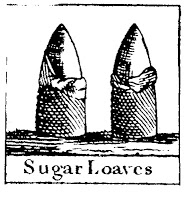
At the rate Evelina used sugar in her fruit preserves, she needed many loaves of it. Unable to purchase it at the family store in the village, she bought what they needed in Boston at Faneuil Hall.  On this day, she appeared to be breaking at least part of a sugar loaf into usable bits for her kitchen.  The family gardener helped her, perhaps because the sugar loaf was so heavy to hold.

Sugar wasn’t the only commodity that Boston had to offer.  Evelina’s husband, Oakes, and his brother, Oliver Ames Jr., had gone to the city, the latter in search of a new carriage. He – or they – didn’t purchase anything, just looked.  Oliver Jr. would have been very careful about the cost and quality of such a big item.  Both men would have admired the various coaches, chaises, gigs and traps they must have seen.

It’s worth noting that Evelina reveals today where she kept her “bags of cloth,” when not working on them: in the shed. As she organized them today, folding cloth and perhaps tossing any textiles that couldn’t be used, she would have heard steady rain on the roof.


November 14, 1851

Moby-Dick_FE_title_page


Tuesday Nov 14th  Bridget has cleaned the store room

and I have been working about in the chambers

have put Franks chamber in order papered

a little trunk &c &c  Have been working about

the house all day  I can scarcely tell what 

Im about all the time but I find something 

to keep me busy and I scarcely sew at all

Frank has been making a fuss about a robin to wear

The American edition of Herman Melville’s Moby-Dick or The Whale was first published on this date in New York, by Harper & Bros.  It followed a British edition that had come out about one month earlier.  Neither edition was a commercial success.

Today may have been a milestone for American literature, but the occasion went unnoticed by Evelina and most readers, discerning or otherwise. Evelina was focused, as usual, on domestic concerns “about the house,” including putting the bedroom or “chamber” of her youngest son, Frank Morton Ames, in order.  He, meanwhile, was complaining about an item of clothing that he needed to wear. Does anyone know what a “robin” is?

Old Oliver was, as usual, paying a farmer’s attention to the weather:  “this was a cloudy day most of the time the wind got round south west and was warmer than it has bin for several days past”.

November 13, 1851

Drum


Thursday Nov 13th  Have been cleaning the draws in

the beaureaus and have papered the closet beside

the fire place and painted some boxes &c

Ellen Meader […] has been making Susan a visit

this afternoon  The Stoughton band have been

in the neighborhood this evening. They marched 

and played up as far as the house and back to the

school house.  Went to Mr Swains and had coffee &c &c

Mr Ames has been to Boston

Stoughton, Massachusetts, has a wonderful musical legacy, most famously the Old Stoughton Musical Society, a choral group that has been active since 1786. Known in its first hundred-twenty years simply as the Stoughton Musical Society, some of its members referred to it as the “Grand Club”*. When it celebrated its centennial in 1886, Lt. Governor Oliver Ames and Governor George D. Robinson were two notable attendees at a celebratory concert. Oliver (3) was very fond of music; he even took singing lessons in his youth. He must have enjoyed the musical evening.

The long and revered history of the Old Stoughton Musical Society sheds no light on the existence of a Stoughton marching band, however. Evelina’s entry may be the only known mention – at least to date – of such a band.  On this day in 1851 it marched and played instruments through the village of North Easton, presumably after the factory had closed for the day. Why did it stop at the Ames’s house? What was the occasion? Surely the music it played was a welcome change from the usual clanging and hammering that emanated from the shovel shop.

Other than this pleasant interlude, Evelina’s day was ordinary.  While her daughter Susie had a friend over, Evelina cleaned, papered and painted.  Later in the day – perhaps as she accompanied little Ellen Meader home – she had “coffee &c &c” at the home of Ann and John H. Swain.  Oakes Ames spent the day in Boston.


Mary Swan Jones, The One Hundredth Anniversary Celebration, 1886


November 12, 1851

IcePond-732701

*

Wedns Nov 12th  Painted the closets in the sitting

room chamber which with other things has taken

me most of the day.  Susan has passed the 

afternoon at Mr Swains  Mr Whitwell called

this afternoon. I felt very sorry to stop my work as

I was very much engaged at the time  Have not

sewed at all to day  This evening have felt too much

fatigued


According to Old Oliver, “this was a fair cold day wind north west. the factory pond was frozen over this morning”  It was a good day to stay indoors, which Evelina did.  She still hadn’t completed all the refurbishments on the house, so she spent the day painting the shelves in the closet in the sitting room; the shelves in the parlor were already finished.  By evening, she was “too fatigued” even to sew.

Daughter Susie spent the day at the home of Ann and John Swain, perhaps playing with Ann’s niece, Ellen Meader.  Reverend William Whitwell braved the north west wind and paid a call on Evelina.  Much as she liked him and admired his Sunday sermons, she was less than pleased to set aside her painting for his visit.

And “the factory pond” – probably Shovel Shop Pond – had skim ice, at least, all the way across it.  What did that do to shovel production?  How did the dams, flumes, and wheels work when the water began to ice up?


*Photo courtesy of Kenneth Aisawa, http://www.theboundsofcognition.blogspot.com

November 11, 1851

Helen Angier Ames

Helen Angier Ames


Tues Nov 11th  Jane and Bridget washed this morning and I have

cleaned the front chamber closet and put things in

order in the chamber and worked about house untill about

four and went to tea in Olivers  Mr & Mrs Swain and 

Mrs Meader (Mrs Swains brothers wife) were there

Father & Sarah and her children dined there  They

had ducks for dinner

Post-election political discussions were no doubt rebounding in print news across the nation but in North Easton, Massachusetts, at the Ames compound, domestic concerns held sway. There was washing, cleaning and tidying up to be done. Laundry day had been postponed from its usual Monday slot; perhaps Evelina had waited for Jane McHanna to return from Mansfield. Evelina didn’t like doing laundry at all.

Today was Helen Angier Ames’s fifteenth birthday.  The only daughter of Sarah Lothrop Ames and Oliver Ames, Jr., she was at school in Boston, so not able to celebrate at home. Neither was her brother Fred at table, for he was at Harvard.  Perhaps the roast duck that Sarah and Oliver served to their dinner guests was in Helen’s honor, in absentia.

Helen Ames never married, choosing instead – or learning to accept – spinsterhood in North Easton and Boston.  She had a small social life with friends and family and when the railroads became more established, she traveled with her parents and cousins to places like Niagara Falls, Detroit, and points west. She played piano very well, occasionally playing the reed organ at the Unitarian church, where she was “acknowledged to be the best performer.”** Her uncle, Cyrus Lothrop, named one of his sailing vessels after her: the Schooner Helen A. Ames.

As a teenager, Helen enjoyed the company of Evelina’s niece, Lavinia Gilmore, another young woman from Easton who would never marry. Helen also was in school with a friend from Bridgewater named Catherine Hobart, the youngest daughter of a family well known to the Ameses.  Catherine, or Cate, would one day become her cousin Oakes Angier’s wife.

Helen’s father died in 1877, her mother not until 1894.  In 1882, at the age of 46, she herself “died suddenly in the prime of a life of thoughtful and generous service, deeply honored, loved, and lamented.”* Her brother, Fred, commissioned John LaFarge to create a stained-glass window, the Angel of Help, for Unity Church in memory of a sister he had loved.


*William L. Chaffin, History of Easton, Massachusetts, 1886, pp. 411-412

**Winthrop Ames, The Ames Family of Easton, Massachusetts, privately printed, 1937, p. 130