August 11, 1851

220px-Brooklyn_Museum_-_The_Invalid_-_Louis_Lang_-_overall

*

Aug 11th Monday  Had a new girl come to day to assist some about

the house and help me sew.  Went to assist Mrs Holmes

found her sick abed and alone her aunt Clifford

left her as sick as she is. She must be an unfeeling

woman  Mr Holmes went to Canton with the team and

will try to get his mother for a few days. Julia Waters

did up the work this morning  This afternoon she has

been all alone with Willie  I made her bed for her at night

Harriet Holmes, Evelina’s neighbor, continued to be quite ill.  Evelina and others looked after her, including an aunt who departed her post before a new helper arrived, earning Evelina’s stern disapproval.  As Harriet had a toddler, Willie, to look after, the aunt leaving her alone was not only “unfeeling,” but negligent.

Help was on the way. Harriet’s husband, Bradford, drove a team – of oxen, most likely – to Canton to fetch his mother. Before they returned, Evelina made fresh the sickbed, as she had done on other nights. Harriet would be tended to.

And this morning, even as Jane McHanna wrestled with the weekly wash, a “new girl” entered the Ames household to help with the chores and the sewing. That must have brightened Evelina’s Monday.


* Louis Lang, The Invalid, 1870, oil on board, Brooklyn Museum of Art, Gift of Mrs. Walter deForest Johnson.


August 10, 1851

il_570xN.520777977_foe3

*

1851

Aug 10th Sunday  As usual have been to church to day

Mr Whitwell preached.  Went to the

methodist meeting house to a sing at 5 Oclock

got sick of it and went home at recess.

Oakes A Oliver & Helen Ames went with Orinthia to the

sing and carried her home.  Frank went from 

the sing and carried Ellen H & Louisa Swan to 

ride

Her sons clearly enjoyed music, but Evelina’s appreciation was perhaps not up to theirs, if her reaction to today’s musical gathering is any indication. That, or the singing wasn’t very good.  She “got sick of” the sing at the meeting house and left when she could. Perhaps she was just ready to be at home at the end of a long, hot Sunday and already anticipated the choring and sewing ahead of her tomorrow. She may have had a good book waiting for her.

Oakes Angier, Oliver (3) and Frank Morton were regular attendees at the sings; they enjoyed the music.  They also enjoyed the company of a circle of friends who attended the sessions, including Ellen Howard and Louisa Swan. Frank Morton was the son who drove Ellen and Louisa home, while Oakes Angier and Oliver (3), along with their cousin Helen Angier Ames, drove Orinthia back to the Howard house.

Ellen Howard was the tenth of Elijah Howard’s twelve children (by three wives.) Small wonder that the Howards were willing to board Orinthia Foss for a time; Nancy Howard was quite used to setting many places at what must have been a capacious dining room table. Ellen Howard ended up marrying George Withington, a Unitarian minister who came to town about this time. He ultimately left the ministry and served for many years as Easton’s town clerk.

Louisa Swan was the daughter of Dr. Caleb Swan, who had eleven children by his three wives. Louisa never married; she eventually left Easton for Vermont, where she lived with her sister Ruth who was married to U. S. Senator Justin S. Morrill.

* Currier & Ives,The Morning Ride,”  1859

August 9, 1851

Early-Tornado-Drawing_GrazulisBook


*

Aug 9th Sat  Was mending most of the forenoon after doing

my chamber work  This afternoon Helen & I have

been to Mothers found her quite sick with a cold

so that she could not speak aloud.  Called for

Orinthia to carry her with us but she did not go

Brought her home with us at night  Just as we 

got to Mr Howards there came up a tempest &

we stoped untill it was over

Helen Angier Ames, aged 14, accompanied her Aunt Evelina this afternoon to the Gilmore farm, perhaps to see Evelina’s niece, Lavinia Gilmore, aged 19. The two young women were friends. The schoolteacher, Orinthia Foss, was invited to go along as well but declined. Instead, she joined Evelina and Helen on their return trip.

As she often did, Evelina went to visit her mother and family at the farm where she grew up. Hannah Lothrop Gilmore, aged 79, lived most of the time with her son Alson. She was usually in good health, but today she was “quite sick” with a summer cold and laryngitis.  Illness seemed to be all around Evelina in these dog days of summer.

On their ride home, the women encountered a storm violent enough to make them stop off at the Howards’ house. The outburst was, in fact, part of a squall line that produced a tornado in Hartford, Connecticut.  A “tempest,” Evelina called it, using a word that nowadays isn’t often heard in American English.  Modern usage might describe the storm less poetically as a “weather event.”

*U.S. Tornado Early History, http://www.ustornadoes.com  

August 8, 1851

SE004034small

1851

Aug 8th Friday  My teeth are very sore to day and I feel about

sick and did not go into Mr Holmes very early

Went about ten Oclock and made her bed and

fixed her hair  Went in evening and found

Mrs Witherell making her bed  Mrs Witherell

has had her parlour painted a[nd] papered she

is very much dissatisfied with the way the paper

is put on and talks of having it scraped off

The aftereffects of the dental care that Evelina received yesterday from Dr. Washburn made for a slow and unpleasant start to her day.  By mid-morning, however, she was out and about. She went to the neighbor’s to check on the ailing Harriet Holmes.  She went back at night, too, and found her sister-in-law Sarah Witherell in attendance.  Both women took time to arrange Harriet’s bed linens, perhaps removing them for cleaning.

Sarah Witherell had done some painting and papering in her parlor with which she was unhappy.  She would have had to get permission and funding from her father, Old Oliver, for the project.  We see from this that Old Oliver was capable of spending money for decoration, perhaps especially if his daughter requested it. How he took the news that the decorating would have to be redone isn’t recorded, however!

Evelina was so preoccupied today that she may not have noticed that the haying was finally over.  Old Oliver announced yesterday that it had been“a midling good hay day. […] we got in the last of our hay to day – we have had bad weather for haying this year + have bin a long time about it”

August 7, 1851

Teeth


Aug 7th Thursday  Have been to Bridgewater to day

to have my teeth fixed  Dr Washburn kept me there

untill past twelve and then said he should have to heat

up the teeth which take an hour and half.

Left them with him and went to Mr Harris’ and 

returned at night for them.  Oliver was with me

we called at Mr J Mitchells.  Mrs Mitchell & sister

Harriet had gone to Marshfield

It says a great deal about 19th century dentistry that the illustration above, made for a spelling book, used an image of dentures to depict the word “teeth.”  In 1851, false teeth were the norm for most adults. Dental hygiene was primitive and regular care by professionals unavailable. Although brushes for teeth were around, toothpaste didn’t come in until the 20th century.  Those who could afford to pay a dentist usually ended up with false teeth. So it was for Evelina, who had dentures, or at least several false teeth that she had to leave at the dentist’s today to be fixed. Her son, Oliver (3) accompanied her.

Nahum Washburn was the Ames family’s dentist.  A graduate of Dartmouth College, he was trained in homeopathy but preferred dentistry.  He had an office in Bridgewater from 1840 to 1883.

Washburn cared about the pain that his patients had to go through and developed a machine to reduce their discomfort when he worked on their mouths.  In 1859, he obtained a patent for a

“DENTAL APPARATUS FOR RELIEF OF PAIN WHILE OPERATING”

a contraption that was “a combination of dental forceps…with [an] electro-magnetic mechanism…so that the electrical current or currents [could] be made to flow through the nerve or nerves of the tooth, or the jaw or flesh immediately contiguous…in order to benumb the same and render such more or less insensible to pain during the performance of the dental operations. ” *

Doesn’t sound all that painless.


*Journal of the Franklin Institute, Volume 69, Philadelphia, p.165


August 6, 1851

Thread

1851

Aug 6th Wednesday  Immediately after breakfast Mr Holmes

came in and said his wife was very sick and

wished me to go in there  I found her in a high

fever with frequent chills  staid all the forenoon

Was expecting to go to the sewing Circle this

afternoon at Mrs Roland Howards but could

not have a horse untill it was too late to go

Made Mrs Holmes bed in the evening

Harriet Holmes, a neighbor in the village, took ill and Evelina, summoned by the husband, Bradford Holmes, went to their house to help. In an era when trained nurses were not widely available, and physicians an expensive service, many families relied on caring friends and relatives to look after the sick.  Evelina and her sisters-in-law often helped nurse the ill in the village.

Harriet Holmes was the same woman who herself had looked after two invalids the previous winter: her own mother and a Miss Eaton, both of whom died. Harriet was in her mid-thirties and had three young children to look after. Her husband was a teamster, probably for the shovel company.  He would have looked after the oxen and, more than likely, was one of the men called into service to bring in the hay.

Evelina tried to juggle her nursing of Mrs. Holmes with the monthly meeting of the Sewing Circle, but couldn’t bring it off.  She couldn’t get a horse until it was too late, so she gave up. Horses, too, may have been pressed into service for the haying which was, according to Old Oliver today,  “a fair good hay day. wind south west most of the time.”


August 5, 1851

Haymaking

1851

August 5th Tuesday  Have been sewing part of the day

This afternoon took my work and went to Mr

Torreys with the intention of stopping an hour or two

Abby left this morning for Pembroke & I had a 

long chat with Mr Torrey heard all the news.

On my return called on Mrs Lake found her

about house & quite smart.  Heard that Mrs Holmes

was sick

Haying continued, as Old Oliver noted yesterday in his journal:

“in the morning the wind was south west + there was a verry little sun shine untill about 10 – O – clock when the wind shifted to the north east. + it raind in the afternoon but not butt little we mowd the thin part of the Flyaway and brought it home well. + put it out in small heaps”

Evelina worked on her sewing, as usual, and even carried it with her in the afternoon into the village where she visited Col. John Torrey for “a long chat.”  John Torrey was a widower twice over. He had been married first to an Abigail Williams who died quite young. They had no children. In 1828, Torrey married Evelina’s older sister, Hannah Howard Gilmore, and they had three children, of whom two survived infancy:  Abigail “Abby” Williams Torrey, named for the first wife, and Mary Malvina Torrey. Both girls were close to their Aunt Evelina who seems to have served as a maternal figure after Hannah died sometime in the 1840s.

Col. Torrey was a controversial figure in Easton of whom we know only enough to be curious, and not enough to have that curiosity satisfied. (He should not be confused with another John Torrey who was a prominent botanist in New York in the same era.) Listed as a “Trader” in the census, he earned the title of Colonel by years of service in the local militia. Somewhere along the way Torrey invoked the enmity of a local character and lampoonist named James Adams who wrote a derogatory poem about him. Historian William Chaffin recorded this information without including the piece in question.  Chaffin only said that “Our Hero: A Descriptive Poem,” was published in a sixteen-page pamphlet and was “not merely satirical, but derisive and scathing.”*

* William Chaffin, History of Easton, 1886, pp. 764-765


August 4, 1851

9999008697-l

[No entry]

Evelina made no entry today in her diary, for reasons we’ll never know.  Too hot? Too cross? Too busy? Too much laundry? We can only guess.

Instead of commentary, we’ve posted an image of the Ames family tree familiar to many Ames descendants, especially those who own copies of Winthrop Ames’s 1937 family history, The Ames Family of Easton, which includes a fold-out version of this illustration.  The tree features the lineage of the two Ames brothers who stayed in North Easton: Oakes and Oliver Jr., but doesn’t include the other sons and daughters of Old Oliver and Susannah who also produced issue: Horatio, William Leonard, Sarah Witherell and Harriett Mitchell.

Some readers have asked for clarification on who was who within the family. What follows is a list of the children and grandchildren of Old Oliver and Susannah.  More information about this group and their descendants can be found in a detailed family geneaology produced by William Motley Ames and Chilton Mosely Ames in the late 1980s.

Old Oliver and Susannah’s children and their children in birth order:

Oakes Ames and Evelina Gilmore Ames had five children:

Oakes Angier, Oliver (3), Frank Morton, Henry Gilmore (d. young) and Susan Eveline Ames

Horatio Ames and Sally Hewes Ames had three children:

Susan Angier, Horatio Jr., and Gustavus Ames

Oliver Jr. and Sarah Lothrop Ames had two children:

Frederick Lothrop and Helen Angier Ames

William Leonard Ames and Amelia Hall Ames had seven children:

William Leonard Jr., Angier, Oliver, John Hall, Amelia Hall, Fisher, and Herbert M. Ames

William Leonard Ames and Anna Pratt Hines had one child:

Oakes Keene Ames

Sarah Angier Ames and Nathaniel Witherell, Jr. had three children:

George Oliver, Sarah Emily, and Channing Witherell (d. young)

Harriett Ames and Asa Mitchell had three children:

Frank Ames, John Ames, and Anna Mitchell

Two other children of Old Oliver and Susannah, Angier Ames and John Ames, died without issue.

August 3, 1851

Plaque for Catholic Church

*

1851

Sunday Aug 3d  Went to the consecration of the Catholic

Church dedicated to The virgin Mary. The bishop &

priest took a pail of water and a cedar twig and went

around the house and sprinkled the foundation with the

water and then the aisles & walls and some of the

congregation got a sprinkling. This afternoon went to

our own church.  Frank carried Orinthia home

Oakes A carried Louisa Swan to the hall under our

church to a sing & carried S E Williams & L Kimball

home from it

By 1850, Easton’s Catholic population, which had been almost non-existent before about 1840, now numbered approximately 150, primarily due to the influx of Irish Catholic immigrants, many of whom went to work at the shovel factory.  The Irish had no church of their own, and had been gathering for worship in a hall belonging to the Ames family on those Sundays when an itinerant priest came to town.  The congregation had outgrown that facility, however, and needed their own house of worship.

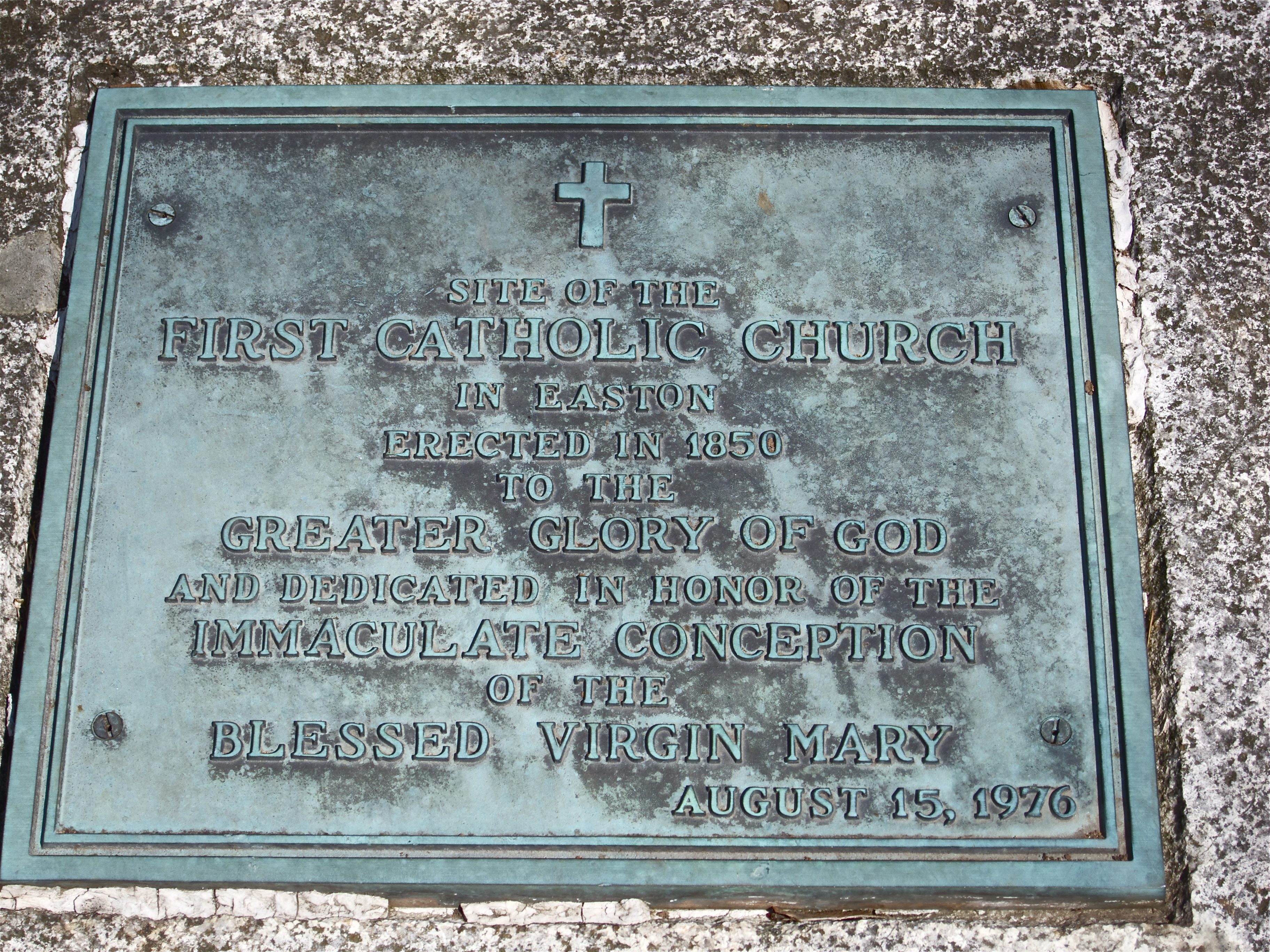
The Ames family donated a plot of land on Pond Street to the Catholics so that they could build their own church.  The stone plaque in the photograph above commemorates that first church, built in 1850 and consecrated on this very Sunday in 1851.  Evelina and, presumably, other members of the Ames family attended the consecration, a ceremony to which Evelina paid close attention.  They went back to their own Unitarian church in the afternoon.


* SITE OF THE

FIRST CATHOLIC CHURCH

IN EASTON

ERECTED IN 1850

TO THE

GREATER GLORY OF GOD

AND DEDICATED IN HONOR OF THE

IMMACULATE CONCEPTION

OF THE

BLESSED VIRGIN MARY

AUGUST 1976 [date of plaque]

August 2, 1851

65eb3ab64b1e3e383ab7982a18ea85a1

*

/51 

Saturday Aug 2d  Mrs James Mitchell, Cousin & sister Harriett

Mitchell came to the other part of the house to day

Sister Harriet returned to E Bridgewater with them

Frank went to Boston to see a Dr about his

throat got him a white hat.  We were all 

invited into Mr Bucks to see Miss Lothrop from

Boston  Orinthia & Helen went  Mrs Witherell

& I called after tea the boys went in the evening


Evelina felt better. She was back in the social swing today, going out after tea with her sister-in-law Sarah Witherell to meet a Miss Lothrop. Earlier in the day, Sarah Witherell had entertained two or three women named Harriet in her parlor in “the other part of the house”: sister Harriett Ames Mitchell, friend Harriet Angier Mitchell (Mrs. James Mitchell) and, possibly, cousin Harriet Ames. It’s also possible that Evelina, in writing the word “cousin,” meant to identify Harriet Angier Mitchell as a cousin which, by a stretch of several “removeds,” she was. In the latter case, there was no cousin Harriet Ames present. Confusing to us, certainly, and, perhaps, confusing to them.  Who was visiting in the parlor?

Old Oliver, meanwhile, was in the thick of haying season.  He noted that “this was a fair good hay day wind south west and we got in all the hay we had out some of it had bin out over a week and all of it since last Monday –“

One young man who was neither outside with a pitchfork helping his grandfather nor inside the factory fashioning a shovel was almost-eighteen year old Frank Morton Ames. Frank had been suffering from a sore throat that he evidently couldn’t get the better of, so he took off to Boston to have it looked at. When he returned to Easton, he reported nothing alarming.  Rather, he arrived with a startling new white hat, looking perhaps like one of the young men in the illustrated daguerrotype above. According to some sources, white beaver hats enjoyed a short vogue at this period. Frank must have stood out in the gathering at the Bucks’ house that evening.


* Image from Daguerreian Society, Mark Koenigsberg Collection