February 18, 1851

yoke-of-oxen

Feb 18  Tuesday  After doing my usual mornings work sit

down to sewing on Susans work   She sewed with me

and counted stiches again  She will do pretty well

and keep quite steady when we count stiches

This afternoon went into Olivers to assist on Helens

quilt but found it most done.  Was called home

to see Mr Whitwell   Abby & Malvina Torrey & their 

cousin Mrs Fullerton  called  Pleasant

Sewing lessons for eight-year old Susie Ames continued today.  She seemed to be getting the hang of the needle as long as she counted her stitches.  This meant calculating and maintaining an equal number of stitches per inch of sewing. After the lesson was through, Evelina tripped next door to help with the making of a quilt. She discovered that the work was pretty well complete, however, which was just as well as she was called back home to sit with Reverend Whitwell, who came to visit.  More follow-up to the Sewing Circle meeting?

Outside, away from this cozy domesticity, Old Oliver was clomping around looking at oxen to buy.  He found a pair that he particularly admired and seemed pleased with his purchase:

“this was fair day  wind about west and not cold   I bought a yoke of oxen to day of a Mr Whitcom of East Randolph for $125-00 they are a handsom red + look a good deal alike.  he said they would be 6 years old this spring comeing   the off one girts 7 feet + 2 inches + the nigh one 7 feet   they weighed after drinking with yoke on 3220 lb.  the man  said he had them for twins”

And while Old Oliver dealt with the farming side of the Ames enterprises, Oakes and his three sons were no doubt busy at the shovel works, the young men continuing to learn the ins and outs of manufacturing, much as little Susie was learning to be domestic.   The futures of all four offspring were being lined up.
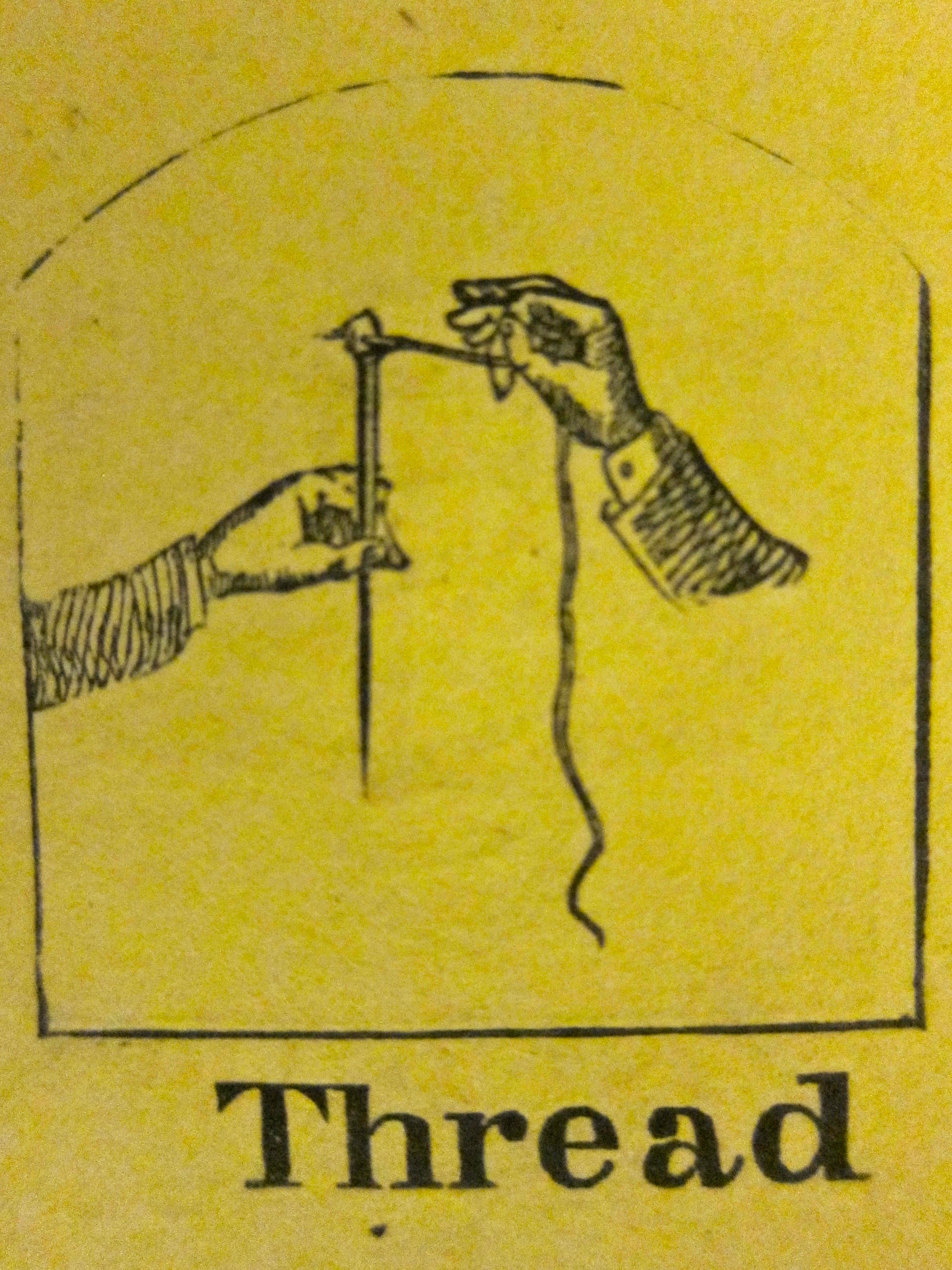
February 12, 1851

Thread

1851

Feb 12th This was the day for the sewing circle & what a crowded

house! Not one here except Mr Whitwell and our own

families  Father Ames came in to tea & Sarah W

George, Emily & Oliver & wife  Poldens boy was buried

to day  Isabell & Ann went to the funeral & took tea

with Jane after they came back.  I prepared enough

for 40 and think it is very provoking to have none

 of the members  It is a delightful day.  Letter from Miss Foss

No one came to Evelina’s party.

“Very provoking,” indeed.  Mortifying, even, that not a single member of the Sewing Circle attended today’s meeting, unless you count Reverend Whitwell.  All the preparations, the baking, the cleaning, the spools of thread from Boston, all in vain.

Evelina took the rejection with a lacing of humor: “What a crowded house!”  Although disappointed and upset, she must have been grateful for the way the Ames clan filed in to partake of the feast. From Old Oliver (who almost never came to tea) and all three Witherells to Oliver Jr and Sarah Lothrop Ames to her own children and husband, presumably, the family closed ranks around her and filled her parlor with warm bodies.  Even the Irish servant girls on their way home from a wake partook of the spread of food – in the kitchen with Jane McHanna, of course.

So what happened?  Evelina said the day was delightful but her father-in-law, a dependable chronicler of the daily weather, described “the going” that day as “rough + bad” even though the weather itself was “fair”.  After days of terrible weather that had swung from rain to ice and back again, some of the absentee members probably couldn’t drive their wagons out of their own yards.  Bad roads might account for some, if not all, of the truancy.

Nevertheless, the incident raises questions about Evelina’s popularity and social standing.  She was married to one of the most important men in town, and she and Oakes enjoyed the friendship of many.  Is it possible that some of the women in the Unitarian Circle resented her, or felt themselves superior to her?  Where were the women she had grown up with? Were they jealous of her? Did she fail socially in comparison to her sisters-in-law, each whom had a more refined upbringing? Sarah Ames and Sarah Witherell never failed to attract a lively turnout for their Sewing Circles.

All these possibilities must have swirled in her mind.  The true test would come when the Sewing Circle met again at Evelina’s, many months from this day, this awkward day that Evelina surely hoped to forget.

January 26, 1851

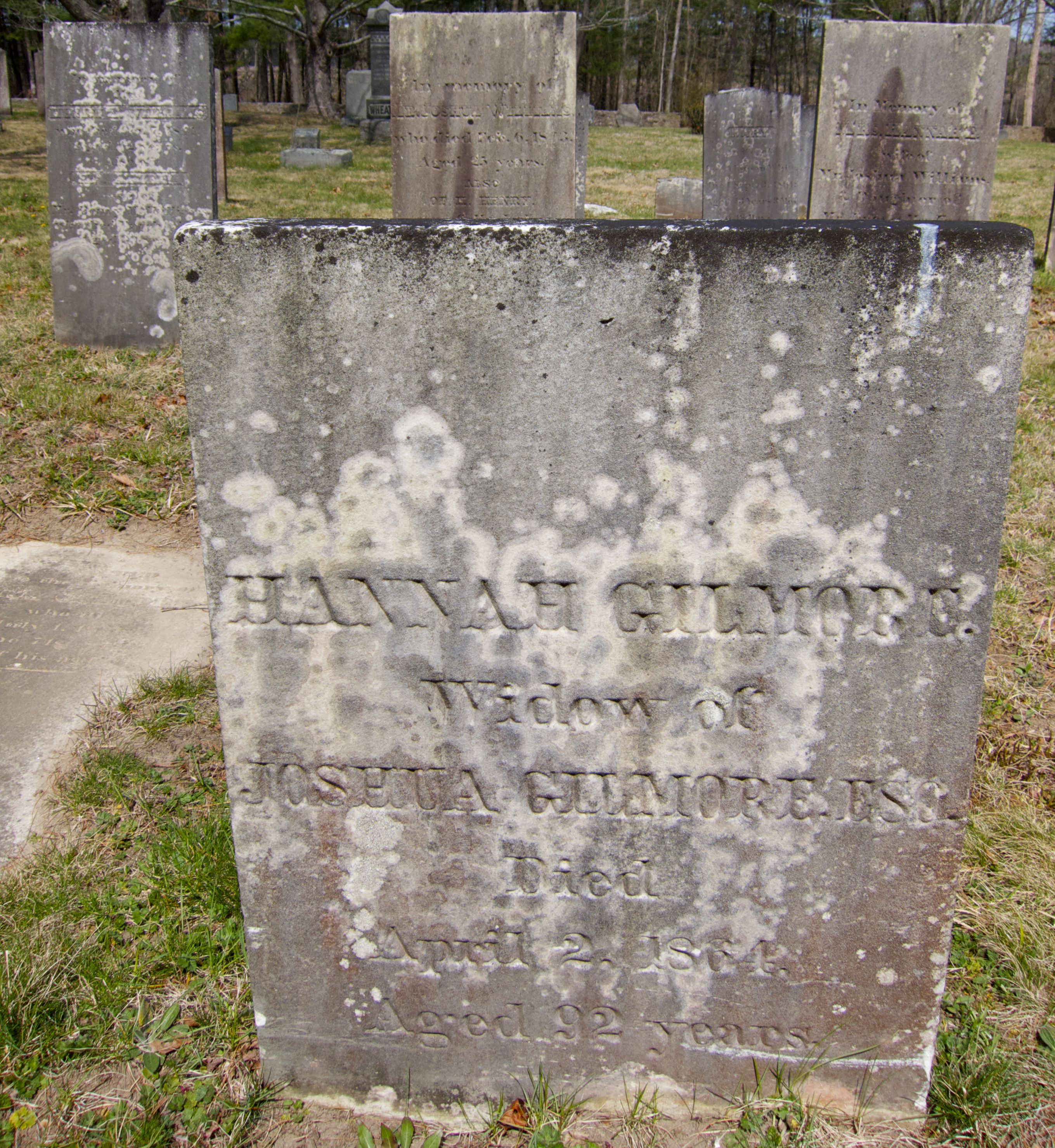
Gravestone of Hannah Gilmore

Gravestone of Hannah Gilmore

Jan 26  Sunday  Have been to meeting all day and heard two

excellent sermons from Mr Whitwell  Came home

between meetings.  Alson rode home with Mr Ames

Mother came with us from the afternoon meeting will

stop a few days.  Mr Whitwell walked up this morning

expecting to exchange with Mr Lovell but he (Mr Lovell)

was not prepared.  Mr W says a minister ought always to

be prepared.  Edwin called this evening.  It is a beautiful day.

A scheduling mix-up at church today caused consternation.  Most congregations had a practice of exchanging ministers.  On a regular basis, a minister from one church would swap one Sunday with a minister from another, allowing the congregations to listen to other voices and sermons.   On this Sunday, the scheduled switch between Reverend Whitwell of the Unitarian Church and Reverend Lovell of the soon-to-disband Protestant-Methodist assembly failed to take place.  Mr. Whitwell wasn’t pleased, but he seemed to recover just fine.  He delivered two more “excellent sermons.”

“Mother” was Hannah Lothrop Gilmore, or Mrs. Joshua Gilmore, as she would have been known, or perhaps  The Widow Gilmore, her husband having passed away in 1836.  One year shy of eighty, she was the mother of eight children, of whom only three were still alive.  Evelina was her only living daughter.

Mrs. Gilmore lived most of the time with her middle son, Alson, his wife, Henrietta, and their children at the family farm in the southeastern corner of Easton.  Just north of the town line with Raynham, the Gilmore property lay on what was known as the Turnpike Road.  In the distant past, Joshua Gilmore had maintained a tavern at that site, and had collected the fees from travelers on that road.  In 1851, the family still got income from the Turnpike, but the tavern was gone.  The land was all farm.

Occasionally, Mrs. Gilmore would visit with her daughter in North Easton.  Alson would carry her to church and after the service was over, Hannah would leave with Oakes and Evelina to stay at their home for the week.   While in North Easton, she’d be able to visit not only with her Ames grandchldren, but also with other grandchildren in the area, like Abby and Malvina Torrey.  And on this Sunday, her grandson Edwin Williams Gilmore, a grown son of Alson who no longer lived at the farm, paid a visit.  He would soon be building a home close to the Ameses.

January 24, 1851

Doll

Jan 24 Friday.  Was very busy this morning about house  Sent

for Abby to go to Augustus’s.  Mr Torrey called to say that

she could not go & made a long call and was as plausible

and good as ever.  Went to Augustus about ten

and alone, but had the pleasure of Mr Whitwells

company back as far as his house  This evening have

called at Mr Holmes but did not see Miss Eaton

Have finished both of the dolls frocks of pink, blue lace  Fine day

The doll that Evelina has been working on since the beginning of the year was finished today.  Wooden with painted features and lace dresses, it was fashioned as a miniature adult.  Baby dolls didn’t come in until almost the 20th century. Isn’t it interesting that the doll was handmade and not store-bought?  It was just a few years too early for Evelina to be able to buy a porcelain doll out of Germany and France, the ones with the big glass eyes, leather hands and silk dresses that speak to us today of Victorian taste. Those manufactured dolls began to enter the American market in the 1860s. With Yankee ingenuity, and not a little help from others, Evelina made her own doll for her daughter. How did Susie like the it?  We don’t get to find out, nor do we know when Evelina gave it to her daughter, but we can guess it was a pleasant surprise.

John Torrey called at the Ames house today.  A former colonel in the local militia, Torrey was also Evelina’s brother-in-law.  He had been married to Evelina’s late sister, Hannah, who died in December, 1848, leaving behind two daughters, Abigail and Mary “Malvina”.  The Torrey family lived right in the village of North Easton, so Evelina was able to see her nieces often.  Abby is 20 years old as the diary opens, Malvina only ten.

Reverend Whitwell featured in Evelina’s diary again today; she certainly seemed to enjoy his company.  She may have been someone who placed ministers up on a pedestal; they were the spiritual leaders of the day and she was a woman of sincere faith.  But, despite his being described by Chaffin as a serious, scholarly type, he may also have been an attractive novelty at a gray time of year.  He was new to the neighborhood and sought the acquaintance of Oakes and Evelina. Did Evelina have a little crush on him?

January 23, 1851

Thread

23 Jan  Thursday.  Went again to Elisa Quinns this

morning to get another dolls dress cut & staid untill

about noon to work on it & left it to be finished.  This

afternoon have been to Mr Whitwells to the sewing

circle.  There were but few members present a part over

there yesterday  We carried a piece of striped shirting

and I cut out a part of it.  Abby came to pass the

afternoon but did not stop.  The boys all went to Canton

for an assembly.  Very pleasant

Evelina, and probably her sisters-in-law, made their way to the Whitwells’ home today for the monthly meeting of the Sewing Circle.  The gathering was smaller than usual, as some members had attended the original meeting, held the day before, despite the snow storm.

The Sewing Circle was a regular meeting of about twenty women from the congregation of the Unitarian Church.  Led by Reverend Whitwell, it moved each month from house to house, giving each member a chance to host the event.  The program itself consisted of sewing, each woman bringing her own work, or helping a friend with a project, or perhaps sewing together in concert for a purpose; Evelina is unclear on this.  Mr. Whitwell probably opened the meeting with a prayer, and may even have read to the women as they worked or rendered his  thoughts on topics either scriptural or secular.  The meeting may have been less formal than that, but the minister’s presence made it a sanctioned event.  Ordinarily, women didn’t gather regularly outside their homes for recreation. No book clubs!

In fact, Easton’s sewing circle was an iteration of a female benevolent society, such as ladies in towns and cities in many parts of the country were forming in the first fifty years of the 19th century.  The purposes of the societies varied.  Some, like the Fragment Society in Boston (which formed in 1812 and is still active today) provided clothing and bedding for poor women and children.  Some, like the Worcester Anti-Slavery Sewing Circle, were abolitionist,  while others focused on missionary work, or simply helped raise money for their local parish.  And though their purposes were quite specific, the consequences of the sewing circles were broader than their participants imagined.  These gatherings were a tiny but important early step toward allowing women to contribute to society outside their own homes.

By the time the Ames women returned home from their meeting, Evelina’s boys were on their way to Canton to another assembly.  Oakes Angier, Oliver (3) (even with his chillblains) and Frank Morton rarely missed an opportunity to go to a dance or a “sing” or a party.  They were lively young men.  All in all, a sociable day for the Ames family.

January 22, 1851

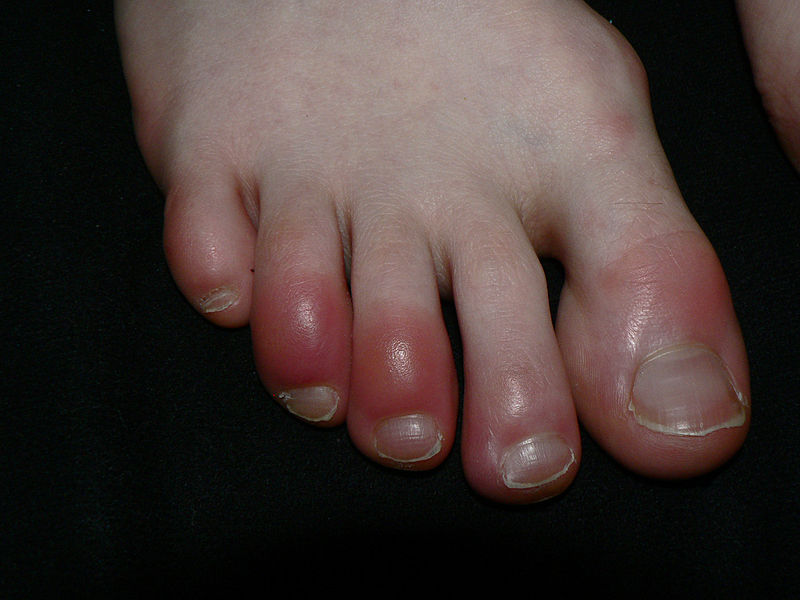
Chillblains

Chillblains

1851 Jan 22 Wednesday  Commenced working on the sack again this

morning quite early.  Went to Elisas about ten

to get her to make a dress for Susans doll staid

untill twelve and left her to finish it

Got ready to go to the sewing Circle at Mr Whitwells

But it commenced snowing very fast which prevented

our going.  This evening have finished Susans sack

Oliver poor fellow sits here almost crying with the chillblains

Evelina finished sewing a sack (a kind of apron) for her daughter that she’d been working on for several days, and turned to another ongoing project, doll clothes.  At mid-morning she left the house and went to Elisa and Patric Quinn’s home along Stoughton Road (today’s Elm Street).  Elisa was a dressmaker while Patric was employed at the shovel factory.  Like so many employees in that period, they had emigrated from Ireland.  Elisa was going to help Evelina finish two dresses for Susie’s new doll.

Leaving the little dresses in Elisa’s capable hands, Evelina returned home for midday dinner, just before snow began to fall.  She and her sisters-in-law had planned to go to the monthly meeting of the Sewing Circle, held this afternoon at the parsonage where the Whitwells lived, but poor visibility put an end to their travel.  The ladies stayed home.

Oliver Ames (3), Evelina and Oakes’ middle son, was suffering from chillblains, an unsightly and uncomfortable affliction of extremities: toes, fingers and ears.  Cousin to frostbite, chillblains are an itchy, painful inflammation brought on by exposure to moist cold air.  Some say it’s caused by too-rapid warming of skin and tissue after exposure to cold.  Different treatments were offered: poultices, soaking or rubbing with salt.  Lydia Maria Child, author of The American Frugal Housewife, offered a specific remedy:

“The thin white skin, which comes from suet, is excellent to bind upon the feet for chillblains.  Rubbing with Castille soap, and afterwards with honey, is likewise highly recommended.  But, to cure the chillblains effectually, they must be attended to often, and for a long time.”

It appears that Oliver (3) was in for several days of discomfort.

January 15, 1851

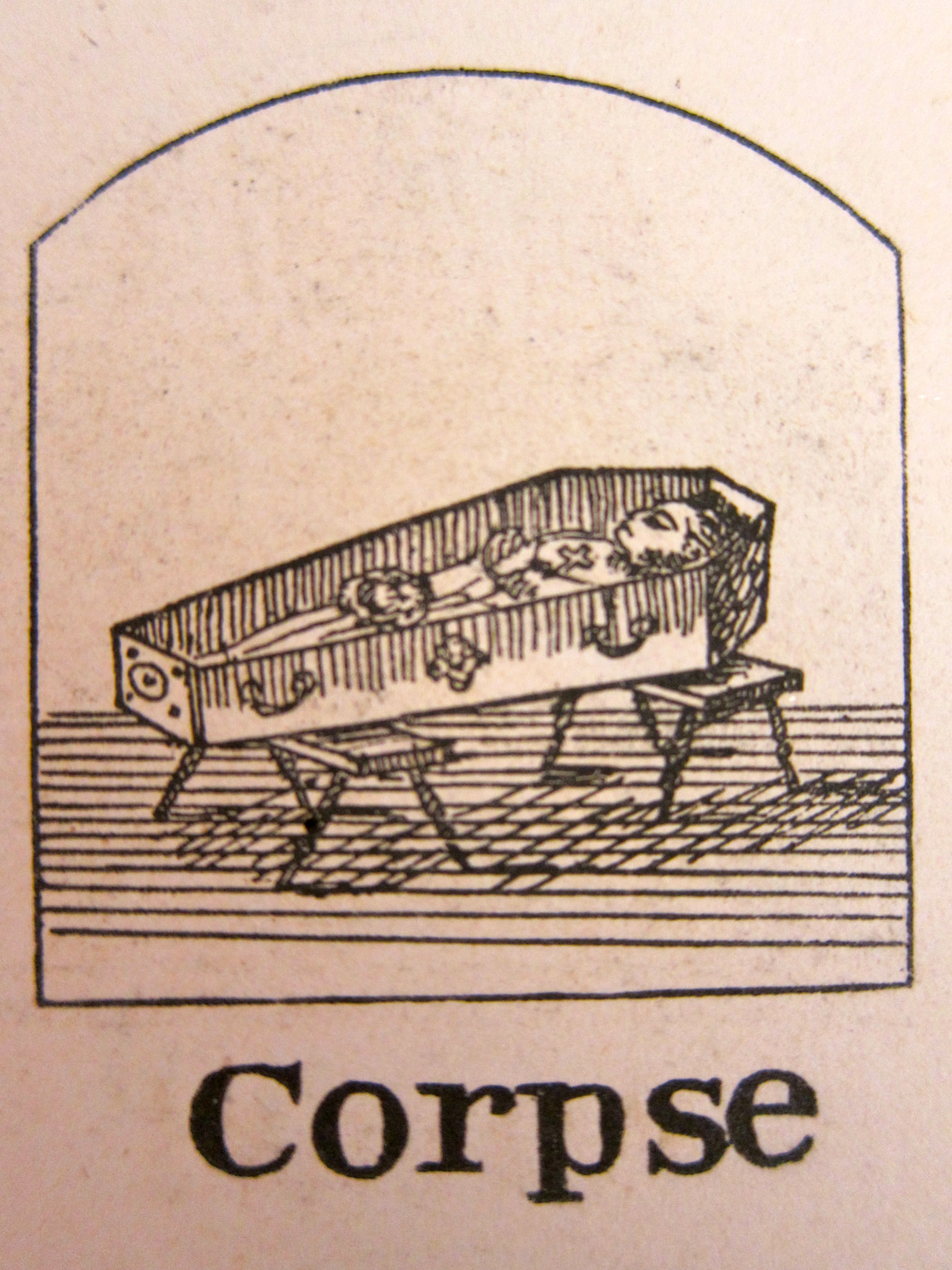
Corpse

1851

Jan 15 Wednesday  This morning after doing my usual

morning work went to Mr Carrs  to put the robe on the

corpse.  in the afternoon attended the funeral.  Mr

Whitwell spoke very well to the mourners & made a good

prayer  Mr Whitwell and Mr Reed were over to tea.  After

they went away I passed the evening at Olivers with Mr

& Mrs Peckham  Made a hair cloth cover for one of the

rocking chairs cushions and sewed in the evening on a

shirt

Today Evelina attended the first of several funerals she will go to over the course of her diary.  The death of young Lewis Carr won’t be the only case of consumption, either.  In this case, she helped the Carr family by sewing a robe for the body and dressing the corpse.  Death was familiar to women like Evelina; tending to its aftermath was one of their responsibilities.

And then life went on.  After the service, Evelina (with Jane McHanna’s help, certainly) served tea to Rev. Whitwell and Mr. Reed, another man from Easton.  There were several Reed families in town, so we can’t know for sure which Mr. Reed came to tea.  In her diary, Evelina mentions Daniel Reed most frequently.  Daniel was a carpenter, according to the census; today we might call him a builder.  In any case, he was well known to the Ameses.  His wife, Mary Reed, was a member of a sewing circle to which the Ames sisters-in-law belonged and the family attended the Unitarian church.

After dark, Evelina walked next door to Oliver Jr. and Sarah Lothrop Ames’s house to visit with Joseph and Susan Peckham.  She may have taken her work box with her to sew while they visited.  No doubt, they discussed the death of Lewis Carr.

January 14, 1851

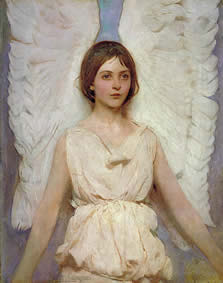
Abbott H. Thayer, Angel, 1887, oil Smithsonian American Art Museum Gift of John Gellatly

Abbott H. Thayer, Angel, 1887, oil
Smithsonian American Art Museum
Gift of John Gellatly

/51

Jan 14  Tuesday.  This morning after taking care of my room went

to the store and into Mr Carrs to offer my assistance there.

Lewis Carr died last night very suddenly bleeding at the 

lungs.  Has been in a decline since last July but was about

the house as usual yesterday and conversed with O A and 

his friends in the evening & told what he was going to do when

he got well.  about ten or eleven Oclock called to his mother

to come quick which was the last word & died almost instantly

This afternoon carried Mr & Mrs Whitwell to A A Gilmores.

The “white plague,” consumption, was a killer; today we know it as tuberculosis and, in parts of the world, it’s still killing.  In 19th century America, it was a leading cause of death, the scourge of young lives, particularly.  Its contagious properties were unknown, which helped it spread.  Although different treatments, such as prolonged rest in warm climates, were tried (when possible), no cure for the disease would be found until the middle of the 20th century.  Some people did recover from TB; most did not.

Lewis Carr, a friend of Oakes Angier Ames, was barely 20 years old. He was the son of Caleb and Chloe Carr of North Easton where the family had lived for generations.  His father, known as “Uncle Caleb” in his later years, was a life-long employee of the shovel works and close to the Ames family.  So close, in fact, that two decades later, Caleb would serve as a pall-bearer at Oakes Ames’s funeral.

It is typical that Evelina would help the Carr family at this time.  She and her sisters-in-law were often called upon to sew the shrouds that corpses were wrapped in, which is what she did on this day for the family.

January 13, 1851

Washing

/51 Jan 13  Washing day of course, and I have been

about house in the morning as usual.  A Augustus dined

with us, come up in the stage.  Made a hair cloth back to

another rocking chair  Went to Mr Whitwells with Mr

Ames this evening, met with Alson & wife.  It is a

beautiful moonshiny evening and we have had a

pleasant ride and have enjoyed myself very much.  Mr &

Mrs Whitwell I like very much  Father killed another

yoke of oxen to day and we have a quarter & the tripe.

Boiled that we had last week to day.

Monday is Wash Day.  This might be a Yankee commandment, were there a written code.  History has it that the first day the Pilgrims got off the Mayflower was a Monday, and the first thing the women did after all those weeks at sea was to wash their clothes.  The timing stuck, and remained a custom for centuries.  On Mondays at the Ames house, Jane McHanna washed the family clothes and linens while Evelina did almost everything else in terms of housework and cooking.  Evelina was not fond of putting her hands into soapy water.

The roads around town must have improved.  This evening, Evelina and Oakes finally got over to the Whitwells’ house, presumbly for a delayed acknowledgment of Mr. Ames and Mr. Whitwell’s shared birthday.  Evelina clearly enjoyed herself.  Another couple was there: Alson and Henrietta Gilmore. Alson is Evelina’s older brother.  He owns the old family farm in the southeast corner of Easton, just north of the town of Raynham.  He and his wife have six children together, as well as a son from Alson’s first marriage.  This is Alson “Augustus” Gilmore, who had midday dinner at the Ames house today.  Augustus lives in Boston as the year opens but will soon move back to North Easton.  He does courier work for the Ames brothers.

Evelina is close to her nieces and nephews; their presence in her life, and her affection for them, is evident throughout the diary.  Less certain is the regard that other members of the Ames family held for the Gilmores; family lore has it that the two families moved in different social circles and that even into the 20th century, the Gilmore clan was looked down on by members of the Ames clan. From Evelina’s happy description of the day, however, we can surmise that she was unaware, on this lovely, “moonshiny” night, anyway, of any discrimination.

January 12, 1851

Preach

/51 Jan 12 Sunday  Have been to church all day and heard two

excellent sermons from Mr Whitwell.  The afternoon text was

“Train up a child in the way he should go and when he is old

he will not depart from it”  Passed this evening at Mr Willard

Lothrop with Mr Ames & met with Minister Norris & Mr Torrey

This noon I stopped to hear Mr Whitwells class in the Sabbath

School afterwards went into Mr Daniel Reeds with Mother

Very warm + pleasant for the time of the year

The Ames family, Unitarians all, attended meeting today and stayed for both services, which encompassed a morning program, an intermission, and an afternoon program.  In their family pew, Evelina, Oakes, Oakes Angier, Oliver (3), Frank Morton and Susan sat with or near Old Oliver, Sarah Witherell and her children, George and Emily.  Also nearby, if not in the same pew, sat Oliver Jr, Sarah Lothrop Ames and their children, Fred and Helen, faces upturned to hear Reverend Whitwell deliver the day’s two sermons.  Eight-year old Susie may have squirmed in her seat; she wasn’t inclined to sit still for the second service.  And Oakes Ames was known to fall asleep, however inspiring Mr. Whitwell’s words were to Evelina.

In 1851, the Unitarians congregated at a church in Easton Centre, a few miles south of the village of North Easton (but still within the boundaries of the Town of Easton, Massachusetts.)  Like many families, the Ameses had to travel by carriage or sleigh to attend Sunday service.  The adults would have ridden, or “been carried,” as the expression went,  but the children may have had to walk the distance.  Children walking to church, regardless of distance, was common.  If this was true for the Ames family, we might imagine that cousins Oliver (3) and Fred walked together, as they were close friends.

At intermission, children went into Sunday School and the adults socialized.  Winthrop Ames, a grandson-to-be, described the scene in his family history (from 1937):

“They tethered their horses in a long, open shed and stayed through both morning and afternoon services, eating the luncheons they had brought and gossiping with the townsfolk during the intermission.”

On this winter Sunday Evelina and her mother, Hannah Lothrop Gilmore visited at the nearby home of Daniel and Mary Reed.  Socializing continued in the evening as Evelina and Oakes called on Willard Lothrop.