December 24, 1851

new-england-for-web

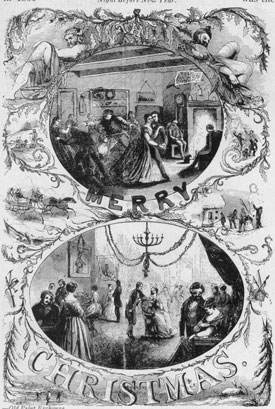
Christmas illustration from Godey’s Lady’s Book, December 1851

Wednesday Dec 24th  This morning gave the sitting room stairs

bedroom &c a thorough sweeping and was about the 

house at work a greater part of the forenoon

knit on my hood when I seated myself at work

read some in Ladys Book which I have

commenced taking for another year.  Emily brung

me a linen collar that her mother made for a

Christmas present


Emily Witherell delivered a Christmas gift from her mother, Sarah Witherell, to her Aunt Evelina, a gesture that may have caught Evelina off guard.  In practice, the Ameses had not been in the habit of observing Christmas, finding this religious celebration too festive for their Puritan-derived tastes. Yet times were changing and, in future years, Evelina would become both a recipient and giver of Christmas presents.

Evelina’s transition from being suspicious of Christmas to celebrating it was stimulated by various factors, not the least of which was its promotion in her favorite magazine, Godey’s Lady’s Book, the same magazine whose subscription Evelina renewed today. The periodical recognized and encouraged the holiday’s appeal to its well-heeled readers, many of whom would have read Charles Dickens’ A Christmas Carol, published less than a decade earlier. Unlike Unitarian (and one-time Congregationalist) Evelina, a growing number of Godey’s readers were less hide-bound to a doctrine devoid of celebration. The influx of Irish Catholics, who did honor the holiday, influenced some of this change, too.

While many in the nation made preparations for Christmas, a terrible fire at the Library of Congress in Washington, D. C., resulted in the destruction of nearly two-thirds of their holdings. Included in the loss was most of Thomas Jefferson’s original library.**

**http://www.accessible-archives.com/2013.01/the-other-fire
 

December 10, 1851

Thread


Dec 10th  Wednesday.  Mrs S Witherell S Ames and

self have spent the day quilting at Mrs Reeds

on a quilt that belongs to the sewing circle  Have

had a fine time.  Met quite a number of

ladies there. Had a taste of Mrs Howards mince

pie  We stopt the evening.  Mrs Witherell

J R Howard & Mr Harrison Pool came  We carried

Mrs Elijah Howard home

Although Evelina had reported the conclusion of the Sewing Circle season on November 5, today “quite a number” of Unitarian women met again to work on a quilt. They worked all day and into the evening, making the event even more sociable than usual.  Caroline Howard and Nancy Howard were among Evelina’s friends who attended and enjoyed tea and mince pie.

In New York City, meanwhile, Oakes Ames would have been wrapping up his business affairs and preparing to return home, having been away since the 3rd of the month.  Surely, not every moment of his trip had been devoted to shovels. He was no drinker, so the bartenders in the city wouldn’t have poured him any whiskey, but, like his wife, he was sociable.  He might have joined friends or clients for dinner. He also might have done favors for family or friends from home.

Rev. William Chaffin tells us that Oakes once searched out some socks in New York for his father’s coachman, Michael Burns, whom Chaffin described as “an Irishman of the old style.” Not long after Michael had emigrated to Massachusetts, “his mother, still alive in Ireland, knit him several pairs of socks, and sent them over by a friend of Michael’s.  She supposed that anyone coming over would necessarily ‘see my son Michael.’ But the friend found on landing at New York that he was two hundred miles away.  He wrote Michael telling him that he would leave the socks at a certain address.”

Michael approached Oakes “and asked him if he wouldn’t hunt up the socks and bring them home. It was just the sort of kindness Mr. Ames delighted in, and so when he went to New York he hunted up the socks with some difficulty and brought them to the overjoyed Michael.”*

*William L. Chaffin, “Oakes Ames 1804/1873”, Easton Historical Society, North Easton, 1996, pp. 6-7


December 2, 1851

 FillmorePresident Millard Fillmore

Dec 2d  Tuesday.  It has been cold to day but not near as

cold at yesterday or as windy  Mary has put

her clothes out.  Jane has ironed some shirts

for Mr Ames & I have ironed some collars

cuff & handkerchiefs &c for self  Mother & self

have passed the afternoon at Mr Whitwells

Mr & Mrs John R Howard were there.  Had

a pleasant visit

While the servant Mary – whose last name we never learn – put out most of yesterday’s wet laundry to dry, Jane McHanna rose from bed to iron some of Oakes Ames’s shirts.She had spent part of yesterday placing them in a tub of starch. Evelina took to ironing as well, looking after her own collars, cuffs and handkerchiefs. Ironing, which required a small fleet of flatirons being kept warm on a hot stove, was a welcome chore on a cold day. We don’t often read of Evelina doing the ironing herself.

In Washington, D. C., President Millard Fillmore’s State of the Union address was delivered in writing to Congress.  His speech was quite literal, full of specific details about foreign policy, exports, mining, gold in California, the acquisition of Texas and the surveying and improvements necessary for the territories and frontier.  He lauded the importance of agriculture, noting that “four fifths of our active population are employed in the cultivation of the soil,” and argued for a Bureau of Agriculture.

Fillmore also could not help but write of the growing differences between North and South and the 1850 legislation that was designed to address various aspects of the problem of slavery. He began his address optimistically, writing “the agitation which for a time threatened to disturb the fraternal relations which make us one people is fast subsiding…” but later admitted “that it is not to be disguised that a spirit exists, and has been actively at work, to rend asunder this Union which is our cherished inheritance from our Revolutionary fathers.”

In closing, Fillmore urged patience and reconciliation.  He counseled his countrymen to honor the Compromise of 1850.  “Wide differences and jarring opinions can only be reconciled by yielding something on both sides,” he cautioned.

October 19, 1851

OLYMPUS DIGITAL CAMERA

Sunday Oct 19  Last night was very stormy, rained very fast

and heavy wind.  This evening is very pleasant

but it has rained all day so that none of the 

family went to meeting  Alson came after Lavinia

about three Oclock  I have been reading most

all day “Olive”  It is rather interesting but wish 

I had spent the day more profitably

Evelina’s father-in-law, Old Oliver Ames, also recorded the day’s bad weather in his daily journal: “it began to rain last night + this morning there is a north eas[t] storm + the wind blows verry hard. it stormed nearly all day but was clear at night – there was an inch + a half of water fell”

According to the weather record for 1851 – the first year that Atlantic hurricanes were officially tracked – the storm that Evelina and Old Oliver describe was Tropical Storm #6. It made landfall in Rhode Island, thus its impact on nearby North Easton would have been severe. Despite the rain and wind, the buildings in the Ames complex appear to have come through fine. Old Oliver would have mentioned it otherwise.

For the fourth week in a row, Evelina missed church. One Sunday, there had been no service; on two other Sundays, she had been ill and today, weather prevented attendance. She was probably missing her weekly dose of religious direction from Reverend Whitwell and social interaction with her fellow Unitarians.  She occupied herself by reading “Olive,” which was most likely a domestic novel in the genre that she often read.  It would have been the kind of book that Old Oliver called “love trash.”

September 14, 1851

87219f


*

Sunday Sept 14th  Have been to meeting to day,  At noon

brought Miss Eddy home with us.  She walked

with Augustus to church. It is communion day

and Oakes Mrs Stevens & I stoped to bring

Mrs Witherell home.  We rode up to the great

pond and beyond to get some grapes & afterward

called at Mr Torreys

The Ames family attended both morning and afternoon service this Sunday, but instead of staying near church for the intermission, they rode home for a midday break.  Another change in routine may have been that communion was served at the service, which seems out of keeping with modern Unitarian practice.  Does anyone know if Unitarians took communion in the mid-19th century?

After church some of the Ameses rode up to the Great Pond, stopping at Col. John Torrey’s in the village on their way home. Evelina says she, Oakes and Mrs. Stevens brought Sarah Witherell along, a generational grouping that suggests that the “Oakes” in the carriage was her husband rather than her son Oakes Angier. Yet Evelina has, to date, always referred to her husband as “Mr. Ames,” as was the custom.  Did she write his first name unconsciously, or was her son the one in the carriage?  Readers, do you have an opinion? Whoever was in the group, each seemed to have a pleasant late afternoon foraging grapes in the cooler air.

Elsewhere in America on this date, James Fenimore Cooper, author of the popular Leatherstocking Tales, died in Cooperstown, New YorkWhile his Leatherstocking novels secured him fame throughout the western world, Cooper wrote many other novels, some with political overtones to them.  He was not popular with the Whigs. One day shy of his 62nd birthday, he died of dropsy (edema.)

* Baumann’s Rare Books


August 24, 1851

Road

Sunday 24th Aug  We turned out to church pretty well for us

to day 9 from here 7 from the other part of the 

house 5 from Olivers.  Mr Whitwell preached

Cousin Jerry, Warren, Orinthia Lavinia & Rachel

came at noon  Alson & wife Edwin & Lavinia came

after meeting.  Lavinia will spend the night.

This evening Cousin J & W went with me to call at Willards

Twenty-one people attended church today from the Ames family compound.  Immediate and extended family members and their guests rode down Centre Street to the Unitarian meeting house to listen to Reverend William Whitwell preach. How many carriages rolled down the road?  Did any of them walk, or did they all ride? Did they all fit into the family pews?  Some returned home after the first service.

Adding to the crowd after church, Evelina’s brother Alson, sister-in-law Henrietta, and two of their offspring, Edwin Williams Gilmore and his sister Lavinia, came to the house as well. The gathering spoke to the warmth and closeness of the extended family.  It also spoke to the relative ease of travel at this time of year. Traveling between the homes of friends and family had been marked this month, with everyone taking advantage of the good weather – and good roads – before winter.

The visiting continued in the evening when Evelina took Jerry and Warren Lothrop to visit Willard Lothrop, a local spiritualist, shovel shop worker, and likely relative.


July 20, 1851

Rests


1851

Sunday July 20th  Have been to church all day  Mr Whitwell

preached felt very sleepy and heard but a

little of the sermon  After meeting went over

to the Methodist meetinghouse to a sing.  There are

some fine singers there.  Oakes A & Orinthia called

for Louisa Swan and brought her to the sing & Orinthia

went back to Mr. Howards

The Ames family was Unitarian. Three generations of them, from Old Oliver to little Susie, dutifully attended church almost every Sunday, just as Evelina did today. Their attachment to the Unitarian service, however, didn’t preclude tolerance of other Protestant congregations in town. The Ameses and others were generally friendly with the Methodists who, like the Unitarians, had broken with the “dark and hopeless Calvinism”* that once prevailed in the meeting houses of New England.

The Methodists had a long history in Easton, the first near-one-hundred years of which were recounted in chatty detail by Unitarian minister and town historian, William Chaffin, in his 1886 History of Easton.*  As the Methodists, founded by Wesley brothers John and Charles, gained adherents in the late 18th and early 19th century, the sect took hold in Easton, too, shortly after the demise of the local Baptist Society. In addition to their welcoming services and missionary zeal, Methodists offered something special to congregations everywhere: Music.

The “sing” that Evelina went to today at the Methodist meeting house was a gathering to sing hymns, many of which were written by the Wesley brothers themselves. Also in attendance was at least one Ames son, and probably the other two as well.  The boys enjoyed the sings, both for the music and for the chance to socialize with other young people.  Oliver (3), who was very musical, was particularly fond of the gatherings.

* William Chaffin, History of Easton, 1886.


June 12, 1851

photo

Alson Augustus Gilmore

June 12th Thursday  Jane quite unwell and went off to

bed after breakfast, after dinner quite smart

Bridget came about nine & we finished our

ironing  Howard & Clark sent over my cottage

bedstead &  put Castors on the bedroom chamber

bedstead  I have made my front chamber 

bed clean & put clean window curtains &

valance  Mr Whitwell called.  I called at Mrs Lakes


Evelina did housework today, with qualified help from an ailing Jane McHanna and a big hand from Bridget O’Neil, who had been working for Evelina quite a bit lately.  On the social scene, reliable Mr. Whitwell paid a visit, and Evelina went out to see a friend, Mrs. Lake.

This day marked the birthday of Alson Augustus Gilmore, son of Alson Gilmore and his late, first wife, Rachel Alger Gilmore. Known as Augustus, the 29-year-old was a frequent visitor to the home of his Aunt Evelina and Uncle Oakes. As we have seen throughout this winter of 1851, he had worked periodically for the Ames brothers – Oakes and Oliver Jr. – and taken many a midday meal at Evelina’s dining room table.

In 1851, Augustus appeared to be settling back into life in Easton, after having taught school elsewhere for several years. He brought with him his expectant wife, Hannah, and two-year old son, Eddie; the family settled into temporary quarters while Augustus scouted for some property on which to build a house.  He, his cousin Oakes Angier Ames, and another man, Elisha Andrews, started a boot-making factory.

A successful small-town life lay ahead for Augustus. Not only would he be involved for twenty years in the shoe-making trade, but he would continue to work for his Uncle Oakes as well.  A valued ally, he would courier important documents and mail for the Ames enterprises. Well known around town, Augustus served as a “model moderator […] in twenty-four annual town meetings, and seventeen special town meetings, besides other public assemblies.”*  He was also active in the Unitarian Church and remained close to his Ames cousins throughout his life.

* William Chaffin, History of Easton, 1886

April 13, 1851

200px-First_Unitarian_Church_in_1886

*

1851

April 13th Sunday.  Have been to church all day Frank

staid at home in the morning Mrs G Ames went

with us to meeting all day and liked Mr Whitwell

I staid at noon with Mother most of the time

Called at Mr Whitwells with Louisa Howard

Mrs Dr Deans & Mrs H Pool. Mrs Whitwell

has no help now & is not very well. rather cold

On this cold spring day, the Ames family, minus Frank Morton, went to church with Almira Ames, widow of Oakes’s cousin George Ames.  Perhaps Almira joined Evelina and her mother during the midday intermission when many women were welcomed into the parsonage by Eliza Whitwell, wife of the minister. Eliza was under the weather but still was under a social obligation to open her house to fellow Unitarians who could not get home and back during the pause between the morning and afternoon services.

Mrs. Dr. Deans, otherwise known as Hannah (Wheaton) Deans, wife of Dr. Samuel Deans, was also present at the Whitwell’s.  The “Dr.” title in front of her name didn’t mean that Hannah was a physician; far from it. It meant that she was married to a physician.  She was a daughter of old Daniel Wheaton who lived out on the Bay Road.

Evelina often admired Rev. Whitwell’s sermons but seldom related their content. In these tumultuous months following the enactment of the Fugitive Slave Law, did Mr. Whitwell ever speak about slavery or abolition? We know that other Unitarian ministers were quite vocal about abolishing slavery.  On this same Sunday in Philadelphia, three hundred miles to the south, Rev. William H. Furness gave a discourse on the Fugitive Slave Law, speaking from the pulpit with all the authority that his robed position could give him.  A graduate of Harvard and friend of Ralph Waldo Emerson, Furness was, like William Whitwell, an accomplished theologian.  He was also a passionate abolitionist; was Reverend Whitwell?


*First Unitarian Church of Philadelphia, ca. 1886

March 10, 1851

images-2

/51

March 10  Monday  This is town meeting day.  Mr Ames & O Angier went

They spent the whole day there but accomplished very little

Mr Pratt & Brown chosen School committee O Angier was

nominated for one & lacked by one vote of being chosen

They brought home the school report of the last year

which is not very favourable for the schools in town generaly

Miss Foss & Clarks school are spoken very well of.

It commenced snowing about ten Oclock & is quite stormy this evening

Town Meeting was – still is – a great New England tradition. In the 19th century (and well into the 20th) the meetings were often scheduled in March, making them an annual marker of winter’s impending departure.

People turned out for town meeting.  Rather, men turned out for town meeting.  Women, who before 1780 in Massachusetts had enjoyed suffrage, no longer could vote.  National suffrage for women, a cause that would create deep divisions among the Ames women of a later day, would not be achieved until 1920.

Oakes Ames and his eldest son, Oakes Angier Ames, attended meeting and stayed all day. Oakes Angier evidently ran for school board but just missed being elected. He was showing a taste for politics, something that his father felt as well. His mother, perhaps influenced by her son’s loss, harrumphed that “very little” was accomplished at this year’s meeting, although she seemed pleased that their boarder, Orinthia Foss, was mentioned as being a good teacher.

Today’s town meeting was moderated by one of Easton’s greybeards, Capt. Tisdale Harlow. A resident of the Poquanticut section of town, Harlow was a former selectman, town treasurer, school board member, veteran of the War of 1812, and captain of the Easton Light Infantry in 1833-34. He had crossed swords with the Ames family in the 1830’s in a town row about the introduction of Unitarianism into the Congregational church. Harlow and many others were against it; Old Oliver, his sons and others were for it.  The sectarian controversy wore on for about eight years and ultimately led to a permanent split in the congregation. Historian William Chaffin suggested that “[i]ts unhappy effects were felt for many years.”  Were there remnants of hard feelings on display at today’s town meeting?