June 10, 1852

 FullSizeRenderOld view of Gilmore house near Foundry and Washington Streets*

June 10th Thursday  This morning worked a few moments

on my bonnet and about half past ten Mr &

Mrs Orr Mr Ames & self went to Alsons to

spend the day  Mr Ames Orr & Alson rode

to W Bridgewater after noon  Mother is most 

sick with a cold  Called at Mr Copelands

to get Susans hat & Lavinia mended it where

it was burned

The Orrs of Boston continued their visit with Evelina and Oakes. The rain showers – too brief to satisfy area farmers – receded and the sunshine returned, along with wind that was “strong and verry dusty.”** The Ameses and the Orrs took to the road, traveling a few miles south to spend the day with Evelina’s mother at the Gilmore farm.

After midday dinner with the Gilmores, Oakes Ames, Robert Orr and Alson Gilmore rode east to West Bridgewater. What was their business? Evelina and Melinda stayed behind with elderly Mrs. Gilmore who was poorly. Evelina managed to go over to the Copelands to pick up a hat she had left there for Susan, which Lavinia proceeded to mend for her little cousin.

Old Oliver, meanwhile, was looking ahead to bringing in the hay, assuming it hadn’t been ruined by the lack of rain.  He “bought a yoke of cattle from Howard Lothrop,”** the latter a well-known man in Easton who, according to a 19th c. history of Plymouth County, “styled himself a farmer, yet did much business of a partially legal character [..] for which work his superior business qualities and excellent judgment especially fitted him.” The Honorable Mr. Lothrop was also a former town clerk, state senator, member of the Governor’s Council, and father of Sarah Lothrop Ames. Between the two strong men, seller Howard and buyer Oliver, who got the best deal?

*Image from Howard Gilmore Papers, Courtesy of Easton Historical Society

**Oliver Ames, Journal, Stonehill College Archives, Arnold Tofias Collection

***usgwarchives.org
May 22, 1852

large-1057

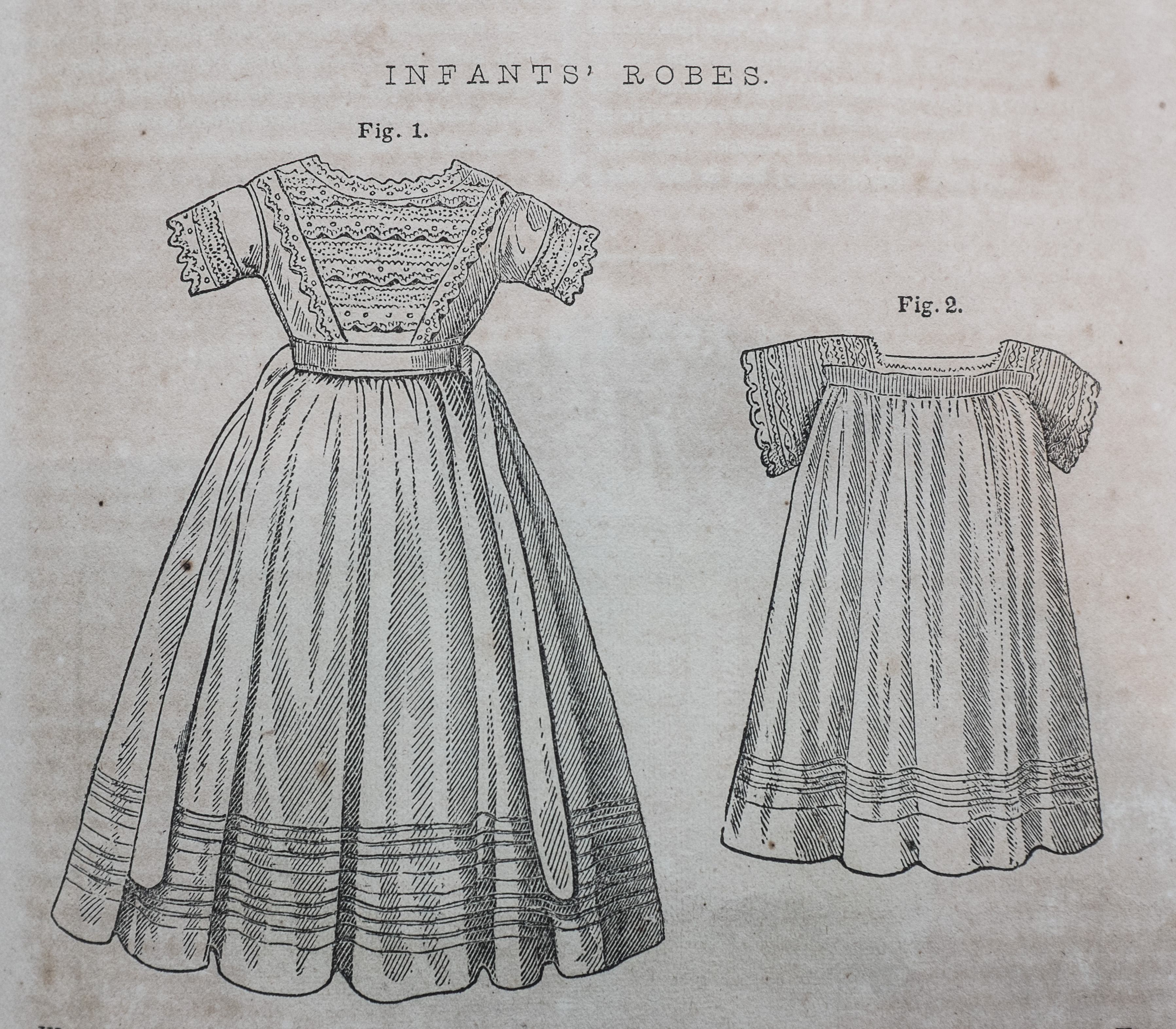
Infant wear from Godey’s Lady’s Magazine, 1851

Sat May 22d

1852  Mrs Paterson here again to day and has cleaned 

Susans chamber, windows & doors in Franks and

taken up the carpet and cleaned the front

chamber except the floor  Lavinia & Orinthia

came about eleven,  Edwin & Augusta here to tea

and went home with Lavinia  Mrs McHanna stood

godmother for McCabes child


Spring cleaning continued.  Mrs. Patterson returned to help Evelina clean, and the two women worked hard. Windows, doors, carpets and more were scrubbed, wiped or beaten, as appropriate.

Jane McHanna, the Ames’s regular servant, must have had time off today. She attended a baptism, presumably at the little Catholic church on Pond Street, to act as a godmother for a child of the McCabes. About this time, there was an Irish family in Easton, Bernard and Hannah McCabe, who had young children. Perhaps Jane became a godmother for three-year old William McCabe or, more likely, a younger sibling. There were several McCabe families in Bristol and Plymouth counties at this time, however, so we can’t be certain who this young child was.

The baptism or christening of infants was an important rite for both Catholics and Protestants. They had different approaches, certainly, but the intent was the same: to bless a child and erase its original sin. Unitarians differed from the Catholics and Calvinist-based Puritanism on this latter issue, as Unitarians didn’t accept the notion that children were born depraved. It was a critical doctrinal point. Jane McHanna would have accepted the more traditional view, and probably considered it an honor to have been selected as godmother.

May 19, 1852

a57b960ef05c59d007f70efe1b8f5f79


Wednesday 19th May  Washed the windows in the 

parlour and cleaned it   all that is necessary this spring

Was about house until about four Oclock

when Mrs Swain came and spent the 

afternoon  Mr Swain came to tea  Worked

on the garden about an hour  Susan has

the nose bleed almost every day.  This afternoon

came home before the school was done


Spring cleaning was late this year, as the women’s attention had been given over to family illness. The kitchen had been repainted some weeks earlier, but other rooms hadn’t been dealt with. Evelina set out to rectify the delay and, probably with support from Jane McHanna, donned her apron to tackle the best room in the house, the parlor, much of which had been redecorated back in February, so needed little attention beyond its windows and a basic cleaning.

One imagines Evelina and Jane in working clothes as they went about with their brushes, rags and mops. But what did Evelina wear under her apron, or after she changed out of her choring dress? Was she wearing any mourning attire? Did her outfit signify at all the recent loss of her nephew George?

In the 19th century, “[m]ourning was particularly a woman’s affair,”* perhaps because of a societal norm that women were sentimental and emotional, and men were not. There were rules about attire to be followed after the loss of a loved one. At the beginning, black crepe dresses, black veils or headgear, and even black jewelry – onyx, usually, or pins netted with a lock of hair of the departed – were expected to be displayed in some manner. After a certain period, black was put away and lavender, grey or purple dresses were acceptable. The closer the relative was to the deceased, the more exacting the expectation.

In her fine book about death in the Civil War, This Republic of Suffering, Drew Gilpin Faust notes:

“By convention, a mother mourned for a child for a year, a child for a parent the same, a sister six months for a brother. A widow mourned for two and a half years, moving through proscribed stages and accoutrements of heavy, full, and half mourning, with gradually loosening requirements of dress and deportment. A widower, by contrast, was expected to mourn only for three months, simply by displaying black crape on his hat or armband.”**

By these calculations, Sarah Ames Witherell had been dressed in black or lavender too often before. Her husband had died in August, 1848, her young son Channing in May, 1849 and now her son George. Sad to say, she would have had a black dress or two, plus the appropriate accessories, in her cupboard. But what was Evelina obliged to wear? Perhaps not a black dress – although she had one – but an armband? Or a black ribbon in her bonnet? What was the expectation for an aunt?


Jack Larkin, The Reshaping of Everyday Life, New York, 1988, p. 102

**Drew Gilpin Faust, This Republic of Suffering, New York, 2008, p. 147


May 16, 1852

lclapp-1

1852

Sunday 16th May Mr Whitwell preached a funeral sermon

and very good  At noon mother Henrietta

and self spent at Mr Whitwells  After meeting

Mr Ames Susan & I rode to Mr Clapps made

quite a long call  he has but a very few 

flowers in blossom, pansys were very pretty

Have engaged a trellis of him

The last formal recognition of the death of fourteen year old George Witherell took place in the Unitarian church this Sunday when the minister “preached a funeral sermon.”  Different from the ritual text that probably defined the graveside service just three days earlier, the sermon was presumably a collection of thoughts about death in general and the death of the young man in particular.  Reverend Whitwell knew the family well and, being an articulate and thoughtful wordsmith, must have offered the family some personal comfort and consolation.

Evelina appeared to be recovering her strength. With her husband and daughter, she rode to Stoughton after church to visit Lucius Clapp, where they made “quite a long call.” Evelina discussed flowers and a trellis. Was this trellis ordered in place of the one at the front door that was being built only ten days earlier?  Or was this a new trellis entirely, designed perhaps for the garden?  Was this the year of the trellis?

One imagines that Oakes Ames offered less direction about the trellis than his wife.  What he might have preferred to discuss with Lucius Clapp was their shared interest in the Whig party, or their mutual respect for temperance.  According to one nineteenth century historian, Mr. Clapp was a “kind-hearted”* man with a “modest and retiring nature.”* His politics were informed and liberal:

Formerly a Whig, Mr. Clapp has been identified with the most progressive political creeds. He was one of the original Free Soilers, and chairman of the first Free-Soil meeting held in Stoughton. Since its organization he has supported the Republican party. He has been [a] member of school committees several years, and selectman of Stoughton seven years, and now (1883) holds that position. He has always been pronounced in advocacy of temperance, and has been connected with every movement for the betterment and advancement of his native town. He is an attendant and supporter of the Methodist Episcopal Church.”*

Mr. Clapp and Mr. Ames would have had much to talk over.


*D. Hamilton Hurd, History of Norfolk County, Massachusetts, 1884, pp. 424-425

May 15, 1852

IMG_0156_1

May 1852

Saturday 15th  Have been mending a lot of stockings

that have bee[n] put by for a week or two  Spend

too much time in the garden  Gave Mrs Gilmore

Augusta & Abby some plants & flower seeds

Abby stoped a couple of hours  Gave Susan a bath

and took one myself and the afternoon thus passed

Spent the evening   Helen is much better she has

had a sorry time of it  Quite pleasant


Today was “cloudy all day but a little warmer,”* according to Old Oliver. The bath water that Evelina and her daughter Susie used was in no danger of freezing, as it had earlier in the year when Oakes had planned to bathe but forgot and left the the water to freeze in the pail.  The water in the pail should have been poured into a tub not unlike the one in the illustration above, copper-lined, claw-footed, and rimmed in oak.  That Evelina mentioned taking a bath suggests that bathing was not a regular event; personal hygiene operated under a different set of standards in the 19th century.

The baths, taken in the Ames’s indoor bathing room, probably felt quite relaxing, even therapeutic after the stress and grief of the week gone by. For Evelina, even just mending the hose that had sat untended would have been a welcome return to normalcy after the death of young George Witherell.  Working in the garden, too, would have been a pleasure.  Her plants were doing so well, in fact, that she had plenty to spare and give away to some of her female relatives.

Next door,  fifteen year old Helen Angier Ames was finally recovering from an infection on her face, an abscess or boil, that had  been lanced the day before.  The procedure had been successful, and the family’s health concerns seemed to be put away, at least for now.

May 14, 1852

Susan Eveline Ames French

Susan Eveline Ames (French)

1852

May 14th  Susan ten years old to day.  Her father & 

I have promised her 10 dollars each if she will

be a good girl and keep herself neat till her

next birth day.  Have been to work some on

Susans delaine dress altering it The gardener

laid out my verbena and I set out some slips

From the house  Malvina came to stop the night

Helen had her face lanced  Not pleasant


Last year for her birthday, Susie Ames had a little party.  Not so this year, her birthday coming too close on the heels of the death of her cousin George Witherell. Instead, her parents made her a generous promise of “10 dollars each,” if she behaved well and kept “herself neat” for the next year. Those were high expectations for a child, even a Victorian one.

Next door, Helen Angier Ames was still suffering from her own difficult ailment, that of a swollen face. Was it an abscess, or a boil, or something else? The doctor came again to see her and this time lanced her face. Not a pleasant procedure, one imagines. Otherwise, in the main house, family members seemed to be settling back into the normal domestic routine.  Eveline sewed and gardened; her verbena and more went into the ground, despite the continued stormy weather.


May 12, 1852

Corpse

Wednesday May 12th  Helped Mrs Witherell make Georges robe

Planted some seeds that Mrs Howard gave me

and African rose sent from Andover.  Have ripped

the skirt from Susans borage delaine to lengthen

it Swept & dusted my chamber &c &c Jane had

finished the ironing  Have not felt very well

have not got over being broken of my rest.  It has

rained since nine Oclock quite fast

A new gardener commenced work today

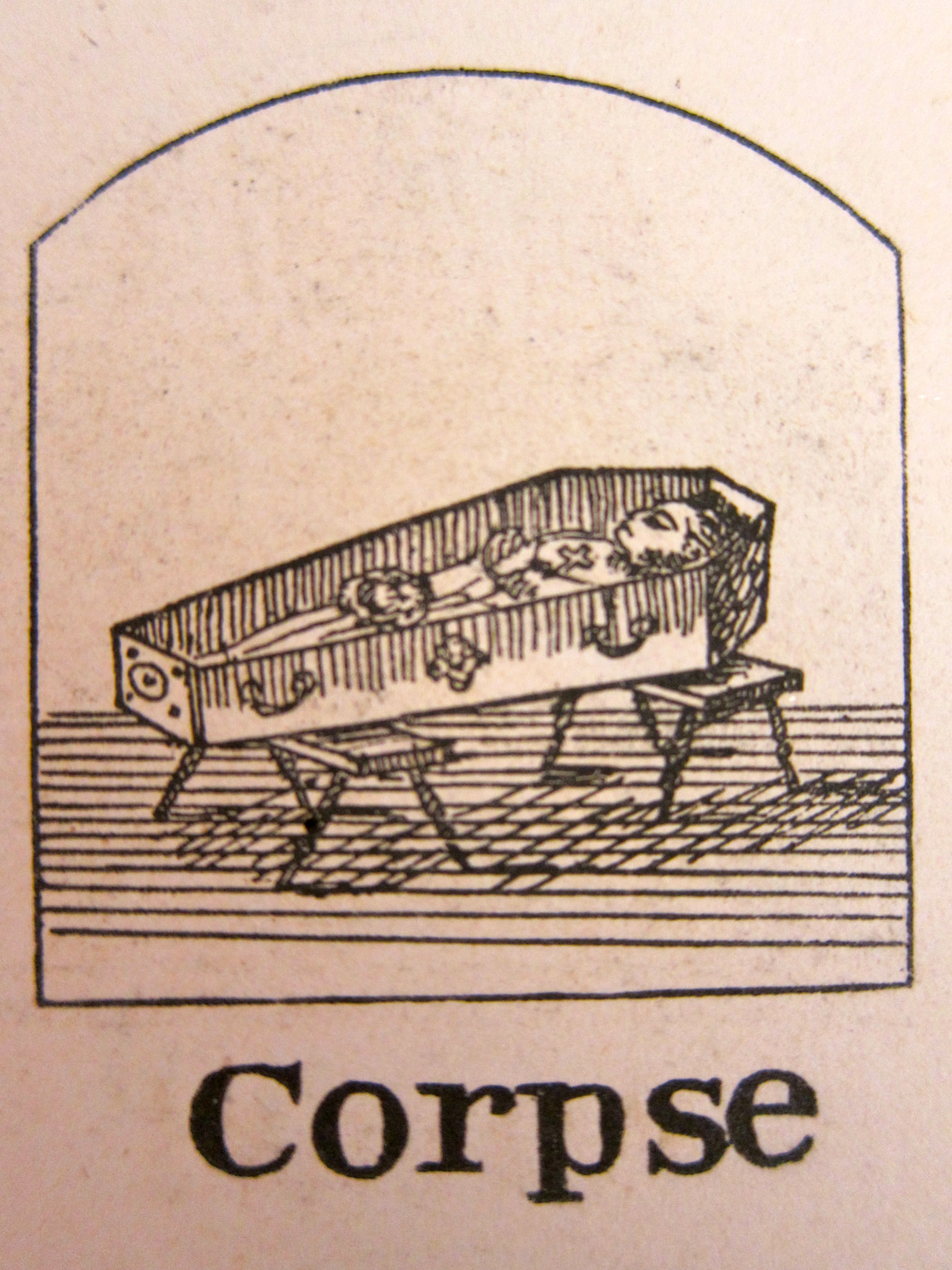
What sad sewing went on today. Sarah Ames Witherell, a thoughtful, dutiful woman who had sewn so many things for friends and family, now sat and made a shroud for her first-born child, George. Only fourteen years-old, he had died the day before after a painful bout of rheumatic fever. Of the three children Sarah had borne, only her middle child, Emily, was still alive.

The steady rain must have enhanced the gloom. Old Oliver wrote that “it began to rain before noon wind north east and it grew cold and raind all the afternoon.”* Evelina must have done her planting first thing in the morning, after which she helped Sarah with the robe for George. She also worked on a skirt for Susan, and swept and dusted while Jane McHanna ironed. She was probably not the only family member who was recovering from “being broken of my rest.” Everyone was trying to return to a normal routine after the disruption and sorrow of George’s illness, although next door, Helen Angier Ames was still suffering from a case of blisters and facial swelling.

*Oliver Ames, Journal, Stonehill College Archives, Arnold Tofias Collection


May 3, 1852

frontispiece_of_edward_shaw's_'the_modern_architect'_(1854)-141D753C60C6EA2D682

The Modern Architect”*

1852

May 3d Monday Our cook room being painted  Jane

had to wash in the bathing room.  Susan washed

the dishes and I did the rest that was done

about the work which was not much.  Rode

to Mr J Howards to get Rural Architect for Mr

Healy called at Mr Clarks and got some Gladiolus

bulbs and at Jason Howards to see their garden

afternoon planted some sweet peas & lilly seed

Oliver came home to night from Providence


More planting, this time of sweet peas and lilies, went on this afternoon. Gardening was preferable to choring on any given day, but it was probably especially true on this Monday. The kitchen, or “cook room” as Evelina called it, was being painted, making the usual chores more difficult. Servant Jane McHanna had to wash the weekly laundry in the bath tub. Evelina must have been pleased to be outdoors in the sunshine, viewing other gardens and planting flowers in her own. She also would have been pleased to greet her son, Oliver (3), home from college on a break.

At some point during the day, Evelina rode south to John and Caroline Howard’s to borrow a book written by Richard Upjohn, a prominent architect. “Upjohn’s Rural Architecture: Designs, working drawings and specifications for a wooden church, and other rural structures” was a popular new publication featuring home designs in the latest styles. Upjohn, who became the first president of the American Institute of Architects, favored Italianate and Gothic style cottages. His book appealed to the up-and-coming middle class as well as to the wealthy. Evelina borrowed it to show her carpenter, Henry Healey. She had something in mind for Healey to build.


*Frontispiece from “The Modern Architect,” by Edward Shaw, 1854


May 1, 1852

Wreath

1852

Sat May 1st  The children were hoping to have a fine

time maying this morning had their wreaths

all made but it rained which prevented

their taking a walk but they had a nice time

in the old tool house. I dined in Edwins

John came there last night  Lavinia & Helen

here.  They were all here to tea to night

S E Williams called at Olivers  I gave her some plants


Rain spoiled the annual outing that Susan, Emily and other children had planned for May Day. They had made special wreaths for the occasion, probably to deliver to the homes of friends. To get out of the weather and save the pleasure of the day, they gathered instead in the “old tool house,” which seemed to make for an agreeable substitute.  Readers from the Easton area, does anyone know the probable whereabouts of this building?

Rain may have spoiled the children’s walk, but it helped soften the ground in the garden.  Old Oliver reported that today the garden was “spaded up and manured.”  He was most likely describing the family vegetable and herb garden, as opposed to Evelina’s flower beds, which were already under cultivation and probably out of Old Oliver’s immediate purview as well as beneath his notice.

Evelina, meanwhile, had her midday meal at Edwin’s and Augusta’s house, seemingly while the rest of the family ate at home. She went over to visit their mutual relative, her brother John Gilmore, who rarely came to town.


April 25, 1852.

Lilac_bush-2edq3ho

Sunday April 25th  A very pleasant day and have

all been to meeting.  Came home at noon

with Hannah & sister and Susan, all returned

in the afternoon.  After meeting called at

Olivers to see Mr & Mrs A Lothrop and rode to

Mr Manley to speak for some plants

Augustus & Hannah rode with us as far as

Mr Swains  Emily & Susan went also to Mr Manlys

Lilacs, a fragrant favorite for gardeners and civilians alike, were among the plants that Evelina selected at Edwin Manley’s today. In the 19th century, many a New England farmhouse featured lilacs close to the door, as American poet Walt Whitman famously describes in When Lilacs Last in the Dooryard bloom’d, his elegy for Abraham Lincoln:

…In the dooryard fronting an old farm-house near the white-wash’d palings,

Stands the lilac bush tall-growing with heart-shaped leaves of rich green,

With many a pointed blossom rising delicate, with the perfume strong I love,

With every leaf a miracle – and from this bush in the dooryard,

With delicate-color’d blossoms and heart-shaped leaves of rich green,

A sprig with its flower I break…

Today after church, the sermons and small social obligations dispensed with, Evelina thought about her flower beds. The day was “fair” and “some warmer,”* so with niece Sarah Emily Witherell and daughter Susan Eveline Ames, she rode up to visit her go-to gardener “to speak for some plants.”  Mr. Manley indicated he would bring the plants by the next day.  Evelina wouldn’t have been able to plant anything today, it being the Sabbath, but she could imagine where she would put the plants, and how they would look, the anticipation of which added to her delight.

*Oliver Ames, Journal, Stonehill College Archives, Arnold Tofias Collection