June 21, 1851

1687-Illustration_from_Theosophie_and_Alchemie-Michael_Maier_and_Johann_Theodor_de_Bry-300x282

21 June Saturday  Early this morning Mrs. Seba Howard

brought Orinthia up and found me in the

garden weeding. We worked there an hour or two

and then went to sewing.  Orinthia on her dress

and I on the hair cloth.  Harriet came and sat

with us awhile in the afternoon and while she

was in I worked on the sleeves to my plaid stone

colour borage  Orinthia called on Abby   Pleasant

Weeding continued to be the dominant occupation of Evelina’s early morning hours. On this Saturday morning her young friend, Orinthia Foss, arrived for the day and immediately stepped to the garden to help weed. Orinthia was carried up from the southern part of town by a contemporary of Evelina named Eleutheria Howard, wife of Major Seba Howard.

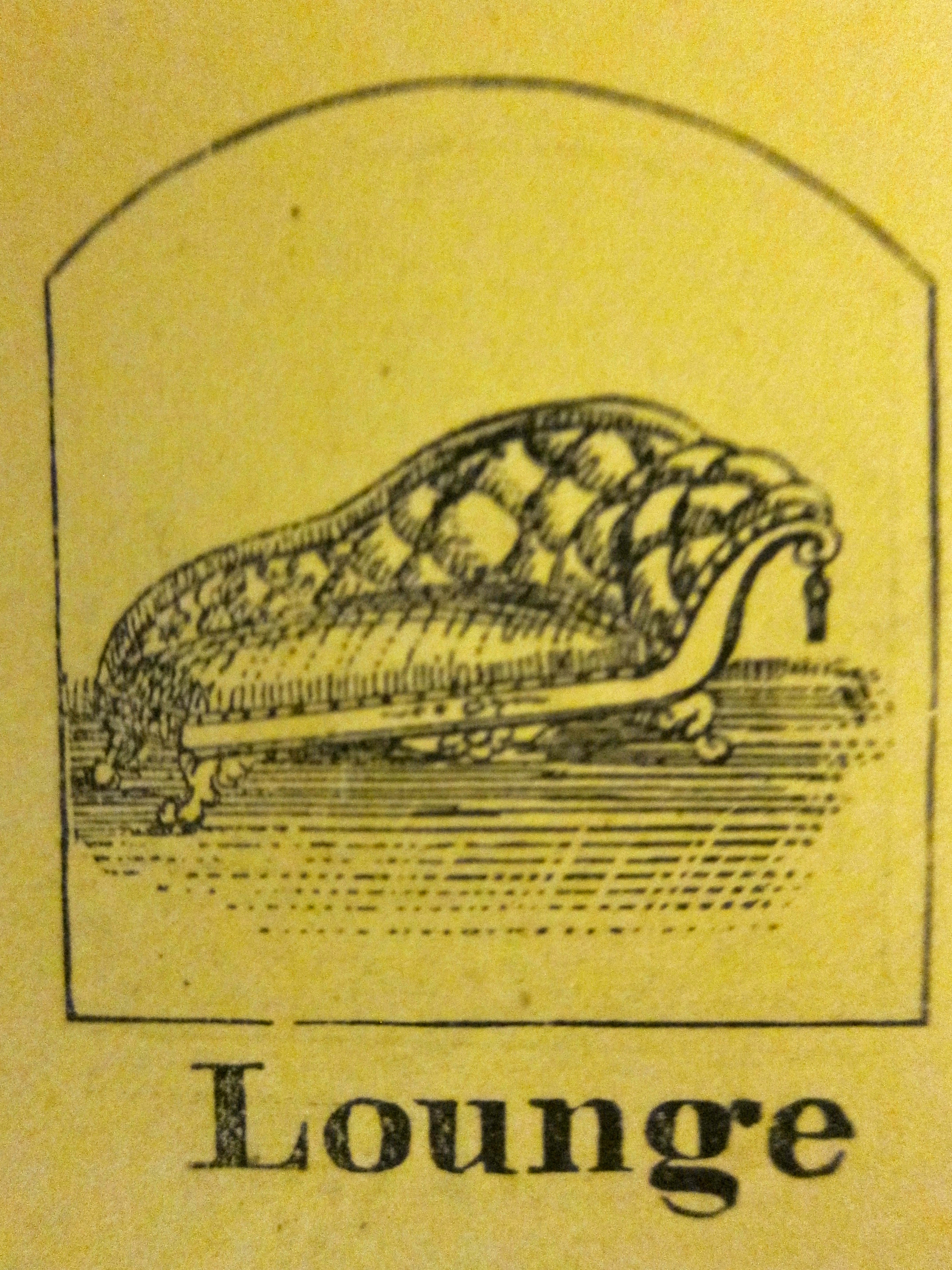
Today was summer solstice, the official start of summer and the high water mark of daylight; the women probably would have enjoyed being outside in the garden all day long, but sewing and other duties called. Each woman had a dress she was working on, and Evelina was still piecing together a horsehair cover for her new lounge. Just as they had sat on so many days during the late winter, so the two sat today, on chairs near the windows for light, with folds of cloth in their laps. Harriett Ames Mitchell, Evelina’s sister-in-law, joined them in the afternoon.

Later in the day Orinthia went to call on Abby Torrey, Evelina’s niece who lived right in the village of North Easton.

June 18, 1851

Black ticking-stripe-15

June 18th Wednesday  Worked again untill nine in the 

garden and then made the tick for the 

mattress.  This afternoon put the cotton in 

and tied it  Bridget was here a couple

of hours & picked over the curled hair

Towards evening called at Mr E Carrs, Dr Wales

and on Mrs J C Williams at Mr Torreys, Mrs S. Ames

called with me  Augustus gone to Boston

Mr Bartlett spent

last night here

Evelina was making progress on the mattress for her new lounge.  She “made the tick” for the cover and stuffed it with old cotton.  The final cover, to be made of horsehair, was still being worked on. Bridget O’Neil, a servant who usually worked next door, came over to help Evelina with the project.

The long-lasting light of day, as the calendar approached summer solstice, allowed for late socializing. Evelina and her sister-in-law, Sarah Lothrop Ames, went out calling.  They visited Esek Carr and, presumably, his wife, Ann; called on young Dr. Ephraim Wales and, again presumably, his wife Maria; and stopped at John Torrey’s to see Mrs. Joshua C. Williams.  Mrs. Williams, we might infer, was a boarder or renter at Col. Torrey’s apartment building, which Evelina called a tenement. Was Mrs. Williams possibly a widow?

A Mr. Bartlett had spent the night with the family.  He was from Maine, so likely had some connection to the shovel works and their ongoing need of wooden handles.


June 17, 1851

DSCF1590small

1851 June 17th  Worked untill about nine Oclock in

the flower garden  Then cut the tick to the mattress

a[nd] basted it ready to make  Jane was ironing and 

I assisted about dinner  After dinner made three button

holes in Mrs S Ames dress.  Went to Mr

Wm Reeds to tea with Mr Ames, Oliver & wife

Mrs W, Mitchell & Mr & Mrs Whitwell & Alson & wife


Gardening, sewing, ironing and cooking made up today’s housework at the Ames’s home on Main Street.  Buttonholes, too, which could be challenging, were a particular specialty of Evelina; many people brought her their buttonholes.  The fact that Sarah Lothrop Ames took her buttonholes to Evelina rather than to a hired dressmaker underscores Evelina’s talent in this department.

William and Abigail Reed must have enjoyed Evelina’s company on Sunday between services, for they invited her back to a small tea party.  The whole Ames family was invited, in fact, and then some. Minus Old Oliver, and the young people, naturally, siblings Oakes, Oliver Jr., Sarah Witherell, and Harriett Mitchell, with wives Evelina and Sarah Ames, gathered at the old professor’s home for a “cuppa.” Reverend William Whitwell and his wife, Eliza, went too, as did Alson and Henrietta Gilmore. That was a good crowd for a 19th century parlor.

Tea was generally the most sociable meal of the day.


June 16, 1851

Lounge

1851

June 16th Monday  Worked about the house awhile

Boiled some curled hair (for the matress

for my lounge) that belonged to the sewing

circle, formerly the pulpit cushion.  Edwin

Manly brought me 5 dahlias and Miss Foss

sent me 20 dahlia slips  This afternoon 

have been fixing the cotton for the matress

have put it in some old cloth

Evelina undertook to fashion a horsehair cushion for the new lounge she just bought in North Bridgewater.  Horsehair was a popular and relatively inexpensive material, so it’s small wonder that Evelina chose it.  That the cloth was “recycled,” to use a word she wouldn’t have recognized, from an old pulpit cushion by way of the Sewing Circle made it all the more attractive. How old that horsehair must have been!

The material may have been cheap, but it would be a bear to cover the new mattress, or cushion, with it. She had to boil it, presumably to both soften and clean it, shape it and sew it onto a cotton covering. She was planning to use some old cotton, too, for the cushion. The work would take several days, but Evelina never minded long or complicated projects when it came to sewing.

Meanwhile, she had 25 dahlias to plant in her garden.

June 4, 1851

Thread

1851

June 4th Wednesday  This morning Mr Lothrop

brought me a calf head and as Jane was Ironing it has

taken me some time to prepare it  Went in to Olivers

to assist Sarah about making her cake for the sewing

Circle.  It met there this afternoon and they had a

goodly number  I have cut two shirts

for Mr Ames and put them into the sewing circle to

make  We have had a pleasant meeting

Even as cows all around town and country were giving birth, some of their calves were slated for slaughter.  In sheer numerical, if unfortunate, terms, not all calves had a place on a farm. Females, once grown, could breed and produce milk, but the males had less of a role, unless they had the lines and build to become fine steers or oxen.  Male calves in particular had good market value as veal and thus were often culled. The arrival of a calf’s head for the dinner table signaled that some culling was going on.  Mr. Lothrop may have been DeWitt “Clinton” Lothrop, a farming brother of Sarah Lothrop Ames and manager of the Lothrop property.

The cook rooms at both houses on Main Street were bustling today. Not only was Evelina preparing the calf’s head, but Jane McHanna was ironing near the stove, keeping her irons hot and using the kitchen table as the ironing surface. In Sarah Lothrop Ames’s kitchen, there was much preparation for the afternoon meeting of the Sewing Circle. Evelina went next door to help Sarah with a cake.

No memory of her own failed meeting back in February seemed to cloud Evelina’s enjoyment of today’s Sewing Circle, even when her sister-in-law’s parlor welcomed “a goodly number.” She was able to put a couple of shirts into the pile of work and had a pleasant time.


June 3, 1851

barege2


1851 

June 3rd Tuesday  Have finished Susans green plaid gingham

and have cut the sleeves to her green borage Delaine

Have been mending some, but realy I have done

so little sewing of late that I can scarcely sit myself

to work.  Jane has cleaned the boys chamber in 

the other part of the house

We are having very fine weather and I feel much better

than I have for a few days past


When sewing, Evelina often mentioned using borage, more properly spelled “barege.” Barege is a fabric with a sheer, gauzy weave that features a worsted warp and a silk weft. Warp is the longitudinal thread in a roll of cloth; weft, also known as woof, is the transverse or horizontal thread that is woven through the warp with a shuttle. Using two different types of thread creates a cloth with some texture to it.

Barege was quite popular for dress material in the mid-19th century, even taking prizes at shows. At London’s Great Exhibition of 1851, a medal in the “Worsted Class” went “for a great variety of light goods of the barege class, plain, checked, and brocaded, of excellent combinations.”*  Although most of the fabric that Evelina used was made in New England, it’s possible that the green barege for her daughter’s dress had come from abroad.  The example illustrated above features a barege dress from the early 1860’s.

Getting back to dressmaking, her favorite kind of sewing, may have contributed to Evelina’s improved spirits today. The “very fine weather” probably helped, too.


May 29, 1851

carriage_wreck


1851

May 29th Thursday  Worked in the garden upon weeds untill about

eleven Oclock & then put clean curtains up in the

sitting room & dining room.  have taken up the 

carpet & had the dining room cleaned

Early this afternoon changed my dress and sit down

to sewing which I have not done before for a long

while  worked on Susans dresses that Julia cut.

It has rained all the afternoon had fire in furnace


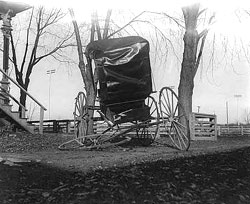
Today was an anniversary of sorts.  According to Old Oliver Ames, exactly one year earlier, Sarah Witherell and Sarah Ames had been injured in a carriage accident: “Sarah + Olivers wife went to Foxborough today and they got hove out of the carriage + hurt some.”  Fortunately, no lasting harm seems to have occurred to either woman.

What had happened?  Had their horse taken a fright and tried to run away? Carriage accidents were usually the result of horses bolting, spooking or crashing.*  Sudden noises – a dog barking, a wave crashing, a flock of birds lifting off, a train whistle – could startle a horse and make it run. Some statistics suggest that horse travel was more dangerous than today’s car travel. For a time, in cities like New York and Chicago, more people per capita were killed in horse-related accidents than are killed now in automobiles.  Travel, then as now, was risky.

Probably oblivious to any recollection of last year’s accident, Evelina managed to spend several hours weeding in her flower garden before rain arrived. In the afternoon she bent to some sewing and worked on dresses for Susan.  Given how fast children grow, Susie’s dresses needed to be completed sooner rather than later.  No doubt Evelina put tucks into these newest clothes for her daughter, intending to make them last.

*http://vickyenglishscamelot.blogspot.com/2011/08/anatomy-of-carriage-accident-what-went.html

May 7, 1851

Thread

Wednesday May 7th  Orinthia went to Boston this morning

with Abby Torrey after she left I went into Olivers

on an errand and stopt a long while as I am

sure to do when I ought not and then went into the

other part of the house to bid Mrs Stetson good

by (as Mrs S Ames and Frank went with her to Bridgewater)

and Mrs Lincoln Drake rode up and saw me by

the window and I was obliged to see her, thus the day passed

and I accomplished very little Went with Mrs Witherell

to the sewing circle at Daniel Clarkes


The Sewing Circle held its monthly meeting today, this time at the home of Daniel and Elvira Clark.  Roughly contemporary in age to Oakes and Evelina, the Clarks were members of the Unitarian Church.  Daniel was a carpenter who occasionally did work for the Ames family. Elvira, like Evelina, was a housewife with teenaged children.  She and Evelina visited together last Sunday during the intermission between sermons.

So much socializing went on today that Evelina had to chastise herself – “I am sure to do what I ought not” – when she spent too much time next door visiting her sister-in-law, Sarah Lothrop Ames. Sarah must have been feeling better; although she didn’t go with Evelina and Sarah Witherell to the Sewing Circle, she had improved enough not only to have a good, long chat with Evelina, but also to have an outing to Bridgewater, which she was “carried to” by her nephew Frank Morton Ames.

Evelina stopped in at Sarah Witherell’s to say goodbye to Mrs. Stetson, a friend of the family who was departing for Bridgewater, too. She then was spotted by Caroline Torrey Drake, a friend who stopped in for a visit. Mrs. Drake, a woman in her early fifties, was the mother of eight children: five girls followed by three boys.  Her first child was born when she was 20, her last child when she was 45.  Now that’s childbearing!


April 29, 1851

CultivationToolsBP

April 29 Tuesday  Frank has finished the beds in the flower

garden and I have set out some plants that Henrietta

gave me and some that I bought of Edwin Manly paid

him one dollar Julia here finishing the dresses for

Susan & my blue Delaine dress.  Mrs George Ames

& I went to Sharon and spent the afternoon

Had a pleasant ride with Dominic


Three spheres of activity informed Evelina’s day. First was gardening, made possible by Frank Morton Ames finally finishing tilling the soil in the flower beds.  He and others had been loosening the soil off and on for several days, which raises the question of how many flower beds Evelina had, and how large they were, and where they were situated relative to the house. Evelina “set out” some plants that she got on Saturday. One group came from her sister-in-law, Henrietta Lincoln Gilmore, at the Gilmore farm; she probably got those for free.  The other group from Edwin Manley, however, she had to pay one dollar for.

The second sphere of action was sewing, of course, which always seemed to be going on in center ring at the Ames house. Today Julia Mahoney, the dressmaker of choice, worked on a dress for Susan and a blue delaine, or light wool, dress for Evelina. The warm weather would soon arrive and the lighter dresses would be needed.

The last sphere was a nice change of pace – literally – for Evelina and her cousin-in-law, Almira Ames. With Dominic, a horse, pulling them along, the two women drove the carriage (or were driven) to nearby Sharon. Whom did they visit? Did they shop in the town?  The ride was pleasant, whatever the errand.


April 26, 1851

Spade

Sat Apr 26th  This morning a man came from the shops 

to spade my flower garden & hoe the currant

bushes Miss Foss Susan & self rode to Edwin Manlys

to speak for some plants and then went to Mothers

got there about half past twelve. Brought

home some Horseradish, Carraway roots & some

few plants Made the skirt to Susans green 

borage Delaine Miss Foss has finished the two shirts.

At last, gardening in earnest. A shovel shop employee was taken off his usual task to go up to the Ames homestead to turn over the soil in Evelina’s flower beds.  He used an Ames shovel, no doubt, and also an Ames hoe to loosen the dirt around the currant bushes behind the house.

Evelina celebrated the spring day with her daughter Susie and boarder Orinthia Foss; the three took a wagon, most likely, north to the home of Edwin Manly.  At the time, Manly lived close to the town line with Stoughton, and was employed at the shovel shop. He was obviously interested in plants and kept an informal nursery on his farm, raising flowers to sell.  His green thumb brought in customers like Evelina. Not too long after this, however, he hurt his hand and had to leave his job at O. Ames & Sons. Fascinated by biology, chemistry and science in general, he studied medicine at Harvard, became a physician and set up an office in North Easton in the early 1860s. Later he moved to Taunton, where he worked as the town librarian for a number of years. Eventually, he moved to California.

Flowers weren’t all that the women brought home in the wagon.  They drove south to the other end of Easton to visit Evelina’s mother, Hannah Gilmore, at the Gilmore farm, where they picked up the horseradish and caraway roots and “some few plants.”   That Evelina and Orinthia had time to sew after all that riding around says a lot about their stamina and work ethic.