October 30, 1852

Nurse

Sat Oct 30th Mr Dawes & Miss A[l]ger left for

Boston this morning  Mrs S Ames watched 

last night with Mr Swains child and Mrs Witherell

is there to day  I have been very busy about

house to day and wish I was able to do

a great deal more as it is much out of order

Yesterday the Ames women visited Ann and John Swain’s house to see their ailing infant son. Today Sarah Lothrop Ames and Sarah Ames Witherell were back, taking turns watching. The outlook for the one-year old wasn’t good, evidently. Evelina would go over to the Swains for the night, being too busy during the day to help.

Evelina was straightening up her house after the departure of the latest houseguests, Mr. Dawes and Miss M. J. Alger. It was the first time in days that her home was back to normal, with only family in residence.  She found everything to be “much out of order,” and no doubt she and her servants bustled about choring and setting things to rights. She seemed too busy even to worry about whether or not her daughter Susie was practicing the piano.

In unrelated news from the Pacific Northwest, this 1852 date marks the first time that the name “Seattle” appeared in print, in a pair of advertisements in The Columbian, a nascent newspaper in Olympia. The city we know today, then just a small settlement, had been known informally as Duwamps, but had been recently renamed after Chief Seattle, a leader of the local Suquamish tribe. How remote and unconnected Evelina would have considered the beginnings of a city so far from her kin and beyond her ken.


October 29, 1852

255px-Daniel_Webster_-_circa_1847

Daniel Webster

(1782 – 1852)

1852 Friday Oct 29th  Mr Dawes came from Boston

about ten Oclock  Miss Alger expected

him before and began to feel uneasy

They went to the shops after dinner

Helen Susan & Emily went to the shop

& then rode to call at Mr Roachs

They were all in here this evening to

hear Mr Dawes play on the guitar  Mrs S

Ames & self called Swains, to see their child

Mrs Lothrop & Brett called with her babe


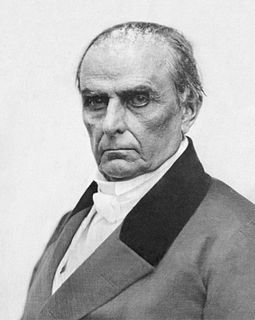
Old Oliver must have been an admirer of Daniel Webster, else why would he mention the man in his daily weather journal? He wrote, “the 29th was a verry plesant warm day. it clouded up some toward night – Daniel Webster was buried to day”.

Daniel Webster, lawyer, diplomat, statesman, orator and Whig leader, was indeed buried on this day. He had died three days earlier after a fall from a horse and was buried with “impressive ceremonies”* at Marshfield, about 35 miles east of Easton. Considered by many to be one of the finest senators ever, Webster had also been a Secretary of State, U.S. representative, constitutional lawyer par excellence, and a devoted preservationist of the union. To the latter end, he co-authored and spoke eloquently on behalf of the Compromise of 1850, which included the controversial Fugitive Slave Act. As a result, he lost the support of many New Englanders; abolitionists washed their hands of him.

On this day in Boston, however, it would have been hard to find his enemies. According to a newspaper account the next day, a united citizenry mourned:

Boston never before presented – probably never will present – such a funeral aspect as was worn in her streets yesterday. Most of the stores and shops were closed, as well as the institutions, offices, and markets, and a large proportion of the city was dressed in the habiliments of wo. [sic] Though the work was only voluntarily the act of individuals, it was very general – Washington, Hanover, and many other streets being covered in black, interspersed with mottoes, flags, portraits, and other mementoes, as the taste of each led him to adopt and carry out.  It was one of the last acts which Boston can perform to express her sorrow for the loss of the great statesman, and it is praise enough to say that it was well and appropriately done. The streets were thronged nearly all the day, crowds of people being present from other places, – and our young men wore the insignia of mourning which had been adopted, and grieved countenances were observed at every turn of the street…*


*New York Times, October 28, 1852


October 27, 1852

381-1233891708GdW7

Wednesday Oct 27  Miss Alger has given the

girls the seventh lesson and Susan

makes hard work of practicing and 

I am sorry that she is so unwilling

Mrs S. Ames, Miss Alger Oakes A and

self have passed the afternoon at Mr

Nahum Williams  Mrs Rollins is at

her fathers  Mrs H & C Lothrop were there


“[T]his was a mild day & little hazy wind southerly.”* Once night fell, a full moon shone down on the rooftops, dooryards and unpaved streets of North Easton, lighting the byways even after curfew. The day itself was unremarkable, although Susan Ames grudgingly endured yet another piano lesson. Evelina bemoaned her daughter’s intransigence.

Evelina did pay a rare visit to Nahum Williams, “a farmer at Easton.”**Accompanying her were the ever-present piano teacher, Miss Alger, as well as Sarah Lothrop Ames and Oakes Angier Ames, the latter an unusual participant in the women’s sociable errand. They visited not only Nahum but his wife Amanda (nee Lothrop) and their daughter, Sarah Elizabeth Rollins. Also present were some Lothrop women – possibly Mrs. Henry Lothrop and Mrs. Clinton Lothrop. Sarah Lothrop Ames was probably related to Amanda.

We have met Nahum Williams before in Evelina’s pages; some time back, he lost his father, Seth, and various Ames family members had attended the funeral. Sarah Rollins was his recently married daughter; she and her husband had moved to Vermont and were expecting their first child. By 1860, she would return to her parents homes in Easton, possibly widowed, with three children: Ellen, George and Jennie.

*Oliver Ames, Journal, Stonehill College Archives, Arnold Tofias Collection

**Hyde Family Geneaology

October 26, 1852


1860s blue striped muslin dress from St. Albans Museums

Dress with undersleeves, mid-19th c.*

Tuesday Oct 26  We have had a large washing

done to day and not finished untill

after dinner  Miss Alger & self spent

the afternoon in Olivers  Mr Ames

& all the children there to tea  Mr & Mrs 

Whitwell was there an hour or two

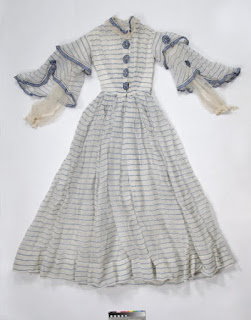
I made Susan a pair of undersleeves

and she is delighted with them


Because of all the company that had visited over the weekend, the servant girls were unable to launder clothes on Monday. Today, extra sheets and towels were added to the usual load and the washing went on into the afternoon. Not that Evelina rolled up her sleeves; after the midday meal, she and her remaining houseguest, Miss M. J. Alger, went next door to visit with Sarah Lothrop Ames and stayed for tea. All the family partook.

At various points during the day, Evelina had her work box open as she completed a pair of undersleeves for her daughter. Susie was “delighted” with them. Were they a peace offering from mother to daughter, perhaps to make up for Evelina’s insistence on Susan learning to play piano?

We’ve seen Evelina sewing undersleeves before. In the 1850’s and into the Civil War, undersleeves were an essential component of any woman’s dress, fitting independently but securely under the looser outer sleeve of the dress proper. Like the collars of the day, a good pair of undersleeves could be worn with different dresses. Susie must have felt rather grown-up with her new pair.

On the industrial side of American life, meanwhile, today was the 27th anniversary of the opening of the Erie Canal. The technological wonder of its day, it was already becoming obsolete. Railroads had arrived and, through their own capacity for moving freight, would soon obviate commercial use of the canal for many (though not all) industries. Shipping would change – was changing. The very word “shipping” derives from the fact that, initially, more goods moved by water than by land. This would no longer be true in this country or elsewhere in the developed world.

We should remember that Harriet Ames Mitchell, Old Oliver’s youngest daughter, was living in Erie at the time with her husband Asa and their three children.  Did they mark the day?


*Image of striped blue muslin dress with undersleeves courtesy of St. Albans Museum, England


October 14, 1852

fig05

Cambridgeport, ca. 1854*

Thursday Oct 14th Mrs Mower left for Maine this

morning or rather she is to stop over night in 

Cambridgeport and home tomorrow  Mrs Witherell &

Mrs S Ames came in for an hour or two this afternoon

I feel that I have not seen Mrs Mower as much

as I wish  I have given her my winter bonnet

3 dollars in Cash and other things & paid her

passage from Boston

Louisa Mower, an old friend of Evelina, left for home. Evelina bought Louisa the ticket from Boston to Maine, gave Louisa some cash and her own old bonnet.  Evelina was often generous to friends and family this way – to the females, at any rate. She looked after the women she cared about and in her entry today, she sounds a bit sad to see this particular friend depart.

“[T]his was a cloudy cool day wind north east and some misty just at night”* wrote Old Oliver in his journal; he doesn’t suggest it, but the sky and wind portended a winter storm, the first of the season. Louisa’s travel to Maine would be delayed on account of it.

Cambridgeport, where Louisa was staying while waiting, is a neighborhood within the city of Cambridge that today borders the Charles River east from Massachusetts Avenue to Central Square. In the 19th century, it was part wetlands, part residential, and part transportation hub. It was the site of the relatively new Grand Junction Railroad and Depot Company, which connected trains heading west and north – a line that’s still active in our 21st century. A few years later, Cambridgeport was also the location of the F. A. Kennedy Steam Bakery, where Fig Newtons and Lorna Doones were born.


*Image courtesy of http://www.mit.edu

**Oliver Ames, Journal, Stonehill College Archives, Arnold Tofias Collection


October 12, 1852

DSCF1683small

Gravestone of George Oliver Witherell

Tuesday Oct 12th  Mother & Louisa dined at Mr Torreys

and I went there to tea I was ready to go

when Mrs Roland & Miss Louisa Howard & Mrs

Dunham from N. Bedford called and stopt

some time  Mrs Witherell & Ames were gone

to Norton to see about Georges grave stone

Augustus & wife & her mother were at Mr Torreys

also

It could be that excitement over the new steam engine that was installed yesterday in the Long Shop continued, but Evelina tells us nothing about it. As usual, she maintains a disinterested distance from business matters. Not that she didn’t care, perhaps, but the business was up to her husband, his brother and her father-in-law. Commerce was in their sphere, the running of the household was in hers, and neither she nor her husband crossed the line between the two. So it was in most households in the middle of the 19th century.

“[I]t was foggy this morning but cleard of[f] warm before noon wind south west,”* reported Old Oliver. Sarah Ames Witherell and Sarah Lothrop Ames rode together to Norton to select a gravestone for Mrs. Witherell’s son, George, who had died at age fourteen the previous spring of rheumatic fever. The task could not have been pleasant, but perhaps Sarah Witherell found solace in marking her son’s passing in such a permanent way. The gravestone – if it is the one that she picked out, as the grave site was eventually moved – can be seen in the Village Cemetery behind the Unitarian Church in North Easton.

*Oliver Ames, Journal, Stonehill College Archives, Arnold Tofias Collection

October 10, 1852

Daniel_Pierce_Thompson

Daniel Pierce Thompson

(1795 – 1868)

Sunday Oct 10th  It is quite unpleasant to day and

as mother & Mrs Mower was not going to meeting

I staid with them  Mrs Ames Oakes A & Frank

went this forenoon, and Mr Ames returned alone

this afternoon  I have been reading some in

the Rangers Torys Daughter and writing

Helen came in and played on the piano

this evening  Mrs Witherell & Ames came in a while

Evelina skipped church to stay home with her mother and houseguest, not minding too much because of poor weather, which Old Oliver described as  “cloud[y] damp + verry warm wind.”

The women did not sew, but they probably chatted a bit and read a lot. Evelina was reading The Rangers: Or, The Tory’s Daughter: A Tale Illustrative of the Revolutionary History of Vermont and the Northern Campaign of 1777, by Daniel Pierce Thompson. Mr. Thompson was a famous writer in the period before the Civil War, especially in New England. His novels were as well-known as Nathaniel Hawthorne’s, but his turgid prose, popular in its day, has caused him to fall far out of fashion. He was also a political figure in Vermont and an active abolitionist, but his novels are not much remembered.

The first two sentences of the book that Evelina was reading illustrate his dated style:

Towards night, on the twelfth of March, 1775, a richly equipped double sleigh, filled with a goodly company of well dressed persons of the different sexes, was seen descending from the eastern side of the Green Mountains, along what may now be considered the principal thoroughfare leading from the upper navigable portions of the Hudson to those of the Connecticut River. The progress of the travellers was not only slow, but extremely toilsome, as was plainly evinced by the appearance of the reeking and jaded horses, as they laboured and floundered along the sloppy and slumping snow paths of the winter road, which was obviously now fast resolving itself into the element of which it was composed.

In the evening Evelina put down the book – which must have been slow going – and whatever letters she was writing, and the whole family listened as Helen Angier Ames played the new piano.


October 7, 1852

elm-yellows


Oct 7th Thursday  Have been cutting out some shirts

for bosoms.  Catharine Murphy has made

four window curtains for my front chamber

Mrs Witherell Mrs S Ames & self passed the

afternoon & evening at Mr Swains  Mr Ames 

came to tea and Oliver rode down after us and 

stopt awhile Mr & Mrs Meader are there &

Ellen Meader  Augustus wife went to Boston


There was quite a bit of socializing today, prompted in part by good weather. “[T]he 7th was a fair pleasant day + verry warm,” noted Old Oliver Ames. Henry David Thoreau, some 40 miles to Oliver’s north, was more discursive about the sunshine:

I sit on Poplar Hill. It is a warm Indian-summerish afternoon. The sun comes out of clouds, and lights up and warms the whole scene. It is perfect autumn. I see a hundred smokes arising through the yellow elm-tops in the village, where the villagers are preparing for tea. It is the mellowing year. The sunshine harmonizes with the imbrowned and fiery foliage.**

The elm trees such as the ones that Thoreau mentions would also have been seen by Old Oliver. In fact, they would have been seen across the state and beyond. Once upon a time, American Elms were ubiquitous in the United States.They were tall trees with a wine-glass profile and a graceful green canopy. In the 20th century, however, most of them were wiped out by Dutch Elm disease. The existence of “Elm Streets” in communities around the country attests to the fact that elms were once as common as maples or pines. As Thoreau suggests, many a small town lived under their shade.

*Oliver Ames, Journal, Stonehill College Archives, Arnold Tofias Collection

**Henry David Thoreau, Journal, courtesy of http://hdt.typepad.com/henrys_blog


October 1, 1852

Wax candle


Oct 1st  Friday   Went to Boston with Mrs Witherell to

see our pianos.  Miss Kinsley was going to the 

city and we asked her to try them for us.  She

thinks they are fine toned  Mrs S Ames also went

with us and Helen & Miss Hobart after school

Miss C Hobart is a very pleasant girl

I bought some wax candles at 62 per lb

Mrs Mower & Norris came home with us


Despite last night’s frost, this Friday proved to be “fair” and “pritty warm.”*  Evelina and her sisters-in-law, Sarah Ames Witherell and Sarah Lothrop Ames, took advantage of the pleasant weather to trip into Boston “to see our pianos” and do some shopping. Meeting them at the music store was Lucy Adelaide Kinsley (soon to become Mrs. Francis Howard Peabody) from Canton. A pianist herself, she approved of the purchases.

Joining the sisters-in-law later in the day, after school was over, were teen-agers** Helen Angier Ames and her friend Catharine Hobart. Evelina was growing fond of Helen’s friend; did she imagine that “Miss C Hobart” would one day be her daughter-in-law and mother of her grandchildren?

The two mothers were excited about the pianos. We can imagine that at least one or two of the expensive wax candles that Evelina bought were destined to be placed in candlesticks – or candelabra – near the new instrument. The old homestead was growing more elegant by the week. And it was back to that homestead that the women headed at the end of the day. Ordinarily, they would have stayed over in the city but instead, they returned to North Easton with houseguests in tow.

*Oliver Ames, Journal, Stonehill College Archives, Arnold Tofias Collection

** Teenager was not a term that Evelina would have used – it didn’t become a word until the 20th century.

September 29, 1852

Thread

Wednesday Sept 29th  Mrs Witherell & Ames came in

& helped me about my baking and this

afternoon I have had the sewing circle  Not

one of the Pools here and had but very few

numbers. about a dozen or fifteen including 

my own family at tea  It is a beautiful moon 

light night and they spent part of the evening


With help from her sisters-in-law, Evelina prepared for the arrival of Sewing Circle members. It was a “fair cool day,”* so weather could not deter attendance. In the afternoon, the women came. Well, some came.  “[V]ery few numbers” arrived for the meeting, but at least it wasn’t the zero attendance of her previous gathering. There were enough ladies in the parlor to make the event a success.  Some of the group stayed until after dark, able to find their way home by the light of the moon.

Still, members of the Pool family didn’t show, which vexed Evelina. The Pools were a family she had grown up with in the south-eastern section of town. A Pool daughter, Augusta, had married Evelina’s nephew, Edwin, and now lived nearby. Evelina felt a connection to the family, although it may be that the family did not feel a connection to her. She never mentions Augusta’s mother, Lavarna, for instance, in the roll of ladies who call on her, though she did host the Pool family at tea in January when Augusta and Edwin were married. It’s possible that the Pool women disliked her. Perhaps they were jealous of her social success in marrying Oakes Ames. Your thoughts, readers?


*Oliver Ames, Journal, Stonehill College Archives, Arnold Tofias Collection