February 13, 1852


Fire engine

1852

Feb 13th  Friday  Have been to work on Olivers shirt

that I was intending to finish last week and have not

got it done yet  have scarcely got over my

Boston jaunt.  Carried my sewing into the other

half of the house awhile  Brother Oliver returned

from Boston to night & says the large machine

shop just back of Mr Orrs was burned last night

Mrs Witherell here about two hours this evening

A serious fire happened in Boston, as Oliver Ames Jr. reported when he got home. The family probably read about it in the city newspapers, including The Boston Atlas:

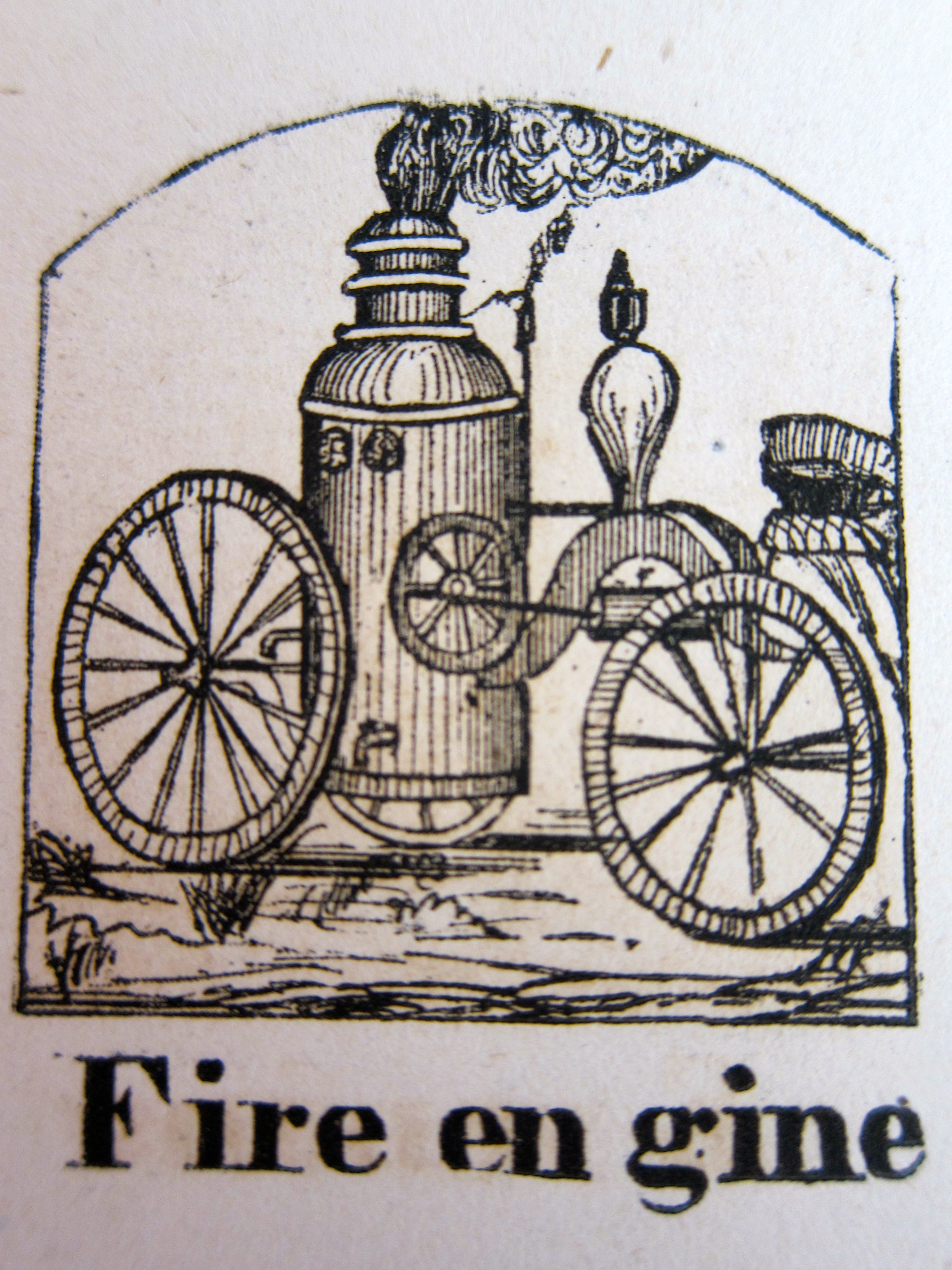
“FIRE. – Firemen Injured. – About 10 o’clock last night a fire was discovered in the upper part of a five story brick building, in the rear of No. 24 Kingston street. The fire broke out upon the upper floor, used for chair painting. The flames spread rapidly, and in a few minutes the roof fell in, pressing portions of the walls over the sides, the falling bricks injuring five firemen who were upon ladders directing the streams upon the fire, two of them very badly indeed. The third story was improved by the “Boston Laundry,” and was burnt out. The second story, occupied as Fox’s machine shop, and the first by Horace Jenkins, mason, were thoroughly drenched with water. The building, a sham built concern, is owned by Willard Sears. The wind was quite high and the weather freezing cold at the time, and the firemen deserve great credit for their well directed and energetic efforts in subduing the devouring elements, – and it is with pain and regret that we have to record injury to so many of their number: – John Smith, of Hydrant No. 2, very severely in the back and shoulders; Christian Karcher, Engine C. No. 1, badly bruised; Abraham Ross and James McCullis, of Hydrant Co. No. 3, bruised. Charles Ricker, of same company, received a severe injury in the back. It was reported that Smith’s and Ricker’s injuries are of a very serious nature. They were all carried into houses nearby, and medical aid procured.”

Then as now, fire was deadly serious.  John Smith died of his injuries three days later, Boston’s first modern fireman to suffer a Line of Duty Death.**

*The Boston Atlas, February 12, 1852

**http://www.bostonfirehistory.org, accessed Feb. 11, 2015

February 11, 1852

Rain

Feb 11th Wednesday  Returned from Boston to night very

much fatigued  It has rained poringly all

day and I was out shopping and most horrible

walking in the streets  Went to Doe & Hazleton

and bargained for a looking glass  bought an

all wool Delaine of Mr Norris  Mrs Witherell

was here some time this morning

Boston in February is subject to terrible weather, as Beantown residents in 2015 know all too well from recent record-breaking snow.  In 1852, heavy precipitation was also the rule, although on this particular day it didn’t snow, but “rained poringly.” Shopping suddenly wasn’t as much fun as it had been the past two days. Evelina found the going “most horrible,” but still managed to chase down some good buys.

She treked to an area of the city known as Cornhill – not Cornhill Street, or Lane, or Road, but just plain Cornhill.  This area of the city is now irrevocably altered, having been turned into Government Center, a modernistic architectural complex, in the 1970s.  Only a small portion of the original Cornhill known as Sears Crescent now remains. In the 1840s and 1850s, Cornhill was known as a center for Boston’s intelligentsia. Writers, poets, and book publishers gathered there.

In 1852, at number 42 to 48 Cornhill, there were also several retail shops, including one called Doe & Hazleton. Owned by Joseph Doe and J. M. Hazleton, the store specialized in “Decorative Furniture.” It was there that Evelina went and “bargained for” a mirror, to be delivered to North Easton in the near future.  She also bought some wool cloth from another Orr son-in-law, Caleb Norris, and probably had that delivered, as well.

By day’s end, Evelina was back in North Easton, “much fatigued” from her shopping.

January 30, 1852

Chess

Jan 1852

Jan 30th  Friday  Have commenced making a flannel

skirt for self & finished Susans dark print apron.

Mother [and] self passed the afternoon at Edwins.  Mr

Ames came to tea. Mrs S Ames called there with Mrs

Holmes. Mrs Witherell and the others returned to 

night  She has not her teeth but is to send for them

Oliver & Fred went to James Mitchell and called at

several other places  had a fine time Oliver played

chess with Judge Mitchell

Oliver Ames (3), Evelina’s middle son and a future governor of Massachusetts, was still home from college, as was his first cousin, Frederick Lothrop Ames.  The two young men were having “a fine time” on their winter break.  Chess was just one of the games they might have played to while away the dark evenings, another being whist.

Chess had been around for centuries, having first developed in India and the Islamic world.  It had evolved over time; dark and light squares on a chessboard were first introduced in the 10th century, for instance, rules for a stalemate or draw in the 15th, and so on.

By the nineteenth century, chess was really coming into its own.  In 1802, one J. Humphreys published a book called Chess Made Easy.  In 1830, the first known female chess player was acknowledged (though probably not encouraged.)  The first international chess tournament was held in London in 1851, won by Adolf Anderssen, and in 1852, the year we find Oliver Ames (3) playing the game on a winter’s night in Bridgewater, Massachusetts, sandglasses were first used to time a game.

Before the decade was finished, an American prodigy name Paul Morphy came to fame, winning nearly every game he played and defeating most of the older expert players. In the United States, a chess “epidemic” was born.

January 29, 1852

Teeth

1852

Jan 29th Thursday  Mrs Witherell Oliver 3rd & Fred & George went

to Bridgewater this morning for Mrs Witherells temporary

set of teeth.  Father & Mrs S Ames & Emily here to dine

Mrs S Ames came about half past eleven and spent

the rest of the day.  Have written a letter to Harriet

Ames [of] Burlington.  Went after mother in a sleigh to night

Augustus & wife spent the evening Three evenings this week


Sarah Ames Witherell traveled to Bridgewater today to pick up a “temporary set of teeth” to replace the real ones that had been pulled out earlier this month. It turned out that they weren’t ready, so she had to return home without them. As before, she was accompanied by several family members including her son George Oliver Witherell and two of her nephews, first cousins and good friends Oliver (3) and Frederick Lothrop Ames, who were still home on a recess from college.

Evelina, meanwhile, fed midday dinner to all the family members who stayed behind in Easton.  Sarah’s daughter, Emily, didn’t go with her mother this time; unlike Oliver and Fred, she and Susie Ames may well have been back in school. Evelina may have been feeling the strain of so much company.  She notes that her nephew Augustus and his wife, Hannah Lincoln Gilmore, had come to call “Three evenings this week.” Augustus, who did a lot of work for Oakes and Oliver Jr., often made himself at home at the Ames’s.

Harriet Ames of Burlington, Vermont, to whom Evelina wrote today, was a spinster cousin. Her mother was the widow of Old Oliver’s brother, John.*

*not the same John Ames who manufactured paper in Springfield

January 25, 1852

Ice

1852

Jan 25  Sunday  Have had a lovely day although it is somewhat

cold.  The first pleasant sabbath we have had for

a long while  We have all been to church except

Mrs Witherell who still stays at home on account

of her teeth being out. Mother came with us

from church to night. We have had fine sleighing

for a long time  Mr Whitwell gave us a fine 

sermon this afternoon

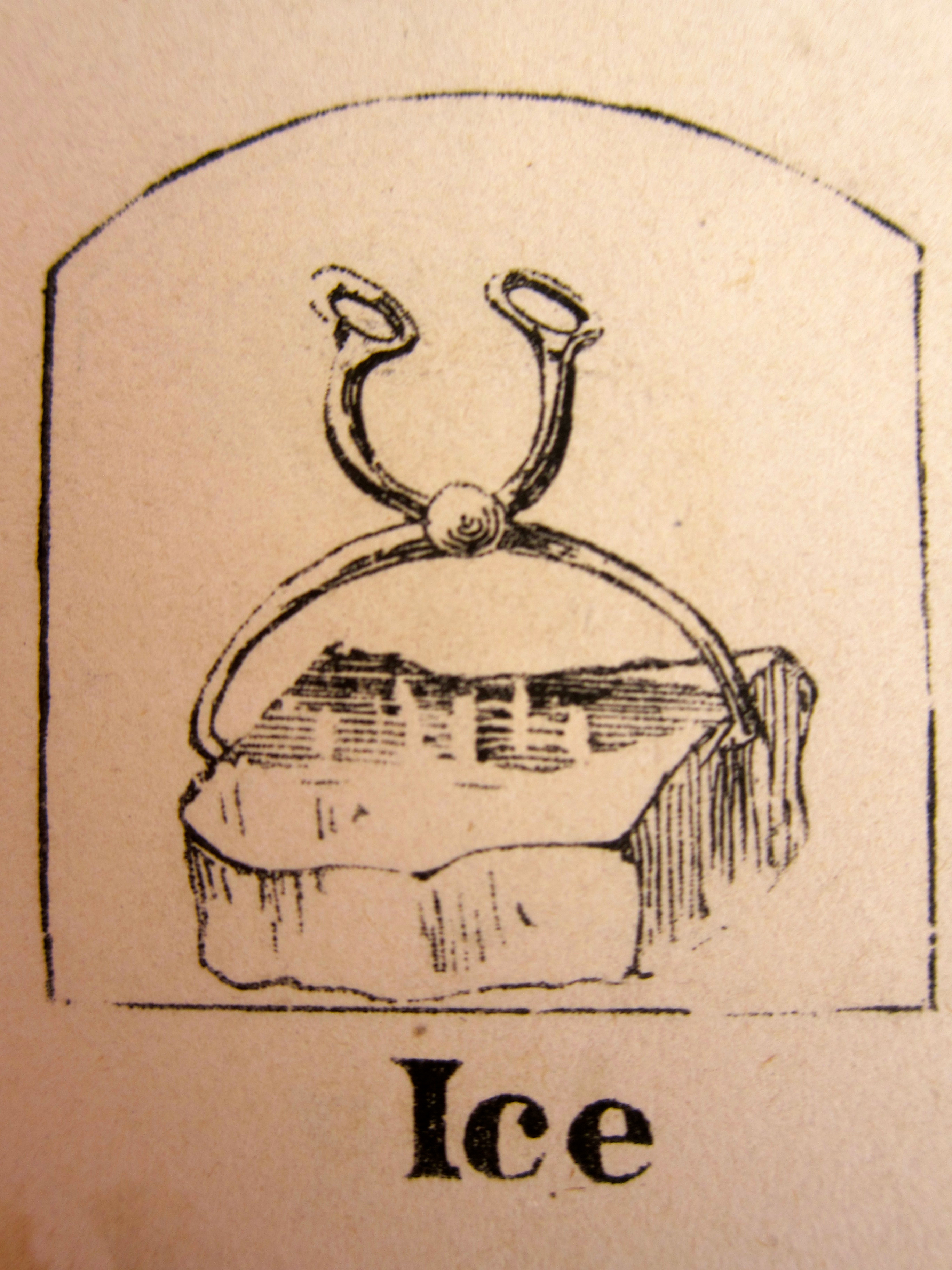
Old Oliver, too, appreciated today’s weather: “this is a fair pleasant day wind south west + thaws some   it is the first fair Sunday we had for a long time…” He also noted with satisfaction that “we began to fill our new ice hous yesterday,”* much of it with the ice that his grandsons Oliver (3) and Fred Ames had harvested on Friday.

The ice house was built right next to the pond** from which the ice was harvested. It was probably lined with sawdust for insulation; when the ice was removed, block by block, the sawdust absorbed some of the moisture and kept the building cool.  Even if the temperature outside rose, the temperature inside stayed relatively low. The ice was crucial to the storage and preservation of food in those days before refrigeration.

Today’s fair weather enticed everyone to church except Sarah Ames Witherell, who preferred to remain somewhat hidden while she recovered from recent dentistry.  The group drove the sleigh (or sleighs) to the meeting house, which was a couple of miles south of their family compound. Evelina sat in the family pew and enjoyed herself; she always liked hearing what Reverend Whitwell had to say.  She and her family brought her mother, Hannah Lothrop Gilmore, home for a visit.

*Oliver Ames, Journal, Stonehill College Archives, Arnold Tofias Collection

** Thanks to information from James Carlino, Dwight MacKerron and John Ames, we believe the ice pond in question may be Monte Pond, on the north side of Elm Street, just east of Rte. 138 in the northeastern corner of Easton. John also remembers an ice house next to French Pond on Union Street, also just east of Rte. 138, north of and parallel to Elm Street.  He bought some old ice tools there in the 1970s that he used in making sculpture.

January 20, 1852

OLYMPUS DIGITAL CAMERA

Jan 20th Tuesday  Have made Susan two pr of fur cuffs

one pair for school and one for best.  Hannah called

for me to go with her to call upon Augusta, went

with her found Julia Pool there stoped but a few

moments. This evening Mrs Witherell Emily & Mrs

S Ames brought in their work and passed the evening

They say I never give them the credit of coming here

at all. I certainly will this time

In what Evelina considered to be a rare occurrence, her two sisters-in-law, Sarah Witherell and Sarah Ames, “passed the evening” at Evelina’s. The women brought their work boxes or baskets and sewed together, young Emily and perhaps young Susie with them. Usually, Evelina went over to one of their sitting rooms.

On this same date in 1865, when Evelina’s life had changed, and she and Oakes were in Washington, D.C. while Oakes served as U.S. Congressman from Massachusetts, Oakes was called to the White House.  Winthrop Ames, who once possessed the diary in which Evelina recorded her days in Washington, tells us that Evelina wrote “today Mr. Lincoln sent for Oakes to come to the White House.  He went immediately after dinner and talked with the President until after midnight.’ ”

Winthrop went on to add, in his own words:

“Ames reported that the President said to him then, and in later conferences, ‘Ames, you take hold of this. If the subsidies provided are not enough to build the road ask double and you shall have it. Take hold of it yourself.’ And he added,’by building the Union Pacific, you will become the remembered man of your generation,’ The President said further that if the railroad could be so far completed that he might take a trip over it when he retired from the Presidency it might be the most memorable occasion in his life. Alas! his next railroad trip was to be in the funeral car that bore him to his grave in Springfield, Illinois.”*

*Winthrop Ames, The Ames Family of Easton, Massachusetts, 1937, p.


January 18, 1852

$T2eC16JHJHQE9nzEyP!zBRVGZ!!IT!~~60_35

/52

Jan 18 Sunday  Has snowed quite hard all day.  The

gentlemen all went to meeting & Mrs S Ames & Emily,

Mrs Witherell staid at home because she looks so bad

& Susan & self on account of a cold & cough  Have

read The Vale of Cedars by Grace Aguilar & have

written a letter to Pauline Dean.  Made a long

call in the other part of the house this evening.  Mrs

S Ames there with me

Feeling under par, Evelina and her daughter stayed home from church today while the men of the house pushed through the “fine cold dry snow”** to get to meeting. Sarah Witherell stayed home, too, still recovering from having had her teeth pulled.  It was a luxurious opportunity for Evelina – and Susie and Sarah, perhaps – to sit and read in relative quiet.

Evelina’s choice (which she probably read in serialized form in a periodical, as the tale wasn’t published in book form until 1853) was The Vale of Cedars or The Martyr’s Tale by Grace Aguilar. It was a tale of a Jewish father and daughter trying to hide from the Spanish Inquisition in 1479. The “Vale of Cedars” was their hideout. Eventually discovered and imprisoned, the daughter resisted the church’s demand that she convert to Catholicism.  Thus, the “Martyr’s Tale.”  The dramatic plot with its medieval overtones, exotic location, and anti-catholicism probably captivated Evelina, just as the author meant it to. Aguilar included these words from Byron’s [Oh! Weep for Me] in her introduction to the book:

“The wild dove hath her nest – the fox her cave –

Mankind their country – Israel but the grave.”

George Gordon, Lord Byron

**Oliver Ames, Journal, Stonehill College Archive, Arnold Tofias Collection

January 13, 1852

images-1


Jan 13 Tuesday  Have not done much work to day

can scarcely tell what I have been doing  Have

been trying to fix Susan some work to learn her to sew

Have got out an apron and commenced a stocking

for her to knit.  This afternoon called on Mrs Richards

Holmes, Torrey Savage & Hannah  Spent the evening with

Augustus and wife at Olivers.  Mrs Witherell been to Dr Washburns

& had her teeth out.  Mrs S Ames George & Emily went with her.  Father

& Oliver dined here & the others when they came back from Bridgewater

This was not Sarah Witherell’s best week. Limping from a bad burn on her foot, she kept an appointment with a dentist, Dr. Nahum Washburn, to have her teeth pulled. Dr. Washburn had his office in Bridgewater, in an historic building known as “the Tory House.”  It was the same office that Evelina had been to several months earlier to have her own teeth worked on.

Modern historian Jack Larkin has noted that “[h]undreds of thousands of Americans had at least some of their teeth badly rotted, a source of chronic pain and foul breath to many, with extraction its only cure […] Dentistry, which most rural American physicians practiced, was by far the most effective form of surgery; extraction was a decisive and relatively safe procedure (although infection always posed some risk).”*

While Sarah Witherell suffered today, her family united to support her. Her children and sister-in-law accompanied her to the dentist’s office.  Evelina (with Jane McHanna in the kitchen, of course) fed the entire family, which made for twelve around the dining table. Old Oliver, whose midday meal was usually prepared by Sarah Witherell, came over from the other part of the house. The Ameses from next door were there, too. Everyone came together for Sarah Witherell.

Evelina managed to socialize today, too.  She called on various friends and relatives around town, perhaps sharing the news of poor Sarah’s painful dentistry.


*Jack Lardin, The Reshaping of Everyday Life, 1988, pp. 92 – 93

January 11, 1852


images-1


Jan 11  Sunday  Have been to meeting although it has

been stormy  Mrs Witherell did not go which is

unusual  Henrietta Mrs Clarke & self called on

Mrs Witherell at noon.  She burned her foot and

cannot go out but it is getting better.  Have written

a letter to Oliver this morning and have been reading

Sarah Witherell burned her foot and couldn’t go to church, probably because she couldn’t put her shoe on. How had she burned it?  Fallen against a coal stove? Stepped on a live ember? Spilled hot tea or scalded it stepping into a tub? If the possible sources of the burn are multiple, so were the potential remedies.

“Cotton wool and oil are the best things for a burn,” declared Lydia Maria Child in The American Frugal Housewife.* Dusting a burn with flour and wrapping it in cotton flannel was another common practice. Like today, the application of a salve was soothing.  We might apply cold water; they might have applied butter, assuming they had any on hand to spare. Home treatments for minor burns are still variable, despite today’s over-the-counter ointments and sprays.

Sarah Witherell, we learn here, always went to meeting.  Her absence today surprised even Evelina, who came back from church at intermission to check on her sister-in-law.  Evidently reassured that Sarah would be fine, Evelina settled into her more normal routine for Sunday, which included reading after church and, today, writing a letter to her middle son, Oliver, who was away at college.


*Lydia Maria Child, The American Frugal Housewife, 1846, p. 17

January 6, 1852


OLYMPUS DIGITAL CAMERAOLYMPUS DIGITAL CAMERA

Augusta Pool                                       Lavinia Gilmore
                    

1852

Tues Jan 6 th

A heavy snow storm commenced about

10 Oclock  Mrs Witherell & her children have been

to the funeral in a waggon had a hard time getting

home.  Augusta and Lavinia have been at Edwins

house getting it in order for housekeeping.  This

evening have helped me stone raisons for cake  Edwin

came with them to tea

The bad weather continued, bringing snow that Sarah Witherell and her children, George and Emily, had to fight their way through as they returned from a funeral in a wagon. As Sarah Witherell’s father, Old Oliver, noted, it “snowd all day and in the evening. it was a damp snow and fell level.

Evelina was safe inside, out of the weather. With her were her 19-year-old niece, Lavinia Gilmore, and Augusta Pool, a 22-year-old who was about to marry Lavinia’s brother, Edwin. The two young women had been at Edwin’s house for much of the day, “getting it in order.” How exciting, and perhaps a little scary, for Augusta to be getting married and moving into a new house in the village of North Easton.  She had always lived out in the country, not far from the Gilmore farm, which is how she got to know Edwin.  In fact, Augusta’s older brother, John Pool, was married to Rachael Gilmore, Lavinia and Edwin’s older sister. They would be double-siblings-in-law. (There must be a more official word for the relationship when a brother and sister from one family marry a sister and brother, respectively, from another family.)

When they finished today’s work at Augusta’s new home, the two girls walked over to Evelina’s to help her stone raisins for the wedding cake.  Evelina may have put the raisins in a little warm water to plump them up before popping the seeds out.  Edwin, groom-to-be, joined the women and the rest of the family for tea once the men all arrived home from work.


* Photographs courtesy of The Easton Historical Society, with thanks to Frank Mennino, curator