May 8, 1852

Ill

1852

Saturday May 8th  Mrs Witherell has finished working

my Delaine sleeves and I have put them in

and have finished the dress which I think

is about time.  I sit with George for Mrs Witherell

to lay down this afternoon  He is very sick and 

suffers very much.  Mr Manly brought me some

more plants & I paid him 1,58 cts.  Oliver &

Brown returned this morning

George Witherell, fourteen years old,  was ill with rheumatic fever. In the age before antibiotics, the “rheumatics,” as Evelina called it, was a serious illness. It was a complication of strep throat, which George must have had three or four weeks earlier. Its symptoms, many of which George manifested, were fever; a flat rash; involuntary twitching in the hands, feet and face; painful, tender and swollen joints; chest pain; palpitations and fatigue. As Evelina noted, George suffered a great deal, for rheumatic fever was extremely uncomfortable and unsettling. It was also often fatal.

Sarah Ames Witherell had been nursing her son for several days now.  She took a rest in the afternoon and let Evelina sit with George.  All the family was helping, although George wasn’t the only sick child. Helen Angier Ames next door was down, too, with a somewhat mysterious ailment in her face. Family members were worried about both young people.

Despite the concern everyone must have been feeling, normal routines in this season of planting had to be adhered to. Old Oliver reported that “we began to plow the hill back of the shovel shop pond to day.”


May 5, 1852

Thread

Wednesday May 5th  Worked about house & got my sleeves for Delaine ready

for Mrs Witherell to work  The sewing circle met

at Mrs Nahum Pools.  Mrs S Ames gone to Boston

George quite sick with the rheumatics Augusta gone

to N Bridgewater and so poor I should have had to

go alone.  Preferred to stay at home  Mr Peckham +

family all at Mr Swains.  called to see them & after they

left Mr & Mrs Swain went with me to Edwins garden got

two Gladiolus bulbs.  A beautiful pleasant day

The Sewing Circle met today at the home of Nahum and Lidia Pool, but Evelina didn’t attend. Her usual companions from the village were otherwise occupied, and “poor” she didn’t want to go by herself. She stayed home, or at least she stayed in North Easton. She parcelled out some sewing to her sister-in-law, Sarah Witherell, to work on, and headed out. Perhaps Sarah sat and sewed near her son George, who was “quite sick.”

The day was beautiful, and Evelina seemed to be in fine spirits despite missing the sewing circle, or perhaps because of missing it. She went to see John and Ann Swain and there encountered the Peckham family, who had moved away from North Easton the previous year. They must have been back for a visit.  When they left, Evelina and the Swains went up to the garden of Edwin Manley and bought two Gladiolus bulbs.

May 4, 1852


IMG_0159

Trellis on the door of the home of Oakes and Evelina Ames and extended family, ca. 1860


Tuesday May 4th  Mr Healy & Morse commenced the trellis

for our front door  We had quite a consultation how it should

be made  I[t] was very cold & windy this morning & I fear I

have taken cold in being out so long  Have mended Olivers

sack and cut the pattern and have done some other mending

Augusta made a long call. It is really very pleasant to have

her so near.  Mrs S Ames went to Boston

The trellis that Evelina refers to today could very well be the modest trellis that graces one of the doors in the above photograph. The doorway facing the street in the approximate middle of the photograph was the door that Evelina, Oakes, and their family used for their own. The doorway on the far left, facing the yard, was likely the entry that Old Oliver and his daughter, Sarah Witherell, used. The house on the far right was a separate dwelling that belonged to Oliver Ames Jr. and his wife, Sarah Lothrop Ames.

None of these buildings is still standing. The one on the far right was torn down in 1863 and replaced by a larger, more formal house that is still extant today, with lovely gardens and a well-kept air.  The house in the center, halved on the interior to accommodate the two households of Evelina and Sarah Witherell, was torn down in the 1950s, at the behest of Oakes Angier Ames’s eldest son, Hobart Ames. The site has since been reclaimed by trees and undergrowth.

The trellis was meant to add a fashionable air to Oakes’s and Evelina’s side of the house. Evelina was trying to bring the simple, old Federal dwelling into the Victorian age, inside and out. She had a particular vision for her home, and she worked hard to realize it. Small wonder that the construction required “quite a consultation.”


April 28, 1852

Unitarian Church, Bridgewater, Mass

1852

Wednesday April 28  Have been to the ordination of

Mr Ballou of W Bridgewater with Oakes A & 

Sister Sarah, Mr H Ballou, Briggs of Plymouth

Brigham [illegible] Ballou of Stoughton &c

Mrs Witherell dined at old Mrs Ames, the

rest of us at Mr Thomas Ames.  On my return 

stoped at Augustus’.  Oakes A came to tea

Miss S Lincoln Rachel Augusta & Abby here

It was the middle of a work week, but the Unitarian ministry was busy. In Bridgewater, (or West Bridgewater) a Mr. Ballou was ordained as minister. The name Ballou was associated with many late 18th and 19th century men of the cloth, particularly with Hosea Ballou, an early leader of the Universalist Church. Today’s Mr. Ballou wasn’t he, but may have been a relative.

Why were the Ameses invited to this ordination? Why did they attend? What was the connection? Were they related to the Ballous? They were distantly related to various Ameses in the area, including Thomas Ames, a 52 years-old farmer, who kindly had them to dine.

On this special occasion, as the Unitarians in Bridgewater were honoring ritual and perpetuating their ilk, a forward-looking and entirely new event took place in Boston. The first electric fire alarm in the world “was rung from what is now Box 1212 for a fire on Causeway Street. Created by Dr. William Channing and Moses Farmer, the system consists of forty miles of wire, forty-five signal boxes, and sixteen alarm bells. Police officers and members of the Boston Night Watch are given keys to the locked boxes to enable them to turn in alarms.”* What’s particularly amazing is that “[p]art of the system is still in use today.”*

*Jim Vrabel, When in Boston, 2004, p. 160

April 24, 1852

7841216_6_l

Sat 1852

April 24  Mrs Ames returned last night I came

from Boston to night.  Like my things pretty well

have bought me some bronze candelabras

drugget a lot of gentlemans hose &c &c

Got through with my shopping about three

and went to Mr Orrs.  Lucia Harris is

there Mrs Witherell & Ames came to see my

things in the evening

The bronze candleabras that Evelina bought in Boston today were purchased, in all likelihood, for the parlor. They were a formal throwback to the time when candles were used for lighting, which was the period that began when the Pilgrims first arrived and lasted to the early part of the 19th century.  By 1852, however, oil lamps and very soon, kerosene lamps, were becoming standard fare for lighting. They were more economical than candles.

Burning candles, then, was something of a “retro” effort that honored the grace and warmth of the familiar candlestick, and suggested that the homeowner had enough money to burn candles if he so chose. No smudgy little whale oil lamp for the parlor or the dinner table, though oil lamps of varying styles and efficiency might operate in the rest of the house. In the room in which company was entertained, the candleabras would glow, and brag.

Both sisters-in-law came over at the end of the day to see what Evelina had bought, and it’s hard to imagine they were interested in the “gentlemans hose &c.” They came over to check out the new candleabras.

April 17, 1852

Village

1852

April 17  Saturday  Julia was at work here a year ago to day

has improved very much in dress making since then

I have my black silk nearly finished.  The Delaine

all done except the sleeves & buttons, am waiting

to go to Boston to get the trimmings.  This afternoon 

have been altering some old dresses for Susan

Hannah called to get me to go up by the school

house and select a place for a house for them

Mrs Witherell went with me  A beautiful pleasant day

Sewing continued today, with Julia Mahoney again on hand to assist with Evelina’s new dresses, one of black silk, the other of a light wool they called delaine. The finished projects would have to wait for trimmings to be fetched from Boston. Evelina meanwhile refashioned some old dresses for her daughter, for “[e]very season there was a great remaking of old garments to bring them up to date.”*

The bad weather of the past two days disappeared and was replaced by fair skies. Despite continued cold temperatures, Evelina was finally drawn outside on a fun errand. Invited by her niece, Hannah Lincoln Gilmore, and accompanied by her sister-in-law, Sarah Ames Witherell, she went to the local school house to look at some property that her nephew, Alson Augustus Gilmore, and Hannah, his wife, were considering.  They had been renting rooms from Col. John Torrey, but now were planning to build a house.

Everyone in North Easton lately seemed to be wielding a hammer. It was spring.


*Winthrop Ames, The Ames Family of Easton, Massachusetts, p. 127


April 16, 1852

 women sewing*

1852

April 16th Friday.  Julia here again to day and we have

been to work on my dresses  Mrs S Ames & Witherell

helped some time this afternoon and we have

got along nicely  Hannah & Augusta called

Augusta brought her work and Hannah finished

Susans stocking.  Susan has the other stocking about

half done.  The first pair that she ever attempted to knit.

Stormy again to day.

The day before had rained “pritty fast” all day long, and today opened in much the same vein, with “snow squals + rain + a high wind.”***  The women stayed indoors and focused on fashion.  Dressmaker Julia Mahoney came over to work on new outfits for Evelina. Sisters-in-law Sarah Ames and Sarah Witherell helped for a time, too, both of them as accomplished at sewing as Evelina. They all “got along nicely,” a phrase that suggests good progress was made on Evelina’s dresses, although the women’s sociability quotient was also probably pretty high.

Others joined the hum.  Nieces-in-law Hannah Gilmore and Augusta Gilmore, a younger set of eyes and hands, arrived with work in hand. Hannah helped her little cousin, Susie Ames, knit a pair of stockings.

The sewing of new dresses – as opposed, say, to the mending of men’s shirt fronts – was the favorite expression of the women’s collective talent with needle and thread. As Winthrop Ames noted, “An immense amount of sewing went on in every family.”** We’ve certainly learned that from Evelina’s diary.  In 1852, they still made their own dresses. “[T]he materials and trimmings, after much consultation about their style and quality, were made up in the house with the help of the town seamstress and pictures from the fashion magazines.”

Things would change. By the start of the Civil War, the Ames women began to have their dresses made up in Boston. But on this day in North Easton, needles flew.


*Image courtesy of nhdsewingmachine.weebly.com

** Winthrop Ames, The Ames Family of Easton, Massachusetts, p.126

*** Oliver Ames, Journal, Stonehill College Archives, Arnold Tofias Collection


April 13, 1852

Ill

1852

Tuesday April 13th  Watched with Mrs Brett last night

She is quite low seemed to like my being there and

urged my coming to see her often and said she meant

to come to see me and be more friendly if she ever

gets well  said her Mother told her in her last hours

to come to me for advice and regretted that she

had not done so but meant to in future  The rain of 

the morning has turned into a heavy snowstorm  Susan & self

carried our work and stopt a couple of hours with Mrs W

A young neighborhood wife named Eveline Brett was ill, probably with childbed fever. Evelina went to stay with her during the night, taking her turn with family members and other neighbors to watch, suggesting that some must have thought that the new mother wouldn’t survive.

Modern historian Jack Larkin has described this neighborly service as “one of the commonest of rituals.”* In towns across New England, when someone was seriously ill, or “dangerously sick,” as Evelina noted a few days ago, “neighbors took turns staying through the night at the sick bed to allow exhausted family members to sleep. Watchers could administer medicine when needed, but, far more important, they provided a continuous comforting presence – as well as witnesses who could quickly gather the family around if death seemed imminent.” *

Evelina’s personal experience on this occasion was especially rewarding. The young mother confided that Evelina’s presence was truly comforting and that if she recovered, she hoped she could go to Evelina for advice. Happily, Eveline Brett would indeed survive her illness and, in the future, bring her baby by to visit the understanding woman who had given her such comfort.


*Jack Larkin, The Reshaping of Everyday Life, New York, 1988, p. 93

March 28, 1852

Ames-Shovel-Handle-2

Ames Shovel Handle Factory, Oakland, Maine*


March 28 Sunday  Went to church this morning and

at noon called at Mrs Wm Reeds with Henrietta

Hannah came at noon but was faint and

I carried her home and got back to church about

the time the services were over  After went down

to the new shops with Mrs W, S Ames Augusta Orinthia

found Mr. Ames, Oliver & Cyrus L there returned by Edwins

and all called there  Mr Ames & self went to Augustus’ this evening

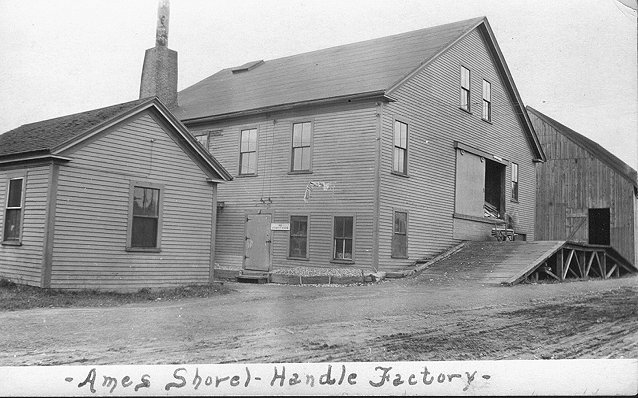
The new shops were up, and various family members rode by to see them after church. No more “dismal ruin”, as reported by Evelina only three weeks earlier. Risen like a phoenix from the ashes of the old shops, the shovel works were about to begin operations in new, if temporary, quarters.

It was a large group that gathered to consider the new buildings. Evelina, who had missed the afternoon service in attending to her ailing niece, Hannah Lincoln Gilmore, nonetheless rode back from church to the site. Accompanying her were her sisters-in-law, Sarah Witherell and Sarah Ames; another niece, Augusta Pool Gilmore; and sometime boarder and frequent companion, Orinthia Foss.  At the site, by accident or design, they found Oakes Ames and his brother, Oliver Ames Jr., and Cyrus Lothrop, a brother of Sarah Lothrop Ames who often resided with his sister. The group must have marveled at the swift reincarnation of the shovel works.

Perhaps a celebratory spirit inspired the crowd to assemble en masse at the nearby home of newlyweds Augusta and Edwin Gilmore.

*Image of Ames Shovel Handle Factory, Oakland, Maine courtesy of the Oakland Maine Area Historical Society. Included to illustrate what the rebuilt shovel factory could have resembled.

March 27, 1852

north-bridgewater-mass-1844-sm

1852

March 27  Sat  Have been mending again to day and painted

some spots in the back entry chamber  Mrs Witherell

& Mrs Lovell from Bridgewater came to see Mrs Witherell

& spent the day.  Mrs Lovell called on Hannah.

Mrs S Ames came in soon after dinner and staid

most of the afternoon  We called to see Mrs

Witherell & Lovell  Have read in the papers this

evening

Sarah Ames Witherell, Evelina’s sister-in-law, had visitors today from Bridgewater. Sarah’s mother-in-law, Lydia Witherell, and a Mrs. Lovell called. Mrs. Witherell was a recent widow, more recent even than her daughter-in-law, Sarah, who had been widowed three years earlier. Where Sarah’s late husband, Nathaniel Witherell, Jr. had died in October, 1848, his father, Nathaniel Witherell, Sr., had passed away in January of this year. Sarah and her two children, George and Emily, had traveled through a snowstorm to attend the funeral.

The Mrs. Lovell who came to call may have been Emeline Perry Creasy Lovell,  wife of Reverend Stephen Lovell, former resident of Easton and one-time pastor of the recently defunct Protestant Methodist church in Easton. But the clergyman and his wife possibly lived in Boston, too, so this Mrs. Lovell “from Bridgewater” may have been someone else. Yet her extra visit to see Hannah Lincoln Gilmore, who was still ailing, suggests that this Mrs. Lovell was familiar with at least some of the residents of North Easton.

While this visiting was going on, Evelina stayed on her side of the house with her other close sister-in-law, Sarah Lothrop Ames.  How did it work to have two separate social conversations going on under one roof, one on each side of divided parlor walls? One imagines that Evelina and Sarah Ames were curious about the nature of the call in “the other part of the house.”