February 6, 1851

Dance

Dance

Feb 6th Thursday  This forenoon was working about house & did

a little mending  Prepared some mince pie meat for baking

Have been into school this afternoon  There were but

about 50 schollars.  Mr Jackson appears to lack energy

Miss Lothrop appeared the best of the two.

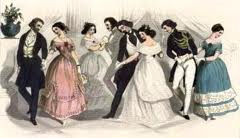
There is a ball at Lothrop Hall to night for the first

time.  Oakes Angier & Frank have gone & Helen

Sarah A & Sarah W spent the evening here.  Pleasant but cold.

Thursday night seemed to be the night for dancing in southeastern Massachusetts. The Ames sons had already attended at least two Thursday evening assemblies in Canton during January and now in February they’re attending a gathering at Lothrop Hall (the location of which is uncertain: Eastondale, perhaps?  Does any reader of this blog know?) Tonight Oakes Angier and Frank Morton went. (Where was Oliver [3]?)  Evelina’s diary is unclear on whether their cousin Helen went with them or, more likely, stayed home with her mother and aunts – the latter option being more typical for shy Helen.

Earlier in the day, Evelina was evidently still involved with looking into local schooling, getting the lay of the land, perhaps, for the incoming Orinthia Foss.  By mid-century in Easton, there were four school districts, or “ricks” as they were known, in four different geographic areas of town.  Paid for by the occasionally reluctant Easton taxpayers, the schools taught local girls and boys up to grade eight or so.  Massachusetts, and New England as a whole, led the nation in its emphasis on education and, in Evelina’s time, Massachusetts had boasted a 96% literacy rate.

Susie was the only Ames child still attending school.  Oakes Angier, Oliver (3) and Frank Morton as boys had each attended school locally before being sent away to nearby private schools such as Leicester Academy.  On this night, however, dancing, not schooling, was foremost on their minds.

February 4, 1851

Governor Oliver Ames (Feb. 4, 1831 - Oct. 22, 1895)

Governor Oliver Ames

Tues Feb 4  Had my morning work done about nine Oclock just

as A A Gilmore & wife came to pass the day.  About eleven

we called to see Simeon Randalls house.  This afternoon

called at Mr Torreys and at Mr Peckhams.  While

we were at tea Mr Torrey called to talk about letting his

house to Augustus.  Received a letter from O Foss.

Passed this evening with Sarah W in the other part

of the house finished another pair pantletts  Pleasant

Evelina’s nephew, Alson “Augustus” Gilmore, and his wife, Hannah Lincoln Gilmore, came to North Easton today to search for a house to rent.  A young couple with one child, Eddie, they were expecting a second child in July, although they may not have shared that information with their aunt.  Even if they had, she would never have spoken of it.  The increasingly prim culture of the day forbid it, but the high rate of infant mortality, too, caused many expectant parents and their relatives to downplay “the blessed event.”  Evelina carried Augustus and Hannah around to look at available properties.

Although Evelina doesn’t mention it, today is the birthday of her middle son.  Oliver Ames (3) turned 20 today.  Like his older brother, Oakes Angier, and his younger brother, Frank Morton, Oliver worked at the shovel shop, learning the business in the expectation that he would one day help run the company.  He had attended school at Leicester Academy and had hoped to go on to college, as his cousin Fred Ames was planning to do, but his father had insisted that he return home to work. Oakes Ames was no fan of formal education, having despised learning in his own youth.

The eldest son, Oakes Angier, naturally stood first in line to superintend the shovel business, but Oliver (3), would be a partner. Like his father, he was ultimately slated to travel as the company’s salesman.  Third son Frank, on the other hand, would be given an auxiliary administrative position in a related family-owned business, the Kinsley Iron Works Company in Canton.

But on this day, those occupations were in the future, as was Oliver (3)’s more memorable service as Governor of Massachusetts from 1886 to 1889. On this birthday, he was a brand-new twenty year old who worked hard all day, read alot, and enjoyed attending “sings”.


January 29, 1851

Carpetbag

Carpetbag

Jan 29th  Finished my carpet bag this morning and afterwards made

a long call on S Witherell and then she came here and sit awhile

with Mother.  This afternoon cut Susan 4 prs of pantletts

and finished a pr that was cut out a long time since.

S Witherell passed an hour with us this afternoon and 

then again this evening  The boys went to the shop awhile

Mr Ames came home at 1/2 past seven (wonderful to relate)

and has been reading in Mr Lovells paper  Very heavy rainfall

Pleasant tonight but very windy

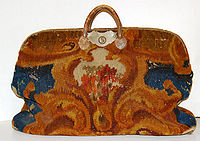
Sewing the carpet bag was speedy work for Evelina, given her skill with a needle.   Carpetbags were fashionable travel bags from as early as the 1820s, in America and England.  They gained notoriety after the Civil War when they became symbolic of certain ruthless opportunists – “carpetbaggers” – from the North who flooded into the South to take advantage of the post-war confusion and economic disarray.  The negative symbolism of this small piece of luggage was unknowable in 1851, obviously, so we can imagine that Evelina carried her new carpetbag with pride.  Perhaps she used it on her next trip to Boston.

Oakes Ames didn’t linger in the office tonight as usual but came home for a quiet evening of reading the Olive Branch.  Evelina was pleased to have his company, which must have provided some variety for her elderly mother, too.  Sarah Witherell’s company would have added to the ease and sociability of the evening.  More often, Sarah stayed in her part of the house in the evening in order to be company to her father. And the boys – Oakes Angier, Oliver (3) and Frank Morton – went back to the shop, although the nine o’clock curfew was nigh.

The Ames house was divided into two living areas, with Old Oliver, Sarah Witherell and her two children on the southern side and  Oakes and Evelina’s family on the northern.  Old Oliver made this division back in 1827 when Oakes and Evelina first married, indicating then that Oakes, as his eldest son, would inherit the family  homestead.  The two families had lived side by side ever since, the house expanding and contracting as children grew up, occupants died or moved out, and grandchildren came into the world.

Some Ames family members of today who can remember the old homestead (it was torn down in 1951) shake their heads in wonder at this living arrangement, curious as to how everyone fit in.

January 27, 1851

Read

Jan 27th Monday.  As usual this morning have been washing dishes

and working about house all the forenoon.  could not sit

with mother at all.  It was cloudy and looked like rain

but Jane ventured to put her clothes out to night  They

are nearly dry.  This afternoon & evening have finished

Susans gingham apron.  Sarah W came in awhile this

evening and the boys have been reading.  After school

Susan went to see Mary Ann Randall.  Cloudy

Another Monday, meaning that Evelina did the housework while Jane McHanna tackled the laundry.  Evelina was too busy “choring,” as she often called it, to sit down in the morning and sew or read with her mother, Hannah Gilmore, who was visiting for the week.  The women sewed together in the afternoon, however, after the midday meal, and in the evening, they enjoyed a visit from Sarah Witherell.  Oakes was most likely over in the office; he and his brother Oliver Jr. often worked there in the evenings after tea.

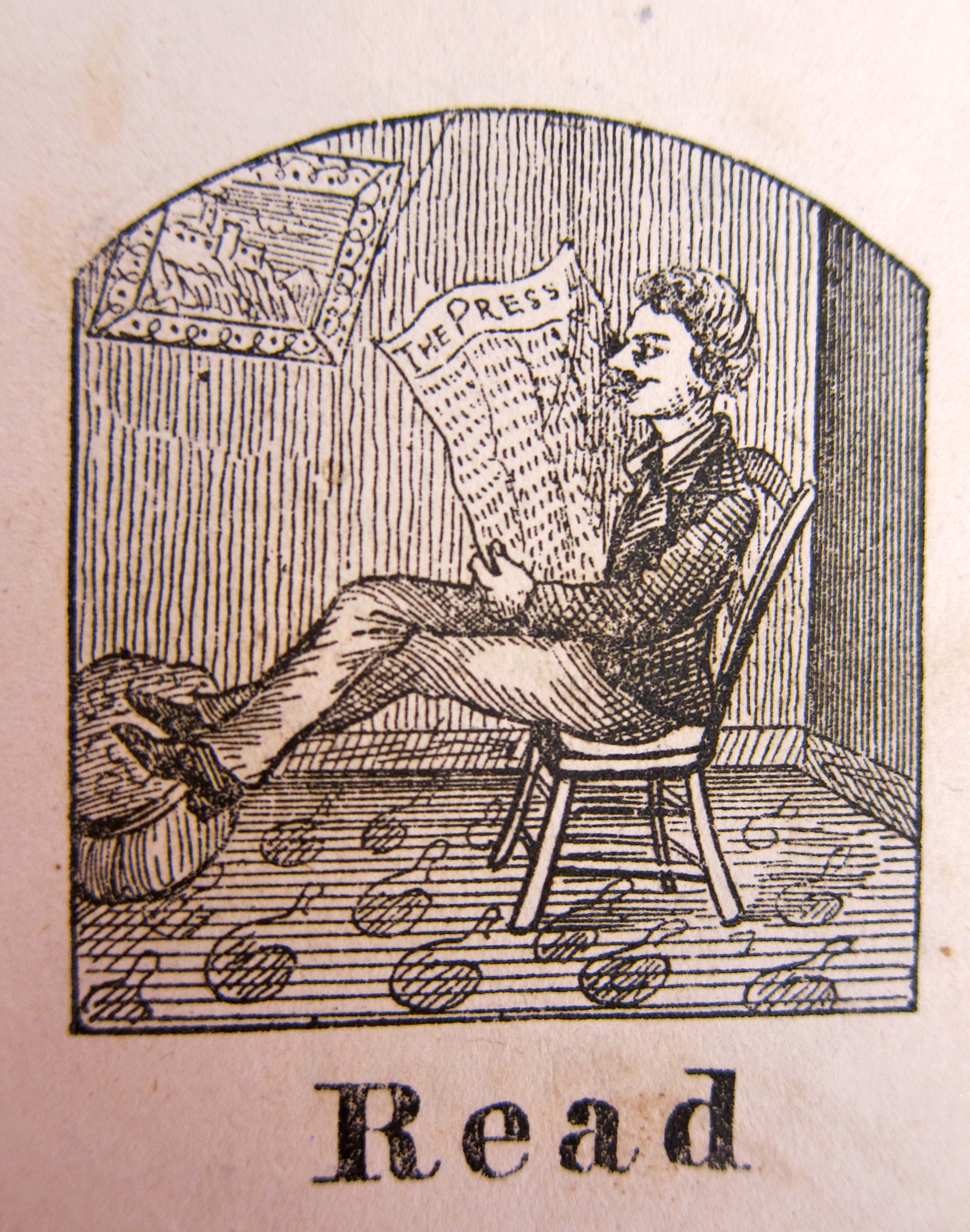
The boys were around, of course.  The shovel factory closed at 6 P. M. whereupon Oakes Angier, Oliver (3) and Frank Morton walked home. There were no dances on a Monday night, so after tea, they amused themselves by reading.  All three boys read, yet Oliver (3) was reckoned to be the most scholarly.  Even as a child he enjoyed reading and, with Oakes Angier, began to collect books. Years later, a colleague would say of Oliver that “in the company of books he found an absorbing pleasure.”*

On this winter night, everyone indulged in the papers or books, reading by the light of various oil lamps.  Evelina was no doubt eagerly turning the pages of David Copperfield, perhaps reading aloud to her mother whose aging eyesight may have precluded the pastime.  Hannah Gilmore loved to read.   In fact, she had named Evelina after the heroine of a book popular in her youth: Evelina; Or the History of a Young Lady’s  Entrance into the World.  This comic novel by British author Fanny Burney came out in 1778, and continued to find an appreciative audience in both Britain and America.   Evelina had probably read it at some point, if only to see how Evelina Anville captivated Lord Orville.

*Memorial Volume for Governor Oliver Ames, ca. 1896

January 11, 1851

Workbox

/51 Jan 11 Saturday.  Made a haircloth back & cushion for one

of my rocking chairs.  Mrs Witherell brought in her work

and staid about two hours.  Willard Lothrop made

quite a long call.  Told Mrs W that he did think at one

time of coming to see her but she looked so dignified &c that

he could hardly muster courage &c &c  This evening have been

mending stockings & reading the papers.  Mr Ames has been

to Boston bought him a pr of Robbins.  Brought home watch

Very warm, pleasant but sloppy.  Bought 5 3/4 lbs Beef of C Lothrop

While Oakes made his usual Saturday trip into Boston, Evelina and Sarah Witherell sat together in the Ames’s front room, sewing. Evelina was completing a horsehair back and cushion for a rocking chair.  Horsehair upholstery was common in the 19th century, the haircloth being both durable and lustrous, plus relatively inexpensive.  Evelina, accomplished housewife that she was, would naturally have undertaken to do this work herself.

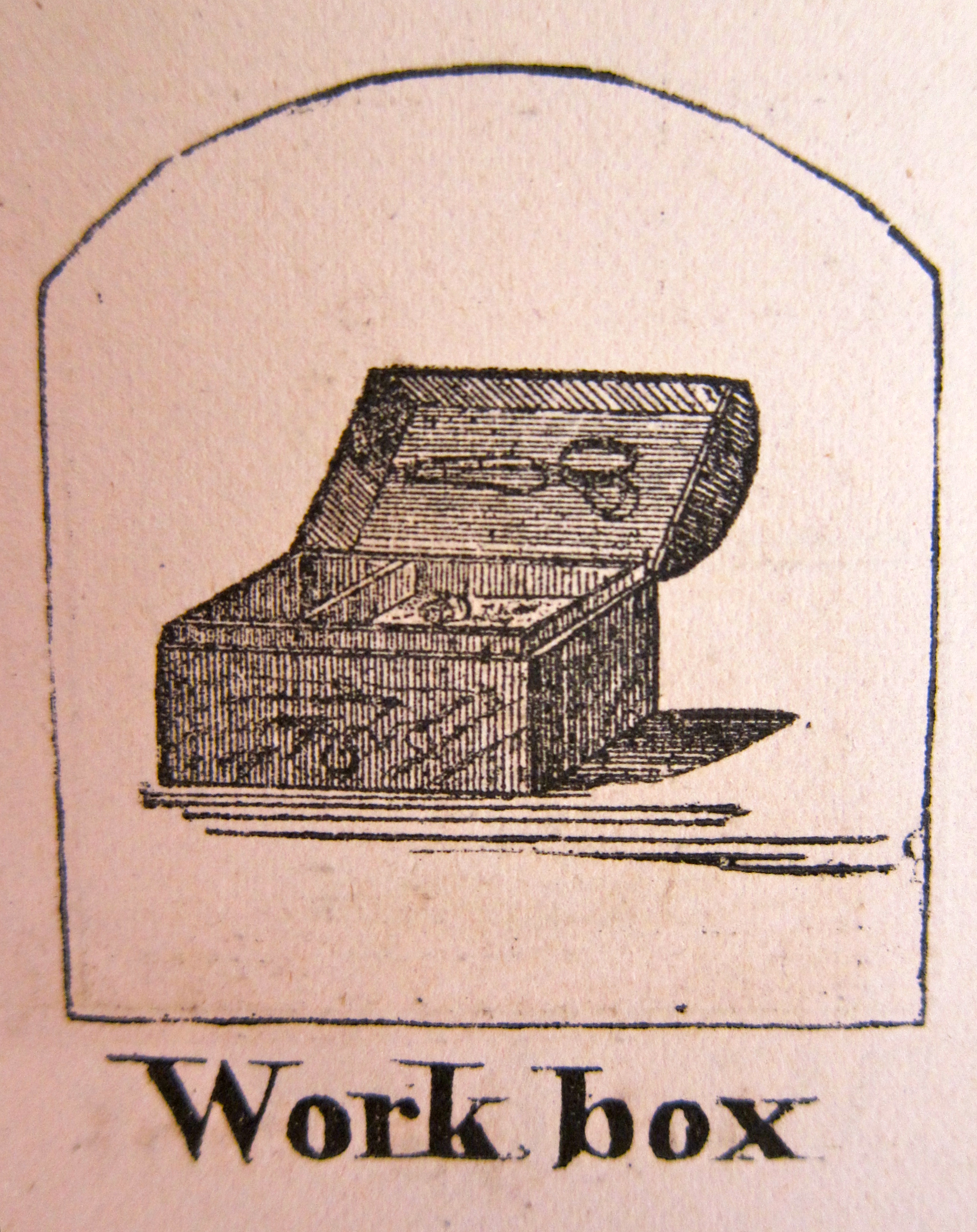
With their work boxes at hand, the two sisters-in-law sat, sewed and conversed until the arrival of a visitor, Willard Lothrop.  Mr. Lothrop, an employee at the shovel shop, was something of a character.  He was a self-declared medium and an impassioned advocate of spiritualism. (He may also have been related to both Evelina and her other sister-in-law, Sarah Lothrop Ames, through the Lothrop family line.  There were many Lothrops in the area.)

Spiritualism was a practice that claimed, in Reverend William Chaffin’s words, “that there is a vital connection between the seen and the unseen worlds by which communication between the two can be maintained.”  Though hardly a new concept, this American iteration took root in the mid-19th century and gained strength for a time after the Civil War.  Many in North Easton, especially those living along the Bay Road, were interested in it.

Lothrop, the purpose of whose call at the Ames house is not disclosed, focused his attention on Sarah Witherell, confessing that he found her unapproachable.  No mention of Evelina being inaccessible!  Lothrop offers us a rare, backdoor insight into the character, or the bearing at least, of the Ames sister of whom we know the least.  Except for her presence in Evelina’s diary, Sarah Witherell left almost no trace behind, no diary, no stories, no grandchildren, no legacy.  In a powerful, visible, active family, she may simply have been its most private member.

After Lothrop left, what did the ladies talk about?  And what are the “Robbins” that Oakes Ames bought in Boston?

January 10, 1851

tcrr_ames

/51

Jan 10th Friday.  Have been baking most all day  Heat

the oven three times.  It rained very hard last night

and carried off most all the snow and it is very wet

and sloppy.  Margaret Keighan here to see Jane.

This is Mr Ames & Mr Whitwells birth day  both

of the same age 47 years.  Have been expecting Mr & Mrs

Whitwell here this afternoon and as they did not come

would have rode there this evening but Mr Ames is engaged

If Evelina and Oakes had been able to visit the Whitwells tonight, they would have had to take the carriage rather than the sleigh because of recent heavy rain.  According to Old Oliver, the sudden wet and warm weather has “took the snow of[f] so much that it spoilt the slaying.”  Evelina, meanwhile, was so tied to the brick oven all day, baking mince meat pies and such , that she had a right to be a little disappointed not to go out this evening.

The Ames family, Puritan stock that they are, don’t overly celebrate anyone’s birthday.  Yet Evelina notes the shared birthday of her husband and the minister.  Oakes Ames was born in North Easton on this day in 1804.  He was the first child of an eventual eight to be born to Oliver Ames and Susannah Angier Ames.  The others to follow would be Horatio, Oliver Jr., Angier (d. in infancy) William Leonard, Sarah, John and Harriett.

Besides Oakes, Oliver Jr. and Sarah are the only siblings who still live in North Easton in 1851.  Except for a stint away at school, Oliver Jr. never moved away.  He and his wife live next door.  Sarah, on the other hand, left for New York in 1836 when she married Nathaniel Witherell, Jr.  Now a widow, she returned to North Easton in the late 1840s and moved back into the old homestead to care for her father after the death of her mother in 1847.

The absentee siblings are away but never forgotten; among the brothers, especially, business deals are ongoing.  Horatio, the black sheep of the clan, lives in Connecticut and runs a forge.  William Leonard had been in New York City and Albany, working as a merchant who sold, among other items, Ames shovels.  When those enterprises failed, he switched to managing a blast furnace, in keeping with the family talent for manufacturing.  But this proved unprofitable, too. By 1851, William Leonard was making his way as a cattleman on the Minnesota frontier.  John, who had also moved to New York City, died in 1844 of a chronic lung ailment.  Harriett is married to a man from Bridgewater named Asa Mitchell, and at this time lives in western Pennsylvania.

As a boy, Oakes moved with his parents to Plymouth while his father worked at various manufacturing efforts, although shovel making predominated.  The family moved back to North Easton in 1813, after the conclusion of the War of 1812, whereupon Old Oliver threw himself into the manufacture of shovels. After that, the family stayed put.

January 5, 1851

Thermometer

Sun Jan 5   Had to do my own housework to day and did not get

it done in season to go to church  Our Lazy boys did not

rise untill nearly nine Oclock.  No meeting this afternoon

Mr Whitwell attended the funeral of Asa Howards child

Mrs McHanna came home in season to get tea.  Went

with S A to see Miss Eaton found her able to sit up 

most of the day.  She has a bad cough & is failing.

After I came back made a call in the other part of the house

There was no church for the Ames family today.  Without the help of their servant, Jane McHanna, Evelina had to get breakfast and dinner by herself, and didn’t finish the preparations in time to get to morning service at the meeting house.   Oakes Angier, Oliver (3) and Frank Morton, perhaps seizing a rare opportunity, slept late despite their mother’s evident disapproval. The afternoon service, which the family also usually attended, was cancelled.

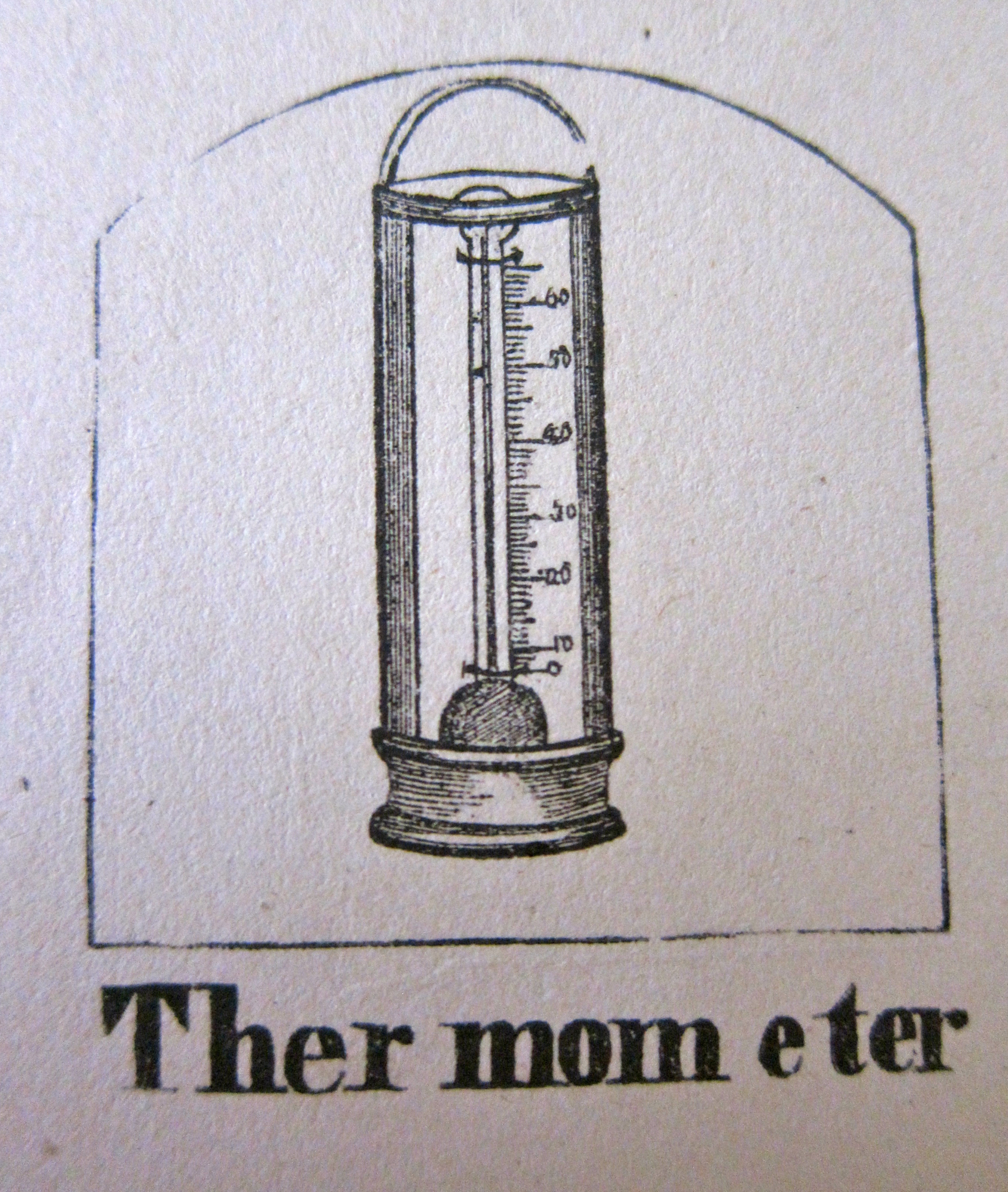
Truth told, Evelina may have been grateful not to make the two mile ride to church. The weather that day, according to Old Oliver, continued “verry cold,” reported at 14 below zero by “the Mr Pools” who lived several miles south of the Ameses. The Pools would know; they manufactured thermometers. Jane McHanna, meanwhile, had to bear the cold on her drive back from Mansfield, returning to North Easton in time to prepare tea.

Despite the cold, Evelina and  Sarah Ames paid a visit to a sick woman in the neighborhood. Calling on the sick was something that Evelina and her sisters-in-law often did. Although there were doctors in town, there was no hospital, nor was there a habit of placing the seriously ill in a hospital.  People were taken care of at home, by family, friends, and townspeople like the Ames women.  Miss Eaton was suffering from tuberculosis or consumption, as it was known.  Evelina, Sarah Ames, and Sarah Witherell visited her often, taking food and helping the family with whom Miss Eaton was living.

Sarah Ames and Sarah Witherell are sisters-in-law.  Sarah Ames is married to Oakes’s brother Oliver, Jr.  Sarah Witherell is Oakes’s sister.  Both women are younger than Evelina; all three women live in close proximity.

New Year’s Day, 1851

IMG_2728

January 1st 1851

Did not rise as early as I ought to commence a new year …

it being about 7 Oclock before we had our breakfast   All wide

awake to get the start of wishing Happy New Year.  Finished

our ironing, and swept the chambers   A A Gilmore & wife

called P M stoped about two hours.  Mrs Witherell finished 

the underclothes for Susans doll.  Elisa at Olivers [Jr] cutting

Helens dress  Commenced a letter to Pauline in answer to one

received last night  Pleasant but very cold.

Most of the people named in Evelina Ames’s first diary entry are family members.  A. A. Gilmore, for instance, is her 30-year old nephew Augustus.  Mrs. Witherell is her sister-in-law, Sarah, busy with doll clothes for Evelina’s youngest child, Susan.  Oliver, Jr. is Evelina’s brother-in-law; his daughter Helen is having a dress made.  They all live in the small, industrial village of North Easton, Massachusetts.  Most live within the Ames family’s substantial compound.

Evelina herself is 42 years old.  Raised on a farm several miles south of the center of town, she has been married to Oakes Ames, a shovel-maker, since 1827.  With three sons and one daughter, she and Oakes live in the family homestead that they share with Evelina’s father-in-law and his aforementioned, widowed daughter, Sarah Witherell, along with her two children.  The Ames men work at the shovel shop, the younger children go to school, and the women tend the home.  Everyone is occupied.

The diary that Evelina kept during 1851 and 1852 offers a modest but illuminating window on daily family life in New England in the ten years before the American Civil War, which they will call “The Great Rebellion.”  It was a decade that marked the end of much of what had come before.  Evelina’s remote, quotidian and predictable life was changing as the railroads moved in, travel became expedited, goods became more accessible and plentiful, and religious thinking was challenged.  As far as her personal circumstances are concerned, much more will change for the family in the years ahead than anyone could have imagined on that cold New Year’s day in 1851.  Of course, we know this now, looking back with perspective, but Evelina didn’t.  She only knew about each day as it happened – which is much of the charm of reading her record.

Hope you will enjoy following along.