August 2, 1852

Rain

Aug 2d 1852

Monday  Was about house most of the forenoon and this

afternoon have been to work on my traveling

dress again had to let out the front & widen

the arm it was so tight  Helen spent the

afternoon here  Mrs G & Mrs S Ames called

in the furnace neighborhood and coming home 

got caught in a heavy shower

Evelina and her father-in-law, Old Oliver, had a different perspective on the afternoon’s rainfall. She called it “a heavy shower,” while he wrote that it was “a small shower.”* Because her female relatives, Almira Ames and Sarah Lothrop Ames, “got caught” in it and probably arrived home soaked, Evelina would have seen the rainfall as torrential. Old Oliver, on the other hand, would only have considered the rain in terms of the measure of water it delivered, whether he was indoors or out. From his dual position as farmer and shovel manufacturer, he considered today’s rainfall as modest. As often happened, the two in-laws differed on details.

While the rain fell in Easton, important politics were getting underway about a thousand miles to the west. In Iowa and Missouri on this date, elections to the 33rd session of the U.S. House of Representatives were being held. It was the beginning of the campaign season, something that might sound familiar to today’s readers. Between them, these two states (which, except for California to the far west and Texas to the far south, were perched on what was then the frontier between the eastern states and the western territories) would send nine representatives to Washington, the majority of them Democrats.

As we have mentioned previously, this 1852 election would be won by the Democrats, in sufficient strength to sound the death knell of the old Whig party. From its ashes would rise the new Republican party.


*Oliver Ames, Journal, Stonehill College Archives, Arnold Tofias Collection


July 26, 1852

imgres-1

Monday July 26th  Hannah & Mary washed and I

have been sewing most of the day but have

a head ache  Have engaged to watch with

Mrs Savage, but do not feel like sitting 

up all night  We have had a rainy

day which was very much needed and

I hope it will make my garden look

better

“[I]t was cloudy this morning wind south east and it raind during the day half an inch or more,” reported daily chronicler Oliver Ames. He had been looking for rain all summer and hadn’t seen enough of it. Today’s rain was most welcome; parlor gardens would be perkier and vegetable patches here and there would be improved.  Evelina hoped her garden would “look better.”

What was blooming in Evelina’s garden at this time of year? So many flowers had gone by by this point in the summer, having peaked between May and early July, yet perennials like Black-eyed Susans and Coneflowers would be in full presentation. If Evelina had geraniums, or other annuals, they too might still be stretching toward the sun – and grateful for the day’s rain. The fact that Evelina was able to gather a “boquet” to take to a friend at church the day before proves that flowers were alive and well in her garden.

Evelina, unfortunately, wasn’t feeling at the top of her game. Nonetheless, she agreed to sit up over night with her ailing neighbor, Hannah Savage. Perhaps Evelina was conscious that her acute headache couldn’t compare with Mrs. Savage’s ongoing battle with tuberculosis. Evelina would get over her ailment but Hannah would die from hers.

June 22, 1852

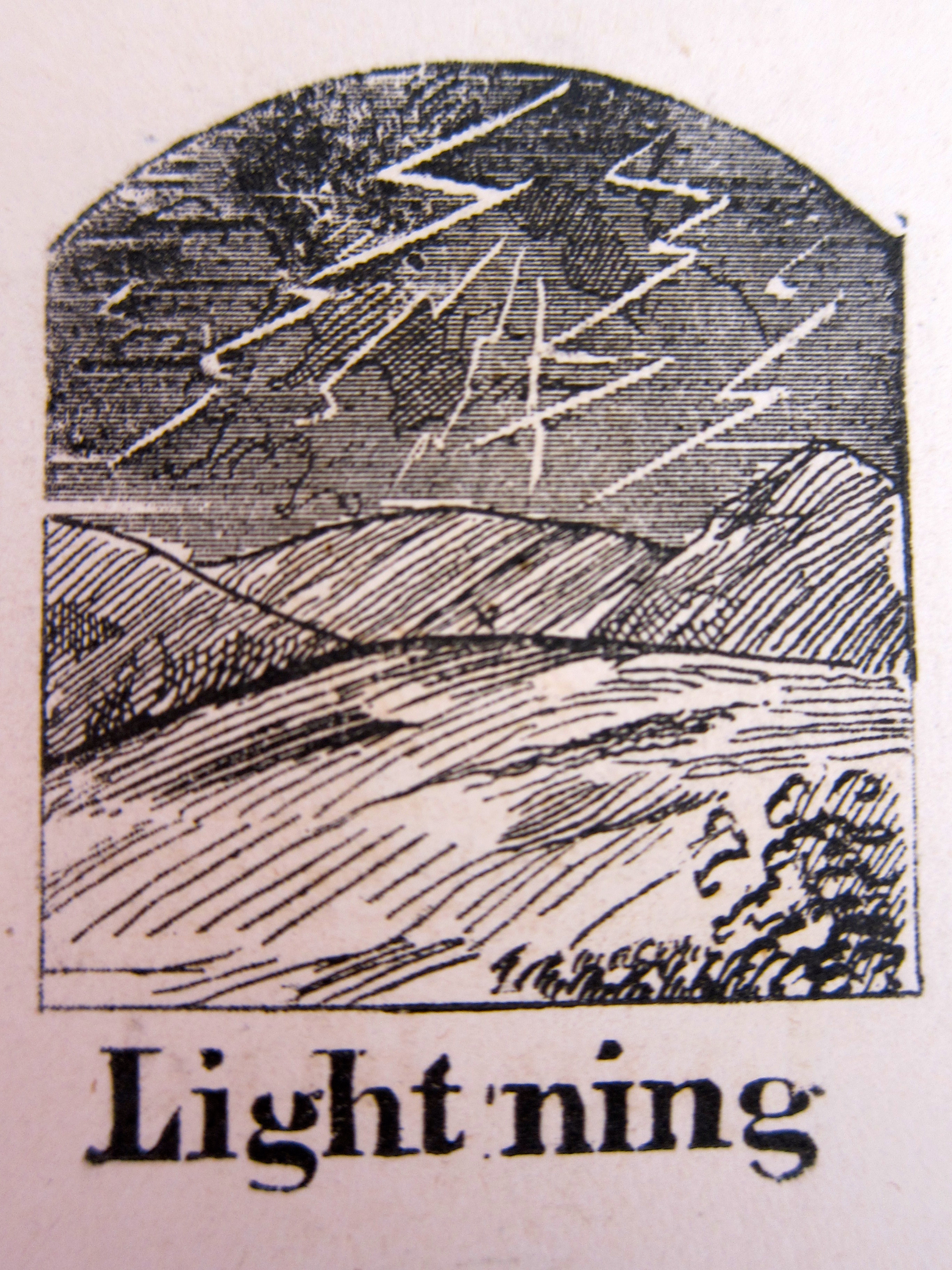
Lightning

1852

Tuesday June 22d  Worked in the garden again this

morning untill about ten.  My garden

takes up quite too much of my time.  This afternoon

carried my work into Olivers.  Sewed the skirt

on to my brown muslin and worked some on the waist

of my purple cambric dress  Catharine here again

to day but it is of no use for me to have her.  Have had

a very heavy shower with thunder & lightning


Evelina complained that gardening “takes up quite too much” of her time, but she did seem to love it. It and sewing were her especial interests. From the two occupations, we can derive the fact that she loved many colors. She didn’t just choose one or two colors, she chose all of them. In her garden we see blossoms of pink, purple, red and yellow in many shades and sizes. In her wardrobe, too, the spectrum is broad. On this day she worked on both a brown muslin and a purple cambric dress.  Just recently, she had finished a green gingham dress, and before that there was a black silk. She had sewn pink aprons, blue silks and plaid skirts, and many of her outfits had bonnets or ribbons to match. Her taste was all-encompassing, it would seem. Did her color selection reflect the styles of the day, or her personal preferences, or both?

While the colorful garden was apparently thriving under Evelina’s careful attention, her sewing projects were not. The new servant, Catharine Middleton, who had been hired primarily to assist with sewing, was not working out. She was “of no use.”

Old Oliver, the family weatherman, was unusually chatty about today’s weather.  He was excited about the rain, but feared it had come too late for certain patches of hay. He wrote: “it was fair this forenoon + cloudy in the afternoon the wind was very high all day from the South west + towards night + in the evening there was a shower of nearly half an inch, but the grass on gravely land is to far gone to be helpt.”


June 17, 1852

image004

June 17th Thursday  Have cut Susan a mantilla this

morning and basted it ready to make and 

have been mending some.  Mother is at Mr

Torreys to day staid there last night  It

is rather cooler to day and this afternoon

had a fine shower  Catharine Middleton

here but she is not worth much to sew

A new servant, Catharine Middleton, was proving a disappointment to Evelina. Catharine’s sewing skills were “not worth much;” Evelina wanted someone with more ability.  Evelina was hard to satisfy in the sewing arena. She was so very good at it herself that most young women of average ability would have fallen short, unable to survive the scrutiny of a woman famous for her buttonholes.

Outside the busy house, construction ran apace. Men moved stones for the new Long Shop across the street, and even closer to home, “Mr Arnold finishd sleighting the cariage hous to day.”* This new building would soon be ready to house the three or so carriages belonging to Ames family members.

The best news of all was the lowered temperature and arrival of a little rain “towards night when we had a shower of about a quarter of an inch .”* Every drop of water was needed.

June 15, 1852

LongShop

Recent image of Long Shop 

June 15th  Tuesday  Julia here and I have been sewing

some but have not had much time […] I

t’s very hot weather mother spent the

day at Edwins I called there awhile and 

ripped my green gingham dress to have 

it made over.  had quite a heavy shower 

this morning which was needed very much

Everyone agreed that this day was “verry warm” and that rain was needed.* Evelina, looking up from her sewing, reported that they had “quite a heavy shower.” Her father-in-law, however, described the rain as “a small shower in the forenoon about an eighth of an inch.” Her glass was half-full, his was half-empty when it came to considering the benefit bestowed by this particular rainfall.

Such quick rain wouldn’t have been enough to interfere with the building of the new stone shops at the factory. Workers had begun to arrive on Saturday and, surely, some initial construction was already underway.  Old Oliver would have made sure of that. This first building on the new site, which was much closer to where the Ames family lived, was dubbed the Long Shop.

Industrial historian Greg Galer describes the Long Shop as “a simple, narrow, gable-roofed, two story building 525 feet long and 35 feet wide with a 60 by 50 foot ell and an additional 30 by 10 foot engine house. “**  This sturdy, less flammable facility would be up and running by the end of the year, and soon include a 60 hp steam engine.

Residents of North Easton today know the Long Shop as one of several shovel factory buildings repurposed for residential use. Along with others, Mr. Galer was instrumental in the successful effort to preserve the historic character of the Long Shop as the site was developed.

* Oliver Ames, Journal, Stonehill College Archives, Arnold Tofias Collection
** Gregory Galer, Forging Ahead, 2002, p. 150

June 9, 1852


IMG_0582


Example of bonnet frame


June 9th  Wednesday  Mr & Mrs Orr  Mr Ames & self dined

in Olivers and Oakes & Frank came to tea

with us.  Mrs Davidson & two daughters there

Mr Ames & Mr Orr rode to Canton

Mrs Orr brought me a frame for a lace

bonnet and I have fitted it to my head ready

for the trimming

With their guests, Robert and Melinda Orr, Evelina and Oakes ate midday dinner next door. It was a rare occasion to be invited to dine at Oliver Jr.’s and Sarah’s, an indication of how important the houseguests were.  At tea time, they were joined by Betsy Davidson, wife of the postmaster, and her little girls Lizzie and Julia. Oakes Angier and Frank Morton Ames joined the group, too, after finishing work at the shovel shops.

Evelina was given a special bonnet frame by Melinda and got right to the pleasant task of creating a new bonnet, “ready for the trimming.” The two friends probably sat and chatted as Evelina worked on it. Perhaps Melinda had brought some lapwork with her, or perhaps Evelina gave her something to sew. Neither woman would have been apt to sit idly while the other worked.

After dinner, Oakes and Robert rode over to Canton, probably to visit the Kinsley iron works. Back at home, Old Oliver Ames was breathing a bit easier after the much-needed rainfall of the previous day and night, reporting that “the plowd land is wett down considerable.” Just what the farmer asked for.


April 21, 1852

01-01_full

Examples of 19th c. lunch pails*

1852

Wednesday April 21st  It still continues to rain through not as

hard as yesterday  Have been to work on

Susans dresses altering them  Went with

Mrs S Ames to the store  Susan has carried

her dinner to school three days and thinks

it something nice  Swept my chamber and put

it in order

The heavy rain of the past two days wasn’t giving up easily. Old Oliver wrote that “it raind considerable last night + the wind blew hard and it is cloudy + rainy this morning + the water is verry high.”**

Despite the weather, the Ames women continued many of their usual routines: sewing, of course, and housework, but errands, too. Evelina and her sister-in-law Sarah Lothrop Ames went to the company store in the village. Little Susie Ames went to school, as she had even during the worst part of the storm. Instead of coming home for dinner in the middle of those rainy days, however, she carried her meal to school and ate there.  No school cafeteria or hot lunch program in those days! She thought it “something nice” to stay at school for the midday meal.

Courtesy of the National Museum of American History, Smithsonian

** Oliver Ames, Journal, Stonehill College Archives, Arnold Tofias Collection

April 20, 1852

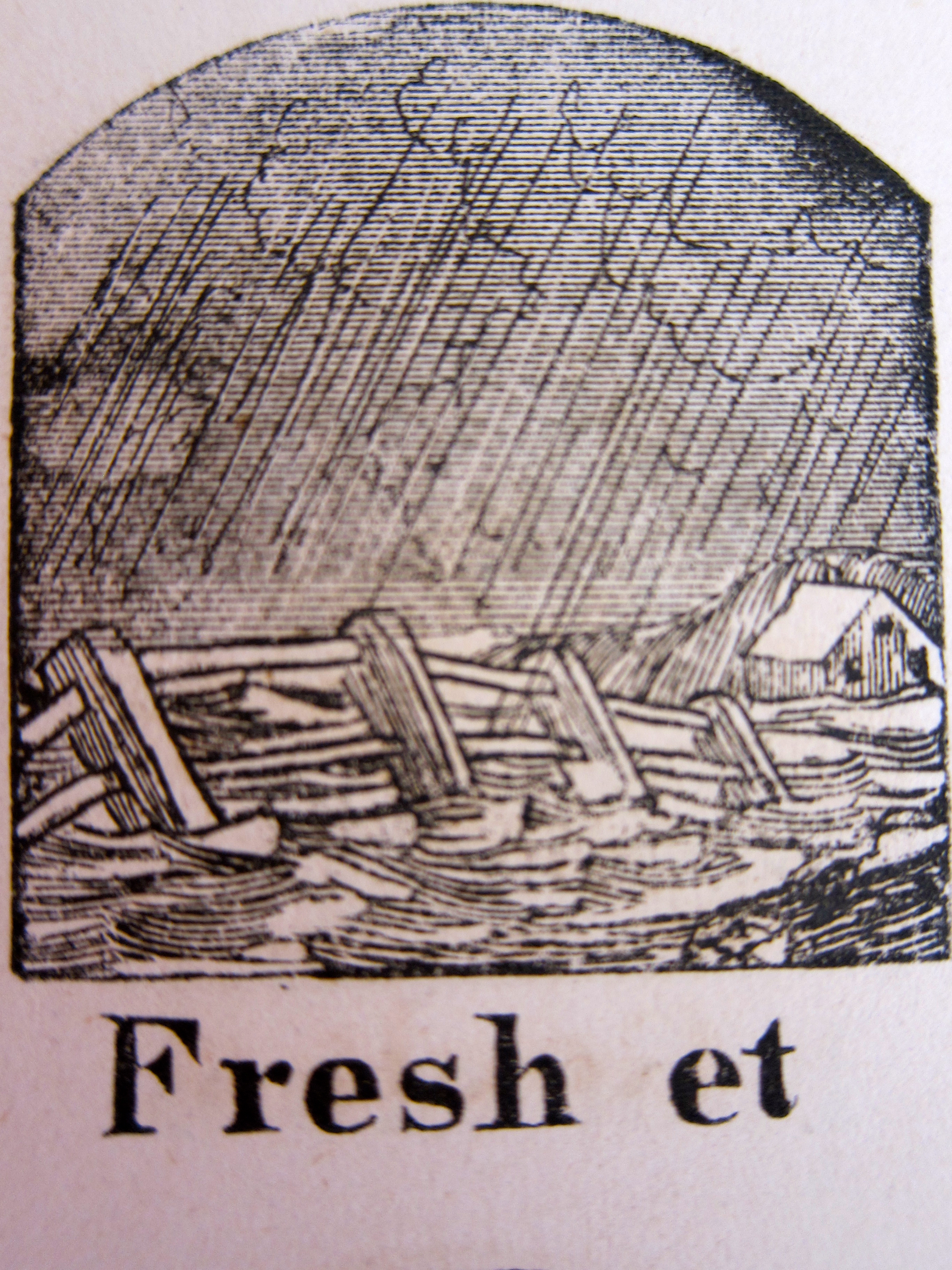
Freshet

Tues April 20th

1852  Storms again to day and nearly as hard

as yesterday.  rained poringly last night

Mr Packard came at half past three and Mr Ames

went to the hoe & knife shop to raise planks 

the water being very high  The highest that

has been known for years  Augusta spent

the afternoon  Worked all the forenoon cleaning

out grease from the buttery

The Nor’easter continued.  The Queset Brook, which ran behind the Ames compound, the Shovel Shop Pond and other local bodies of water threatened to overflow under the deluge of rain. The water came down “poringly” and, according to Old Oliver, “it raind about all day.”* To use a word that is not often encountered in the 21st century, a freshet was imminent.

A freshet is a sudden overflow of a creek or stream brought on by a heavy rain and/or the sudden melting of snow. It was a potential hazard that people who lived near waterways worried about every spring, and on this day the fears of such folks in Easton came close to being realized.

The water rose “the highest that has been known for years,” threatening to flood the hoe and knife shops. The men, led by Oakes Ames, responded quickly to adjust the wooden planks at the site of the dams on the pond. Local historians Dwight MacKerron and Frank Mennino corrected this editor’s initial misinterpretation that raising planks meant lifting machinery off the floor, the latter suggesting instead that:

“raising the planks referred to actually allowing water to leave the ponds under a controlled flow via a secondary sluiceway that was employed in most dams just for that purpose. In the case of the hoe shop there was a man made canal that would serve that purpose. It takes pressure off the dam, and might avert a catastrophic failure which would certainly have severe consequences.”

Sydney Packard may have been the man who came to assist Oakes. He was a 40 year-old father of eight and long-time employee of O. Ames & Sons.  Some twenty years later, Packard would be one of the pallbearers at the funeral of Oakes Ames.

So far in 1852, the Ames family had endured first fire and now flood, and their troubles were not over.

Thank you, Dwight MacKerron and Frank Mennino for your input on the workings of waterways of North Easton.

April 19, 1852

 March_2014_nor'easter_2014-03-26Satellite image of a Nor’easter

1852

April 19th Monday  It rained very fast all day and 

about noon the rain beat in the side lights 

of the entry, and parlour windows   had to take

back the carpet a little from our window put

dishes under the windows and caught a good

deal of water.  Have cut down my Verbenas

and Petunias fixed a skirt of a dress for

gardening

A powerful Nor’easter storm beat into New England this day.  Both Evelina and her father-in-law described the rain as “fast,” Oliver further elaborating that the rain came in sheets, “not in drops.”*  Evelina (and Jane McHanna, most likely) had to deal with water coming in through the side light panels on either side of the outside door. They scurried, too, to pull back the carpet from the windows and put dishes on the floor to catch some of the water beating into the house.

The wind howled and “[t]he storm continued all day , a part of the time pritty fast,” reported Old Oliver. Everyone stayed indoors, no doubt, yet Evelina reports cutting back some of her plants, which suggests outdoor work. That couldn’t have happened on a day such as this, however, so perhaps the verbenas and petunias had wintered-over in pots inside the house, and it was those that she cut down.

Gardening was on her mind, of that much we can be sure. She prepared a skirt to wear outside when she was in her flower beds, probably “repurposing” an old dress for the task. Her handwriting was rushed and incomplete when she wrote the last sentence of today’s entry; she inadvertently omitted to cross the “x” in fixed, leading this editor to conclude that she had “fired” a skirt.  Not so, thanks to a sharp reader who came up with the correct version.

Image courtesy of Wikipedia, April 18, 2015