September 3, 1851

Trunk

Wednes Sept 3d  Alson came this morning & brought

Orinthia and staid to dinner and carried Mrs Stevens

home with him  Orinthia has been packing her clothes

Mrs Stevens stiched three more collars for me & Mrs

Witherell two that are for Frank.  Abby Torrey called

this afternoon &c and on her return Orinthia & I went

to the store  Pauline passed the afternoon with Helen

Orinthia Foss was packing her clothes, getting ready to return home to Maine. What prompted the departure isn’t clear. Did she lose her job, or was she called home on family matters? She would return to North Easton eventually, but did she know that when she left?  How did she feel about leaving this town where she had lived for six months? How did Evelina feel about the loss of her young friend, even temporarily?

Orinthia wasn’t the only one with a trunk to be packed. Oliver Ames (3), too, was a day away from departure and had a trunk into which his mother – and others, perhaps – were placing his new collars and mended shirts. Last minute sewing was still going on, but by this time the trunk would have been nearly full of the clothes that Oliver would need for a term at college.

That Oliver was going away to study at Brown was just shy of miraculous.  At 20, he was old to be going, for one thing; in the nineteenth century, the average students were teenaged, like Fred Ames at Harvard. But more than that, his father Oakes had not wanted him to go. According to one 19th century acquaintance of Oliver, Oakes “had inherited some measure of that Puritanical contempt for the liberal arts.” After completing prep school, Oliver had been directed to work at the factory, “to learn the trade of shovel-making. But the desire for a higher education remained strong, and when at the end of his five years apprenticeship he had mastered the trade, his father yielded to his solicitations, and allowed him to enter Brown University.” * Oliver had earned his ticket out.

* Hon. Hosea M. Knowlton, “Address,” Oliver Ames Memorial, 1898, pp. 98-99


August 30, 1851

OLYMPUS DIGITAL CAMERA

*

Sat Aug 30th Have been marking Olivers clothes and fixing

them.  Called to Mr Whitwells Major Seba Howards

Mr Samuel Dunbars and at Alsons with Pauline

Took tea at Alsons brought Orinthia home with us

All of Mr John Pools family were there or rather

Rachel Augusta & Elisabeth.  Mrs Stevens came

there yesterday  Alson & Mr N Hall here to

dinner & tea

Another sociable Saturday was enjoyed by many throughout Easton, as friends and neighbors rode here and there calling on one another. As one modern historian has noted, “formal and informal forms of socializing were the most common amusements throughout the period. Then, as now, folks liked to visit one another, usually after supper and on weekends. The middle class gathered in their parlors, talked, sang, played games, and so on.”**

Evelina certainly did her part. With her friend Pauline Dean, she paid calls on various friends, including the Howards, the Dunbars, and the dependable Reverend Whitwell and his wife Eliza. At her brother Alson’s farm, where they took tea and visited with old Mrs. Gilmore, they chatted with three daughters of the John Pool family, including Rachel, Augusta and Elizabeth.  Rachel and Augusta had visited Evelina earlier in the month and accompanied her to the company store and the shovel shop.  Evelina was a friend to young women – especially to Orinthia Foss, the schoolteacher, whom they scooped up and took back to North Easton.

On their way home, as they likely rode past fields of Queen Anne’s Lace and Goldenrod, did they acknowledge that summer was coming to an end?


Photograph by John S. Ames III

** Marc McCutcheon, Everyday Life in the 1800s, Cincinnati, 1993, p. 200.


August 23, 1851

Mayflower

The Mayflower

Sat 23d Aug  The two Mr Lothrops went to the shop after

breakfast and I baked Cake & ginger snaps in

Mrs Witherells oven  This afternoon I went with

them to Mothers to tea, called at Mr Seba Howard

and took Orinthia with us and brought her here

at night  The Miss Tolmans are still at the 

Howards  Evening Mrs Mitchell came in.  Pauline

passed the afternoon in the other part of the house

Even in the hot weather, baking had to be done.  After breakfast, Evelina saw cousins Warren and Jerry Lothrop head off with the men to the shovel shop.  Pauline Dean, another guest, didn’t accompany them, but neither did she hang around the kitchen with her hostess. She spent part of the day, at least, in the other part of the house. By herself, Evelina baked cake and ginger snaps.

In the afternoon, once again laden with company, Evelina went down to the Gilmore farm with the young Lothrop men to visit Evelina’s elderly mother. Hannah Lothrop Gilmore was probably pleased to get a visit from these two male relatives. How closely related Mrs. Gilmore was to Warren and Jerry is uncertain; the Lothrop clan was extensive, and had been settled in Plymouth and Bristol Counties (and on into Maine) for generations.

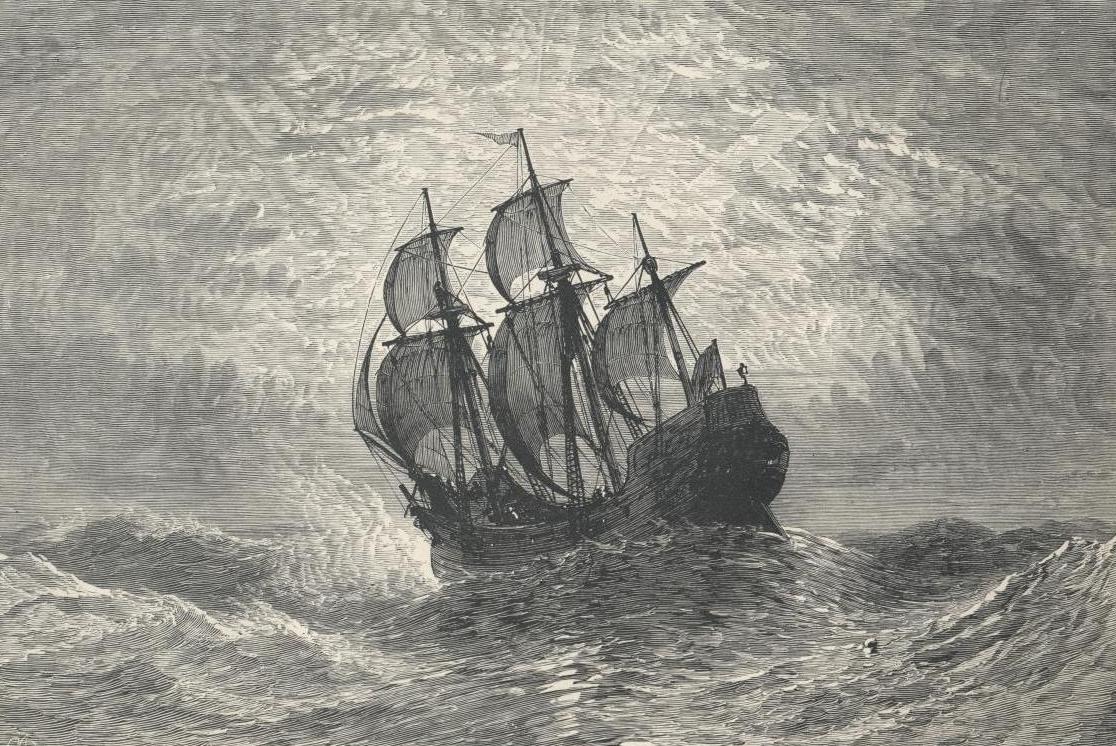
What is certain is that if “cousin” Jerry and Warren were related to Evelina through the Lothrop line, they were also probably related to Sarah Lothrop Ames, as the two women themselves were second cousins. Evelina’s grandmother, Hannah (Howard) Lothrop, and Sarah’s grandmother, Betty (Howard) Lothrop, were sisters.*  They were descended from John Alden and Priscilla Mullins of Mayflower fame.

On the way home, Evelina picked up her young friend, Orinthia Foss, who ended up spending the night.  Where did everyone fit? How did everyone sleep?

* Winthrop Ames, The Ames Family of Easton, 1937, pp. 230-231


August 22, 1851

1024px-The_Yacht_'America'_Winning_the_International_Race_Fitz_Hugh_Lane_1851

*

Friday Aug 22nd Aug  This morning stormy and Pauline sat with me

sewing made the button holes in Susans pink apron

This afternoon went with Pauline to mothers to

tea.  Called at Col Whites & at Orinthias school.

Mr Pratt & White and several ladies at the examination

On our return home found Cousin Jerry &

Warren Lothrop here  Pauline & Warren were very sociable with each other

Morning sewing and afternoon socializing were the order of the day, with houseguest Pauline Dean demonstrating a marked preference for the latter. The weather in the morning was “stormy”; Old Oliver reported a tornado in Cambridge. But the afternoon was calm, so Evelina and Pauline went out. When they returned, Pauline zeroed in on a visiting Lothrop cousin named Warren, and the two flirted.

Meanwhile, Orinthia Foss’s performance as a teacher was reviewed by the local school superintending committee. Amos Pratt, a fellow teacher, and Col. Guilford White, a shoe manufacturer who eventually became a lawyer in Boston, evidently led the examination.  They were accompanied by several unnamed ladies.

On this very same day, across the pond and around the Isle of Wight, a new yacht, “America,” that had been commissioned by members of the New York Yacht Club raced against 15 other boats in the Royal Yacht Squadron’s annual regatta.  “America” won, and from that victory sprang a competition known as the America’s Cup that now boasts the world’s oldest international sporting trophy. Doubtless, the race was reported in the papers; perhaps Oakes and Evelina read about it.


* Fitz Henry Lane, “The Yacht ‘America’ Winning the International Race,” 1851


August 17, 1851


Marriage

Sunday 17 Aug  Went to meeting all day  At noon I went

with Henrietta to Mr Whitwells passed a very

pleasant intermission  Mother was at meeting

went home with Mrs Curtis  Orinthia came

home having a severe toothache  Frank carried

her back to Mr Howards and staid untill

nearly ten  It is very dark & stormy to night

has stormed all day.  Margaret Norton married.

As on so many other Sundays, the Ames family went to church.  Evelina stayed for both services and spent the intermission with her sister-in-law, Henrietta Williams Gilmore at the parish house. Eliza Whitwell, the minister wife, no doubt offered them a cup of tea and other refreshments. Evelina’s mother probably sat with them, too, before leaving for the Gilmore farm.

Old Mrs. Gilmore and her daughter-in-law, Henrietta, may have been privy to a marriage ceremony later in the day, when a servant of the Gilmores named Margaret Norton was married. Before the Civil War, it was customary for marriages to take place at home. As historian Jack Larkin has noted, “Most American couples were wed by a clergyman at the home of the bride, in […an] informal ceremon[y] of republican simplicity.”* But Margaret, besides having no home of her own, was from Ireland and thus probably Catholic. She may have been obliged by Catholic practice to marry in the church, possibly the new church that had just been built.

Orinthia Foss did not have such a pleasant day. She came down with a “severe toothache” and had to go home.  Frank Morton Ames offered his services as driver and stayed out late, his mother noted. Lively young man that he was, he wasn’t inclined to turn in early. Was it the stormy weather or the company of Ellen Howard and Orinthia that held him at the Howards’s house? Did Evelina wait up for him?  Or did his father wait up for him?  How did that go?

*Jack Larkin, The Reshaping of Everyday Life: 1790 – 1840, New York, 1988, p. 63.


August 16, 1851

Tub

Sat 16th Aug  Have been to work on my white loose dress

that Julia cut out some time since and it is ready for

the washtub  Frank and Oliver came from Bridgewater about

three and brought home Charles Mitchell & Sister Harriet

Mr Brett two Miss Tolmans from New Bedford Jane & William

Howard & Orinthia came & went to the shop about 5 Oclock

The party at Robbins Pond in Bridgewater may have ended, but the festive mood continued.  Oakes Angier Ames headed into Boston, but his brothers Oliver (3) and Frank Morton returned from Bridgewater with their Aunt Harriett and her brother-in-law, Charles Mitchell and, perhaps, others. At the same time or maybe just a short while later, Orinthia Foss and a spill of friends to whom Evelina had been introduced only a few days earlier arrived and went to the factory.

Why this sociable group visited the shovel factory at the end of the day is a mystery. Were they delivering the Ames brothers back to work? Were they visiting someone else there? Did Oakes or Oliver Jr. find it amusing? Was Old Oliver privy to this after-party?

Evelina, meanwhile, was working on her wardrobe and was ready to put a new dress into the washtub.  She might have looked up from her sewing to see the young people drive by.


August 10, 1851

il_570xN.520777977_foe3

*

1851

Aug 10th Sunday  As usual have been to church to day

Mr Whitwell preached.  Went to the

methodist meeting house to a sing at 5 Oclock

got sick of it and went home at recess.

Oakes A Oliver & Helen Ames went with Orinthia to the

sing and carried her home.  Frank went from 

the sing and carried Ellen H & Louisa Swan to 

ride

Her sons clearly enjoyed music, but Evelina’s appreciation was perhaps not up to theirs, if her reaction to today’s musical gathering is any indication. That, or the singing wasn’t very good.  She “got sick of” the sing at the meeting house and left when she could. Perhaps she was just ready to be at home at the end of a long, hot Sunday and already anticipated the choring and sewing ahead of her tomorrow. She may have had a good book waiting for her.

Oakes Angier, Oliver (3) and Frank Morton were regular attendees at the sings; they enjoyed the music.  They also enjoyed the company of a circle of friends who attended the sessions, including Ellen Howard and Louisa Swan. Frank Morton was the son who drove Ellen and Louisa home, while Oakes Angier and Oliver (3), along with their cousin Helen Angier Ames, drove Orinthia back to the Howard house.

Ellen Howard was the tenth of Elijah Howard’s twelve children (by three wives.) Small wonder that the Howards were willing to board Orinthia Foss for a time; Nancy Howard was quite used to setting many places at what must have been a capacious dining room table. Ellen Howard ended up marrying George Withington, a Unitarian minister who came to town about this time. He ultimately left the ministry and served for many years as Easton’s town clerk.

Louisa Swan was the daughter of Dr. Caleb Swan, who had eleven children by his three wives. Louisa never married; she eventually left Easton for Vermont, where she lived with her sister Ruth who was married to U. S. Senator Justin S. Morrill.

* Currier & Ives,The Morning Ride,”  1859

August 9, 1851

Early-Tornado-Drawing_GrazulisBook


*

Aug 9th Sat  Was mending most of the forenoon after doing

my chamber work  This afternoon Helen & I have

been to Mothers found her quite sick with a cold

so that she could not speak aloud.  Called for

Orinthia to carry her with us but she did not go

Brought her home with us at night  Just as we 

got to Mr Howards there came up a tempest &

we stoped untill it was over

Helen Angier Ames, aged 14, accompanied her Aunt Evelina this afternoon to the Gilmore farm, perhaps to see Evelina’s niece, Lavinia Gilmore, aged 19. The two young women were friends. The schoolteacher, Orinthia Foss, was invited to go along as well but declined. Instead, she joined Evelina and Helen on their return trip.

As she often did, Evelina went to visit her mother and family at the farm where she grew up. Hannah Lothrop Gilmore, aged 79, lived most of the time with her son Alson. She was usually in good health, but today she was “quite sick” with a summer cold and laryngitis.  Illness seemed to be all around Evelina in these dog days of summer.

On their ride home, the women encountered a storm violent enough to make them stop off at the Howards’ house. The outburst was, in fact, part of a squall line that produced a tornado in Hartford, Connecticut.  A “tempest,” Evelina called it, using a word that nowadays isn’t often heard in American English.  Modern usage might describe the storm less poetically as a “weather event.”

*U.S. Tornado Early History, http://www.ustornadoes.com  

August 3, 1851

Plaque for Catholic Church

*

1851

Sunday Aug 3d  Went to the consecration of the Catholic

Church dedicated to The virgin Mary. The bishop &

priest took a pail of water and a cedar twig and went

around the house and sprinkled the foundation with the

water and then the aisles & walls and some of the

congregation got a sprinkling. This afternoon went to

our own church.  Frank carried Orinthia home

Oakes A carried Louisa Swan to the hall under our

church to a sing & carried S E Williams & L Kimball

home from it

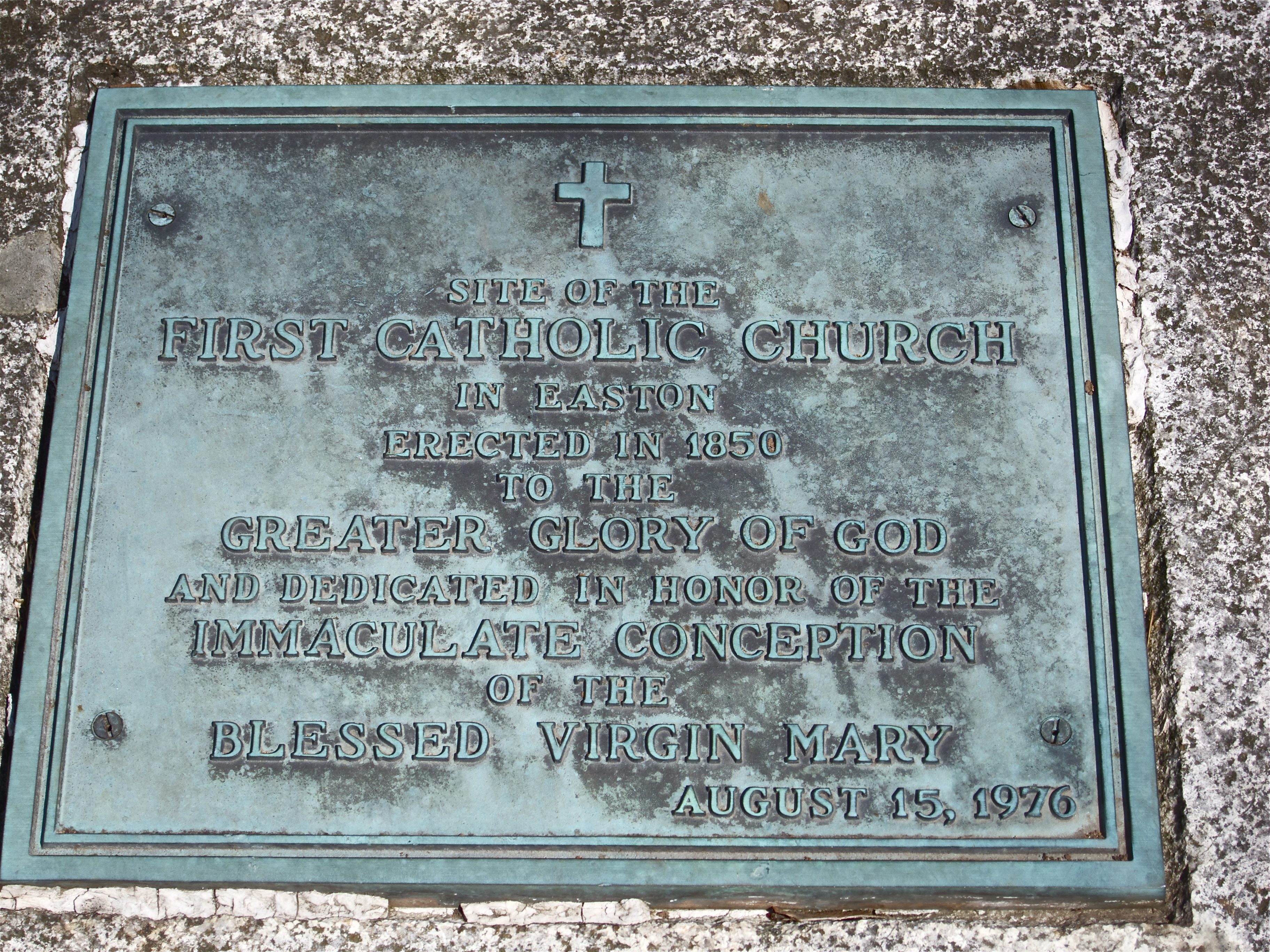
By 1850, Easton’s Catholic population, which had been almost non-existent before about 1840, now numbered approximately 150, primarily due to the influx of Irish Catholic immigrants, many of whom went to work at the shovel factory.  The Irish had no church of their own, and had been gathering for worship in a hall belonging to the Ames family on those Sundays when an itinerant priest came to town.  The congregation had outgrown that facility, however, and needed their own house of worship.

The Ames family donated a plot of land on Pond Street to the Catholics so that they could build their own church.  The stone plaque in the photograph above commemorates that first church, built in 1850 and consecrated on this very Sunday in 1851.  Evelina and, presumably, other members of the Ames family attended the consecration, a ceremony to which Evelina paid close attention.  They went back to their own Unitarian church in the afternoon.


* SITE OF THE

FIRST CATHOLIC CHURCH

IN EASTON

ERECTED IN 1850

TO THE

GREATER GLORY OF GOD

AND DEDICATED IN HONOR OF THE

IMMACULATE CONCEPTION

OF THE

BLESSED VIRGIN MARY

AUGUST 1976 [date of plaque]

August 2, 1851

65eb3ab64b1e3e383ab7982a18ea85a1

*

/51 

Saturday Aug 2d  Mrs James Mitchell, Cousin & sister Harriett

Mitchell came to the other part of the house to day

Sister Harriet returned to E Bridgewater with them

Frank went to Boston to see a Dr about his

throat got him a white hat.  We were all 

invited into Mr Bucks to see Miss Lothrop from

Boston  Orinthia & Helen went  Mrs Witherell

& I called after tea the boys went in the evening


Evelina felt better. She was back in the social swing today, going out after tea with her sister-in-law Sarah Witherell to meet a Miss Lothrop. Earlier in the day, Sarah Witherell had entertained two or three women named Harriet in her parlor in “the other part of the house”: sister Harriett Ames Mitchell, friend Harriet Angier Mitchell (Mrs. James Mitchell) and, possibly, cousin Harriet Ames. It’s also possible that Evelina, in writing the word “cousin,” meant to identify Harriet Angier Mitchell as a cousin which, by a stretch of several “removeds,” she was. In the latter case, there was no cousin Harriet Ames present. Confusing to us, certainly, and, perhaps, confusing to them.  Who was visiting in the parlor?

Old Oliver, meanwhile, was in the thick of haying season.  He noted that “this was a fair good hay day wind south west and we got in all the hay we had out some of it had bin out over a week and all of it since last Monday –“

One young man who was neither outside with a pitchfork helping his grandfather nor inside the factory fashioning a shovel was almost-eighteen year old Frank Morton Ames. Frank had been suffering from a sore throat that he evidently couldn’t get the better of, so he took off to Boston to have it looked at. When he returned to Easton, he reported nothing alarming.  Rather, he arrived with a startling new white hat, looking perhaps like one of the young men in the illustrated daguerrotype above. According to some sources, white beaver hats enjoyed a short vogue at this period. Frank must have stood out in the gathering at the Bucks’ house that evening.


* Image from Daguerreian Society, Mark Koenigsberg Collection