March 1, 1851

Photographing

March 1st  Saturday  This forenoon put a bosom into an old

shirt of Mr Ames.  After dinner worked on shirt

bosoms, carried them into Olivers and staid two

hours and then went to meet Orinthia at the

Daguerretype saloon.  Called at the store and on Abby

Torrey  On my return called on Miss Eaton found her

more comfortable than I have seen her for some time

Mrs. Holmes mother has been sick for a week.  Very 

pleasant.  Augustus not here

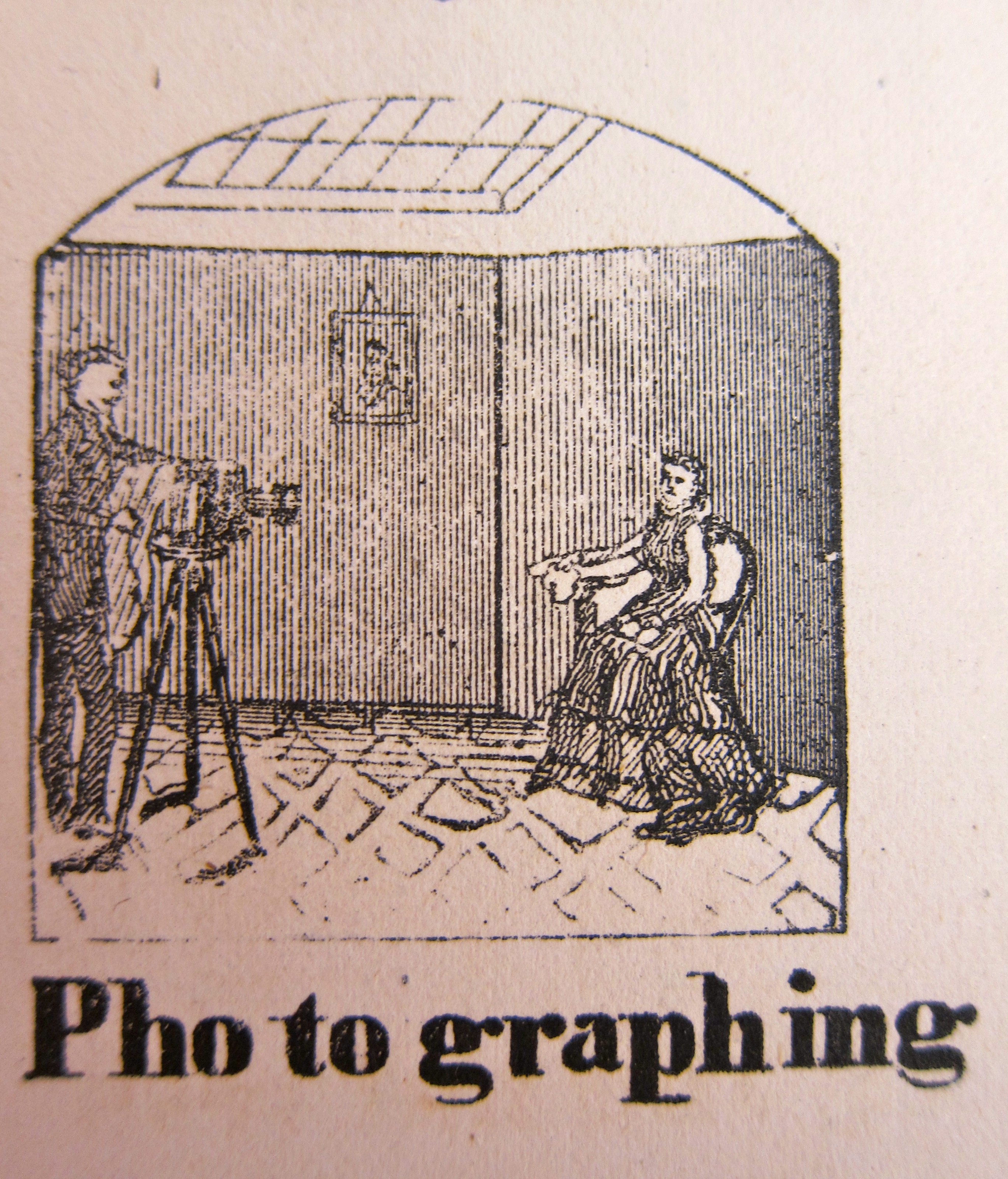
Only a dozen years after a Frenchman named Louis Daguerre reproduced an image of a Paris street onto a piece of treated glass, the new medium of photography had become so popular and successful that someone in the small town of North Easton, Massachusetts had seen fit to set up a “saloon” to take pictures.  What a novelty for the townspeople.

After a day of rather pedestrian sewing, Evelina Ames, housewife, went to the daguerreotype studio to meet Orinthia Foss, schoolteacher (and boarder at the Ames’s,) to have their likenesses taken. What a lark for them to go pose for the camera.  Whose idea was it? Did they pose together?  Did they pose alone?  Or did only one of them have an image taken? How long did she or they have to hold still?  Who ran the shop? Where are those photographs today?  What good friends Evelina and Orinthia are getting to be.

A stop at the company store and a visit with her niece, Abby Torrey, were next on the agenda for Evelina’s afternoon. Now that it was March, the daylight began to last a little longer, allowing more time for errands before heading home. One last stop at the house of Bradford and Harriet Holmes was in order. There, two invalids, Miss Eaton and Mrs. Wright, were being “watched,” or looked after by various friends and relatives, in a manner resembling today’s hospice care. Miss Eaton, of indeterminate age, had been in poor health for several months, probably with consumption.  Sixty year old Mrs. Wright, mother to Harriet Holmes, had also taken ill.  She was suffering from pleurisy and was not expected to recover. Spring might be on its way, but not for these two women.

February 27, 1851

Coal scuttle

1851

Feb 27 Thursday  Cannot say much for my work to day

Orinthia cleaned the sitting room for me while I

was making the fire in the furnace.  had a good 

deal of trouble with it  Augustus made quite a

long call this morning talking over matters & things

Have finished putting in the bosom & wris[t]bands to 

the old shirt that I commenced Tuesday & mended one

for Mr Ames

It sounds as if Evelina’s normal routine was challenged today.  First, she had to struggle with the coal furnace, or stove, probably stoking it and trying to make it catch and hold.   She was certainly familiar with “making” fires, but coal was not her strong suit.  She had spent most of her life burning wood, and she didn’t manage the new furnace well.

Second, her nephew Augustus came to call in the morning at a time of day when she was likely to still be working about the house.  He was full of conversation about “matters & things,” probably filling her in on his move to Easton,  his decision to leave teaching, and his hopes for the new boot and shoe factory he was setting up in the Lothrop Building. Evelina, fond aunt that she was, was no doubt interested in what Augustus had to relate, but the housewife in her was perhaps worried about not getting through her choring or not finishing the last of the ironing or not getting to the necessary mending while Augustus made his long visit.  Happily, Orinthia Foss was around to help with some of the basic sweeping and dusting.

In the afternoon, her housewifely pace seemed to settle down and she was able to pick up her sewing.  She reworked an old shirt belonging to her husband, replacing the most worn areas with new pieces.  A shirt that today we might throw out or put into the rag bag, she saved.  No wonder Reverend Chaffin accused her of being “very economical.”  She was, with no apologies.  No apologies from her husband, either.

February 25, 1851

Helen Angier Ames

Helen Angier Ames

1851

Feb 25  Tuesday  This morning Helen left home for school

at Dorchester.  She felt so bad when she left

that I did not go in to see her.  Her Father & Mother

went with her and returned to night, they went into

Boston and stoped an hour or two.  Mr Jennings

& Crommet called this evening to see Orinthia

I have been to work on a bosom of shirt putting

a new one into an old shirt of Oakes Angiers.  Very windy.

A[u]gustus here

Under some duress, the teenaged Helen Ames was taken to boarding school today, clearly not wishing to go.  Her parents insisted and accompanied her to see her settled.  Their stop in the city on the way home might have been a lift of spirits for a mother and father who had just driven away from a disconsolate child.

The children of both Oakes and Oliver Jr. each went away to school for a portion of their education.  Oakes and Evelina’s boys had already gone and returned home; Susan still had her boarding school ahead of her.  Oliver Jr. and Sarah’s two children, Fred and Helen, were at this stage both away at school.  Oliver Jr. and Sarah were empty-nesters, to use a term they wouldn’t have recognized.  They might have recognized the emotion, however.  Strange to think of them in their separate house, just the two of them now, quiet, (although Sarah’s younger brother, Cyrus Lothrop, sometimes lived with them) while right next door in the old homestead lived a whole commotion of relatives.

Schooling seemed to be the theme of the day.  A Mr. Jennings and a Mr. Crommet called to see Orinthia Foss, presumably on matters of her employment as a schoolteacher. Does any reader out there know either of these names?

His wife and son still living elsewhere – Bridgewater, perhaps – while he set up their rented lodgings in North Easton, Augustus Gilmore was staying temporarily with his aunt Evelina and her family.  He would soon bring Hannah, who was expecting, and little Eddie to town.

February 24, 1851

School

Feb 24th Monday.  This morning Orinthia commenced a

private school at the school house had twenty

scholars.  Was choring about house all the forenoon

This afternoon made over a valance for

Franks bed and did some mending.

Martin Guild was burried at two Oclock.  None

of us attended the funeral  Helen & Sarah Ames

called a few moments this evening.  Heavy rain.

Looks like little Susie was back in school today, this time under the tutelage of Orinthia Foss, the new teacher.  Not only would Susie see Miss Foss in the school room every day, but also at home for breakfast, dinner, and tea. During her tenure in Easton, Orinthia would take turns boarding with different families in town beginning with the Oakes Ameses. The exact location of the schoolhouse where she taught is undetermined, but it may have been located right in the heart of the village, at the Rockery.*

As usual, Evelina spent this busy Monday doing housework, or “choring,” as she called it, in the morning, or “forenoon,” while Jane McHanna labored with the weekly washing. What do you suppose was served for midday dinner on Mondays, when the women of the house were preoccupied with everything except cooking?  Perhaps the family ate one of those mincemeat pies that had been prepared days in advance and kept very cold somewhere. Yankee housewives were known to keep some baked goods frozen for months, either by placing them on shelves in an ice house, or simply by storing them in unheated spaces not far from the kitchen. A risky practice, one might think, especially with the varied temperatures and rainy weather that has characterized this particular February.

Also as usual, Evelina turned in the afternoon to her mending and sewing. She refurbished a valance for Frank Morton’s bed.  Although his brothers Oakes Angier and Oliver (3) shared a bedroom, Frank had a space, if not a room, to himself.  A valance was an essential component of his bedstead, naturally offering some warmth and privacy that might otherwise be lacking.

* Information from Frank Mennino, Curator of the Easton Historical Society.  Thank you, Frank.

February 23, 1851

Map of Maine, 1850

Map of Maine, 1850

1851

Feb 23  Sunday  Have not been to church to day on account

of my cough, although it is a great deal better.

Orinthia staid at home too, having a bad cold and 

being a good deal fatigued.  We have had a nice 

quiet time talking over Maine affairs.  She spent

Thursday night at Mr Mowers.  Have written a long

letter to Louise J. Mower to day.  Mr Whitwell exchanged

with Mr Bradford of Bridgewater.  It is a lovely day.

This was the second Sunday in a row that Evelina missed going to meeting.   She stayed behind ostensibly to keep the new boarder company and to nurse the lingering cough that she admitted to herself was much better.  Was she still avoiding certain people at church, or had she gotten past the Sewing Circle incident?  Whatever her reasoning, she had a pleasant visit with young Orinthia Foss, the new schoolteacher.

Orinthia seems to have hailed from the state of Maine, where the Ames family had vital business connections.  The wooden handles of the Ames shovels came from Maine, where good wood like ash was still plentiful. Massachusetts, on the other hand, in 1850, was fairly well devoid of decent stands of hardwood after two centuries of settlement and development.  Wood from Maine was a critical resource for the Ames enterprise and over the years, one or other of the Ames men made a periodic trip north to examine the supply and cultivate the connections. Oliver Jr., for instance, made a trip to Wayne, Maine, near Augusta, in the mid-1860s.

On her journey to North Easton, Orinthia Foss spent a night with the Warren Mower family in Greene, Maine, a town near today’s Lewiston-Auburn area. Quite wooded, and close to the Androscoggin River as well.   Mrs. Warren Mower was the former Louisa Jane Gilmore born in Leeds, Maine, in 1820. Was she a relative, perhaps? Evelina’s eldest brother, John Gilmore, lived in Leeds, having moved there from Easton in the 1840s.  What was the connection? Whether or not they were related, Evelina and Louisa were clearly friends who corresponded regularly.

February 22, 1851

Rubbers

Feb 22nd  Saturday  This morning sat down to sewing

quite early to work on Susans apron.  Mr Torrey called 

to see about Augustus having his tenement.  Augustus

has engaged Mr Wrightmans house for the present.

Lavinia & myself passed this afternoon at Mr Torreys.

Called at the store, met Mrs. Peckham & Miss

Georgianna Wheaton there  Miss Foss came to night.  Mr

Ames has been to Boston brought Susan Rubbers.

Cleared off pleasant to night

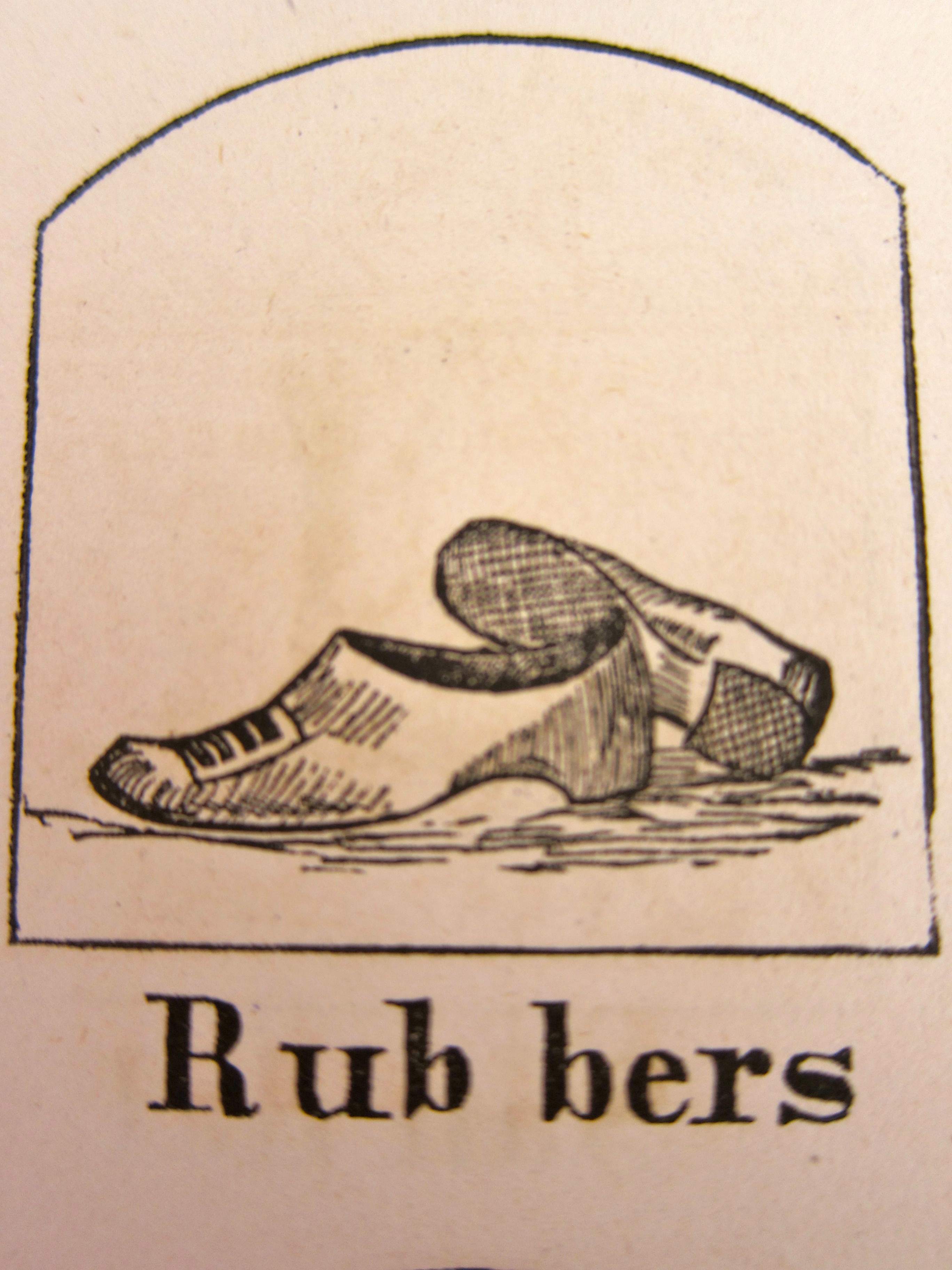
In his journal today, Old Oliver noted that “It’s pretty muddy now,” which explains why Oakes Ames returned from Boston with overshoes, known as rubbers, for his daughter.  Probably everyone in the household donned rubbers during this late winter wetness.

Evelina negotiated the streets just fine, it seems, as she and her niece traveled the short distance to the center of town to call at the company store and at her brother-in-law’s house.  Their mutual nephew, Augustus Gilmore, had decided not to rent from Col. Torrey and would be settling his family instead at a Mr. Wrightman’s house.  And at the end of the day, a new person entered the domestic scene.  Miss Orinthia Foss, the new schoolteacher, arrived from Maine.

February 22 is a date that people acknowledged in 1851 in a manner similar to the way people do in 2014, because it’s George Washington’s birthday.  In this year of Evelina’s diary, President Washington had only been dead for a little over fifty years.  People were alive who could still remember him; Old Oliver was one of them.  Old Oliver was born in 1779, while the Revolutionary War was being fought.  He was two years old when the British surrendered at Yorktown, and eight years old when representatives of the new states assembled in Philadelphia to write a constitution.  George Washington was elected to head that convention and became the country’s first president in 1789, when Old Oliver turned ten.  When Washington died in 1799, beloved and mourned, Old Oliver was a twenty-year old bachelor just making his way in the world.  Much about that world would change over Old Oliver’s lifetime, but the reverence that citizens of the United States felt for their first leader would hold strong.

February 12, 1851

Thread

1851

Feb 12th This was the day for the sewing circle & what a crowded

house! Not one here except Mr Whitwell and our own

families  Father Ames came in to tea & Sarah W

George, Emily & Oliver & wife  Poldens boy was buried

to day  Isabell & Ann went to the funeral & took tea

with Jane after they came back.  I prepared enough

for 40 and think it is very provoking to have none

 of the members  It is a delightful day.  Letter from Miss Foss

No one came to Evelina’s party.

“Very provoking,” indeed.  Mortifying, even, that not a single member of the Sewing Circle attended today’s meeting, unless you count Reverend Whitwell.  All the preparations, the baking, the cleaning, the spools of thread from Boston, all in vain.

Evelina took the rejection with a lacing of humor: “What a crowded house!”  Although disappointed and upset, she must have been grateful for the way the Ames clan filed in to partake of the feast. From Old Oliver (who almost never came to tea) and all three Witherells to Oliver Jr and Sarah Lothrop Ames to her own children and husband, presumably, the family closed ranks around her and filled her parlor with warm bodies.  Even the Irish servant girls on their way home from a wake partook of the spread of food – in the kitchen with Jane McHanna, of course.

So what happened?  Evelina said the day was delightful but her father-in-law, a dependable chronicler of the daily weather, described “the going” that day as “rough + bad” even though the weather itself was “fair”.  After days of terrible weather that had swung from rain to ice and back again, some of the absentee members probably couldn’t drive their wagons out of their own yards.  Bad roads might account for some, if not all, of the truancy.

Nevertheless, the incident raises questions about Evelina’s popularity and social standing.  She was married to one of the most important men in town, and she and Oakes enjoyed the friendship of many.  Is it possible that some of the women in the Unitarian Circle resented her, or felt themselves superior to her?  Where were the women she had grown up with? Were they jealous of her? Did she fail socially in comparison to her sisters-in-law, each whom had a more refined upbringing? Sarah Ames and Sarah Witherell never failed to attract a lively turnout for their Sewing Circles.

All these possibilities must have swirled in her mind.  The true test would come when the Sewing Circle met again at Evelina’s, many months from this day, this awkward day that Evelina surely hoped to forget.

February 6, 1851

Dance

Dance

Feb 6th Thursday  This forenoon was working about house & did

a little mending  Prepared some mince pie meat for baking

Have been into school this afternoon  There were but

about 50 schollars.  Mr Jackson appears to lack energy

Miss Lothrop appeared the best of the two.

There is a ball at Lothrop Hall to night for the first

time.  Oakes Angier & Frank have gone & Helen

Sarah A & Sarah W spent the evening here.  Pleasant but cold.

Thursday night seemed to be the night for dancing in southeastern Massachusetts. The Ames sons had already attended at least two Thursday evening assemblies in Canton during January and now in February they’re attending a gathering at Lothrop Hall (the location of which is uncertain: Eastondale, perhaps?  Does any reader of this blog know?) Tonight Oakes Angier and Frank Morton went. (Where was Oliver [3]?)  Evelina’s diary is unclear on whether their cousin Helen went with them or, more likely, stayed home with her mother and aunts – the latter option being more typical for shy Helen.

Earlier in the day, Evelina was evidently still involved with looking into local schooling, getting the lay of the land, perhaps, for the incoming Orinthia Foss.  By mid-century in Easton, there were four school districts, or “ricks” as they were known, in four different geographic areas of town.  Paid for by the occasionally reluctant Easton taxpayers, the schools taught local girls and boys up to grade eight or so.  Massachusetts, and New England as a whole, led the nation in its emphasis on education and, in Evelina’s time, Massachusetts had boasted a 96% literacy rate.

Susie was the only Ames child still attending school.  Oakes Angier, Oliver (3) and Frank Morton as boys had each attended school locally before being sent away to nearby private schools such as Leicester Academy.  On this night, however, dancing, not schooling, was foremost on their minds.

February 4, 1851

Governor Oliver Ames (Feb. 4, 1831 - Oct. 22, 1895)

Governor Oliver Ames

Tues Feb 4  Had my morning work done about nine Oclock just

as A A Gilmore & wife came to pass the day.  About eleven

we called to see Simeon Randalls house.  This afternoon

called at Mr Torreys and at Mr Peckhams.  While

we were at tea Mr Torrey called to talk about letting his

house to Augustus.  Received a letter from O Foss.

Passed this evening with Sarah W in the other part

of the house finished another pair pantletts  Pleasant

Evelina’s nephew, Alson “Augustus” Gilmore, and his wife, Hannah Lincoln Gilmore, came to North Easton today to search for a house to rent.  A young couple with one child, Eddie, they were expecting a second child in July, although they may not have shared that information with their aunt.  Even if they had, she would never have spoken of it.  The increasingly prim culture of the day forbid it, but the high rate of infant mortality, too, caused many expectant parents and their relatives to downplay “the blessed event.”  Evelina carried Augustus and Hannah around to look at available properties.

Although Evelina doesn’t mention it, today is the birthday of her middle son.  Oliver Ames (3) turned 20 today.  Like his older brother, Oakes Angier, and his younger brother, Frank Morton, Oliver worked at the shovel shop, learning the business in the expectation that he would one day help run the company.  He had attended school at Leicester Academy and had hoped to go on to college, as his cousin Fred Ames was planning to do, but his father had insisted that he return home to work. Oakes Ames was no fan of formal education, having despised learning in his own youth.

The eldest son, Oakes Angier, naturally stood first in line to superintend the shovel business, but Oliver (3), would be a partner. Like his father, he was ultimately slated to travel as the company’s salesman.  Third son Frank, on the other hand, would be given an auxiliary administrative position in a related family-owned business, the Kinsley Iron Works Company in Canton.

But on this day, those occupations were in the future, as was Oliver (3)’s more memorable service as Governor of Massachusetts from 1886 to 1889. On this birthday, he was a brand-new twenty year old who worked hard all day, read alot, and enjoyed attending “sings”.


January 31, 1851

photo

Jan 31st Friday  This morning sat down with mother quite early

mended several articles. & altered the waist of Delaine Dress

Augustus came in the stage & dined here & carried mother

to Mr Torreys.  I went about two & passed the afternoon

Called on Mrs Lothrop at Dr Wales, Engaged the

school house for O Foss to keep a private school.

Came home quite early & wrote her a letter.  Sewed

on Susans panteletts.  Very cold but not quite as cold as yesterday

Evelina and her mother, Hannah Lothrop Gilmore, sat together and sewed this morning.  After mending several items – there was always mending to be done – Evelina reworked the waist on a delaine dress, “delaine” meaning “of wool” in French.  It was a popular and durable fabric in this era.  But altering the waist begs the question, did she have to take it in or let it out?  And had she begun to wear her sleeves in the new “pagoda” style?

Augustus Gilmore, Evelina’s nephew and Hannah’s grandson, soon arrived and, once Oakes and his sons came home from the factory at noon, they all dined together. Augustus was close to his Ames cousins, and worked for the company from time to time.  After dinner,  Augustus accompanied his grandmother to the Torrey house in the village, where Hannah’s granddaughters, Abby and Malvina, lived.  Evelina joined them there a bit later, and paid another call as well, on Mrs. Lothrop.  There were many Lothrops in Easton, so we can’t know just which one Evelina visited.

We can know that Evelina was somehow involved in the setting up of a private classroom.  A young woman named Orinthia Foss, with whom Evelina corresponded, was due to arrive in North Easton to teach.  The genesis of this arrangement is a mystery. Was Evelina doing this because of concerns about Susies’ schooling?  Who else was involved? And who was Orinthia Foss? How was she hired?

Whatever the back story was on this new little school, Evelina took a bold step today when she committed to renting a schoolhouse.  She promptly returned home to write Orinthia with the good news.