May 11, 1852

Abbott H. Thayer, Angel, 1887, oil Smithsonian American Art Museum Gift of John Gellatly

Abbott H. Thayer, Angel, 1887, oil
Smithsonian American Art Museum
Gift of John Gellatly

Tuesday May 11th  George died this morning about eleven

Has not spoken so that we could understand

since yesterday noon.  died at last very easy

without a struggle or groan.  Mrs S Ames & self

laid him out,  His mother has slept but about

two hours for two days and nights. Have trimmed

my straw bonnet. Miss Copeland sewed it over  Spent

about two hours in Olivers this afternoon.  Helen has a 

blister on her arm  The gardener set out some rose plants.

Prairie Rose Baltimore bell and Fraxinella sent

from Boston

George Oliver Witherell, aged fourteen, died on this day from rheumatic fever.  He had been suffering for many days, but “died at the last very easy.”  His Aunt Evelina had been with him for much of the illness, spelling his exhausted mother, Sarah Ames Witherell. She and her other sister-in-law, Sarah Lothrop Ames (who had her own sick child at home), laid out the corpse.

The family must have expected George’s death by this stage of his illness; certainly the attending physician had already predicted it. But anticipation is not the same as actuality, and the death of the young man would have hit everyone hard. Evelina dwelt in her diary on George’s last few minutes, but then added a few mundane notes about her summer bonnet, her niece Helen’s continued battle with an unnamed infection, and some new additions to the flower garden. She might have wished to move on to less painful concerns.

George’s grandfather, Old Oliver, noted his grandson’s death succinctly: “George Witherell dyed to day about eleven O clock.” Oliver rarely included personal items in his daily record; that he wrote of George’s death is a sign of regard, however minimal we might consider it. His grief would have been real.

Of Sarah Ames Witherell’s feelings, we’re told nothing, and must imagine her utter exhaustion and complete sorrow.
May 8, 1852

Ill

1852

Saturday May 8th  Mrs Witherell has finished working

my Delaine sleeves and I have put them in

and have finished the dress which I think

is about time.  I sit with George for Mrs Witherell

to lay down this afternoon  He is very sick and 

suffers very much.  Mr Manly brought me some

more plants & I paid him 1,58 cts.  Oliver &

Brown returned this morning

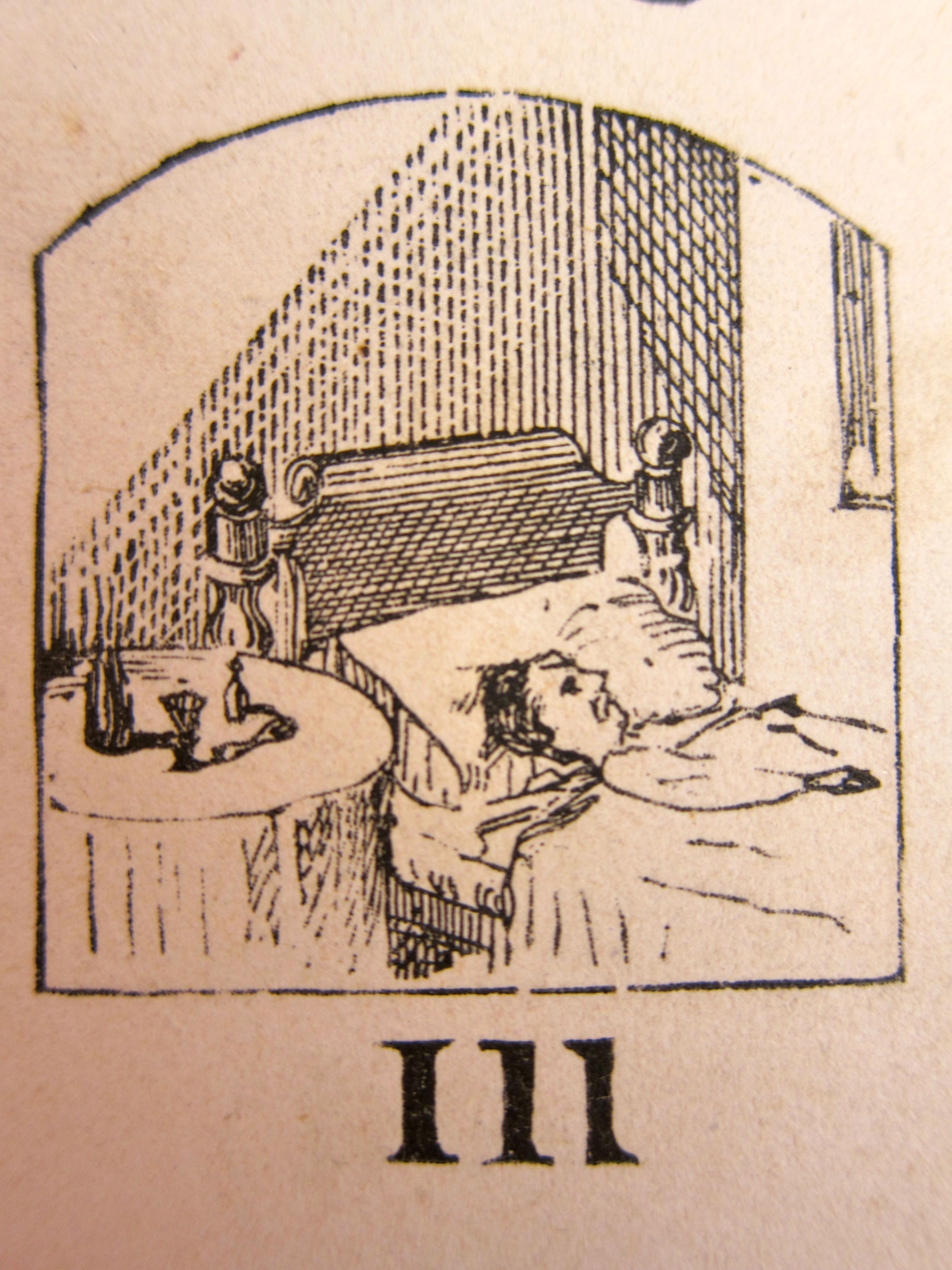
George Witherell, fourteen years old,  was ill with rheumatic fever. In the age before antibiotics, the “rheumatics,” as Evelina called it, was a serious illness. It was a complication of strep throat, which George must have had three or four weeks earlier. Its symptoms, many of which George manifested, were fever; a flat rash; involuntary twitching in the hands, feet and face; painful, tender and swollen joints; chest pain; palpitations and fatigue. As Evelina noted, George suffered a great deal, for rheumatic fever was extremely uncomfortable and unsettling. It was also often fatal.

Sarah Ames Witherell had been nursing her son for several days now.  She took a rest in the afternoon and let Evelina sit with George.  All the family was helping, although George wasn’t the only sick child. Helen Angier Ames next door was down, too, with a somewhat mysterious ailment in her face. Family members were worried about both young people.

Despite the concern everyone must have been feeling, normal routines in this season of planting had to be adhered to. Old Oliver reported that “we began to plow the hill back of the shovel shop pond to day.”


May 7, 1852

il_340x270.517720740_i0s3

Polyanthus

Friday May 7th  Was in the garden to work a short

time transplanted some pinks but worked on

Olivers clothes most of the time.  Mr Brown &

Oliver rode to Mr Copelands and got me a polyanthus

and to the furnace in the afternoon to Canton 

and Sharon.  Mrs S Ames returned from Boston to

night & Helen with her  Helens face is very

swollen has not been to school for a week


With her middle son Oliver home from Brown, Evelina had a great deal of mending to tend to. She might have preferred to be in her flower garden, but she only had a short window in which to repair her son’s shirts, hose, and coats. Oliver, meanwhile, rode out with his college roommate, Mr. Brown. They roamed from Easton to Canton and Sharon and in the process picked up a polyanthus, or primrose, for Evelina. They got the latter from a Mr. Copeland, who was perhaps Josiah Copeland, an elderly resident of Easton who lived with his wife and unmarried daughter.

George Witherell continued to be ill in the other part of the house, but he wasn’t the only family member who was ailing.  Helen Angier Ames had to come home from boarding school because of a swollen face. Perhaps she had an infection – an abcess of some sort – or perhaps she was having an allergic reaction to an insect bite or other allergen. Whatever was ailing her, she hadn’t attended class for a week, and her mother had to fetch her home.


May 6, 1852

images-1

Queen of the Prairie

1852 May

Thursday 6th Worked in the garden a short time and

about nine went to the shovel shops with Hannah

and her sister  They spent the afternoon here and

Augusta.  Edwin came to tea  Mr Brown,

Olivers room mate, came to night.  We ladies rode

to Mr Clapps, bought Queen of the Prairie for 37 cts

Warm sunshine sent Evelina outdoors for much of the day. She gardened after breakfast, then broke away at nine a.m. to go over to the shovel shops with her niece, Hannah Lincoln Gilmore, and Hannah’s sister, Sarah Lincoln. What were the ladies doing at the factory? Evelina wouldn’t have gone there on her own volition.

The Lincoln sisters, originally from Hingham, spent much of the day with Evelina.  They were joined by Augusta Pool Gilmore, whose husband Edwin Williams Gilmore later came to tea. “We ladies” traveled to the home of Lucius Clapp, another fine gardener with plants to sell, where Evelina purchased a Filipendula rubra, or Queen of the Prairie. Clapp was a well-respected citizen of Stoughton, described by a contemporary historian as “one of the representative farmers of this progressive age.” *

Oliver (3), meanwhile, was briefly home from Brown University.  His roommate, a Mr. Brown, came to North Easton for a visit. It was a full table at tea time.

D. Hamilton Hurd, History of Norfolk County, Massachusetts, pp. 424-425


May 4, 1852


IMG_0159

Trellis on the door of the home of Oakes and Evelina Ames and extended family, ca. 1860


Tuesday May 4th  Mr Healy & Morse commenced the trellis

for our front door  We had quite a consultation how it should

be made  I[t] was very cold & windy this morning & I fear I

have taken cold in being out so long  Have mended Olivers

sack and cut the pattern and have done some other mending

Augusta made a long call. It is really very pleasant to have

her so near.  Mrs S Ames went to Boston

The trellis that Evelina refers to today could very well be the modest trellis that graces one of the doors in the above photograph. The doorway facing the street in the approximate middle of the photograph was the door that Evelina, Oakes, and their family used for their own. The doorway on the far left, facing the yard, was likely the entry that Old Oliver and his daughter, Sarah Witherell, used. The house on the far right was a separate dwelling that belonged to Oliver Ames Jr. and his wife, Sarah Lothrop Ames.

None of these buildings is still standing. The one on the far right was torn down in 1863 and replaced by a larger, more formal house that is still extant today, with lovely gardens and a well-kept air.  The house in the center, halved on the interior to accommodate the two households of Evelina and Sarah Witherell, was torn down in the 1950s, at the behest of Oakes Angier Ames’s eldest son, Hobart Ames. The site has since been reclaimed by trees and undergrowth.

The trellis was meant to add a fashionable air to Oakes’s and Evelina’s side of the house. Evelina was trying to bring the simple, old Federal dwelling into the Victorian age, inside and out. She had a particular vision for her home, and she worked hard to realize it. Small wonder that the construction required “quite a consultation.”


May 3, 1852

frontispiece_of_edward_shaw's_'the_modern_architect'_(1854)-141D753C60C6EA2D682

The Modern Architect”*

1852

May 3d Monday Our cook room being painted  Jane

had to wash in the bathing room.  Susan washed

the dishes and I did the rest that was done

about the work which was not much.  Rode

to Mr J Howards to get Rural Architect for Mr

Healy called at Mr Clarks and got some Gladiolus

bulbs and at Jason Howards to see their garden

afternoon planted some sweet peas & lilly seed

Oliver came home to night from Providence


More planting, this time of sweet peas and lilies, went on this afternoon. Gardening was preferable to choring on any given day, but it was probably especially true on this Monday. The kitchen, or “cook room” as Evelina called it, was being painted, making the usual chores more difficult. Servant Jane McHanna had to wash the weekly laundry in the bath tub. Evelina must have been pleased to be outdoors in the sunshine, viewing other gardens and planting flowers in her own. She also would have been pleased to greet her son, Oliver (3), home from college on a break.

At some point during the day, Evelina rode south to John and Caroline Howard’s to borrow a book written by Richard Upjohn, a prominent architect. “Upjohn’s Rural Architecture: Designs, working drawings and specifications for a wooden church, and other rural structures” was a popular new publication featuring home designs in the latest styles. Upjohn, who became the first president of the American Institute of Architects, favored Italianate and Gothic style cottages. His book appealed to the up-and-coming middle class as well as to the wealthy. Evelina borrowed it to show her carpenter, Henry Healey. She had something in mind for Healey to build.


*Frontispiece from “The Modern Architect,” by Edward Shaw, 1854


April 30, 1852

135555850

1852

Friday April 30th  Worked in the garden awhile this

morning  Mr Scott has grained the cook

room  Rachel dined here & was intending to 

spend the day but Mrs Packard came to Edwins

and she went back there  Mrs Lincoln

passed the afternoon & Augustus to tea  Abby

spent the day, was away awhile with Mrs

Clapp after some flowers.  Hannah gone to Boston


The last day of the month was “a fair day + the warmest we have had this spring …,”* according to Old Oliver Ames, who also noted that he “killed 4 shoats to day.”

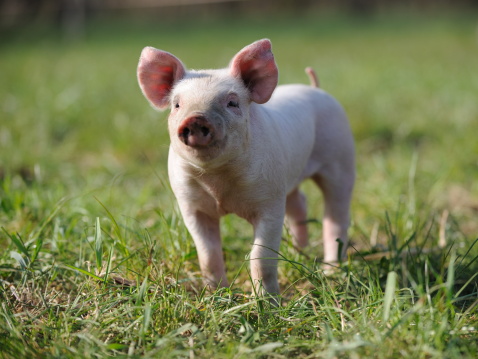
A shoat is a newly weaned pig that typically  weighs in at about thirty pounds. It wasn’t unusual to find a farmer thinning a litter of pigs (also known as a drift of pigs) at this time of year, for different reasons. Many farmers bought shoats at this time of year to fatten up over the summer and slaughter in the fall. For reasons known only to himself, Old Oliver chose to slaughter four of his young pigs rather than sell them. Perhaps the shoats in question were unpromising specimens, or perhaps the Ames family was ready for a little fresh pork.

In the first part of the 19th century, the word “shoat” was also used as a pejorative slang term, intended to describe someone as fairly useless. To call someone a shoat was to say that he or she was dispensable and unimportant.

*Oliver Ames, Journal, Stonehill College Archives, Arnold Tofias Collection

April 21, 1852

01-01_full

Examples of 19th c. lunch pails*

1852

Wednesday April 21st  It still continues to rain through not as

hard as yesterday  Have been to work on

Susans dresses altering them  Went with

Mrs S Ames to the store  Susan has carried

her dinner to school three days and thinks

it something nice  Swept my chamber and put

it in order

The heavy rain of the past two days wasn’t giving up easily. Old Oliver wrote that “it raind considerable last night + the wind blew hard and it is cloudy + rainy this morning + the water is verry high.”**

Despite the weather, the Ames women continued many of their usual routines: sewing, of course, and housework, but errands, too. Evelina and her sister-in-law Sarah Lothrop Ames went to the company store in the village. Little Susie Ames went to school, as she had even during the worst part of the storm. Instead of coming home for dinner in the middle of those rainy days, however, she carried her meal to school and ate there.  No school cafeteria or hot lunch program in those days! She thought it “something nice” to stay at school for the midday meal.

Courtesy of the National Museum of American History, Smithsonian

** Oliver Ames, Journal, Stonehill College Archives, Arnold Tofias Collection

April 19, 1852

 March_2014_nor'easter_2014-03-26Satellite image of a Nor’easter

1852

April 19th Monday  It rained very fast all day and 

about noon the rain beat in the side lights 

of the entry, and parlour windows   had to take

back the carpet a little from our window put

dishes under the windows and caught a good

deal of water.  Have cut down my Verbenas

and Petunias fixed a skirt of a dress for

gardening

A powerful Nor’easter storm beat into New England this day.  Both Evelina and her father-in-law described the rain as “fast,” Oliver further elaborating that the rain came in sheets, “not in drops.”*  Evelina (and Jane McHanna, most likely) had to deal with water coming in through the side light panels on either side of the outside door. They scurried, too, to pull back the carpet from the windows and put dishes on the floor to catch some of the water beating into the house.

The wind howled and “[t]he storm continued all day , a part of the time pritty fast,” reported Old Oliver. Everyone stayed indoors, no doubt, yet Evelina reports cutting back some of her plants, which suggests outdoor work. That couldn’t have happened on a day such as this, however, so perhaps the verbenas and petunias had wintered-over in pots inside the house, and it was those that she cut down.

Gardening was on her mind, of that much we can be sure. She prepared a skirt to wear outside when she was in her flower beds, probably “repurposing” an old dress for the task. Her handwriting was rushed and incomplete when she wrote the last sentence of today’s entry; she inadvertently omitted to cross the “x” in fixed, leading this editor to conclude that she had “fired” a skirt.  Not so, thanks to a sharp reader who came up with the correct version.

Image courtesy of Wikipedia, April 18, 2015

April 12, 1852

$_35

Tin Dipper

Monday April 12th  have been making sausages.  Tried

lard salted pork &c &c  Went to the store and bought

large tins mixing pan two small and one larger pan and 

tin dipper.  Susan washed the dishes  She does not like

to work very well, though she improves some

I had 38 lbs sausage meat seasoned them with 3/4 lbs salt

4 1/2 oz sage & savory 3 1/2 oz pepper  Am going to

watch with Mrs Brett tonight.  Not very pleasant

Evelina gave us one of her own recipes today, for sausage seasoned with salt, sage, savory and pepper.  She “tried the lard,” too, meaning that she boiled it down somewhat. And she probably used some of her new cookware in the process, while young Susie Ames helped grudgingly with the dishes.

As usual, Evelina cooked on a grand scale, inviting speculation as to just how much food her family ate. With a husband, three grown sons and a still-growing little girl all at the dinner table, we can imagine that 38 pounds of sausage didn’t last long. A month, maybe?

Old Oliver, meanwhile, was in forward gear.  After noting the “cool” and “chilly” temperature, he seemed please to write that “we were a digging a cellar to day for a cariage hous –“  Perhaps the planning for the new stone shops had inspired him to add another building – a carriage house – to the list of new constructions.