August 15, 1851

Vintage Ames Shovel

Vintage Ames Shovel

Friday 15th Aug  Julia here to work to day cutting me

a purple loos dress & cutting a pink french

calico for Susan.  Made a childs waist to it.

Oakes Frank & Oliver went this afternoon

to Robbins pond in E Bridgewater to a party.

Oakes A is to go from there to Boston tomorrow

I have passed the afternoon at Mr Peckhams

had a pleasant visit

Robbins Pond, where the Ames sons and their Aunt Harriett went today for a party, is in Bridgewater and is known today for its bass fishing.  Who hosted the party there in 1851 isn’t known, but all the Ameses, including Evelina, were invited.  Evelina declined, however, suggesting yesterday that she might enjoy herself too much if she went. She went to call on the Peckhams instead.

On a much more serious note, today marks the one year anniversary of a terrible accident at the shovel factory. According to Old Oliver, an employee named William Loftis “was hurt so bad yesterday by leting a shovel catch in the polishing wheel that he dyed.” Loftis was an illiterate laborer in his late twenties. Like the Middleton and Maccready families with whom he lived, he had immigrated from Ireland.

Old Oliver seemed to blame Loftis for getting caught in the machinery, perhaps through inattention or carelessness. He doesn’t suggest that the factory was at all at fault, or that the machinery could be reconfigured in a way to make it less dangerous. As far as Old Oliver and most factory owners at the time were concerned, employment carried a certain level of risk, risk that was assumed by any man who received a pay check.

It’s doubtful that the Ames family was indifferent to the fate of William Loftis, however. It’s likely that Evelina or one of her sisters-in-law sewed a shroud for the body for a proper burial. Knowing Oakes Ames’s instinctive kindness to strangers and employees, he probably would have reached out to Loftis’s family. The absence of a widow and children, however, suggests that Loftis was simply buried and simply forgotten.


August 14, 1851

IMG_2478

Thursday 14th  Worked about house awhile and then went

to sewing & fixing some work for Ellen cut a 

chimise for self &c. Charles Mitchell brought

Sister Harriet and Johnny from Bridgewater

Harriet has gone back to attend a party 

at Robbins pond tomorrow.  We all have an

invitation but I think I had best not go though

it would give me pleasure

Evelina put out some fabric today for the new girl, Ellen, to cut into pattern pieces. She noted that her sister-in-law, Harriett Ames Mitchell, came over briefly from Bridgewater with her middle child, John Ames Mitchell, but soon went back to prepare for a party.

Although his birthday went unmentioned in the diary, Frank Morton Ames, the third child of Evelina and Oakes Ames, turned 18 today. Taking his place in a patriarchal society behind two bright older brothers, Frank had to vie for recognition almost from the beginning. Like Oakes Angier and Oliver (3), Frank attended local and boarding school, in the latter case Andover, and had just completed his schooling the year before Evelina took up her diary.

Unlike Oakes Angier and Oliver (3), Frank was a troublemaker “who needed more discipline.”  According to historian William Chaffin, Frank and a friend once sneaked out of their respective homes, took a horse and buggy to a dance in Canton, and returned “very late.” When Oakes Ames learned about it, he and the other father, William S. Andrews, took their sons down to the shop where they “were horsewhipped in the presence of the workmen.”  As Chaffin notes, “Discipline was apt to be severe in those days.”*

One of the pleasures of Frank’s life was his participation in the local militia, a company of which was formed in 1852.  Again he had to stand behind a brother, in this case Oliver (3), who was made captain while he was appointed quartermaster, but eventually Frank made major. He resigned that position in 1860, by which time he was married and living in Canton.  Neither he nor his brothers served in the Civil War.

Frank would go on to have checkered success in several fields away from the shovel factory. With his brothers, he worked to rebuild his father’s reputation.  Despite the severity of treatment he had experienced from his father, he remained devoted to Oakes’s memory.

* William Chaffin, “Oakes Ames 1804-1873”, private publication


August 10, 1851

il_570xN.520777977_foe3

*

1851

Aug 10th Sunday  As usual have been to church to day

Mr Whitwell preached.  Went to the

methodist meeting house to a sing at 5 Oclock

got sick of it and went home at recess.

Oakes A Oliver & Helen Ames went with Orinthia to the

sing and carried her home.  Frank went from 

the sing and carried Ellen H & Louisa Swan to 

ride

Her sons clearly enjoyed music, but Evelina’s appreciation was perhaps not up to theirs, if her reaction to today’s musical gathering is any indication. That, or the singing wasn’t very good.  She “got sick of” the sing at the meeting house and left when she could. Perhaps she was just ready to be at home at the end of a long, hot Sunday and already anticipated the choring and sewing ahead of her tomorrow. She may have had a good book waiting for her.

Oakes Angier, Oliver (3) and Frank Morton were regular attendees at the sings; they enjoyed the music.  They also enjoyed the company of a circle of friends who attended the sessions, including Ellen Howard and Louisa Swan. Frank Morton was the son who drove Ellen and Louisa home, while Oakes Angier and Oliver (3), along with their cousin Helen Angier Ames, drove Orinthia back to the Howard house.

Ellen Howard was the tenth of Elijah Howard’s twelve children (by three wives.) Small wonder that the Howards were willing to board Orinthia Foss for a time; Nancy Howard was quite used to setting many places at what must have been a capacious dining room table. Ellen Howard ended up marrying George Withington, a Unitarian minister who came to town about this time. He ultimately left the ministry and served for many years as Easton’s town clerk.

Louisa Swan was the daughter of Dr. Caleb Swan, who had eleven children by his three wives. Louisa never married; she eventually left Easton for Vermont, where she lived with her sister Ruth who was married to U. S. Senator Justin S. Morrill.

* Currier & Ives,The Morning Ride,”  1859

August 8, 1851

SE004034small

1851

Aug 8th Friday  My teeth are very sore to day and I feel about

sick and did not go into Mr Holmes very early

Went about ten Oclock and made her bed and

fixed her hair  Went in evening and found

Mrs Witherell making her bed  Mrs Witherell

has had her parlour painted a[nd] papered she

is very much dissatisfied with the way the paper

is put on and talks of having it scraped off

The aftereffects of the dental care that Evelina received yesterday from Dr. Washburn made for a slow and unpleasant start to her day.  By mid-morning, however, she was out and about. She went to the neighbor’s to check on the ailing Harriet Holmes.  She went back at night, too, and found her sister-in-law Sarah Witherell in attendance.  Both women took time to arrange Harriet’s bed linens, perhaps removing them for cleaning.

Sarah Witherell had done some painting and papering in her parlor with which she was unhappy.  She would have had to get permission and funding from her father, Old Oliver, for the project.  We see from this that Old Oliver was capable of spending money for decoration, perhaps especially if his daughter requested it. How he took the news that the decorating would have to be redone isn’t recorded, however!

Evelina was so preoccupied today that she may not have noticed that the haying was finally over.  Old Oliver announced yesterday that it had been“a midling good hay day. […] we got in the last of our hay to day – we have had bad weather for haying this year + have bin a long time about it”

August 7, 1851

Teeth


Aug 7th Thursday  Have been to Bridgewater to day

to have my teeth fixed  Dr Washburn kept me there

untill past twelve and then said he should have to heat

up the teeth which take an hour and half.

Left them with him and went to Mr Harris’ and 

returned at night for them.  Oliver was with me

we called at Mr J Mitchells.  Mrs Mitchell & sister

Harriet had gone to Marshfield

It says a great deal about 19th century dentistry that the illustration above, made for a spelling book, used an image of dentures to depict the word “teeth.”  In 1851, false teeth were the norm for most adults. Dental hygiene was primitive and regular care by professionals unavailable. Although brushes for teeth were around, toothpaste didn’t come in until the 20th century.  Those who could afford to pay a dentist usually ended up with false teeth. So it was for Evelina, who had dentures, or at least several false teeth that she had to leave at the dentist’s today to be fixed. Her son, Oliver (3) accompanied her.

Nahum Washburn was the Ames family’s dentist.  A graduate of Dartmouth College, he was trained in homeopathy but preferred dentistry.  He had an office in Bridgewater from 1840 to 1883.

Washburn cared about the pain that his patients had to go through and developed a machine to reduce their discomfort when he worked on their mouths.  In 1859, he obtained a patent for a

“DENTAL APPARATUS FOR RELIEF OF PAIN WHILE OPERATING”

a contraption that was “a combination of dental forceps…with [an] electro-magnetic mechanism…so that the electrical current or currents [could] be made to flow through the nerve or nerves of the tooth, or the jaw or flesh immediately contiguous…in order to benumb the same and render such more or less insensible to pain during the performance of the dental operations. ” *

Doesn’t sound all that painless.


*Journal of the Franklin Institute, Volume 69, Philadelphia, p.165


August 5, 1851

Haymaking

1851

August 5th Tuesday  Have been sewing part of the day

This afternoon took my work and went to Mr

Torreys with the intention of stopping an hour or two

Abby left this morning for Pembroke & I had a 

long chat with Mr Torrey heard all the news.

On my return called on Mrs Lake found her

about house & quite smart.  Heard that Mrs Holmes

was sick

Haying continued, as Old Oliver noted yesterday in his journal:

“in the morning the wind was south west + there was a verry little sun shine untill about 10 – O – clock when the wind shifted to the north east. + it raind in the afternoon but not butt little we mowd the thin part of the Flyaway and brought it home well. + put it out in small heaps”

Evelina worked on her sewing, as usual, and even carried it with her in the afternoon into the village where she visited Col. John Torrey for “a long chat.”  John Torrey was a widower twice over. He had been married first to an Abigail Williams who died quite young. They had no children. In 1828, Torrey married Evelina’s older sister, Hannah Howard Gilmore, and they had three children, of whom two survived infancy:  Abigail “Abby” Williams Torrey, named for the first wife, and Mary Malvina Torrey. Both girls were close to their Aunt Evelina who seems to have served as a maternal figure after Hannah died sometime in the 1840s.

Col. Torrey was a controversial figure in Easton of whom we know only enough to be curious, and not enough to have that curiosity satisfied. (He should not be confused with another John Torrey who was a prominent botanist in New York in the same era.) Listed as a “Trader” in the census, he earned the title of Colonel by years of service in the local militia. Somewhere along the way Torrey invoked the enmity of a local character and lampoonist named James Adams who wrote a derogatory poem about him. Historian William Chaffin recorded this information without including the piece in question.  Chaffin only said that “Our Hero: A Descriptive Poem,” was published in a sixteen-page pamphlet and was “not merely satirical, but derisive and scathing.”*

* William Chaffin, History of Easton, 1886, pp. 764-765


August 4, 1851

9999008697-l

[No entry]

Evelina made no entry today in her diary, for reasons we’ll never know.  Too hot? Too cross? Too busy? Too much laundry? We can only guess.

Instead of commentary, we’ve posted an image of the Ames family tree familiar to many Ames descendants, especially those who own copies of Winthrop Ames’s 1937 family history, The Ames Family of Easton, which includes a fold-out version of this illustration.  The tree features the lineage of the two Ames brothers who stayed in North Easton: Oakes and Oliver Jr., but doesn’t include the other sons and daughters of Old Oliver and Susannah who also produced issue: Horatio, William Leonard, Sarah Witherell and Harriett Mitchell.

Some readers have asked for clarification on who was who within the family. What follows is a list of the children and grandchildren of Old Oliver and Susannah.  More information about this group and their descendants can be found in a detailed family geneaology produced by William Motley Ames and Chilton Mosely Ames in the late 1980s.

Old Oliver and Susannah’s children and their children in birth order:

Oakes Ames and Evelina Gilmore Ames had five children:

Oakes Angier, Oliver (3), Frank Morton, Henry Gilmore (d. young) and Susan Eveline Ames

Horatio Ames and Sally Hewes Ames had three children:

Susan Angier, Horatio Jr., and Gustavus Ames

Oliver Jr. and Sarah Lothrop Ames had two children:

Frederick Lothrop and Helen Angier Ames

William Leonard Ames and Amelia Hall Ames had seven children:

William Leonard Jr., Angier, Oliver, John Hall, Amelia Hall, Fisher, and Herbert M. Ames

William Leonard Ames and Anna Pratt Hines had one child:

Oakes Keene Ames

Sarah Angier Ames and Nathaniel Witherell, Jr. had three children:

George Oliver, Sarah Emily, and Channing Witherell (d. young)

Harriett Ames and Asa Mitchell had three children:

Frank Ames, John Ames, and Anna Mitchell

Two other children of Old Oliver and Susannah, Angier Ames and John Ames, died without issue.

August 1, 1851

Hay


Friday August 1st  Feel very lazy as usual after a jaunt of

shopping  Have done but very little of any

thing and am too lazy to write and may as

well give it up


Tired after her “jaunt” into town, Evelina was “too lazy” to write an entry in her diary. She often felt that way after a day or two in the city. Considering the distance she had traveled in a rustic conveyance that hadn’t been designed for comfort, behind a horse that jogged along too fast for sightseeing, her fatigue was understandable.

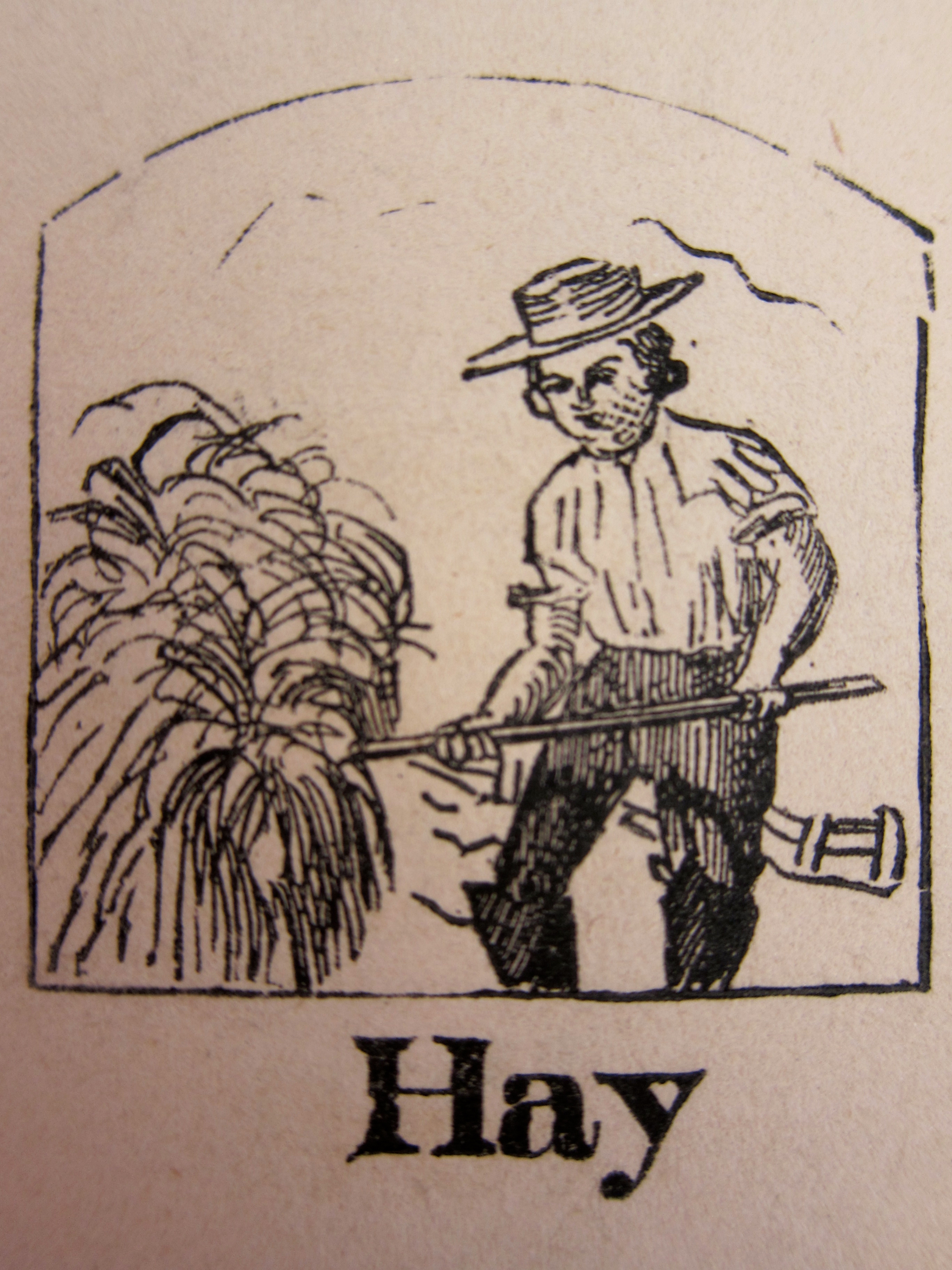
While Evelina had been shopping and sightseeing in Boston, folks back in Easton had been engrossed in one of the most important chores of the year: Haying. Only two days earlier, Old Oliver had noted in his journal: “this was a cloudy day most of the time + pritty cold for the time of year. we had a good deal of hay laying in swath for 2 days past – we opend it + dryed it a little + cockt it up”.

For days to come, haying would be the focus of most of the householders in Easton.  “[Yesterday] was fair in the morning but it clouded up by ten O clock. and there was hardly any sun shine afterwards wind easterly + cold we have 4 or 5 ton of hay out now + 2 ton in the barn to go out again”  Before the haying season had ended, Old Oliver and his workmen would pull in as much as eight tons of hay.  It would be stored to feed the oxen and horses over the winter.


July 28, 1851

Bookcase

Monday July 28th  Was about house as usual this 

morning and have been mending some and fixing

some of Susans clothes  Oakes & Oliver (3) are

having a book case put up in their room by

Ira Ford  They have almost got books enough to

fill it  Julia is to work for Mrs Witherell

making her a purple morning dress

A young carpenter named Ira Ford built a bookcase at the Ames house today in the bedroom of Oakes Angier and Oliver (3).  The boys had acquired schoolbooks and other “books enough” and needed a place to store them all.

Like their mother and unlike their father, the Ames sons like to read. The middle son, Oliver (3), in particular, cherished reading. According to an unnamed eulogist in a memorial volume published in 1895,  Oliver (3) built up quite a collection of books in his lifetime: “In the company of books he found an absorbing pleasure, and to the library which he had begun to collect in his early age he made in later years large additions of rare and valuable volumes.”* After Oliver (3)’s demise, those books that weren’t kept by his family were auctioned off at Sotheby’s.


*Anonymous, Oliver Ames Memorial, ca. 1895, p. 38 

July 23, 1851

7505761_119709544472

*

Wednesday July 23  Have been sewing before noon to day working on

different articles among the rest have made

Susan a pair of short cuffs of cambric

trimed with a wide insertion and edging

Aaron Hobart & Charles Mitchell came to the other part

of the house & dined When they returned Mrs Witherell

Mitchell, Mrs S Ames & self went to Mr James Mitchells to tea

Met Mr & Mrs Judge Mitchell Mrs & Miss Hyde & Aunt Orr there

Sewing was in the forefront of Evelina’s activities lately while gardening seemed to disappear.  Perhaps the heat and the weeding were too much, perhaps her favorite blooms had gone by and she had lost interest. Then, too, she simply may have neglected to record the time she did spend in the flower beds. Whatever the cause, Evelina was back indoors in the mornings, needle in hand.

Her social life, always a little more active in the summer, continued to thrive. She noted that Charles Mitchell, younger brother-in-law of Harriett Mitchell, and Aaron Hobart dined with Old Oliver and Sarah Witherell. This entry is the first mention of the Hobarts, a family that would become intimately involved with the Ameses in the future.  Aaron was the eldest son and namesake of Judge Hobart, a former congressman, and his wife Maria, who lived in East Bridgewater. Recently returned from working in New Orleans, Aaron became “actively identified” with the local Carver Cotton Gin Company**. His youngest sister, Catherine, was at school with Helen Angier Ames in Dorchester.

It was to East Bridgewater that the ladies went today for tea. Evelina and her sisters-in-law met with Judge Nahum Mitchell, also a former congressman and a contemporary of Old Oliver, his wife Nabby, and others.  The Mitchells were related to the Orr family, and one of their daughters (Mary Orr Mitchell Ames) was married to an Ames cousin in Springfield. Needless to say, many of the long-established families in southeastern Massachusetts had intermarried over time and thus were related in long-distance ways.

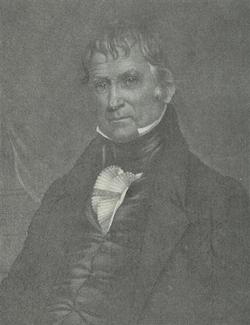
*Judge Nahum Mitchell
** Plymouth County Massachusetts Archives