September 20, 1851

Train

Sat Sept 20th  Was out shopping all day purchased a number

of articles among the rest a Cashmere & french print

dress paper for my parlour brought home two chairs

from Bigelowes  We all returned home this evening

Frank came to Stoughton after us & rode back

on the stage.  Went into Olivers awhile this evening.

Have had a great deal of trouble with my feet while

I have bee[n] gone & to night they are very sore.

The Boston spree continued for most of the day as Evelina walked and shopped for everything from fabric to wallpaper to furniture.  She and Oakes brought their purchases home on the train (or “in the cars” as they might have said) to Stoughton. It was, finally, time to return to North Easton.  Son Frank Morton Ames met them at the depot with a carriage – or wagon –  but rode home by himself on the local stagecoach. The conveyance he brought to the group getting off the train was, perhaps, too crowded with goods from town to fit everyone in.

Perhaps not wanting to let go of the many sensations that three exciting days in the city had produced, Evelina went next door to Oliver Jr and Sarah Lothrop Ames’s house. They had returned the day before, and so missed the fireworks. Surely they compared notes on their experiences at various events at the Railroad and Steamship Jubilee.  They may have compared blisters and sore shanks, too.  They did much walking and standing during their junket, and Evelina at least was feeling the effects. Her feet hurt.

Meanwhile, never having bothered to go into town for the celebration, Old Oliver was moving ahead on improvements for the shovel shop.  In his journal he noted that “this was a fair day wind south west and quite warm we put in the bottom stone for the floom at the great pond to day and the 5 foot one on the east side of it.” A flume for the factory was going in at Great Pond.

September 15, 1851

Peach

Monday Sept 15th  Mrs Stevens & I made our plan

to go to North Bridgewater this afternoon but

could not get a horse in season  Augustus

rode up to his house with us and we brought

Miss Eddy home with us.  Called at Mr Reeds

and got some peaches.  Mr & Mrs Whitwell

called before we went away Ruth & Louisa

Swan called at the other part of the house

Plans to go to North Bridgewater had to be cancelled today when Evelina couldn’t get a horse in time, or “in season,” as she says. The morning hours had been spent on housework and laundry, certainly, and the planned trip to Bridgewater must have been a sweet incentive to get the choring done.  No doubt Evelina and Mrs Stevens were disappointed not to go.

Evelina and Mrs. Stevens did get to call on Evelina’s nephew, Alson Augustus Gilmore and his wife, Hannah Lincoln Gilmore.  Hannah had recently given birth to her second son, Willie, and might well have welcomed the company. The women also secured some peaches at one of the Reeds’ homes, no doubt with plans to make some preserves. Reverend William Whitwell and his wife Eliza called on them and two of Dr. Caleb Swan’s offspring, Ruth and Louisa, called to see Sarah Witherell.  Ruth was about to be married. The social comings and goings of summer continued despite the light frost overnight, a sure sign of approaching autumn.

September 13, 1851

OLYMPUS DIGITAL CAMERA

Sept 13  Mrs Stevens & self sat down quietly to

sewing this morning but it was so warm that

we could not do much  There is quite a

change in the weather this morning.  Had

quite a heavy tempest this afternoon.

Carried our work into the other part of

the house this evening.  Mrs S Ames & Helen

passed the afternoon there

No matter how still Evelina and her guest, Mrs. Stevens, sat this morning, they found themselves enervated by the extreme heat.  They tried to sew but “could not do much,” heavy as the extra cloth must have felt on their laps as they hemmed or mended. Surely they wore their lightest cotton dresses (which were likely to have been somewhat plainer than the morning attire suggested in the illustration above from Godey’s Lady’s Magazine) and probably eschewed wearing caps indoors. Even in their coolest attire, however, they still would have “glowed,” as the old saying goes. Horses sweat, men perspire, women glow.

An afternoon rainstorm – “two showers before sunsett” noted Old Oliver in his daily jounal  – helped clear the air and by evening, Evelina and Mrs. Stevens had joined Sarah Ames Witherell in the other part of the house.  Did Old Oliver sit with them, or was he over in the office with Oakes and Oliver Jr.?  Assuming that Oakes spent the day in Boston on the usual shovel business, did he get caught in the downpour on his way home?

September 5, 1851

Pentax Digital Camera

*

Friday Sept 5th  Expected to be alone to day and was in

hopes to do some sewing but about ten Oclock

concluded to invite Mrs Latham (who came yesterday

to Father Ames,) to tea and all from the other part

of the house.  Jane made a great fuss about getting

tea having some short biscuit to make and I

got very nervous.  Mrs S Ames staid awhile but

went home to tea


The house on Main Street was relatively empty today.  Son Oliver had left for college and friends Pauline Dean and Orinthia Foss had departed as well.  Her husband Oakes and other sons, Oakes Angier and Frank Morton, were at work and little Susie was at school.  How quiet the house must have seemed, even with the sounds from the factory ringing from across the road. Evelina sat down in solitude to sew and found she wanted something more.

A little tea party was what was needed, she “concluded,” although her servant, Jane McHanna, evidently disagreed.  Jane probably had her own agenda of tidying up after yesterday’s whirlwind of departures and so “made a great fuss” about the extra work. Jane’s irritation ran counter to Evelina’s hopes, and some kind of verbal tussle must have ensued. No wonder that Sarah Lothrop Ames, who had come over from next door, didn’t stay around.

The party must have happened, however, else Evelina would have written otherwise. Jane prepared the meal. Late in the afternoon, family from the other part of the house and their guest, Mrs. Latham, were treated to tea and “short biscuit” and, perhaps, other refreshments.

Short bread or short biscuit or short cake – all names for the same, crumbly finger food – was a typical offering at tea parties, and simple enough to make that many cooks wouldn’t even need a recipe, or “receipt.” Using some of the butter that Evelina had bought just one week earlier, Jane McHanna would have followed a process similar to that described by Lydia Maria Child in her book The American Frugal Housewife:

“When people have to buy butter and lard, short cakes are not economical food. A half pint of flour will make a cake large enough to cover a common plate.  Rub in thoroughly a bit of shortening as big as a hen’s egg; put in a tea-spoonful of dissolved pearlash; wet it with cold water; knead it stiff enough to roll well, to bake on a plate, or in a spider.  It should bake as quick as it can, and not burn.  The first side should stand longer to the fire than the last.”


*http://britishfoodhistory.wordpress.com/2012/06/10/shortbread/


September 4, 1851

800px-Manning_Hall,_Brown_University,_Providence,_Rhode_Island_-_20091108

*

Thurs Sept 4th  This morning Orinthia left for Maine

& Pauline for Roxbury in the stage.  Mr Ames &

Oliver via Mansfield to Providence.  Oliver is

delighted with the idea of going to school & I am

sure he will improve his time  It seems

very lonely to day I have taken the bedstead down from

the boys chamber to clean it swept the parlour & washed

most all the windows in the lower part of the house both sides

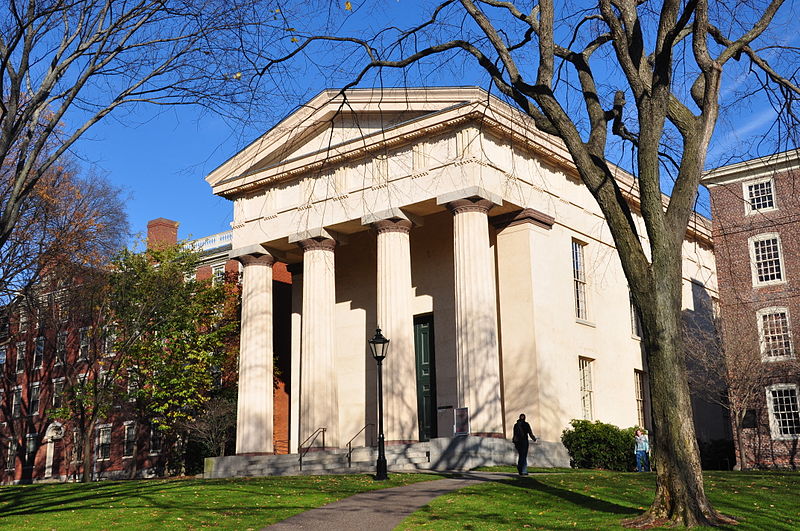
Guests and family departed the Ames compound in North Easton today. Schoolteacher Orinthia Foss left to return to Maine, probably to Leeds where her parents and two younger siblings lived.  Houseguest Pauline Dean, left, too, taking the stage with Orinthia as far as Roxbury. Her final destination was unknown.  The most noteworthy departure, however, was that of 20-year-old Oliver Ames, middle son of Oakes and Evelina.  He was going to college.

Oakes Ames, after having resisted giving his son a college education, had evidently made a decision to let Oliver go. Father and son traveled together to Providence.  Perhaps Oakes helped his son find his living quarters, perhaps he explored the campus at Brown in an attempt to know it for himself, if he didn’t know it already. Sarah Lothrop Ames’s brother from Detroit, George Van Ness Lothrop, had once attended the school; Oakes and Oliver must have known that.

Established in 1764, Brown was the third oldest college in New England. Manning Hall, the neoclassical building shown in the photograph above, was the newest building on campus. No doubt it was a building that Oliver went into often, for it held both the library and the chapel. The president of the college at the time was Francis Wayland, a Baptist minister, who was stern but beloved and progressive.

As Evelina noted, Oliver was immensely pleased to be going to Brown, and she, in turn, seemed pleased for him. She was confident that he would study hard and do well.  Her pride didn’t protect her from feeling
“very lonely” today, though.  Choring was the only antidote she could imagine to liven up the quieter house.


Manning Hall, Brown University, Providence, Rhode Island

September 3, 1851

Trunk

Wednes Sept 3d  Alson came this morning & brought

Orinthia and staid to dinner and carried Mrs Stevens

home with him  Orinthia has been packing her clothes

Mrs Stevens stiched three more collars for me & Mrs

Witherell two that are for Frank.  Abby Torrey called

this afternoon &c and on her return Orinthia & I went

to the store  Pauline passed the afternoon with Helen

Orinthia Foss was packing her clothes, getting ready to return home to Maine. What prompted the departure isn’t clear. Did she lose her job, or was she called home on family matters? She would return to North Easton eventually, but did she know that when she left?  How did she feel about leaving this town where she had lived for six months? How did Evelina feel about the loss of her young friend, even temporarily?

Orinthia wasn’t the only one with a trunk to be packed. Oliver Ames (3), too, was a day away from departure and had a trunk into which his mother – and others, perhaps – were placing his new collars and mended shirts. Last minute sewing was still going on, but by this time the trunk would have been nearly full of the clothes that Oliver would need for a term at college.

That Oliver was going away to study at Brown was just shy of miraculous.  At 20, he was old to be going, for one thing; in the nineteenth century, the average students were teenaged, like Fred Ames at Harvard. But more than that, his father Oakes had not wanted him to go. According to one 19th century acquaintance of Oliver, Oakes “had inherited some measure of that Puritanical contempt for the liberal arts.” After completing prep school, Oliver had been directed to work at the factory, “to learn the trade of shovel-making. But the desire for a higher education remained strong, and when at the end of his five years apprenticeship he had mastered the trade, his father yielded to his solicitations, and allowed him to enter Brown University.” * Oliver had earned his ticket out.

* Hon. Hosea M. Knowlton, “Address,” Oliver Ames Memorial, 1898, pp. 98-99


September 1, 1851

000100849[1]

*

Sept 1st Monday  Jane & Ellen washed and have done most

of the housework and I have been to work on Olivers

clothes have sewed pretty steady to day.  Pauline has

been sewing on a pr of Muslin undersleeves that

I gave her but has not finished them.  Mrs Stevens

covered some button and sewed them with Olivers vest

& mended the buttonholes


Sewing was “pretty steady” today as the date of her son Oliver (3)’s departure for college loomed nearer. Evelina was mending everything and making new items like collars and dickeys. She tried to mark Oliver’s clothes so that they wouldn’t get lost – a time-honored effort by many a mother when a child leaves for college. How did she mark the clothes, though, in those days before indelible ink markers?  There were certainly no “iron-ons” and probably no manufactured name-tags that would have been sewn in by hand, either.  Her most likely solution would have been to embroider Oliver’s initials or name on the inside or underside of each piece of apparel. That sounds like a lot of work.

Houseguest Pauline Dean accompanied Evelina and sewed some on a pair of new undersleeves while another guest, Mrs. Stevens, helped cover the buttons of a vest belonging to Oliver. Clothes must have been everywhere, as laundry was being washed while all this sewing went on. It was Monday, and Jane McHanna and another servant named Ellen had the stove going and the tubs full. The “fair day” and north east wind that Old Oliver noted in his journal would have helped dry the clothes.

Old Oliver also noted that he “went to Canton to day with Mr Clark + others to put in the stone bridges below the shop.” Can any of our local historians identify these bridges?  Are they still in place? The shop, which was originally built in 1847 to supplement the factory in North Easton, is no longer standing. The image above was taken circa 1965.

* Ames Shovel Shop on Bolivar Street, Canton, Canton Historical Society, from Arthur Krim’s Historical Buildings of Canton, Vol. II.

August 30, 1851

OLYMPUS DIGITAL CAMERA

*

Sat Aug 30th Have been marking Olivers clothes and fixing

them.  Called to Mr Whitwells Major Seba Howards

Mr Samuel Dunbars and at Alsons with Pauline

Took tea at Alsons brought Orinthia home with us

All of Mr John Pools family were there or rather

Rachel Augusta & Elisabeth.  Mrs Stevens came

there yesterday  Alson & Mr N Hall here to

dinner & tea

Another sociable Saturday was enjoyed by many throughout Easton, as friends and neighbors rode here and there calling on one another. As one modern historian has noted, “formal and informal forms of socializing were the most common amusements throughout the period. Then, as now, folks liked to visit one another, usually after supper and on weekends. The middle class gathered in their parlors, talked, sang, played games, and so on.”**

Evelina certainly did her part. With her friend Pauline Dean, she paid calls on various friends, including the Howards, the Dunbars, and the dependable Reverend Whitwell and his wife Eliza. At her brother Alson’s farm, where they took tea and visited with old Mrs. Gilmore, they chatted with three daughters of the John Pool family, including Rachel, Augusta and Elizabeth.  Rachel and Augusta had visited Evelina earlier in the month and accompanied her to the company store and the shovel shop.  Evelina was a friend to young women – especially to Orinthia Foss, the schoolteacher, whom they scooped up and took back to North Easton.

On their way home, as they likely rode past fields of Queen Anne’s Lace and Goldenrod, did they acknowledge that summer was coming to an end?


Photograph by John S. Ames III

** Marc McCutcheon, Everyday Life in the 1800s, Cincinnati, 1993, p. 200.


August 29, 1851

WhiteAster

Friday Aug 29th  Alson & Mr Hall came early this

morning and were here to dinner & tea, brought Pauline

with them  Have been mending for Oliver getting his

clothes ready for school  Went with Pauline to Edwins

garden he has not many pretty flowers in blossom has

some fine Dahlias  got 5 lbs of butter at Mr Marshalls

after we came back went into Olivers to hear Pauline

play.  George & wife & Sarah gone to her fathers

The day after Clinton Lothrop’s funeral, Sarah Lothrop Ames, her brother George Van Ness Lothrop and his wife Almira spent the day, at least, at the Lothrop farm with their parents, Howard and Sally Lothrop. They would have had to make long-term plans for the property, now that Clinton wouldn’t be there to tend the family farm.

Alson Gilmore, Evelina’s brother, took his meals at the Ames’s today.  He was working nearby, perhaps with Mr. Hall, helping his son, Edwin Williams Gilmore, build a house. They were putting in the cellar.  Pauline Dean, who must have been staying with or near the Gilmores, returned for a visit. She probably got roped into helping Evelina with the mending.

Evelina had a lot of mending to do, as Oliver (3) was preparing to go off to school.  Like his cousin Fred Ames, he was going to attend an Ivy League college, but in Providence, not Cambridge.  Oliver (3) would be going to Brown, and his mother had to get his clothes ready. Shirt fronts, collars and hose weren’t her only business today, however.  She and Pauline took a break from domesticity and went to Edwin Manley’s to see his garden. There they saw “some fine dahlias.”

Dahlias, which had been introduced in the United States early in the 1800s, had quickly became popular, although not yet listed in Joseph Breck’s Book of Flowers. So successful were they that over the course of the century more than 10,000 varieties were developed or identified and sold. Today, dahlias are still much admired by flower gardeners, yet less than a dozen of those 19th century heirloom examples still exist in cultivation.* The earliest known, White Aster (above) dates from 1879.

*oldhousegardens.com

August 16, 1851

Tub

Sat 16th Aug  Have been to work on my white loose dress

that Julia cut out some time since and it is ready for

the washtub  Frank and Oliver came from Bridgewater about

three and brought home Charles Mitchell & Sister Harriet

Mr Brett two Miss Tolmans from New Bedford Jane & William

Howard & Orinthia came & went to the shop about 5 Oclock

The party at Robbins Pond in Bridgewater may have ended, but the festive mood continued.  Oakes Angier Ames headed into Boston, but his brothers Oliver (3) and Frank Morton returned from Bridgewater with their Aunt Harriett and her brother-in-law, Charles Mitchell and, perhaps, others. At the same time or maybe just a short while later, Orinthia Foss and a spill of friends to whom Evelina had been introduced only a few days earlier arrived and went to the factory.

Why this sociable group visited the shovel factory at the end of the day is a mystery. Were they delivering the Ames brothers back to work? Were they visiting someone else there? Did Oakes or Oliver Jr. find it amusing? Was Old Oliver privy to this after-party?

Evelina, meanwhile, was working on her wardrobe and was ready to put a new dress into the washtub.  She might have looked up from her sewing to see the young people drive by.