December 3, 1851


railnet1850

Dec 3d  Wednesday.  Mr Ames started for New York by

way of Boston.  I went to Boston with him dined

at Mr Orrs  Melinda went for Selina and

she passed the night there with me.  I was very

busy shopping all day  In the evening Mr & Mrs

Norris  Selina & self played cards  Past eleven

when we retired.  Mr & Mrs Byram were there


As Old Oliver wrote at one point in his journal, “Oakes went to New York the 3rd of this month to settle up our accounts.”  With his natural bonhomie and sharp talent, Oakes was the best salesman on the Ames team.  On this trip, he would be away for eight days, delivering invoices, collecting payments, checking on inventory and bringing new orders back home.

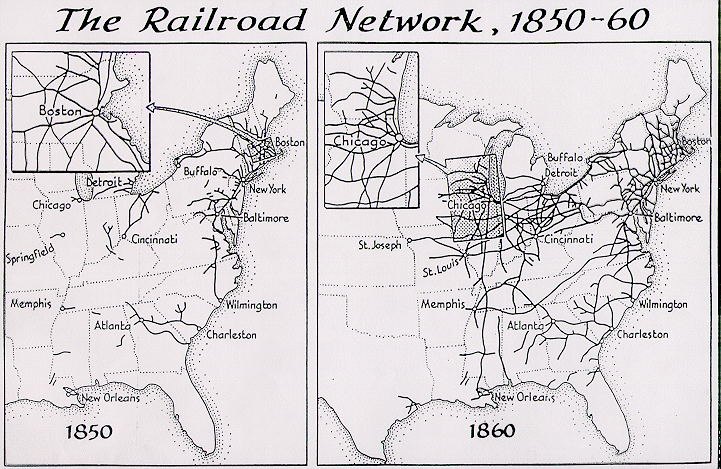
Evelina accompanied her husband into Boston, where they stopped for midday dinner at the Orrs’ before Oakes boarded his train. He would have traveled to New York by way of Springfield, or else taken the Old Colony line down to Fall River where steamboats picked up passengers to complete the trip to New York City.  Evelina, meanwhile, stayed in Boston to shop and enjoy a bit of socializing with the extended Orr family. She played cards past her bedtime.

Back in Easton, shovel making and farm work went on as usual.  Old Oliver, as always, noted the weather: “this was a fair day wind north west + cold. ”  He added that  “we kild 4 hogs to day everage wate 356 lb sold to the workmen at 7 cents a pound those we sent to boston sold for 7 ¼ cents”.  He sold some of the fresh pork to his workmen, probably through the Ames store, and sent the surplus to Boston to be sold.


December 1, 1851

20130117__anchor-ice~p1

*

Dec 1st Monday.  Oliver left again this morning

for Brown University.  Jane was able to do the 

housework this morning & Mary has washed

I have been sewing with Mother  Gave the

furnace up to Ann this morning  It has been 

so windy that we could not dry our clothes

Jane has starched the fine clothes to have

them ready to Iron tomorrow  Cold room all day


It’s not surprising that Evelina got Sarah Witherell’s servant, young Ann Orel, to start the coal furnace this morning, for it was a chore she disliked and the weather was so cold that there was no fooling around with getting heat into the house.  Old Oliver reported that “this was a fair day wind verry high from the north west + cold – a verry disagreeable day to be out in – there was an anchor frost this morning”

Anchor frost is a term for “a frost which causes ice to form along the bed of a running stream […] An anchorfrost can only occur when the temperature of the running water and the bed over which it flows is below freezing point. When this is the case, the rapidity of the stream is sometimes sufficient to prevent the swifter upper current congealing, while the lower current, which moves more slowly on account of the friction, becomes frozen to the bed.” *  Old Oliver knew all about running water and was probably not happy to see anchor ice forming in the Queset.

*Image of anchor ice, courtesy of The Aspen Times

** Arthur Benoni Evans, Leicestershire Words, Phrases, and Proverbs, Volume 11, English Dialect Society, 1881.


November 29, 1851

frontcover_500

Nov 29th  Sat.  This forenoon have been mending

Olivers (3) clothes and putting them in order to 

carry back Monday.  Have been with Oliver

to spend the afternoon at Mothers. Came

home by Mr Lothrops to bring Sarah Lothrop

Fred & Helen home  Alson has been quite 

unwell a week or more & is not able to work

Evelina was enjoying the company of her middle son, Oliver (3), today. Like many a modern child, he had brought his clothes home from college to be put “in order” (but not washed – it wasn’t laundry day.) Evelina mended what she could and then the two of them rode south to visit old Mrs. Gilmore and the family on the farm. They found that Alson Gilmore, Evelina’s brother, had been “quite unwell.” He was evidently bed-ridden, which suggests that their Thanksgiving had been less celebratory than the Ames’s.

Unlike the shovel laborers in the village, Alson did work that didn’t follow a schedule set by a bell.  He labored according to the demands of the season, weather and livestock. How had he managed to run his farm this past week when he was too ill to work? Most likely his fifteen-year-old son, Francis, took over responsibility for any livestock. And if the Gilmores had any dairy cows, it was typically the women of the house – in this case, daughter Lavinia or wife Henrietta – who would typically have done the milking. Because it was November, and after the harvest, there was otherwise not much work that demanded attention.

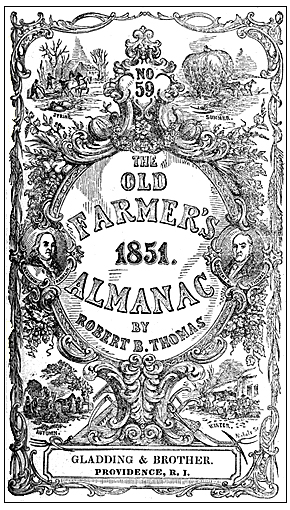
The Old Farmer’s Almanac, seen above, would have been full of advice for Alson and other farmers. We don’t know if Alson consulted it. (Like Old Oliver Ames, he might have consulted instead an agricultural newspaper called The Massachusetts Ploughman.)  The almanac was just featuring its new “Four Seasons” cover, first used in October of 1851 and still in use in 2014. It was designed by Hammatt Billings, a Boston architect and artist who also did the original illustrations for Uncle Tom’s Cabin, and engraved by Henry Nichols of Cambridge, who name appears on the lower right.  The editor was Robert B. Thomas, whose portrait is featured on the right side of the cover, opposite Benjamin Franklin.

November 28, 1851

Clock

Nov 28th Friday  Had rather of a late breakfast

Oliver did not rise untill past ten Oclock

Have been very busy to day making some

collars for Mr Ames & have been looking

over Olivers clothes some  Mr & Mrs Thom

Ames have spent the afternoon with Mrs Witherell

I have been to see them this evening

Like many middle-class families in 1851, the Ames family probably kept at least one clock against a wall or on a mantel. By its hands Evelina could tell that her middle son, Oliver (3), had slept exceedingly late on this morning after Thanksgiving. She might have looked up from her sewing to notice the minutes move by. Just home from his first term at Brown University, Oliver was keeping collegiate hours that were rather more elastic than the factory time by which the days usually ran. Tired from his studies and his journey home, Oliver slept in. Workers at the shovel shop were not accorded that luxury.

Absent a working clock in the house, how did people in the village and its close environs know what time it was?  Pocket watches were popular, certainly, but many in the village wouldn’t have owned one. The young, single immigrant men who lived in the Ames tenement, for instance, and the working families who lived in the factory houses around town needed temporal oversight. A bell at the factory guided them.

According to historian Gregory Galer:

“Life in North Easton in the 1840s was dominated by the Ames Company.  With the move to a more regular work schedule the company instituted the use of a bell, heard throughout the village, to be sure employees would keep a schedule which would allow them to fullfil their duties at the shovel shop.”*

Evelina’s grandson, Winthrop Ames, noted:

“Every week-day morning at ten minutes before five the shop bell warned the town to yawn itself awake; and at nine in the evening it rang a curfew (as it still does) to advise bedtime.  The factories started at seven, by lamplight in winter, and stopped at six, with an hour out at noon for dinner – a ten-hour day.”**

Winthrop was writing in 1937; in 1952, the Ames factory would close in Easton and move to West Virginia.  No curfew bell rings in North Easton today.


*Greg Galer, Forging Ahead, MIT, 2001, p. 240

*Winthrop Ames, The Ames Family of Easton, Massachusetts, privately printed, 1937, p. 128

November 27, 1851

Turkey


Nov 27  Thanksgiving day we have passed in the other

part of the house.  Our sons & Helen went this evening

to a ball in Canton  Father Mrs Witherell Mr Ames &

self had a game of cards.  Mr & Mrs H Lothrop

A[u]gustus & wife Cyrus & Sarah Lothrop

spent the day at Olivers

In 1844, Lydia Maria Child, a Massachusetts mother, author and abolitionist, published the original six verses of a poem about Thanksgiving. The poem was put to music, and verses were added or modified over time. We know it, and everyone sitting around the Ames’s dinner table would have known it:


The New-England Boy’s Song About Thanksgiving Day
Over the river, and through the wood,
To Grandfather’s house we go;
the horse knows the way to carry the sleigh
through the white and drifted snow.
Over the river, and through the wood,
to Grandfather’s house away!
We would not stop for doll or top,
for ’tis Thanksgiving Day.
Over the river, and through the wood—
oh, how the wind does blow!
It stings the toes and bites the nose
as over the ground we go.
Over the river, and through the wood—
and straight through the barnyard gate,
We seem to go extremely slow,
it is so hard to wait!
Over the river, and through the wood—
When Grandmother sees us come,
She will say, “O, dear, the children are here,
bring a pie for everyone.”
Over the river, and through the wood—
now Grandmother’s cap I spy!
Hurrah for the fun! Is the pudding done?
Hurrah for the pumpkin pie!

– Lydia Maria Child


Happy Thanksgiving, everyone.

November 26, 1851

Rolling pin

Wedns Nov 26th  Have heat the brick oven three times

to day  Made Squash mince & apple pies

fruit & plain cake & seed cakes  did not

get the last oven in untill about four Oclock

Jane has assisted some about the work  Dr Swan

came to see her says she must exercise but

must not work hard  Oliver came home in the stage

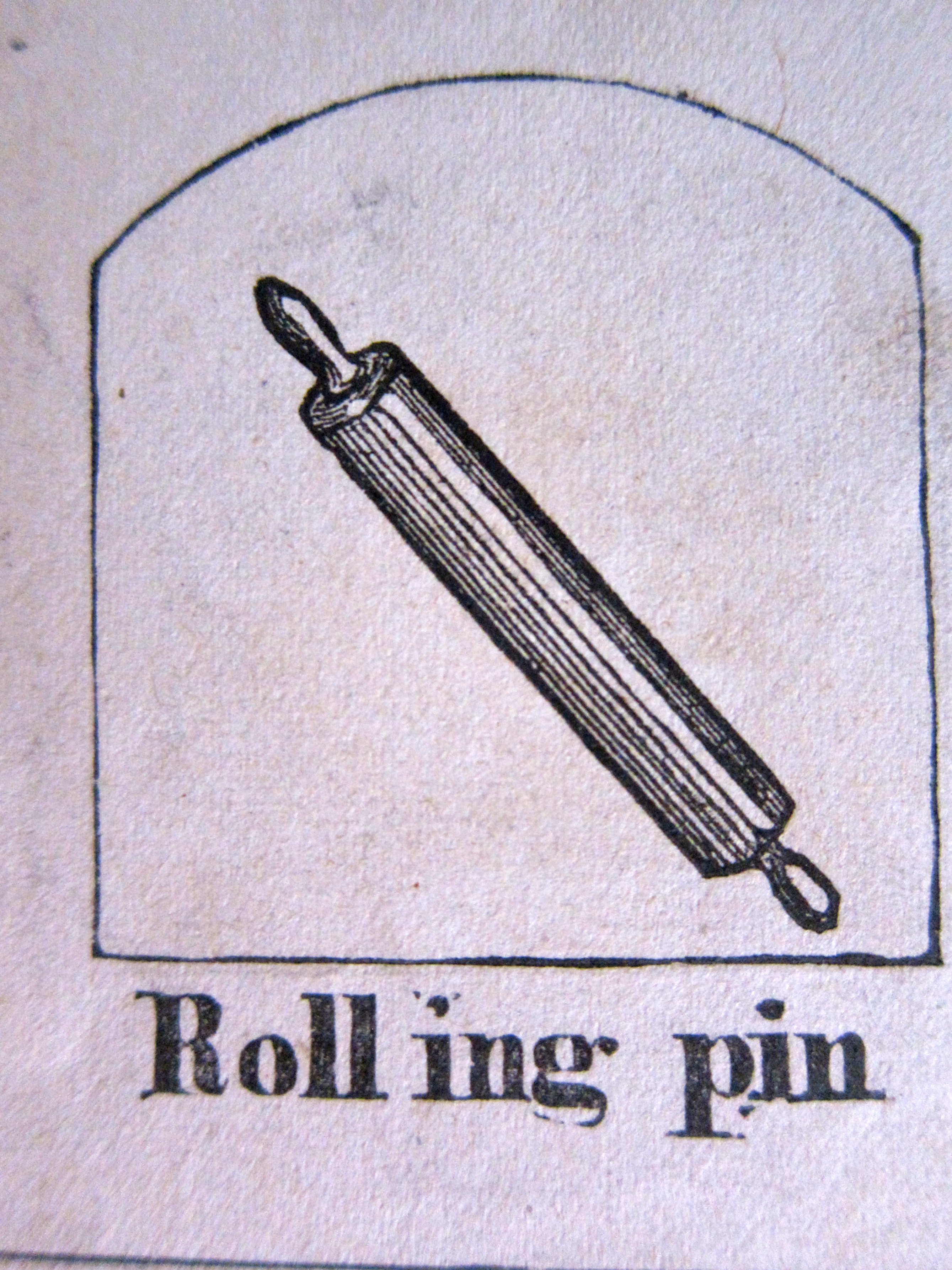
The kitchen was humming today. Evelina baked pies and cakes to feed her family, now back at the full complement of six at table, as Oliver (3) arrived home from college for the holiday. She baked pies and maybe some side dishes to take to the other part of the house, where they would have Thanksgiving dinner the next day with Old Oliver, Sarah Witherell, and Sarah’s children, George and Emily. Jane McHanna “assisted some,” but was still sick enough to have a visit from the doctor – this time, the Ames’s personal physician, Caleb Swan.

In 1851, Thanksgiving was not yet a national holiday. That would happen in 1863, after lobbying by the indefatigable Sarah Josepha Hale convinced Abraham Lincoln to make an institution of a feast that was already celebrated in many – but not all – states. Although the country was suffering from the shock and carnage of a civil war, Lincoln saw good in the idea of a day of gratitude for “fruitful fields and healthful skies”** and, by Executive Order, proclaimed the last Thursday in November as a national Day of Thanksgiving, in perpetuity.

The tradition of Thanksgiving evolved from the Puritan practice of holding days of thanksgiving or fasting, according to immediate need. The Puritans were inclined to see God’s influence in every part of their daily lives. When they were good, God would reward them. When they were bad, He would punish them. Depending on how things were going, their ministers were either making sure to thank God or beg for help. In the 17th century, a local congregation could call for a day of thanksgiving or a day of fasting on its own. As time went on, the practice became more formal and by the 19th century, governors, at least in New England, would call for a day of fasting in the spring (before the planting) and a day of thanksgiving in the autumn (after the harvest). In 1851, this was still how it was done.

Toward the end of the 19th century, as immigration began to influence and de-homogenize American culture, some of the old guard became concerned. Like many an established group, its members wanted to preserve their culture and honor traditions such as Thanksgiving.  The fourth Thursday in November became more than just a feast of gratitude with family members. It became a post-Civil War symbol of America’s beginning, an annual celebration that would help new immigrants understand how the country was first settled by white Europeans. Teaching about the holiday in schools became a priority and thus, for more than a century, an account of a first Thanksgiving feast between the Pilgrims and the Indians has become an indelible, if occasionally controversial, feature of American history.

For Evelina and her family, Thanksgiving was the most important holiday of the year. They would celebrate it with Yankee gusto, which generally meant a gathering of family and a fine feast followed by a game of cards for the old folks and perhaps a dance for the young people.

* A wealth of information about Thanksgiving can be found in “Thanksgiving: A Biography” by James W. Baker, New Hampshire, 2009. 

** Abraham Lincoln, A Proclamation, October 3, 1863
November 25, 1851


kitchen

*

Tues Nov 25th  Mary has done the ironing to day except

the fine clothes and they look much better than usual

Jane is rather better to day and has washed the dishes

and assisted some about the housework.  I have made a

dickey for Mr Ames. Passed the afternoon at Father Ames

with Mr & Mrs Swain & Mrs Meader  Mrs S Ames,

Fred & Helen came home to night

Family members began to gather in anticipation of Thanksgiving. Fred and Helen Ames came home from their respective schools in Cambridge and Boston, adding animation to the quieter house next door.  Surely their parents, Sarah Lothrop and Oliver Ames, Jr., were pleased to see them.  Oliver (3), away at school in Providence, was getting ready for his travel home.

No one was making merry yet, however.  Everyone still had work to do. The new girl, Mary, did some ironing, evidently better than Jane McHanna usually did.  Jane herself, still recovering from an illness that had laid her low for almost ten days, was able to wash dishes and help out a bit. Evelina, after supervising Mary and Jane, was finally freed up to sew and socialize.  She was in a happier state of mind.

The men of the family were working as well.  While Oakes, Oliver Jr, Oakes Angier, and Frank Morton were at the shovel shop, Old Oliver and some of his men began “a building an ice hous.”**

“About sunsett,” it began to snow.


*Image of a mid-19th century kitchen, Courtesy of http://www.victorianpassage.com

**Oliver Ames, Journal, Courtesy of Stonehill College Archives, Tofias Collection


November 21, 1851

Bed

Friday Nov 21st  Jane has not been able to do any thing

to day has had Dr Wales.  I have heat the

brick oven twice made Apple & mince pies

& brown bread  Mr Clarke has taken the 

box & sink from the little porch.

Mrs Witherell has been baking and she

made my bed & Susans for which I feel

quite mortified  And assisted about the dishes.

Jane McHanna, the Ames’s servant, really was ill. Dr. Ephraim Wales called at the house to examine her. A young doctor, he was the son and grandson of doctors, also named Ephraim. Beyond that, we don’t know much about him. He and his wife, Maria, were listed in both the 1850 and the 1855 census, yet he drew no mention in the detailed chapter on physicians in William Chaffin’s History of Easton, Massachusetts. Perhaps they moved away before 1886, when Chaffin published his tome.

In 1851, Ephraim and Maria may have lived in the village; by 1855, they appear to have moved out to the country and settled near the Gilmore farm.  Regardless of his home address, on this particular day Dr. Wales braved some wet weather to visit Jane. Old Oliver described the day as ” a verry rainy day wind North east – East + south East the wind blew quite hard there was about 3 inches of rain fell. it raisd the two resevors 13 inches each.”

Evelina and her sister-in-law, Sarah Ames Witherell, stayed indoors and baked. With Jane sidelined, Evelina was once again doing the cooking and the housework, too busy to sew. Sarah must have felt sorry for Evelina, for she slipped away from the baking and made the beds for Evelina while the latter was coping in the kitchen, then came downstairs and helped with the dishes. Sarah, a widow who kept house for her father, was always looking after others.

November 16, 1851

IMG_0017

Modern photograph of house in North Easton built by Edwin Williams Gilmore, 1851


Sunday 16th  We have all been to meeting all day

Went to Mr Whitwells at noon with mother

rode with our new horse do not believe he

is any great affair  Edwin took tea with 

us and I went into his house with him  Wrote

a letter to Oliver.  Oakes A went to North

Bridgewater to see Mr French about selling

some hogs for father.  I asked once to let me go but

he went without me


The Ameses went to meeting today, naturally, and Evelina visited with her mother at the parsonage during intermission.  The Ames family often rode in tandem if not together to church; Evelina perhaps rode in a carriage with Old Oliver and Mrs Witherell.  She certainly seemed underwhelmed by the new horse that Old Oliver had recently acquired.

Edwin Williams Gilmore, Evelina’s nephew, stopped by for tea at the end of the day.  He was building a house in North Easton, barely a stone’s throw away from the Ames compound. Although he may have worked at the shovel factory at this time, he would soon embark on a business of his own: a hinge factory that would be a successful enterprise for decades to come. He wasn’t interested in working and living on the family farm; that job would fall to his younger brother, Francis.

For now, Edwin was an ambitious twenty-three year old who wanted to live in the village.  The house, which his father, Alson, had been helping him build, was almost ready. His next step would be to marry, and he evidently had a wife in mind: twenty-two year old Augusta Pool, his neighbor near the farm. Evelina may have been privy to Edwin’s plans; if not, she surely enjoyed looking in on the new property so close to her own. Her visit with Edwin perhaps made up for not going with her son Oakes Angier to North Bridgewater.


November 14, 1851

Moby-Dick_FE_title_page


Tuesday Nov 14th  Bridget has cleaned the store room

and I have been working about in the chambers

have put Franks chamber in order papered

a little trunk &c &c  Have been working about

the house all day  I can scarcely tell what 

Im about all the time but I find something 

to keep me busy and I scarcely sew at all

Frank has been making a fuss about a robin to wear

The American edition of Herman Melville’s Moby-Dick or The Whale was first published on this date in New York, by Harper & Bros.  It followed a British edition that had come out about one month earlier.  Neither edition was a commercial success.

Today may have been a milestone for American literature, but the occasion went unnoticed by Evelina and most readers, discerning or otherwise. Evelina was focused, as usual, on domestic concerns “about the house,” including putting the bedroom or “chamber” of her youngest son, Frank Morton Ames, in order.  He, meanwhile, was complaining about an item of clothing that he needed to wear. Does anyone know what a “robin” is?

Old Oliver was, as usual, paying a farmer’s attention to the weather:  “this was a cloudy day most of the time the wind got round south west and was warmer than it has bin for several days past”.