February 5, 1851

OLYMPUS DIGITAL CAMERA

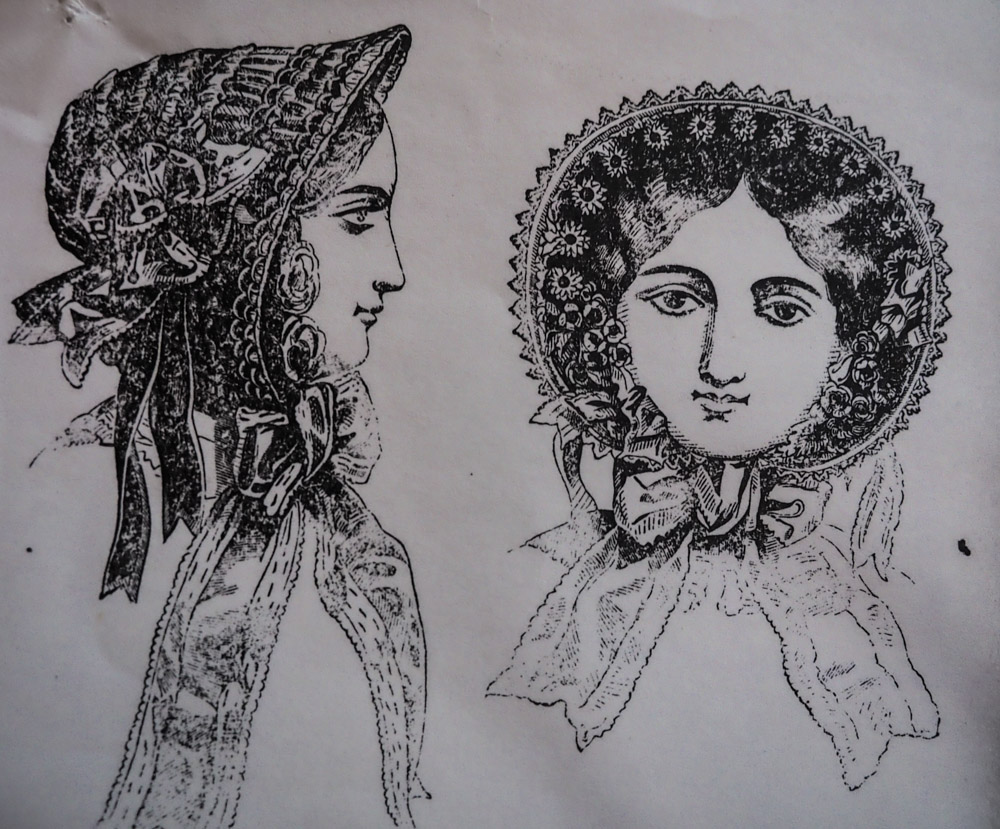
Feb 5th Wednesday  This forenoon made a head dress trimmed

with cherry colour, ribbon & flowers.  Cannot say

much for my days work.  Have been doing a little

of everything & not much of any.  Jane has done

part of the ironing  Oakes Angier has been to Canton

to mark Iron  have been reading in David Copperfield

this evening.  I have been looking over my accounts

It is very warm for the season but cloudy

A ho-hum day for Evelina, warm but gray, and she still partly sidelined by a sore foot.  Small wonder that she chose a colorful project for the morning: trimming a head-dress, more commonly referred to as a bonnet.  She used red ribbons and fabricated flowers and although she deprecated her own handiwork, the task must have been a nice change of occupation.

In the 19th century, no lady’s outfit was complete without a bonnet; it played the accessorizing role that shoes and purses play today in women’s fashion.  Given that a woman’s form was covered from neck to toe by a voluminous dress or cloak, the bonnet was an inevitable point of interest atop the whole outfit.  Not only did it stand out like the star on a Christmas tree, it also served to cover hair that was seldom washed.  It rarely kept a head warm, however – that’s what cloaks with hoods were for.

Most women had at least two bonnets, one for winter and one for summer.  Winter bonnets were made of wool, silk or even horsehair, while bonnets for warm weather were typically made of straw or “chip,”  a fine wood splint.  As the 19th century progressed, the transition from winter to summer bonnet solidified around Easter, thus introducing the notion of the Easter bonnet and competition for the prettiest headdress on that important Sunday.

In other news of the day, Oakes Angier Ames rode to Canton on shovel business to “mark Iron.”  Does this mean he looked through a supply of smelted ingots to select the best for the Ames shovels? Anyone out there care to elaborate on what Oakes Angier did?  Was the Kinsley Iron Company the forge that he visited?  Certainly probable.

February 4, 1851

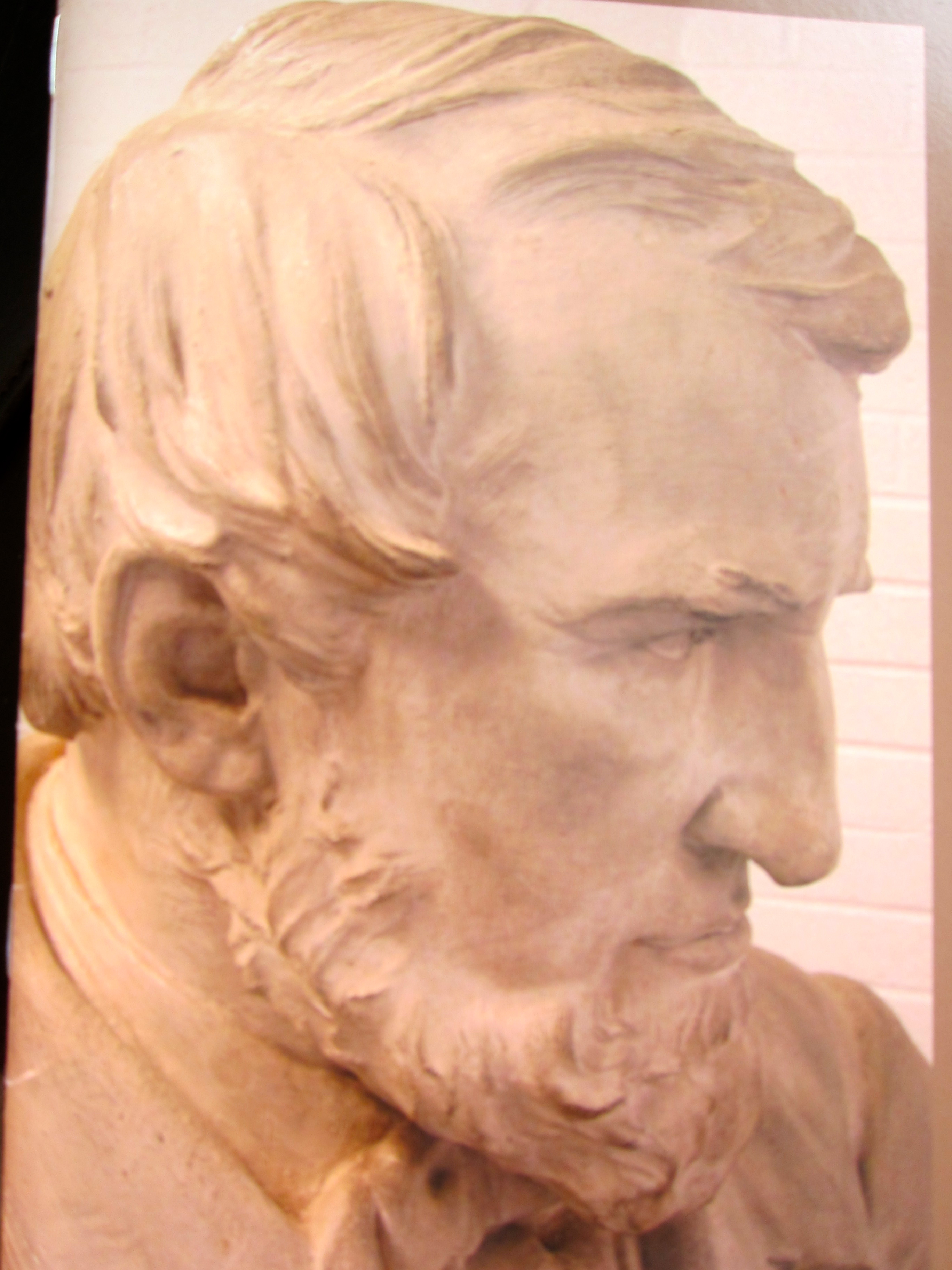
Governor Oliver Ames (Feb. 4, 1831 - Oct. 22, 1895)

Governor Oliver Ames

Tues Feb 4  Had my morning work done about nine Oclock just

as A A Gilmore & wife came to pass the day.  About eleven

we called to see Simeon Randalls house.  This afternoon

called at Mr Torreys and at Mr Peckhams.  While

we were at tea Mr Torrey called to talk about letting his

house to Augustus.  Received a letter from O Foss.

Passed this evening with Sarah W in the other part

of the house finished another pair pantletts  Pleasant

Evelina’s nephew, Alson “Augustus” Gilmore, and his wife, Hannah Lincoln Gilmore, came to North Easton today to search for a house to rent.  A young couple with one child, Eddie, they were expecting a second child in July, although they may not have shared that information with their aunt.  Even if they had, she would never have spoken of it.  The increasingly prim culture of the day forbid it, but the high rate of infant mortality, too, caused many expectant parents and their relatives to downplay “the blessed event.”  Evelina carried Augustus and Hannah around to look at available properties.

Although Evelina doesn’t mention it, today is the birthday of her middle son.  Oliver Ames (3) turned 20 today.  Like his older brother, Oakes Angier, and his younger brother, Frank Morton, Oliver worked at the shovel shop, learning the business in the expectation that he would one day help run the company.  He had attended school at Leicester Academy and had hoped to go on to college, as his cousin Fred Ames was planning to do, but his father had insisted that he return home to work. Oakes Ames was no fan of formal education, having despised learning in his own youth.

The eldest son, Oakes Angier, naturally stood first in line to superintend the shovel business, but Oliver (3), would be a partner. Like his father, he was ultimately slated to travel as the company’s salesman.  Third son Frank, on the other hand, would be given an auxiliary administrative position in a related family-owned business, the Kinsley Iron Works Company in Canton.

But on this day, those occupations were in the future, as was Oliver (3)’s more memorable service as Governor of Massachusetts from 1886 to 1889. On this birthday, he was a brand-new twenty year old who worked hard all day, read alot, and enjoyed attending “sings”.


January 29, 1851

Carpetbag

Carpetbag

Jan 29th  Finished my carpet bag this morning and afterwards made

a long call on S Witherell and then she came here and sit awhile

with Mother.  This afternoon cut Susan 4 prs of pantletts

and finished a pr that was cut out a long time since.

S Witherell passed an hour with us this afternoon and 

then again this evening  The boys went to the shop awhile

Mr Ames came home at 1/2 past seven (wonderful to relate)

and has been reading in Mr Lovells paper  Very heavy rainfall

Pleasant tonight but very windy

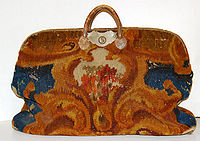
Sewing the carpet bag was speedy work for Evelina, given her skill with a needle.   Carpetbags were fashionable travel bags from as early as the 1820s, in America and England.  They gained notoriety after the Civil War when they became symbolic of certain ruthless opportunists – “carpetbaggers” – from the North who flooded into the South to take advantage of the post-war confusion and economic disarray.  The negative symbolism of this small piece of luggage was unknowable in 1851, obviously, so we can imagine that Evelina carried her new carpetbag with pride.  Perhaps she used it on her next trip to Boston.

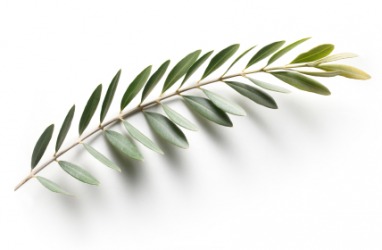
Oakes Ames didn’t linger in the office tonight as usual but came home for a quiet evening of reading the Olive Branch.  Evelina was pleased to have his company, which must have provided some variety for her elderly mother, too.  Sarah Witherell’s company would have added to the ease and sociability of the evening.  More often, Sarah stayed in her part of the house in the evening in order to be company to her father. And the boys – Oakes Angier, Oliver (3) and Frank Morton – went back to the shop, although the nine o’clock curfew was nigh.

The Ames house was divided into two living areas, with Old Oliver, Sarah Witherell and her two children on the southern side and  Oakes and Evelina’s family on the northern.  Old Oliver made this division back in 1827 when Oakes and Evelina first married, indicating then that Oakes, as his eldest son, would inherit the family  homestead.  The two families had lived side by side ever since, the house expanding and contracting as children grew up, occupants died or moved out, and grandchildren came into the world.

Some Ames family members of today who can remember the old homestead (it was torn down in 1951) shake their heads in wonder at this living arrangement, curious as to how everyone fit in.

January 28, 1851

Pray

1851

Jan 29th Tuesday  This morning sit down quite early to 

making a carpet bag of pieces that were left of the parlour

carpet.  This afternoon cut a place in the drugget for

the parlour register  Abby & Malvina passed the afternoon

here and this evening.  Mother Abby & myself have been

to a prayer meeting at Mr Bucks.  Mr Buck, wife &

their children all spoke & prayed  Charley best of all.

Abby made a few remarks & a number of others.  Cloudy.

It appears that the recent domestic mishap of spilled varnish on the parlor carpet was solved by the installation of new “drugget” or carpeting. The change of carpeting must have been in the works before Evelina’s purchase of drugget in Boston two weeks back.  After the rug was installed (by whom?,) Evelina scavenged enough scraps from the cutting to begin to assemble a carpetbag for herself.  Waste not, want not.

The mention of cutting the rug to fit around a register helps confirm the existence of a central furnace in the old house.  In fact, Old Oliver had installed coal furnaces only recently on his property, in the counting house or office as well as in the residence.  Coal as fuel was a marked change from earlier days when the family had relied on wood-burning fireplaces for heat.  Oakes Angier must have been pleased with the change.  According to his grandson Winthrop, Oakes Angier detested the old fireplaces, remembering that they  “broiled you on one side while you froze on the other.” *

Tonight Evelina took her mother and niece Abby Torrey to a prayer meeting at the Bucks’ house where they heard all the Buck family members pray.  Evelina’s take on young Charley Buck was prescient, for he would grow up to be the Reverend Dr. Charles Henry Buck, well-respected Methodist minister in a succession of churches in Connecticut, New York and, eventually, Easton.

*Winthrop Ames, The Ames Family, 1937, p. 125.

January 27, 1851

Read

Jan 27th Monday.  As usual this morning have been washing dishes

and working about house all the forenoon.  could not sit

with mother at all.  It was cloudy and looked like rain

but Jane ventured to put her clothes out to night  They

are nearly dry.  This afternoon & evening have finished

Susans gingham apron.  Sarah W came in awhile this

evening and the boys have been reading.  After school

Susan went to see Mary Ann Randall.  Cloudy

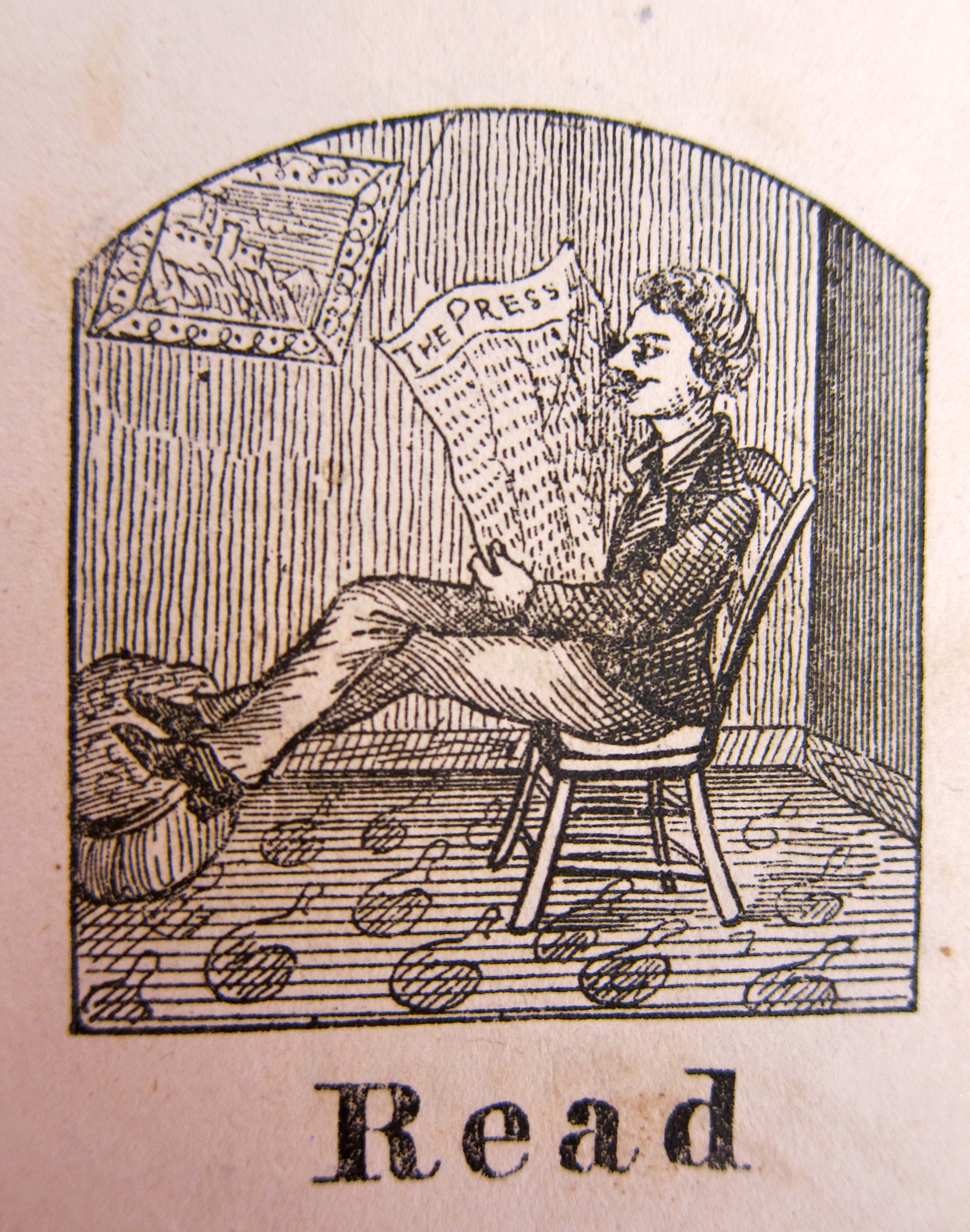
Another Monday, meaning that Evelina did the housework while Jane McHanna tackled the laundry.  Evelina was too busy “choring,” as she often called it, to sit down in the morning and sew or read with her mother, Hannah Gilmore, who was visiting for the week.  The women sewed together in the afternoon, however, after the midday meal, and in the evening, they enjoyed a visit from Sarah Witherell.  Oakes was most likely over in the office; he and his brother Oliver Jr. often worked there in the evenings after tea.

The boys were around, of course.  The shovel factory closed at 6 P. M. whereupon Oakes Angier, Oliver (3) and Frank Morton walked home. There were no dances on a Monday night, so after tea, they amused themselves by reading.  All three boys read, yet Oliver (3) was reckoned to be the most scholarly.  Even as a child he enjoyed reading and, with Oakes Angier, began to collect books. Years later, a colleague would say of Oliver that “in the company of books he found an absorbing pleasure.”*

On this winter night, everyone indulged in the papers or books, reading by the light of various oil lamps.  Evelina was no doubt eagerly turning the pages of David Copperfield, perhaps reading aloud to her mother whose aging eyesight may have precluded the pastime.  Hannah Gilmore loved to read.   In fact, she had named Evelina after the heroine of a book popular in her youth: Evelina; Or the History of a Young Lady’s  Entrance into the World.  This comic novel by British author Fanny Burney came out in 1778, and continued to find an appreciative audience in both Britain and America.   Evelina had probably read it at some point, if only to see how Evelina Anville captivated Lord Orville.

*Memorial Volume for Governor Oliver Ames, ca. 1896

January 20, 1851

olive-branch

Jan 20th Monday  This morning worked about the house as usual

on washing days & varnished Susans wooden doll.

Jane put her clothes out but soon had to take them

in again as it commenced raining.  This afternoon

I have been mending Oakes Angiers black pants

and finished cutting Susans plaid sack

This evening have been working on Susan’s plaid

apron and reading Mr Lovell’s paper

Keeping clothes clean is always a challenge, but it was especially so in the 19th century when doing laundry was an all-day, manual chore.  Small wonder, then, that little girls wore “sacks” or aprons over their dresses to keep their outfits from getting soiled.  Sacks had no buttons, so were easier to wash than dresses. They were rather shapeless, sleeveless tunics, often made from simple muslin; aprons were the same idea except fitted with a sash. There were no hard and fast rules about the design or material, however.  To imagine the approximate outline of what Evelina was making for Susie, think of the little girls in John Singer Sargent’s famous 1882 portrait, “The Daughters of Edward Darley Boit,” at the MFA.  Three of the four daughters are wearing something over their dresses. Later in the century, sacks and aprons  would evolve into pinafores, an iteration that became as much decorative as protective.  Aprons never went away, however.

After sewing for most of the day, Evelina took up “Mr. Lovell’s paper” to read. Reverend Stephen Lovell lived in Easton and was, for a few years, minister of the short-lived Protestant Methodist church.  Although Rev. Lovell “gave general satisfaction,” attendance at his church was “feeble,” according to town historian William Chaffin, so the congregation disbanded about this time.  Still, Lovell remained visible in town through his involvement with Olive Branch.

Olive Branch was a popular weekly newspaper published in Boston by Reverend Thomas F. Norris .  Although Chaffin writes that Lovell was editor of this paper, all other sources assign that honor to Norris.  Olive Branch proclaimed itself to be “Devoted to Christianity, Mutual Rights, Polite Literature, Liberal Intelligence, Agriculture, and the Arts.” *  It advocated peace in the increasingly divisive period leading up to the Civil War.  Norris, Lovell and others who worked for the paper – women among them – must have been disheartened by the elusiveness of their goal.  The paper ran from January 1837 through December 1860.

* Joanna River, “Eliza Ann Woodruff Hopkins and The Olive Branch,” josfamilyhistory.com

January 16, 1851

Muff & Tippet B & W

1851

Jan 16 Thursday  Went to Boston with S Ames.  Oakes A carried 

us over to the stage.  We found it very bad walking 

could scarcely cross the street without going over

shoe in snow & water but otherwise a delightful day

We bought some druggett & Sarah a muff & tippet

for herself & cuff & tippet for Helen.  We got us some

oysters at Vintons.  Called at Mr Orrs about four thirty

that we should have time to reach the cars but we were left.

Boys went to an assembly at Canton

Alson & Augustus dined here.

O, joy, a trip to Boston, an event that Evelina typically finds “delightful” no matter what the weather.  After two days of sadness about the death of Lewis Carr, Evelina and Sarah Lothrop Ames headed into the city via stage coach on a shopping excursion.  The railroad, which they called “the cars,” did not yet reach North Easton, but did stop in Stoughton.  The women intended to return by train at nightfall, and be carried home from Stoughton by one son or other, but missed the train and had to stay overnight.  They may not have been disappointed to have to stay in town.

Sloppy weather didn’t prevent the successful acquisition of goods.  Evelina bought some drugget, or carpeting, while Sarah found accessories for herself and her daughter.  Muffs and tippets, naturally, were very much in fashion for winter wear.  Dining on oysters was another highlight, as was a visit to an old family connection, Mr. Orr.

The homefront in Easton was busy, too.  Evelina’s brother, Alson, and his oldest son, Augustus, took midday dinner with Oakes and his children.  Little Susie would have been the only girl at the table.  In the evening, Oakes Angier, Oliver (3) and Frank Morton headed to Canton to a dance.  Everyone’s spirits seemed brighter today.

Photo of muff and tippet, ca. 1840,  from Minnesota Historical Society

January 5, 1851

Thermometer

Sun Jan 5   Had to do my own housework to day and did not get

it done in season to go to church  Our Lazy boys did not

rise untill nearly nine Oclock.  No meeting this afternoon

Mr Whitwell attended the funeral of Asa Howards child

Mrs McHanna came home in season to get tea.  Went

with S A to see Miss Eaton found her able to sit up 

most of the day.  She has a bad cough & is failing.

After I came back made a call in the other part of the house

There was no church for the Ames family today.  Without the help of their servant, Jane McHanna, Evelina had to get breakfast and dinner by herself, and didn’t finish the preparations in time to get to morning service at the meeting house.   Oakes Angier, Oliver (3) and Frank Morton, perhaps seizing a rare opportunity, slept late despite their mother’s evident disapproval. The afternoon service, which the family also usually attended, was cancelled.

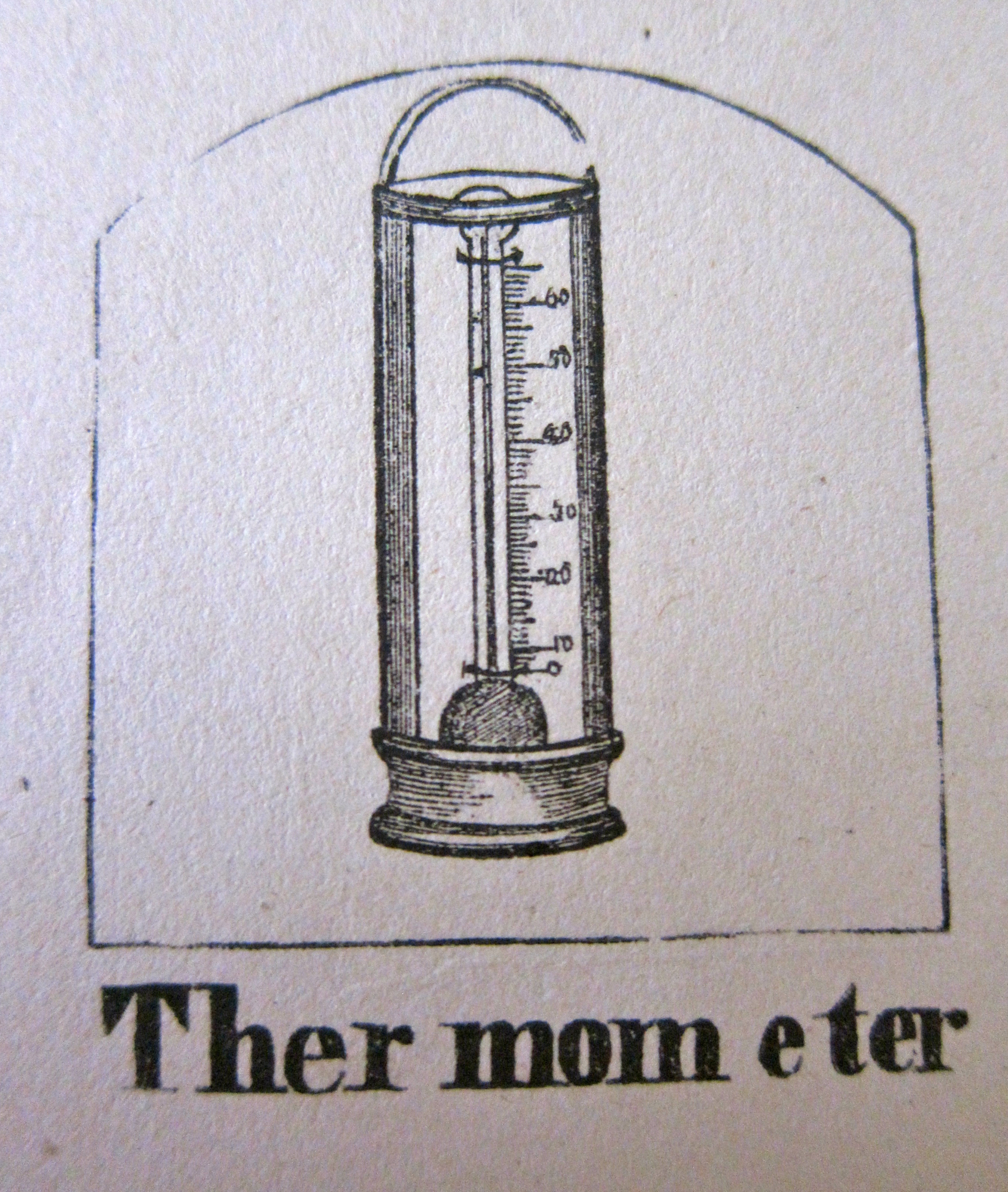
Truth told, Evelina may have been grateful not to make the two mile ride to church. The weather that day, according to Old Oliver, continued “verry cold,” reported at 14 below zero by “the Mr Pools” who lived several miles south of the Ameses. The Pools would know; they manufactured thermometers. Jane McHanna, meanwhile, had to bear the cold on her drive back from Mansfield, returning to North Easton in time to prepare tea.

Despite the cold, Evelina and  Sarah Ames paid a visit to a sick woman in the neighborhood. Calling on the sick was something that Evelina and her sisters-in-law often did. Although there were doctors in town, there was no hospital, nor was there a habit of placing the seriously ill in a hospital.  People were taken care of at home, by family, friends, and townspeople like the Ames women.  Miss Eaton was suffering from tuberculosis or consumption, as it was known.  Evelina, Sarah Ames, and Sarah Witherell visited her often, taking food and helping the family with whom Miss Eaton was living.

Sarah Ames and Sarah Witherell are sisters-in-law.  Sarah Ames is married to Oakes’s brother Oliver, Jr.  Sarah Witherell is Oakes’s sister.  Both women are younger than Evelina; all three women live in close proximity.

January 3, 1851

Oakes Ames

Oakes Ames

Friday Jan 3

Got breakfast this morning about 1/2 past 6 Oclock

Worked about house most all day.  Did not sew but

a very little   Finished a letter to Pauline Dean for

Mr. Ames to mail at Boston    O A wrote a few lines and

sent her a pr of Cuff pins   Mr Ames has the ague in his

face.  Read untill half past nine in the papers.

Pauline writes that Mrs Brooks & little boy are there

Came with Mr Reed.  Mr Brooks is to come for them

“Mr. Ames” is Oakes Ames, of course: Evelina’s husband.  “O A” is their eldest son, Oakes Angier Ames.  With one notable exception that occurs much later in her diary, Evelina always referred to her husband using his surname.  That a woman of her age and upbringing would be so formal in talking about her husband shouldn’t surprise us; in 1851, anyone with a similar education and background would have done the same.  The 19th century was a formal century.  Titles and surnames were used in conversation, in correspondence and even in a diary that, presumably, would be read only by its author.

“Ague” is an old term for fever, usually defined as “chills and fever.”  So how Oakes Ames had a fever in his face is hard to imagine.  Perhaps this was a country expression for having a cold or sinus pain in one’s head.  Certainly, it was the time of year for colds and illness.  The ague affliction stayed with Oakes for several days during a spell of weather that his father, Old Oliver, described as “verry cold.”  Something like January 3, 2014!

January 2, 1851

Evelina Gilmore Ames

Evelina Gilmore Ames

1851

Jan 2 Thursday  I sit down to my sewing pretty early this morning.  Had

some squash pies made   Quinn & wife carried Mrs McHanna

to Mansfield about 2 Oclock PM soon after Mrs Peckham

came & passed the afternoon & evening.  I had to get my own

tea.  Isabel washed dishes.  Mr P[eckham] came in about eight

Thomas Davidson & wife at Olivers [Jr] this evening  Frank went

to A A Gilmores with Quinn  Not able to work  Looked 

over a barrell of Apples & locked them up from the boys

Evelina had to do without her servant, Jane McHanna, this afternoon and thus made her own tea.   Isabel Orel, who usually worked for Sarah Witherell and “Father Ames” (known today as the original Ames patriarch, Old Oliver), helped Evelina by washing dishes.  Jane McHanna, meanwhile, was driven to nearby Mansfield where she may have had family.  Jane came from Ireland, originally, as did Isabel Orel, Patrik Quinn, and most of the domestic employees in the village.

John Peckham worked in the counting house at O. Ames and Sons shovel factory; he and his wife Susan would move away from North Easton this year.  Thomas Davidson, a merchant and the town’s  postmaster, spent the evening with his wife Betsey at the next-door home of Evelina’s brother-in-law Oliver Ames Jr and his wife Sarah Lothrop Ames.

And “the boys,” from whom Evelina had to safeguard the winter’s supply of apples?  They were the sons of Evelina and Oakes Ames: Oakes Angier Ames (often referred to as “O A”), Oliver Ames (the third of that name, who, for the purposes of clarity, will be identified with a “3” after his name), and Frank Morton Ames, the youngest and wildest brother of the three.   OA is 21 as the year opens, Oliver is a month shy of turning 20, and Frank is 17; he spent part of this day with his older cousin Augustus Gilmore.  Strapping young men, they work at the shovel shop six days a week.  Small wonder that they have prodigious appetites, thus causing their mother to lock up the apple barrel to protect the supply.