April 10, 1851


photo

1851

April 10th Thursday  This day is Fast but no one would

think it by the way I have spent it.  I have

moved the bed from the dark bedroom and 

put it in Franks chamber and moved his

cot into Oakes & Olivers chamber for a few

weeks Oakes A Lavinia Orinthia & Susan went

over to the Methodist meeting house to a sing & called

on Ellen H took her with them.  Weather Pleasant

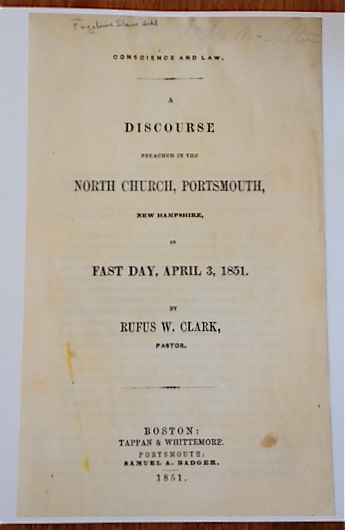
For nearly 275 years, Fast Day was a published holiday in Massachusetts and other New England states (like New Hampshire, above, which celebrated Fast Day on April 3.)   A religious practice brought over from England by the Puritans, the original Fast Days were pious rites of repentance and supplication marked by abstinence and day-long prayer in church, “a day set apart that all might join in the prayer to the Almighty for strength and wisdom”.*  Any calamity, misfortune, drought or disease, regardless of season, might prompt a church leader to call for fasting.

Dating from about 1622, the earliest Fast Days were under the purview of the local clergy, but the practice eventually became widespread enough to become the domain of the state governments.  And where once they were observed on an ad hoc basis as the need for divine intervention arose, Fast Days gradually became a single, annual holiday, usually observed in early April right before spring planting. Over the years, it became a more secular observance and by the latter part of the 19th century, “Not much fasting is done and less praying.”*  In 1894, the governor of Masschusetts abolished the practice of Fast Day and substituted a new holiday, “Patriots’ Day,” in honor of the 1775 Battles of Lexington and Concord and the anniversary of the first bloodshed of the Civil War at a skirmish in which four Massachusetts militiamen died.

Evelina’s entry in her diary proves that Fast Day was anything but a day of prayer and supplication at the Ames’s. Instead, this temperate day in early April marked the start of spring cleaning. Evelina and Jane and perhaps others began upstairs, moving furniture around in order to clean and refurbish two or three of the bedrooms. Much would be disrupted before they were through.

The temporary upshot was that Frank Morton Ames moved into the bedroom shared by his two older brothers. This rearrangement of their sleeping quarters brought the three brothers together in dormitory fashion, yet each maintained his own personal agenda. Tonight, Oakes Angier headed out to a sing at the Methodist meeting house right in the village, taking along a small coterie of females: Cousin Lavinia, sister Susie, the boarding teacher, Orinthia and their mutual friend, Ellen Howard.  Spring was in full swing.


*New York Times, April 20, 1896


April 6, 1851


800px-Martin_W._Carr_School_-_Somerville,_MA_-_DSC03412

*

1851

April 6 Sunday.  Have been to meeting all day, and 

as usual heard two excellent sermons from

Mr Whitwell.  It rained very hard while

we were going and has rained fast all day.

Edwin called after meeting & Martin Carr &

a Mr Davenport from Attleborough.  Oakes & Oliver

called at Mr Bisbees with them

The Ames family went to both church services today and, as Evelina had come to expect, heard “two excellent sermons” from Rev. Whitwell. Despite the rain, the Ameses had visitors this afternoon. Friends of Oakes Angier and Oliver (3) called: cousin Edwin Williams Gilmore, and friend Martin Carr, who brought a Mr. Davenport with him. The young men all went out together.

Martin W. Carr was the son of “Uncle Caleb” Carr, a long-time employee of the shovel shop, and brother of Lewis Carr, the young man who died back in January from consumption. The family was descended from Robert Carr, an early governor of Rhode Island.

Martin would find his own claim to fame.  A jeweler by profession, he went on to found M. W. Carr and Company, maker of knick-knacks and souvenirs, including “gold and silver jewelry, hairpins, belt and shoe buckles, button hooks and garter belts […] matchbooks, cigarette cases, ashtrays, hatpin holders, letter openers, souvenir spoons, ink stands, magnifying glasses, lamp shades, bud vases, napkin rings and trays with imprints of the homes of American authors such as Emerson, Longfellow and Hawthorne.”**  The factory was a mainstay of Davis Square in the City of Somerville, and Carr himself a prominent citizen involved in many civic activities.  The city honored him in 1898 by naming an elementary school after him. The Easton boy made good.

* Martin W. Carr School, 1898, Somerville, Massachusetts, National Register of Historic Places, now condos.

**Somerville Journal, 1894/Coldwell Banker

March 30, 1851

headache1

*

March 30 Sunday  Have not been to meeting at all to day.  My

cold is very troublesome have a very bad head ache.

could not read much.  Mr Cyrus Lothrop 3d called this 

evening & Frederick, Oakes Angier & Orinthia rode

down to Mr E Howards this evening.  Mrs Howard

has gone to Nashua to make a visit.  Mother returned

home from meeting  A very fine day

I commenced making fire in the furnace

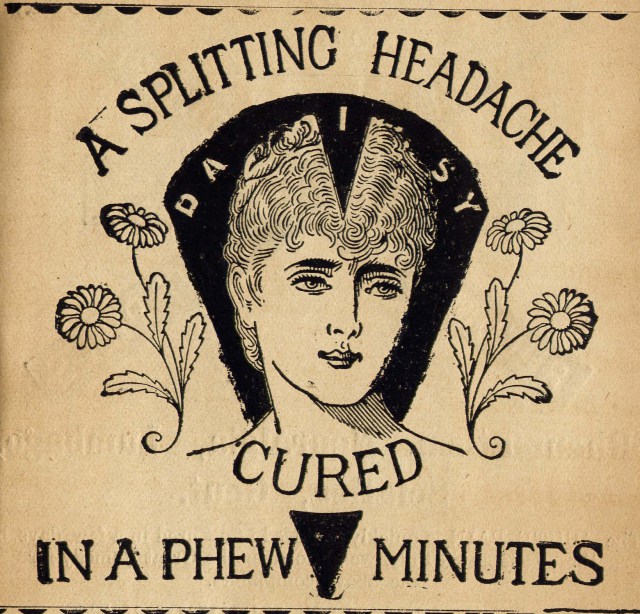
Evelina continued feeling poorly today. After yesterday’s helping of the commercial elixir, Wistar’s Balsam of Wild Cherry, one can’t help but wonder if her headache was, in fact, a symptom of hangover from the alcohol she unknowingly ingested.

The consumption of alcohol was absolutely forbidden at the Ames’s house.  Both Oakes and his brother Oliver Jr took a temperance pledge early on, and kept it. They hoped their workmen would follow their example. In this they differed from their father who, in his heyday of running the shovel works, had allowed his workers a ration of rum as part of their regular routine.  Old Oliver’s habits had been learned in the 18th century, which had a more lenient attitude about liquor.  In the 19th century, however, tolerance of alcohol disappeared. Temperance became the banner of the day, its support increasing yearly and culminating, ultimately, in the Prohibition amendment in the 20th.

In the Ames dining room, even something as mild as cider was frowned upon.  Cider was considered by some at a “gateway” beverage to liquor and hard spirits; others found it innocuous. Evelina kept some in the pantry to put in her mince pies but never served it at table.  Once, however, she offered a tumbler of cider to her future son-in-law, Henry French when he turned down a cup of coffee. Oakes admonished them both by stating flatly that, “No cider shall be drunk at my table.”

Alcohol was a controversial issue.  If Evelina had known that the medicine she was taking was laced with alcohol, she might not have indulged.  If Oakes had known, he wouldn’t have allowed her.

*Advertisement from ca. 1900.  


March 27, 1851

0380042t

1851

March 27 Thursday.  Spent the day with Mother at A[u]gustus,

got home just before six Oclock and went

in the evening to the dancing school with Mrs S. Ames

Cut out and commenced a bleached shirt for

Mr Ames but have not done so much as to finish 

the sleeves.  Mrs. S. Ames has been to Boston from 

Sharon.  A fine day and very good travelling

the roads are quite dry.  Mother stopt at Mr Torreys.

After Evelina and her mother spent the day with, respectively, nephew and grandson Augustus, Hannah Gilmore left to spend the night at her son-in-law, John Torrey’s, house in the village, leaving Evelina briefly unencumbered from looking after the elderly woman. Evelina seized the opportunity to go out with her sister-in-law, Sarah Ames, to help chaperone a dance for the young people.

No doubt the Ames sons, Oakes Angier, Oliver (3) and Frank Morton were at the dancing school, as they had been for most of the previous Thursday evening assemblies. So, probably, was Fred Ames, making a rare appearance while home from school.  While adults from their parents’ generation were always present at these occasions, one wonders how the young men felt having their mothers among the group standing guard.

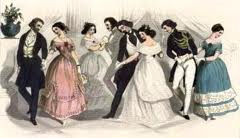
These assemblies were important social occasions that provided innocent pleasure and animation. They fostered acquaintances among the young people of the town who had few other opportunities to mingle.  Dance steps were learned, exercise was taken, manners were polished, courtships were sparked, hearts were engaged or disappointed, and perpetuation of the species forwarded in this important small town gathering. Surely both Evelina and Sarah Ames watched the proceedings with interest.

March 10, 1851

images-2

/51

March 10  Monday  This is town meeting day.  Mr Ames & O Angier went

They spent the whole day there but accomplished very little

Mr Pratt & Brown chosen School committee O Angier was

nominated for one & lacked by one vote of being chosen

They brought home the school report of the last year

which is not very favourable for the schools in town generaly

Miss Foss & Clarks school are spoken very well of.

It commenced snowing about ten Oclock & is quite stormy this evening

Town Meeting was – still is – a great New England tradition. In the 19th century (and well into the 20th) the meetings were often scheduled in March, making them an annual marker of winter’s impending departure.

People turned out for town meeting.  Rather, men turned out for town meeting.  Women, who before 1780 in Massachusetts had enjoyed suffrage, no longer could vote.  National suffrage for women, a cause that would create deep divisions among the Ames women of a later day, would not be achieved until 1920.

Oakes Ames and his eldest son, Oakes Angier Ames, attended meeting and stayed all day. Oakes Angier evidently ran for school board but just missed being elected. He was showing a taste for politics, something that his father felt as well. His mother, perhaps influenced by her son’s loss, harrumphed that “very little” was accomplished at this year’s meeting, although she seemed pleased that their boarder, Orinthia Foss, was mentioned as being a good teacher.

Today’s town meeting was moderated by one of Easton’s greybeards, Capt. Tisdale Harlow. A resident of the Poquanticut section of town, Harlow was a former selectman, town treasurer, school board member, veteran of the War of 1812, and captain of the Easton Light Infantry in 1833-34. He had crossed swords with the Ames family in the 1830’s in a town row about the introduction of Unitarianism into the Congregational church. Harlow and many others were against it; Old Oliver, his sons and others were for it.  The sectarian controversy wore on for about eight years and ultimately led to a permanent split in the congregation. Historian William Chaffin suggested that “[i]ts unhappy effects were felt for many years.”  Were there remnants of hard feelings on display at today’s town meeting?

February 24, 1851

School

Feb 24th Monday.  This morning Orinthia commenced a

private school at the school house had twenty

scholars.  Was choring about house all the forenoon

This afternoon made over a valance for

Franks bed and did some mending.

Martin Guild was burried at two Oclock.  None

of us attended the funeral  Helen & Sarah Ames

called a few moments this evening.  Heavy rain.

Looks like little Susie was back in school today, this time under the tutelage of Orinthia Foss, the new teacher.  Not only would Susie see Miss Foss in the school room every day, but also at home for breakfast, dinner, and tea. During her tenure in Easton, Orinthia would take turns boarding with different families in town beginning with the Oakes Ameses. The exact location of the schoolhouse where she taught is undetermined, but it may have been located right in the heart of the village, at the Rockery.*

As usual, Evelina spent this busy Monday doing housework, or “choring,” as she called it, in the morning, or “forenoon,” while Jane McHanna labored with the weekly washing. What do you suppose was served for midday dinner on Mondays, when the women of the house were preoccupied with everything except cooking?  Perhaps the family ate one of those mincemeat pies that had been prepared days in advance and kept very cold somewhere. Yankee housewives were known to keep some baked goods frozen for months, either by placing them on shelves in an ice house, or simply by storing them in unheated spaces not far from the kitchen. A risky practice, one might think, especially with the varied temperatures and rainy weather that has characterized this particular February.

Also as usual, Evelina turned in the afternoon to her mending and sewing. She refurbished a valance for Frank Morton’s bed.  Although his brothers Oakes Angier and Oliver (3) shared a bedroom, Frank had a space, if not a room, to himself.  A valance was an essential component of his bedstead, naturally offering some warmth and privacy that might otherwise be lacking.

* Information from Frank Mennino, Curator of the Easton Historical Society.  Thank you, Frank.

February 20, 1851


images-1

Feb 20th  Thursday  This morning sat down to sewing quite

early with Lavinia.  worked for Susan and she

sewed some with us  Sent George after Mr & Mrs

Whitwell about one Oclock.  Mr Whitwell attended 

the funeral of James Wells child  Commenced 

raining quite hard & this evening is very dark

The boys & Lavinia & Susan have gone to the 

dancing school at Lothrop Hall

The Thursday evening assemblies, or dancing school, continued. On this occasion, Oakes Angier, Oliver (3) and Frank Morton took their cousin, Lavinia Gilmore, and little sister, Susie, with them.  How exciting for Susan to go along to watch the young men and women dance; probably exciting for Lavinia, too.  She was at the marriageable age of nineteen and, in the manner of the day, was probably hoping to marry soon.  Getting off the farm for a week to stay with her aunt Evelina in the village of North Easton was an opportunity to socialize and perhaps meet someone special.  Did anyone ask her to dance?  Did her male cousins watch out for her?  Did she like what she wore?

Elsewhere in Easton life was not so light-hearted.  Reverend Whitwell officiated at a funeral for the infant son of James and Celia Wells.  James and his brother John, for whom the little boy was named, worked at the shovel factory.  They were originally from Maine.

And, being February, the weather took a dive for the worse.  The young people’s ride home from Lothrop Hall must have been disagreeably wet.  Mr. and Mrs. Whitwell, who had evidently stayed for tea after the funeral, were unable to get home and had to spend the night at the Ames’s house. Young George Witherell was spared the challenge of carrying them back to the parsonage in the dark, windy downpour.

February 15, 1851

Chemise

Chemise

Sat Feb 15  This morning mended a pair of pants for Frank

and some other things.  Finished two chemise for Susan

made her a skirt out of an old quilted one of mine.

It has been a very stormy day.  the public school

finished this afternoon.  Oakes A, Mr Pratt, Davidson,

Barrows, R. Willis, Lillie & one or two others visited the 

school.  There were no ladies on account of the rain

Mr Ames went to Boston.  Brought Miss Eaton some maple sugar

While her husband went into Boston today despite poor weather, Evelina stayed in, mended clothes and completed two chemises for Susan. The chemise, a forerunner of today’s slip, was a standard undergarment for women and girls in the 19th century, worn right under the dress (and under the corset, when corsets were worn.)  As Evelina suggests, some undergarments were quilted for warmth, an essential consideration in cold New England. On stormy days like this one, women needed all the padding they could accommodate under their wide skirts.

Oakes Angier Ames visited the local schoolhouse today with men from the school’s superintending committee: Amos Pratt, a teacher; Thomas Davidson, the town’s postmaster; Joseph Barrows, a “shovelmaster” with legal training who lived in a house built by Old Oliver; Rufus Willis, a shoe manufacturer; and Daniel Lillie, another employee of O. Ames & Sons.  Daniel and Oakes Angier were in their early twenties, while the other men were older.  Daniel would be close to the Ames family over the years, and ultimately serve as a pallbearer at Oakes Ames’s funeral in 1873.  Today, however, in the rain, without their wives, the men appeared at the public school on the last day of this session.  Why was Oakes Angier along?  He wasn’t a member of the committee, but perhaps he was developing an interest in local politics.

Oakes Ames, meanwhile, returned from Boston in the evening, bringing with him a gift of maple sugar – a sign of spring – for the failing Miss Eaton.   He may also have returned with news of a serious incident in the city.  Shadrach Minkins, a fugitive slave living and working in Boston, was arrested today by federal marshals at a coffeehouse on Cornhill Street. Minkins would be taken to court, only to be rescued by an anti-slavery group, the Boston Vigilance Committee, who hid him and helped him escape to Montreal.  The controversial new Fugitive Slave Law was being tested.  Had Oakes witnessed any of this?

February 14, 1851

Valentine from the 1870's by Esther Howland

Valentine from the 1870’s by Esther Howland

Feb 14th Friday  Mended a pair of pants for Oakes Angier & 

cut out some work for Susan.  Went to the store for a

pair of shoes for self & Susan.  Called on Miss Eaton

on my return met the Dr there.  He thinks she will 

live into March.  Has failed very much since I saw her

Passed the afternoon with Mrs Wales & Miss Lothrop in

the other part of the house.  Mr Jackson called here this eve.

Pleasant this morning, afternoon cloudy & a little rain

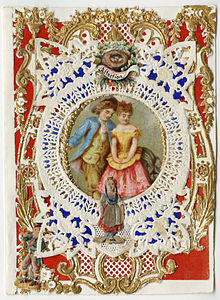
The 19th century descendants of the Puritans weren’t known for their celebratory spirit, so we shouldn’t wonder that Valentine’s Day went unrecognized at the Ames’s house.  Although the practice of sending a sweet message to one’s beloved had thrived in England for several decades, the concept was just gaining traction in the United States. Personal Valentine greetings in the form of hand-written poems were familiar to many young people, but nothing was mass-produced until mid-century when a graduate of Mount Holyoke named Esther Howland, whose father was a stationer in Worcester, Massachusetts, developed and sold a lacy Valentine card, America’s first.  The idea took off and shortly thereafter, Graham’s American Monthly noted that “Saint Valentine’s Day […] has become, a national holyday.”   The idea hadn’t caught on at the shovel works, though; if it had, Oakes Ames probably would have seized the opportunity to buy one for his wife.

Evelina took a small step back into her social life today.  Not only was she able to call on Miss Eaton at the Holmes’s house, but she also got an update from the doctor, who confirmed that Miss Eaton was dying.  Miss Eaton did not yet have a “watch” on her, but the time would come when different friends and relatives would take turns sitting with her until she passed.

After her visit with Miss Eaton, Evelina relaxed into a sociable afternoon in “the other part of the house.”  With her sister-in-law Sarah Witherell, she chatted with two female acquaintances while rain returned outside.  In the evening, Mr. Jackson came to call.  He was probably the school master whose teaching had “lacked energy” last week when Evelina visited the local school.  Why was he calling?  Had he learned that Evelina was involved in the establishment of a private school?

February 6, 1851

Dance

Dance

Feb 6th Thursday  This forenoon was working about house & did

a little mending  Prepared some mince pie meat for baking

Have been into school this afternoon  There were but

about 50 schollars.  Mr Jackson appears to lack energy

Miss Lothrop appeared the best of the two.

There is a ball at Lothrop Hall to night for the first

time.  Oakes Angier & Frank have gone & Helen

Sarah A & Sarah W spent the evening here.  Pleasant but cold.

Thursday night seemed to be the night for dancing in southeastern Massachusetts. The Ames sons had already attended at least two Thursday evening assemblies in Canton during January and now in February they’re attending a gathering at Lothrop Hall (the location of which is uncertain: Eastondale, perhaps?  Does any reader of this blog know?) Tonight Oakes Angier and Frank Morton went. (Where was Oliver [3]?)  Evelina’s diary is unclear on whether their cousin Helen went with them or, more likely, stayed home with her mother and aunts – the latter option being more typical for shy Helen.

Earlier in the day, Evelina was evidently still involved with looking into local schooling, getting the lay of the land, perhaps, for the incoming Orinthia Foss.  By mid-century in Easton, there were four school districts, or “ricks” as they were known, in four different geographic areas of town.  Paid for by the occasionally reluctant Easton taxpayers, the schools taught local girls and boys up to grade eight or so.  Massachusetts, and New England as a whole, led the nation in its emphasis on education and, in Evelina’s time, Massachusetts had boasted a 96% literacy rate.

Susie was the only Ames child still attending school.  Oakes Angier, Oliver (3) and Frank Morton as boys had each attended school locally before being sent away to nearby private schools such as Leicester Academy.  On this night, however, dancing, not schooling, was foremost on their minds.