April 18, 1852


paul-revere-1

1852

April 18 Sunday.  Another unpleasant sabbath but we have

all been to meeting.  Oliver & wife staid at home

this afternoon.  Mr Whitwell gave us two short but

good sermons of about 20 minutes  At intermission

went into Mrs J Howards with Mrs E Howard

Mrs L Howard & Mrs Dr. Deans    called a few moments

on Mrs Whitwell.  Have finished Night & Morning

As was their custom, the Ameses attended church today en masse, at least in the morning. They drove separate carriages to the meeting house through the “cloudy, cold + misty”* morning. Oliver Jr. and his wife Sarah Lothrop Ames rode home at noon, but Evelina and her family, presumably, busied themselves at intermission with various opportunities to socialize.

Oakes Ames most likely slept through the sermons, even though they were “short.” Evelina, however, liked Reverend Whitwell’s sermons today, as she often did. Would he have made any allusion to the historic date?  April 18 was the anniversary of the 1775 ride of Paul Revere and William Dawes to warn “every Middlesex village and farm” of the approach of British forces.  It was a date that American schoolchildren once had to memorize.

Less than a decade later, poet Henry Wadsworth Longfellow would immortalize the historic date in Paul Revere’s Ride:

Listen my children and you shall hear

Of the midnight ride of Paul Revere,

On the eighteenth of April in Seventy-Five;

Hardly a man is now alive

Who remembers that famous day and year…

Longfellow, one of the most popular American poets of the 19th century, wrote Paul Revere’s Ride some eighty-five years after the dramatic events in Concord and Lexington that opened the Revolutionary War. It was published in The Atlantic Monthly in January, 1861, on the eve of the Civil War.  Many believe that the poet, an adamant abolitionist, wrote the piece to remind American citizens of the historic principles and great bravery that shaped the formation of the United States.


Oliver Ames, Journal, Stonehill College Archives, Collection of Arnold Tofias


April 14, 1852

Washing

1852

April 14th Wednesday  Jane washed yesterday and put

her clothes out to day […] and it is very pleasant and

most like spring of any day we have had.  Made two

toilet cushions and covers for them of plaid muslin

Mrs Sarah Ames brought in her work this afternoon

awhile and I put a bosom into a shirt for

Mr Ames.  Read this evening in Night & Morning

The rain and snow of the preceding two days had disrupted domestic routine, meaning that servant Jane McHanna washed the weekly laundry on Tuesday instead of Monday and hung clothes out today. Evelina didn’t seem to mind, given how “most like spring” the day turned out to be. She seemed to have recovered from having gone without much sleep the day before.

Sarah Lothrop Ames came over from next door and the two sisters-in-law sat and sewed. Evelina sewed a shirt front for her husband and made two toilet cushions. The word “toilet” in the nineteenth century referred to personal grooming, as in getting dressed or cleaning one’s teeth or sitting at a dressing table.  A toilet cushion, then, was most likely a seat for a stool or small chair for a bedroom or dressing area. Evelina made both the pillow itself and its cover of “plain muslin.”

Night and Morning was, presumably, a work of fiction. Evelina must have found it in one of the periodicals she liked to read, such as Gleason’s Pictorial, or in a book she or Oakes had purchased in Boston.  Any readers out there familiar with this work?


April 8, 1852

slide3_4


1852

April 8th Thursday  Fast day  Orinthia & Frank went to meeting

and at four oclock to a sing at the meeting house

hall.  Mr Ames has been to work all day the same

as usual  I have been very busy at work on

one thing and another have sewed on Susans

apron have it nearly done which makes the fifth

that I have made this spring

Evelina made note that today was a Fast Day, an annual event intended to be spent in fasting, prayer and supplication to the Almighty for a good growing season. The practice originated with the Puritans and evolved over time.  By 1852, it was a fading custom. Frank Morton Ames and Orinthia Foss went to church and to a “sing” afterwards, but both Evelina and Oakes Ames worked “as usual.” No one appeared to fast or spend the day in church.

A different long-standing custom of the country – slavery – needed to fade and disappear, yet hadn’t. It would only disappear with bloodshed, because the untenable social and cultural practice could not be resolved in a practical, orderly and non-violent way. War would be required, and soon.

On this day in 1852, a state court in Missouri decided against Dred Scott, a one-time slave who had sued his former owner’s estate for freedom. Scott and his wife, Harriet, had once been owned by the late Dr. John Emerson. The narrative of the case was complicated, but was based mainly on the Scotts having resided for a period of time in the free state of Illinois while working for the Emersons.  Scott believed that he and his wife should have been freed. But Dr. Emerson’s widow, Irene, kept the couple as her slaves, and wouldn’t even allow Scott to purchase his freedom. Scott sued and won in a lower court, but lost his case in the Supreme Court of Missouri.*

Scott and his lawyer appealed the case, which would go on to the U.S. Supreme Court in 1857. In one of the Court’s most infamous decisions, Chief Justice Roger B. Tanney, a Jacksonian Democrat who believed in states’ rights and a slaveholder who had manumitted his own slaves, would nonetheless declare that the Negro had no rights. An “originalist” group, Tanney’s court determined that the Constitution as originally written had made no provision for the citizenship of Negroes. For Tanney, slavery was an issue to be decided at the state level.

The Dred Scott case was one more irrevocable step in the path to civil war. The U. S. government essentially abdicated federal jurisdiction over slavery, which only accelerated the sectional divisions and conflicts. Bloody Kansas burst open, and within a decade, unprecedented conflict would convulse the nation.


*”Decision in a Slave Case,” article from the Washington National Intelligencer, April 8, 1852, courtesy of http://hd.housedivided.dickinson.edu/node/25809 


March 28, 1852

Ames-Shovel-Handle-2

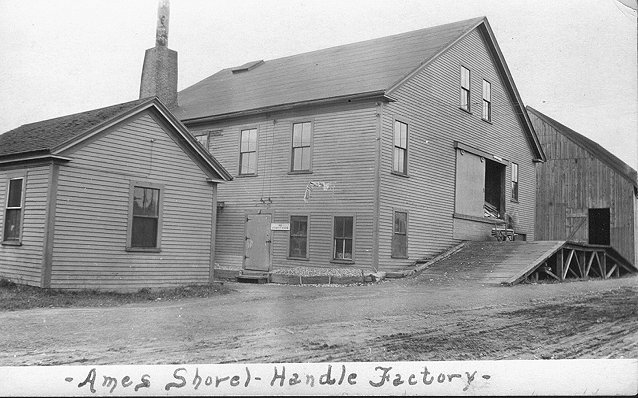
Ames Shovel Handle Factory, Oakland, Maine*


March 28 Sunday  Went to church this morning and

at noon called at Mrs Wm Reeds with Henrietta

Hannah came at noon but was faint and

I carried her home and got back to church about

the time the services were over  After went down

to the new shops with Mrs W, S Ames Augusta Orinthia

found Mr. Ames, Oliver & Cyrus L there returned by Edwins

and all called there  Mr Ames & self went to Augustus’ this evening

The new shops were up, and various family members rode by to see them after church. No more “dismal ruin”, as reported by Evelina only three weeks earlier. Risen like a phoenix from the ashes of the old shops, the shovel works were about to begin operations in new, if temporary, quarters.

It was a large group that gathered to consider the new buildings. Evelina, who had missed the afternoon service in attending to her ailing niece, Hannah Lincoln Gilmore, nonetheless rode back from church to the site. Accompanying her were her sisters-in-law, Sarah Witherell and Sarah Ames; another niece, Augusta Pool Gilmore; and sometime boarder and frequent companion, Orinthia Foss.  At the site, by accident or design, they found Oakes Ames and his brother, Oliver Ames Jr., and Cyrus Lothrop, a brother of Sarah Lothrop Ames who often resided with his sister. The group must have marveled at the swift reincarnation of the shovel works.

Perhaps a celebratory spirit inspired the crowd to assemble en masse at the nearby home of newlyweds Augusta and Edwin Gilmore.

*Image of Ames Shovel Handle Factory, Oakland, Maine courtesy of the Oakland Maine Area Historical Society. Included to illustrate what the rebuilt shovel factory could have resembled.

March 18, 1852

images-2

1852

March 18th  Thursday  A very heavy rain storm to day

Amelia Orinthia & self have had a quiet day

but mine has not been pleasant work, have

mended Mr Ames old shop coat have put new

cloth in the under part of the sleeves, mended

button holes so, think it will last some time.

Also mend Franks pants  Orinthia has been 

to work on her delaine dress

The women at the Ames residence stayed indoors today, held inside by “a cold driving rain storm.”* They sewed, naturally, but Evelina didn’t particularly enjoy herself. Orinthia got to work on a new dress, but Evelina had to mend her husband’s shop coat and her son Frank’s pants. Mending was never as much fun as sewing, but it was essential. As we have noticed before, Evelina was devoted to making things last. Like other Yankee housewives, she had been brought up to: “Eat it up, wear it out, make it do or do without.”**

Yet as the family grew more wealthy, Evelina began to enjoy the luxury of not doing without. She shopped in Boston for fashion accessories and household items that she would never have had in her youth. As modern historian Jack Larkin has pointed out, a “household’s furnishings constituted a material world that defined the limits of comfort, heating and lighting, and filled functional needs for sitting, sleeping and eating, but they also spoke of Americans’ economic status and aspirations.”***

Old habits die hard, as we know. The Ameses had money, and Evelina didn’t have to mend her husband’s shop coat; she could have insisted that he buy a new one, or she could have sewn one for him, perhaps. Her ingrained sense of economy, however tempted by the changing world around her, wouldn’t allow it. William L. Chaffin, the town historian who knew the Ames family, described Evelina as “economical” in his late-life remembrance of Oakes Ames, and shared the tale that Oakes joked about Evelina at the dinner table, suggesting to guests that his wife wanted them to help themselves to preserves that were going bad so she could use them up.

On this day, rather than demand that her husband purchase a new work coat – which we can surmise he had no interest in doing – Evelina fixed up the old one, and sighed that she wasn’t sewing a new dress instead.

*Oliver Ames, Journal, Stonehill College Archives, Arnold Tofias Collection

** A 20th century, World War II-era version of this maxim was “Use it up, wear it out, make it do or do without.”

***Jack Larkin, The Reshaping of Everyday Life, 1988, p. 264


March 13, 1852

frank-bellew_thumb3b12885r

                    Frank Bellew                            “Raising the Wind; or, Both Sides of the Story”*    


1852 March 13th  Saturday  Have been mending &

sewing on my waists  Have passed the afternoon

in the other part of the house with

Amelia  Mr Ames came to tea  There has been fifty or 

more carpenters to work on the shops the past week

and it has been pleasant weather.

Good weather was a boon to the rapid rebuilding of the shovel shops after the devastating fire of March 2d. Although she remained in the house sewing for much of the day, Evelina and her visiting sister-in-law, Amelia Gilmore, would have been able to hear the hammering and shouting from scores of carpenters hustling to rebuild O. Ames & Sons.

In New York City today, a political cartoon appeared in a weekly newspaper, The New York Lantern. The subject of the cartoon had to do with a request before Congress to augment funding for overseas mail delivery.  Two shipping lines, one American, one British, were competing for the mail trade. The American Collins Line, which was losing money, was subsidized by the U.S. Post Office; the British Cunard Line was also assisted by its own government and was way ahead; its faster, larger fleet was eating into the American market.

In the cartoon, figures representing the two lines faced off over toy ships in a tub. Cunard is represented by John Bull helping a small boy work a bellows. The Collins Line is represented by a small boy, cheeks puffed, blowing at the water by himself. Behind him stands an aloof, apparently disinterested “Uncle Sam.”

Today was Uncle Sam’s first appearance as an illustration. He had existed in name since about 1810, but on this day, a young cartoonist named Frank Bellew turned Uncle Sam into a recognizable American icon. Bellew, whose parents were English, worked his trade as an illustrator and cartoonist in New York City for publications such as Frank Leslie’s Illustrated, but eventually resettled in New Orleans. Charles Dickens knew his work and admired it: “Frank Bellew’s pencil is extraordinary. He probably originated more, of a purely comic nature, than all the rest of the artistic brethren put together.”**

Uncle Sam lives today, thanks to Frank Bellew. The Cunard Line is alive and well, too, now owned by The Carnival Corporation.  The Collins Line, however, ever faltering, failed to survive the Financial Panic of 1857 and went bankrupt the following year.


The New York Lantern, March 13, 1852, Courtesy of the Library of Congress

** Wikipedia, accessed March 6, 2015

March 10, 1852

Handkerchief

1852

March 10th  Wednesday  Early part of the day

was sewing on a waist or rather cutting

it out and getting it to fit.  Augusta

came in this afternoon but as Amelia

& self were invited into Olivers she went

with us and Edwin.  Mr Ames came to tea

Amelia trimmed some pocket handkerchiefs

for me that Mrs Ames got in New York

The rebuilding of the shovels shops was moving along well. They “put the roof on the stone shop to day,”* according to Old Oliver, who watched each day’s progress carefully. It had been a full week since fire had destroyed most of the factory buildings. The response and reconstruction had been immediate!

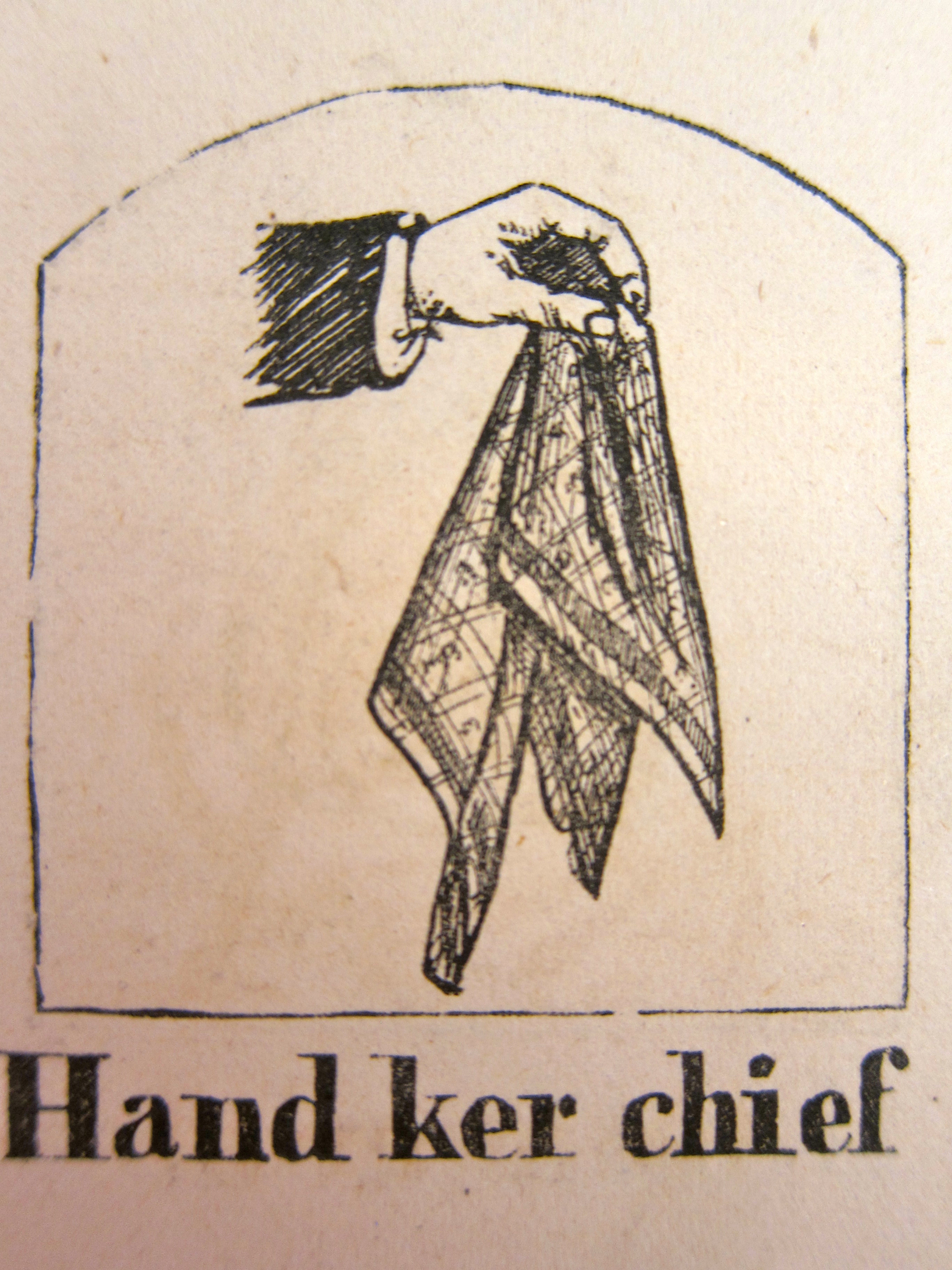
Amelia Gilmore, the widow of Evelina’s younger brother, Joshua Gilmore, Jr., was visiting for several days.  She undertook the hemming of some handkerchiefs – essential components of a lady’s outfit – that Almira Ames had brought Evelina from New York City. The purpose of a handkerchief, a personal item dating back to antiquity, was primarily hygenic, used to wipe one’s nose or brow and cover one’s cough. In a time of contagious diseases such as tuberculosis, cloth handkerchiefs were essential.  Their ubiquity necessitated their incorporation into the fashion profile.

Late in the day, the two went next door to Oliver Jr.’s and Sarah Lothrop Ames’ home for tea.  Oakes Ames went, too, and the newlyweds, Augusta and Edwin Gilmore, tagged along.


*Oliver Ames, Journal, Stonehill College Archives, Arnold Tofias Collection


March 6, 1852

Whitewash

1852

March 6th Saturday  Mr Scott whitewashed the parlour

& sitting room chamber this morning and I

varnished the front entry oil cloth.  Lavinia

came at eleven and Augusta this afternoon

Alson came after Lavinia and stopt to tea

Charles Pool came up and carried Edwin

and Augusta home to stay till Monday

I have been to work on a stiched pink apron

for Susan

A full moon shone down on North Easton this night, highlighting the charred ruins of the shovel factory.  Before it rose, however, Old Oliver took the opportunity of “a fair day”* to travel to Bridgewater, quite probably on shovel business.  He and his sons were developing plans to rebuild the factory, and some help for that would be found in Bridgewater.

Evelina’s way of coping after the devastating fire appears to have been to keep the domestic front moving smoothly. Redecorating continued, social calls were made and enjoyed, and sewing continued without a blink of an eye. Daughter Susan would soon have a new pink apron.

Years later, Evelina and Oakes’s grandson, Winthrop Ames, would credit his grandmother and other Ames wives with exerting a positive influence on his male ancestors. “They made the homes, reared the many children, saved their husbands’ money, encouraged their undertakings, and steadied them in failure and misfortune,”** he said. Evelina’s evident steadiness during this challenging period is one such instance of positive influence. Oakes Ames had come home from the fire “more cheerful” than Evelina had expected; she seems to have behaved with equal optimism. Though naturally sanguine, Oakes’ bright outlook and ability to cope in the aftermath must also have been bolstered by his wife’s unflappable focus on home and (redecorated) hearth. Together, they maintained continuity.

Charles Pool, Augusta’s eldest brother, drove up from southeastern Easton today and fetched his sister and her husband, Edwin Williams Gilmore, “home to stay” for a few days. Perhaps this visit had been prearranged, or perhaps it was an effort by the young couple to get out of the way of remnant smoke and disruption from the fire.

*Oliver Ames, Journal, Stonehill College Archives, Arnold Tofias Collection

**Winthrop Ames, The Ames Family of North Easton, Massachusetts, 1937, p. vi.


March 4, 1852

Shovel Shop Pond And The Island North Easton, MA

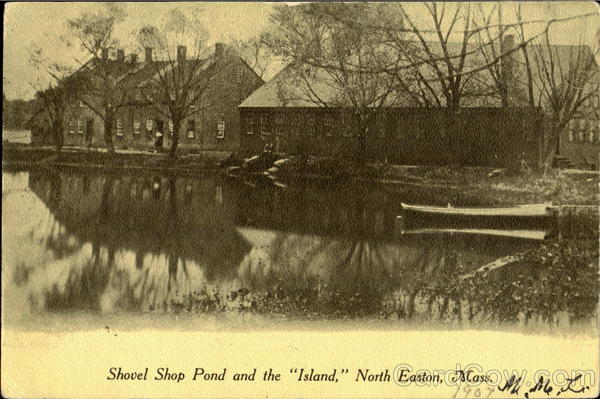
Replacement buildings on a section of the Ames shovel complex

1852

March 4 Thursday  Scott & Holbrook are setting glass at

the shop to day  They have the front entry partly

painted  I carried my work into Edwins this

forenoon  mended O Angiers shop coat  This afternoon

have been to Mr Torreys with Augustus & Lavinia

Called a few moments on Hannah  She has a 

sore mouth and is weaning her child

Evelina addresses her day calmly, as always keeping her distance from the goings-on at O. Ames & Sons. Most other residents of North Easton were still reeling, no doubt, from the huge fire that had burned down a majority of shovel factory buildings over the night of March 2. The sun was shining and the wind was out of the north west, pushing around remnant smoke still rising from the ruins of the complex of wooden buildings. Shovel shop employees had no regular job to go to and the owners had some serious decisions to make, fast.

Clean-up from the huge fire was underway, probably by the labor of the very men whose factory jobs had been temporarily eliminated. The men who had been painting and papering at the Ames’s house, for instance, were co-opted to set glass at the shop, suggesting that new panes of glass – the originals probably having been blown out by the fire – were going into the windows of the one or two buildings that had survived.

As town historian Ed Hands points out, “the Ames family and the neighborhood rebounded quickly.”*  Old Oliver and his sons Oakes and Oliver Ames Jr. made a two-fold decision. The first was to create temporary structures to house the manufacturing so that shovel making could resume as quickly as possible.  The second was to create “new, permanent stone shops,”* sturdy, nonflammable structures that could outwit any new fire.

There was insurance money to cover at least some of the rebuilding. Sources differ on the amount of damage that the fire inflicted, but suggest it was between $30,000 and $40,000. The amount of insurance coverage is also uncertain. Old Oliver “states that there was $3,000 worth of insurance on the buildings”** but, according to industrial historian Greg Galer, it’s likely that the Ameses had increased insurance coverage on the factory back in November, 1851. Whatever the actual dollar cost was, “[t]he company bounced back quickly from the devastation, and seemingly without significant financial trauma.”**

*Edmund C. Hands, Easton’s Neighborhoods, Easton, 1995, p. 163

** Gregory Galer, Forging Ahead, MIT, 1989, p. 249


March 3, 1852

Fire


1852

March 3  Wednesday  Last night the finishing shops

were burned to the ground by Quinns letting 

his lantern fall into the varnish  Oakes came

home from the fire about 4 Oclock much

more cheerful than I expected to see him and 

went to bed  OA and Frank came home to put

on dry clothes & went back and staid untill morning

Lavinia & Augusta were here awhile this afternoon


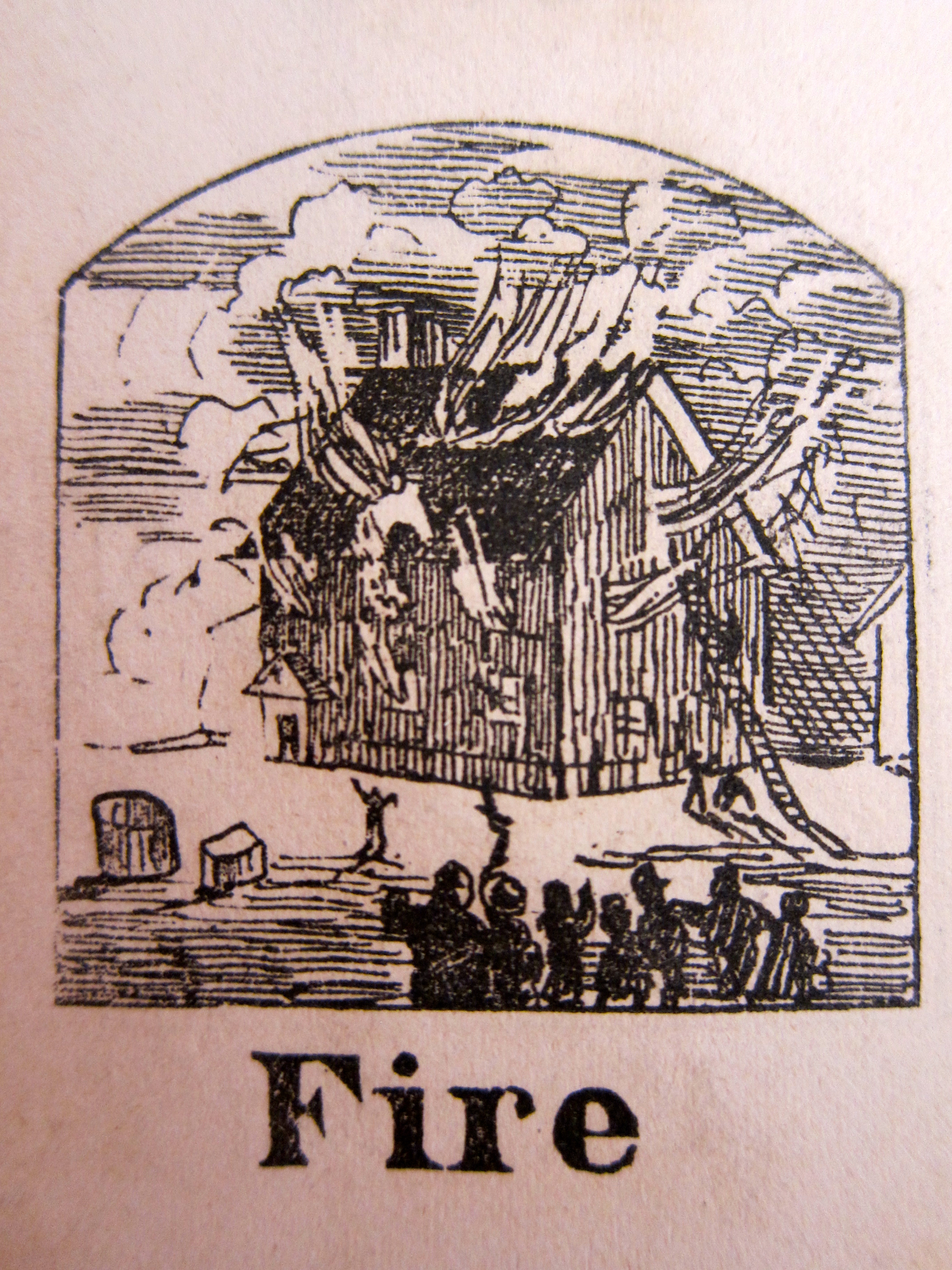
Fire! Most of the shovel company’s buildings, situated in”the most centralized areas of Ames production, ‘the island’ at the outfall of Shovel Shop Pond,”* caught fire and burned to the ground. On his nightly round, Patric Quinn, the watchman, dropped his lantern into the varnish. The subsequent explosion must have been quick and, given the nature of the combustibles, uncontainable from the outset.

Naturally, Old Oliver recorded the event as well: “last night about eleven O clock the finishing shop took fire and the shops adjoining it were burned down – Bisbes shop and the small one made out of the cole hous that was mooved from the hoe shop was saved – the fire took from the varnish …”**

O. Ames & Sons had caught fire before, once in 1844 and again in 1849.  After the 1844 fire, the family “had bought a used fire engine,”** which was brought to bear on the 1849 fire. In that case, Old Oliver credited the engine with saving the day, noting that “if we had have had no engoin I think it would have burnt up.” **

This latest conflagration was different. As modern historian Gregory Galer points out, “luck was not on their side…[the used fire] engine was no match for the blaze, fueled in part by 12,000 well-dried, ash shovel handles; oil and varnish used to protect completed shovels; and the wooden building itself.”*  The shovel shop was in ruins.

Evelina didn’t attend the fire, but she would have been able to see the flames from their front windows. The fire went on all night, her husband, sons and other townspeople present for most of it. There is no record of any injuries.


Gregory Galer, Forging Ahead, MIT, pp. 248-249

** Oliver Ames, Journal, Stonehill College Archives, Arnold Tofias Collection