August 28, 1852

2_6_1_b

Example of Kashmir Shawl Popular at Mid-19th Century*

Sat Aug 28th  Mr Ames called at Mr Orrs this morning said

they were not any of them very well at home.  Went

out to find Mrs S Ames at last met her at

Mr Orrs about noon.  Melinda has not got home

from her journey yet. Bought Mrs Witherell &

self a Cashmere shawl  Have had a pleasant 

visit but am glad to be home again


As he usually did on Saturdays, Oakes Ames traveled from North Easton into Boston on business. Instead of going right to his customers, however, he stopped by the Orrs’ where his wife was staying.  Evelina had been away for over a week and he wanted to report that they – meaning he and two of his sons, Oliver (3) and Frank Morton – had fared ill without her. “They were not any of them very well at home,” he complained.

The fact that Evelina didn’t go rushing home to take temperatures or brew beef tea, but spent the day shopping in the city with her sister-in-law Sarah Lothrop Ames, suggests that she didn’t take her husband’s report too seriously. If she had, she would have headed home right away. She may have felt that Oakes was just expressing dismay over the disorder that had arisen in her absence, a complaint that wouldn’t have been surprising in an era when the majority of men had no role in, skill at, or inclination for the domestic side of life. Evelina hadn’t been there to tend to the household and probably could have related to the words of Elizabeth Cady Stanton, suffragist and mother of seven, who had cause to bemoan “the chaotic conditions into which everything fell without her constant supervision.” Still, Evelina must have been warmed by the thought that she had been missed, and she was glad to get home.

While in Boston, though, Evelina did buy a couple of cashmere shawls, one for herself and one for Sarah Ames Witherell. If the shawls were as beautiful as the one in the illustration, they were two lucky women.  As seen, some shawls during this fashion era were made extra large to fall over the full skirts of the time.


*Image courtesy of Meg Andrews, “The Girton Curtains,” http://www.meg-andrews.com/articles

August 26, 1852

Champlain-02

The Steamboat Oakes Ames, ca. 1868*

Thursday 26th Aug  This morning Mrs Mills got a hack and

carried us all out to ride.  We had a fine view

of the Lake and town, was riding over an hour

and returned to Mrs Stetsons and all dined there

Called into a shop to see stone ware made

Passed the afternoon at Mrs Mowers and there

we had a very pleasant time  Charades & Tableaux

got home about twelve

Evelina filled her last full day in Burlington with social activity. She and a group – Almira Ames, Sarah Lothrop Ames, Fred and Helen, and Oakes Angier, too, presumably – were “carried” out for a ride, during which they admired the “fine view” they got of Lake Champlain and the town itself. It was a pretty place. But no amount of imagination in the mind of anyone in the hired carriage could have foretold that one day a steamboat named for Oakes Ames would be plying the waters they were gazing at.

In 1868, in fact, the 244′ Oakes Ames, built in the Napoleon B. Proctor Shipyard, would be launched from Burlington. Designed to ferry railroad cars from Burlington across the lake to Plattsburgh, New York, the steamship was commissioned by the Rutland Railroad, for whom Oakes Ames was a director and one of the line’s “firmest friends.”** In 1874, the ship would be renamed and repurposed for passenger service. Yet the newly christened Champlain II would last in service only until running aground in July, 1875. Although the incident produced no fatalities, the ship’s hull would be dashed beyond repair. Today, the boat is a famous wreck in the water.

Steamship and railroad deals being in the future, Evelina and the group continued to enjoy themselves on this pleasant day. They dined at a friend’s house and visited a stoneware shop. In the evening they all played charades and tableaux, popular parlor games in which participants acted out words or situations, or created still scenes of familiar subject matter, respectively. Such games were particularly popular at Christmastime.

*Image courtesy of the Lake Champlain Maritime Museum

** Burlington Free Press, August 20,1868, p.4.  For an exhaustive narrative about the Champlain II, ex-Oakes Ames, please see a thesis by Elizabeth Robinson Baldwin, May 1997, Texas A & M

August 15, 1852

Bed

August 15th Sunday  Did not sleep much last night

My handbag with bonnet visite & c were missing

found them this morning at Olivers  Helen

carried them home.  Have been to meeting

came home at noon  Mrs Stevens Orinthia &

Lavinia with us.  Called to see Willie

Gilmore found him more comfortable

Evelina often felt poorly right after returning from her shopping forays into Boston; on this occasion, she was unable to sleep. Surely, the seriousness of her son’s pulmonary illness was the larger culprit in her wakefulness than the usual exhaustion from her trip to the city. She was still rattled in the morning, unable to find her handbag, bonnet and
visite which, it turned out, had been mistakenly taken next door by Helen Angier Ames. It would seem that all the women were a little rattled.

The men may have been rattled, too, by Oakes Angier’s illness, but Old Oliver, at least, wasn’t showing it. He kept up his usual weather-related journal entries. Accordingly, today “was a fair warm day with the exception of two slight showers, perhaps 1/8 of an inch in both of them.”*

Somewhere in the course of the day, perhaps after church, Evelina and her husband, Oakes, and Oakes Angier himself, in all likelihood, determined on a course of action for the latter. Oakes Angier would go off to rest in fresher air and, for the journey itself, be accompanied by various family members.  The decision must have offered relief and hope to all. Evelina got outside of her own head enough to call on her nephew, Alson Augustus Gilmore, whose infant son had been so sick with dysentery. Little Willie seemed better. While there, no doubt, Evelina shared the plans to send Oakes Angier away.

*Oliver Ames, Journal, Stonehill College Archives, Arnold Tofias Collection


August 7, 1852

Wagon

Sat Aug 7th  Was sewing part of the forenoon made

some pies & cake  Went into Olivers about four,

Started to go to Augustus in a waggon and

got caught in a shower turned back at the

school house got completely wet  My sons & Mr Ames

were at tea at Olivers  Edwin & wife Lavinia & Abby

there Catharine & I have done some sewing this week

two nightgowns for self one for Susan & one cotton & 

moire skirt & c &c  Susans waists are finished


“[T]he 5, 6 + 7th were pritty warm day[s] + there was some rain,”* wrote Old Oliver in his journal. Evelina was out in that rain and “got completely wet.” Late afternoon showers are part and parcel of August weather in New England. The showers can come up quickly, too, so it’s small wonder that folks moving around the countryside in horse-drawn wagons could get caught in the rain.

While Evelina was getting soaked, her husband Oakes and sons Oakes Angier, Oliver (3) and Frank Morton Ames had tea next door with the Oliver Ames Jr family. How was Oakes Angier feeling, now that he was coughing so much? Perhaps he and his brothers got to hear their cousin Helen play piano again, or perhaps they just ate and conversed. Various Gilmore relatives, including Edwin and Augusta Gilmore, Lavinia Gilmore and Abby Torrey were there as well.  As previously noted, Lavinia and Helen were particularly friendly.

And speaking of friends, fans of Sherlock Holmes might enjoy knowing that August 7, 1852 is the purported birthdate of the fictional Holmes’ steady, tolerant and equally fictional sidekick, Dr. John Watson.

*Oliver Ames, Journal, Stonehill College Archives, Arnold Tofias Collection


August 5, 1852

Rein

1852

Thursday Aug 5th  Have had a rainy day which was

very much needed.  Was intending to go to

Boston with Oakes A in a carriage  Am most

affraid to have him drive Caty as he has been

raising blood of late and has a hacking cough

Lavinia is at Edwins has had Julia

cut her a dress to day  I went there and 

carried my work awhile this afternoon 

Put a new breadth into Susans Borage Delaine

where she tore it

Caty (or Katy), one of the Ames’s horses, was famous in Easton for her willful – and fast-paced – ways. Evelina has complained about her in previous diary entries. Today, however, Evelina had another reason entirely to be “most affraid” to let her son, Oakes Angier, drive the horse. Oakes Angier Ames was coughing up blood.

In an age when consumption, which we know as tuberculosis, was rampant and usually fatal, any person “raising” bloody sputum was immediately suspected of having the disease. TB wasn’t restricted to the lungs, actually; it could attack other parts of the body, such as the spine, but its most common manifestation was pulmonary. Blood coughed into a handkerchief was bad news.

How frightening this development must have been for Oakes Angier, and indeed for the entire Ames family.  Oakes Angier was the eldest grandson, the heir, the star cousin and nephew in whom many expectations were placed. He was beloved, and suddenly he was evincing signs of a potentially fatal illness. Old Oliver makes no mention of this in his journal, however, and Evelina herself had taken a few days to record the news. She may not have wanted to see such words in writing. We may suspect that Oakes Ames knew about his son’s condition earlier, but we can’t know for certain, of course. We can only follow the family as it copes with this huge development.

On this day, Evelina seemed to cope as she always did, by sewing. She took her work across the way to visit Augusta Pool Gilmore, the young bride who was now in the family way. Dressmaker Julia Mahoney was there, as was Lavinia Gilmore, so the women were able to sit and sew and talk in their usual fashion. The touch of normalcy must have been somewhat soothing for Evelina.


August 1, 1852

SerffLedger1


Example of anonymous, old cash ledger

1852

Sunday Aug 1st  Went to meeting this forenoon

but was very sleepy and had a head

ache came home at noon & did not

return, was writing and looking over my

accounts untill the rest returned from 

meeting, good business for the Sabbath

I think. Mr Ames & self went to see Augustus

since meeting.  Alson & wife came after Mary

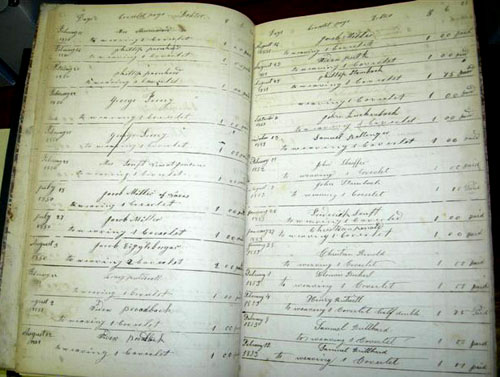
Evelina was plagued by a headache, so didn’t return to the afternoon service at the Unitarian church. As she had done before on a Sunday afternoon, she went over her household accounts. Like many a competent householder, she kept a ledger of cash transactions that detailed the weekly or monthly expenses of running the house. It’s highly unlikely that she had any money of her own; everything would have been paid for by her husband, Oakes, who either saw that she had a regular allowance or gave her funds as needed. She would have been careful with every penny, probably more careful than he was.

On this Sunday, she describes the review of her accounts as “good business for the Sabbath,” but in an earlier entry she had hesitated to do it, fearing that it was inappropriate. Accounting was quiet work, certainly, but it was still work, and that was forbidden on Sunday. By defending the activity in her own diary, she shows us that she was still feeling a little guilty for doing it.

Socializing wasn’t forbidden, however, and when her husband, Oakes, came home from church, the two went out to see Evelina’s nephew, Alson Augustus Gilmore, who had been quite sick with fever. Her brother, Alson, and his wife, Henrietta, meanwhile, “came after” the maid, Mary, and, evidently, took her home with them.


July 28, 1852

Sharps

Sharp’s Pistol, 1848-1850


July 28th, 1852

Wednesday Julia Mahoney has been here

to work to day on my travelling dress

but I have sewed but very little

Was about house all the forenoon 

making cake & pies &c &c  Mrs Ames &

Witherell have been to Dover  Horatio

Ames Jr came last night & I expected

him & father to dine but they went to

Olivers  Horatio went with Mr Ames

to Canton this afternoon & was here to tea

Horatio Ames Jr., a grandson of Old Oliver and nephew of Oakes, had come to the other part of the house for a short visit. By contemporary accounts, he was a troubled young man. The second child of Horatio and Sally Ames, he was born in Albany when his father was working there, but grew up in Connecticut.  In 1849 and 1850, he attended Rensselaer Polytechnic Institute in Troy, New York, but evidently left after just one year.

Early in 1853, Horatio Jr. was in Boston where he married Sophronia Eliot Hill of Salem. He worked as an iron monger at that time, but by 1858 was working as a clerk. On October 27, 1858, he killed himself.

What happened between his year in college and his suicide less than a decade later may pivot on the scandalous divorce of his parents, proceedings for which got underway late in 1852. His mother cited her husband’s multiple infidelities and harsh treatment to herself and her children. Horatio Jr. sided with his mother during and after the breakup. A 20th century account reports that Horatio Jr:

left home shortly after his parents’ divorce and so was out of touch with his father for some years. But he returned home in 1856 following his father’s remarriage. During an argument, he fired at his father in an attempt to kill him. Newspaper accounts of the incident, based on Horatio Sr.’s version of the events, depict him winning a heroic struggle for his life, but then magnanimously letting his son leave. Only after further warnings from his younger son, Gustavus, did Horatio finally have his son arrested. Horatio called his son ‘the worst hardened villain I have ever seen’, but then dropped the charges once Horatio Jnr. became contrite, begging forgiveness.*

The newspaper accounts on which this summation is based present only Horatio Sr.’s side of the story. We simply can’t know exactly what transpired between father and son, but we can know that the son eventually took his own life.  According to some 19th century records, Horatio Jr. is buried in Salem.

*John Mortimer, Zerah Colburn the Spirit of Darkness,2007


July 27, 1852


Asleep

Tuesday July 27th  Mrs Savage had quite a

comfortable night & I came home a

little before 5 Oclock & went to bed

did not rise untill nearly nine

Elizabeth Pool & Augusta came

in this forenoon with their work

Mrs Whitwell Reed Howard & Miss

Jarvis called on us all & Alsons wife

was here to tea & Mother at Augustus’

Evelina’s all-nighter at the bedside of Mrs. Savage didn’t seem to impinge on her day.  After a catch-up sleep in the early morning, she was back on her feet.  Augusta Gilmore and her young sister Elizabeth came over “with their work,” meaning that they brought some sewing with them, and the women sat, sewed, and visited. Later in the day, several ladies from her Unitarian circle of friends “called on us”.  Her brother Alson’s wife, Henrietta Williams Gilmore, came by for tea. A most sociable day, it was.

In the other part of the house, “Horatio Ames Jun r came here to day.”* Horatio was, obviously, the eldest son of Horatio Ames, who was the brother of Oakes, Oliver Jr., Sarah Witherell, Harriet Mitchell and William Leonard Ames. Repeating previous posts, Horatio ran a forge in Connecticut, far from the shovel shop in Easton, but still connected to it financially and emotionally. He and his son were not on friendly terms, and it’s hard to determine just what had brought Horatio Jr to Easton.  He arrived in the evening and for some reason Evelina didn’t mention it in her diary.


*Oliver Ames, Journal, Stonehill College Archives, Arnold Tofias Collection


July 25, 1852


images

Massapoag Pond

July 25th  Have been to meeting and at intermission

went into Mrs John Howards with Mother

Had a very pleasant call met a number 

of ladies carried Miss Jarvis a boquet

of flowers  After meeting rode to Mashpog 

pond with Mr Ames & Susan.  Came home

through Sharon & went by Col Tisdales

a very pleasant ride but feel much fatigued


Evelina had a “very pleasant” time at church today. She carried some flowers from her garden with her and gave them to a friend, Miss Jarvis, at intermission. She was worn out by the end of the day, however, because after church, she, her husband, and daughter drove up to Massapoag Pond in Sharon. The day was sunny and warm and the drive along the woods may have been pleasant, especially as they drew near the water. There were old iron works in the area; perhaps they were what interested Oakes in the outing.

On the way home, the threesome drove by the home of the late Col. Israel Tisdale. Frank Mennino, curator at the Easton Historical Society, tells us that:

“The Tisdale family was well known in the area from colonial days, once operating an inn on Bay Road. Later, the family built two farmhouses and ran a large farm on Mountain Road. One of the houses was the house that Oakes and Blanche [Ames] stayed in while Borderland was being built, and was lived in for many years by the Manning and Kent families. It burned in the early 1980’s after being empty for some time. Mountain Road was ‘party central’ back then.”

Oakes, Evelina and Susie did no partying as they ventured home, but they did have “a very pleasant ride,” nonetheless.


July 20, 1852

imgres

Pre-Civil War Ames Shovel with “D” wooden handle*

1852

July 20th Tuesday  I was in hopes to do something this

week but did not commence right yesterday

In the first place yesterday afternoon Mr

Whitwell called & Mr Ames took him & Oliver

to Bridgewater  Then uncle Ephraim called and I

must needs run in to laugh at Mrs Ames and

found Mrs Sheldon there and to day I

have not done much but talk over yesterdays affairs.


According to Old Oliver, the day was “fair with a verry hot sun wind easterly.”** Full summer, in other words. Everyone would begin to feel the heat, including the factory workers putting in their ten hour days at: “hammering, plating, drawing (backstraps), welding, smoothing, setting, opening, filing, riveting, finishing (handles), [and] handling”*** the shovels. Unlike workers elsewhere in the state, these workers seemed content with the hours they worked and the pay they received. “The relationship between the Ames family and shovel shop workers appears to have been amicable, for much of the business’s history.” ****

To date, no one had ever gone on strike at the shovel works, while in Amesbury to the north, textile workers had walked off their jobs in June. They were striking for better hours, having become fed up with twelve hour days for everyone, including children. They lost that strike at the woolen mill, which was owned by the Salisbury Corporation, but gained the support of their town government and launched the career of George McNeill, a fourteen year old carder who became the father of the eight-hour movement. Working out of Boston, McNeill would spend his life advocating and agitating for more humane conditions for factory workers.

In 1853, a limited strike took place at O. Ames and Sons. As Old Oliver noted on June 16, 1853, “Our outdore men struck for the 10 hour system to day and we settled with them and lett them go.” Evidently the men who worked outside the factory proper – those who would have been responsible for transporting the shovels, for instance – wanted the same hours as those who worked in the production line. Historian Greg Galer interprets this record to mean that the workers were granted their ten hour limit and were sent home for the day. Winthrop Ames, in his family history, on the other hand, interpreted that sentence to mean that the men were fired.

On a lighter note, Evelina was getting a lot of mileage out of Uncle Ephraim’s interest in Almira Ames. She seemed to spend most of her day doing little more than “talk over yesterdays affairs.”

* Image courtesy of etsy.com

** Oliver Ames, Journal, Stonehill College Archives, Arnold Tofias Collection

*** Gregory Galer, Forging Ahead, MIT, 2002, p. 263.

**** Ibid., p. 265