March 17, 1852

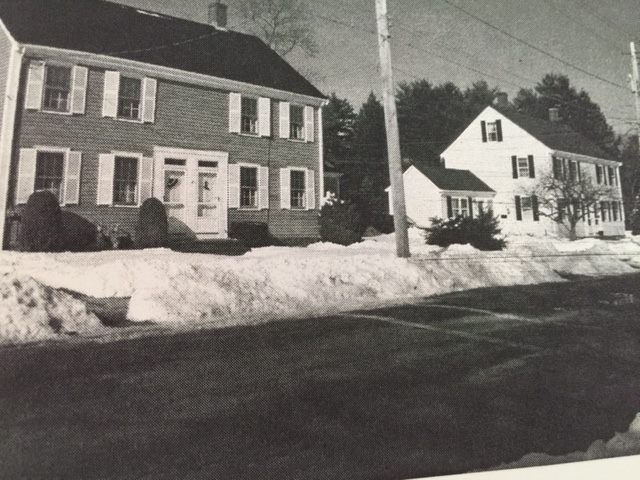
 IMG_0085Modern photograph of two private homes on Oliver Street in Easton, originally built in 1852 as part of the temporary structure for the shovel factory.*

March 17

1852  Wednesday.  Passed the day at Mothers with Amelia

and Susan   Carried Augusta to her fathers

and afternoon she and Rachel came down

to see us  Miss Foss closed her school Sat.

Came to Mothers this morning and to

night came home with us.  Carried cloth

and cut out a bleached shirt  Amelia worked

on the sleeves.

Evelina spent a pleasant day with her mother and several relatives. Her friend Orinthia Foss came to stay for a time. Evelina’s father-in-law, Old Oliver Ames, was completely focused on the rebuilding of the shovel shops. He seemed pleased to report:

“this was a cloudy day wind northeast. + in the afternoon it was cold + chilly. the roof is on the stone shop + the windows are in + the down stream end finisht- + the piece from that to the water shop is up + the roof shingled + the walls are boarded – one hundred + eight feet of the handeling shop is up and part of it clapboarded. the polishing shop is up and the roof shingled and the sides boarded + partly clapboarded the hammer shop is up + the sides + ends boarded and the roof and two thirds sleighted”**

This is one of the longest entries that Old Oliver ever wrote in his journal. He was clearly proud of the progress that had been made in the two weeks since the fire that destroyed almost all. The factory would soon be back on its feet, and planning for more permanent stone buildings could move forward. The wooden buildings that went up so fast would have another use after the stone buildings were erected, that of housing for some of the shovel workers. They would be moved from the original site by the pond and become residences. As you can see from the illustration, some of them are still used today.


* Image taken by Gregory Galer, Forging Ahead, MIT, 2001, Figure 50

** Oliver Ames, Journal, Stonehill College Archives, Arnold Tofias Collection

March 9, 1852

OLYMPUS DIGITAL CAMERA

19th century oil lantern

1852

March 9th  Tuesday  This morning finished putting

the sitting room chamber in order

Mrs Witherell came in with her work

for an hour or two. I sent for Hannah

Augusta & Abby this afternoon.  Abby

came in this evening  Augustus called  his

wife has the canker and was not able to come


Today “was a fair good day + pritty warm,” * accommodating weather for the carpenters working on the shovel shops. According to modern town historian, Ed Hands, the repair would be rapid enough to allow a resumption of manufacturing “in less than three weeks.” But what happened to the shovel makers during the hiatus? Were they kept on payroll? Or were they given unpaid furlough?

What happened to Patric Quinn? An Irish immigrant with a young wife and two small children, he was the watchman who had dropped his lantern into the varnish on the night of March 2d. He started the fire. Was he injured? Was he held accountable?  Did he stay on payroll? He and his wife Elisa, who sometimes did sewing for Evelina, remained in North Easton. They lived on Elm Street in one of the workers’s houses.

At the Ames compound, Evelina put the sitting room and parlor back in order. She and her sister-in-law, Amelia Gilmore sat and sewed.  They were joined for a time by Sarah Ames Witherell who was followed by young Abbey Torry and Augusta Pool Gilmore. Hannah Lincoln Gilmore was too sick to attend.


*Oliver Ames, Journal, Stonehill College Archives, Arnold Tofias Collection

**Edmund C. Hands, Easton’s Neighborhoods, 1995, p. 163

March 8, 1852

Carpenter

March 8th

1852 Monday  To day is town meeting.  George brought

sister Amelia here this afternoon  Have got

the carpet down in the front entry and 

the chamber carpet partly down

S Ames sent for the entry lamp for fear

I suppose that I should keep it but

she […] might not been alarmed

Carpenters have come to rebuild the shops

A new week signaled a fresh start. It had only been six days since the fire at the shovel factory, but the clean-up had gone quickly. The ruins were “dismal,” as Evelina noted yesterday, but the debris was mostly gone, hacked down, shoveled up and carted away. Carpenters had arrived to begin rebuilding, as Old Oliver, too, noted in his diary:  “some of the carpenters came on to day to build up our shops + Mr Phillips + his son came.”*

Life in the village was returning to normal.  Housewives, some with servants, tended to washing day. Children went to school and men went to town meeting.  As at church, the fire must have been part of the conversation as the men gathered to decide on town affairs and expenditures for the coming year. People must have wondered how soon the shovel shop would be up and running.

At the meeting, a new moderator, Alson Augustus Gilmore, presided. Not yet thirty years old, it was his first time holding the gavel; he would repeat the performance twenty-four times over the coming decades.  According to William Chaffin, Gilmore and his predecessor, Elijah Howard, Jr., “served with signal ability.”**

Evelina and her sister-in-law, Sarah Lothrop Ames, had a minor set-to over “the entry lamp,” which appears to have been a luminary that was shared by both houses. Sarah was evidently skittish about not having it, and Evelina was annoyed to have it commanded away.  No cause for alarm, she might have said. She wouldn’t have been annoyed for long, however, as a favorite family member, Amelia Gilmore, arrived for a visit. Amelia was the young widow of Evelina’s younger brother, Joshua Gilmore, Jr. She had lately been working as a private nurse.

*Oliver Ames, Journal, Stonehill College Archives, Arnold Tofias Collection.

**William Chaffin, History of Easton, 1886, p. 637

March 5, 1852

charred-wood-texture_61-1902

Charred Wood

1852

March 5th Friday  Have been mending pants most all

day that were worn at the fire  Lavinia

went to Augustus’ this forenoon and Augusta

went this afternoon.  Mr Scott & Holbrook have 

finished painting the entry and chamber

got through about four Oclock.  I was in

Olivers about an hour this afternoon.  This 

evening received another letter from Harriet Ames


The women of Easton had work to do, too, in recovering from the factory fire.  Surely Evelina wasn’t the only housewife in North Easton who had to repair or clean clothes worn by their husbands, brothers or sons the night of March 2. Needles were out and laps were full as women all over town tended to the rips, tears and soot. Conversation probably centered on the fire as they worked.

The day itself was cloudy and cold, the smell of the charred buildings dampened by a light snow that fell overnight. Yet the cleanup continued. As the men worked at the site, hauling timbers and shoveling up debris, their blackened soles left ashy footprints in the snow, footprints that quickly turned into grime. Many a man was made to wipe or remove his shoes before entering his house for midday dinner.

Evelina stayed focused on her domestic responsibilities. Mr. Scott and Mr. Holbrook were back on task in her parlor, painting and papering, and finished up at the end of the afternoon. Evelina spent some time next door with Sarah Lothrop Ames, and got a letter from cousin Harriet Ames, with whom she had been corresponding lately. And perhaps under her direction, her niece Lavinia and niece-in-law Augusta were looking after their sister-in-law, Hannah Lincoln Gilmore, who was laid low with a mouth infection and a weaning baby. Fire or no fire, life was moving forward.


March 3, 1852

Fire


1852

March 3  Wednesday  Last night the finishing shops

were burned to the ground by Quinns letting 

his lantern fall into the varnish  Oakes came

home from the fire about 4 Oclock much

more cheerful than I expected to see him and 

went to bed  OA and Frank came home to put

on dry clothes & went back and staid untill morning

Lavinia & Augusta were here awhile this afternoon


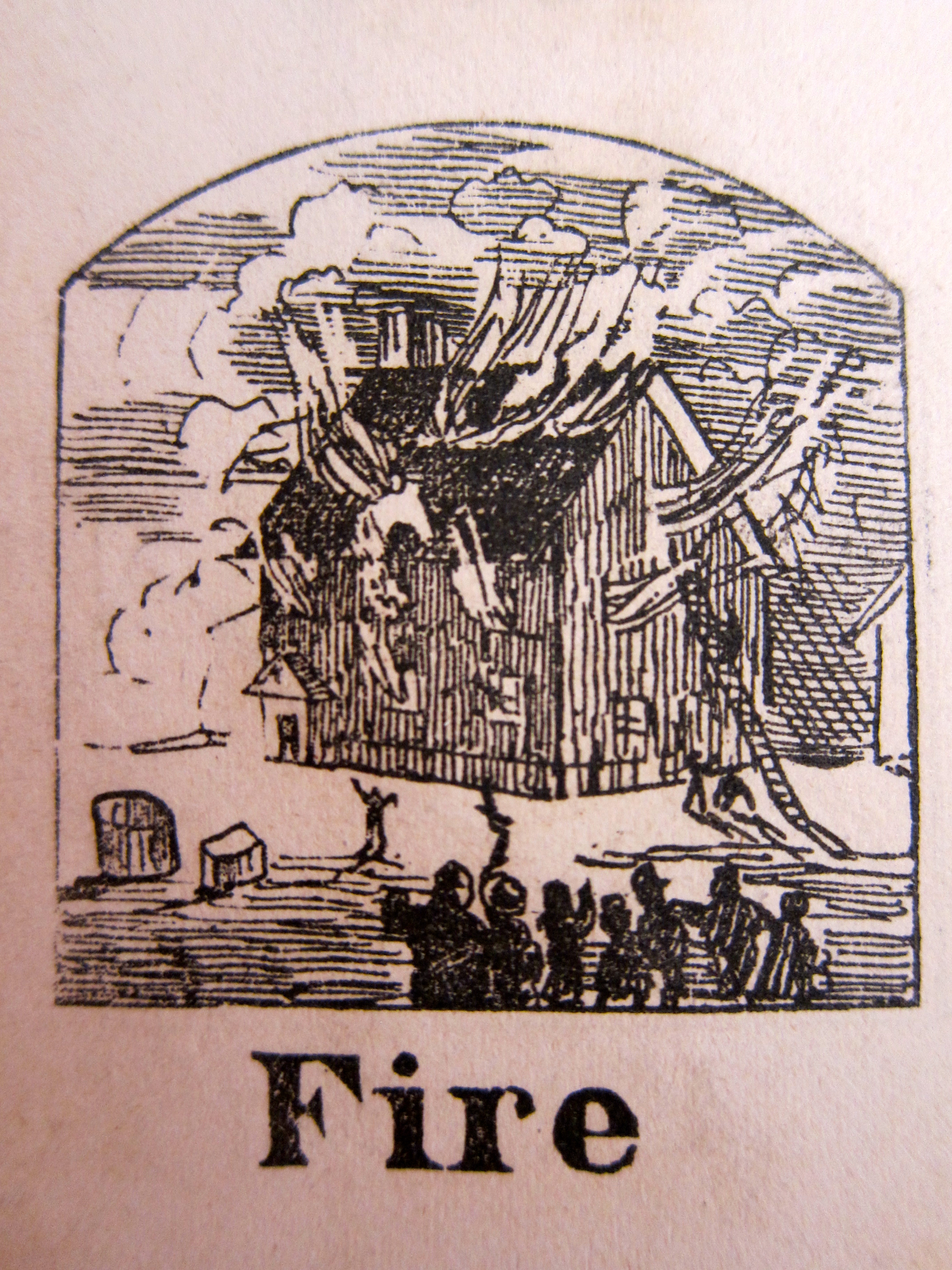
Fire! Most of the shovel company’s buildings, situated in”the most centralized areas of Ames production, ‘the island’ at the outfall of Shovel Shop Pond,”* caught fire and burned to the ground. On his nightly round, Patric Quinn, the watchman, dropped his lantern into the varnish. The subsequent explosion must have been quick and, given the nature of the combustibles, uncontainable from the outset.

Naturally, Old Oliver recorded the event as well: “last night about eleven O clock the finishing shop took fire and the shops adjoining it were burned down – Bisbes shop and the small one made out of the cole hous that was mooved from the hoe shop was saved – the fire took from the varnish …”**

O. Ames & Sons had caught fire before, once in 1844 and again in 1849.  After the 1844 fire, the family “had bought a used fire engine,”** which was brought to bear on the 1849 fire. In that case, Old Oliver credited the engine with saving the day, noting that “if we had have had no engoin I think it would have burnt up.” **

This latest conflagration was different. As modern historian Gregory Galer points out, “luck was not on their side…[the used fire] engine was no match for the blaze, fueled in part by 12,000 well-dried, ash shovel handles; oil and varnish used to protect completed shovels; and the wooden building itself.”*  The shovel shop was in ruins.

Evelina didn’t attend the fire, but she would have been able to see the flames from their front windows. The fire went on all night, her husband, sons and other townspeople present for most of it. There is no record of any injuries.


Gregory Galer, Forging Ahead, MIT, pp. 248-249

** Oliver Ames, Journal, Stonehill College Archives, Arnold Tofias Collection

 

March 2, 1852

Brush

March 2nd Tuesday

1852 March  Have been assisting Mr Scott paper[ing]

again to day  Worked untill past nine

and feel very tired.  The paper is all on

except a patch or two here & there  Francis brought

Lavinia up to Edwins this afternoon  Mr Holbrook

has finished the first coat of paint in 

the sitting room chamber

To begin with, the day was normal. Winter weather continued: “there was a little mist this morning + it froze as it fell and the ground was slipery, wind north East. it was cloudy and a little stormy all day – it cleard of[f] in the evening.”* Evelina was not tempted to go out.  She stayed indoors, focused on redecorating the downstairs.

With Mr. Scott in the lead, Evelina helped put wallpaper up in her parlour.  She must have had to take down the framed prints and new looking-glass in order to do this. The sitting room, too, was being repainted.

Evelina stayed up late, becoming “very tired,” and evidently ready to go to bed as she wrote this entry.  Yet a good night’s sleep would elude her. Indeed, few people in the village of North Easton would be able to sleep through the night of March 2, 1852.

*Oliver Ames, Journal, Stonehill College Archives, Arnold Tofias Collection
February 28, 1852

image059

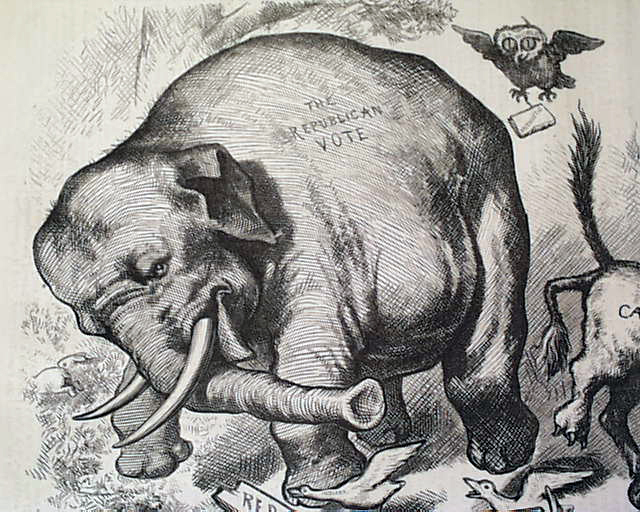
Thomas Nast’s first rendition of the Republican party’s symbol, early 1870s

1852

Feb 28th Saturday  It has been a stormy uncomfortable 

day  Mother is quite unwell & rather homesick

Mrs Witherell spent two hours here this

forenoon  I have finished the flannel

skirt that I commenced Jan 30th and put

a cape top to an old one  Mr Ames has

been to Boston as usual says the slab will be here Monday

Evelina stayed indoors today, sewing, of course, but also tending to her elderly mother, who seemed fretful and “unwell.” The whole town was subjected to what modern weather forecasters would call ” a wintry mix.”  According to Old Oliver, the day began “a snowing this morning wind south east but the snow is dry – it snowd + haild untill about 4 O clock + than began to rain + raind pritty fast untill some time in the night when it cleard of[f] with the wind north west and + cold and the wind blew verry hard”*

In another section of the country also known for its harsh winters, this date in history (plus two years) marks the genesis of our country’s Republican party. According to political historian Robert Remini, “[o]n February 28, 1854, a number of Free-Soilers, northern Whigs and antislavery Democrats met in Ripon, Wisconsin, and recommended the formation of a new party to be called “Republican.”**  Several months later, on July 6, after Congress passed the controversial Kansas-Nebraska act, the nascent group met again in Jackson, Michigan, where they “formally adopted the new name and demanded the repeal of the Kansas-Nebraska and Fugitive Slave Acts and the abolition of slavery in the District of Columbia.”

It wouldn’t take long for the Ames men, former Whigs, to join the new political party.

*Oliver Ames, Journal, Stonehill College Archives, Arnold Tofias Collection

Robert Remini, The House: The History of the House of Representatives, 2006, p. 150  

(NB: A source cited in Wikipedia in February, 2015, says that the date for this meeting in Ripon was March 20)

February 7, 1852

dickens12_2084187b


Charles Dickens, ca. 1852

(1812 – 1870)


1852  Sat  Feb 7th  Orinthia Miss Burill Susan & self called this

morning on Mrs J Howard, Whitwell & E Howards

left Susan at Mr Howards, came home with Frank

from a sing this evening.  Abby Augusta & Helen were

here awhile this afternoon  Helen went out to Bridgewater

last night and came up with Mr & Mrs James Mitchell this

forenoon  Orinthia went home about five and this

evening we have been into Olivers.  Mr Mitchell returned at nine.


This was a non-stop sociable Saturday for Evelina; she, her daughter Susan, dear companion Orinthia Foss, and another young schoolteacher, Miss Burrell, made calls all morning long. In the afternoon, she entertained three of her nieces and in the evening, visited next door at Oliver Jr and Sarah Lothrop Ames’s house. Chat, chat, chat.

In the larger world of letters, Charles Dickens turned 40 years old today. Even at mid-career, he was known as “The Inimitable,” so great was his talent, so voracious his readers. Evelina loved his work and benefited from his prolificacy.

By this point in Dickens’ life, among the books he had already published were The Pickwick Papers, Nicholas Nickleby, various Christmas novellas including A Christmas Carol, Dombey and Son, and David Copperfield, which Evelina had read the previous year. At this time he was composing Bleak House which, like most of his novels, was published in serial form over many months. Its first episode would come out in March, 1852, and run through September, 1853.

Still waiting to be born were future classics such as Hard Times (which targeted Unitarianism, among other entities), Great Expectations, A Tale of Two Cities, Our Mutual Friend – and more. Dickens wrote articles, made speeches, toured, and even acted. He was a high-profile tour de force with a fertile imagination and a thirst for success. Ralph Waldo Emerson, who heard Dickens speak in Boston, compared the author’s ability to “a fearful locomotive to which he is bound and can never be free from it nor set to rest.”*

*Ralph Waldo Emerson, quoted in Annie Field’s diary, 1868.


January 31, 1852

500

Jan 31st  1852

Saturday  have been choring about house & mending most

all day.  Made a robe for Mitchell Willis child with

Mrs S Ames assistance  Edwin & wife here to tea  Mrs S

Ames has been here about three hours with her work

Mrs Witherell here awhile this afternoon.  Mr Frank

Russell was buried this afternoon.  My three sons went

to the funeral.  Quite a hard snow storm  Mr Ames to Boston

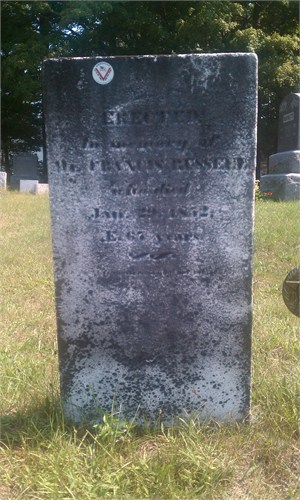
Inclement weather didn’t keep the Ames men from moving around today. Oakes Ames traveled into Boston on business, as he usually did on Saturdays. His sons, Oakes Angier, Oliver (3) and Frank Morton, rode to Easton Center for the funeral of Frank Russell, a 67-year-old blacksmith and veteran of the War of 1812. Russell had died two days earlier from pleurisy, and, despite the “hard snow storm,” he was buried at the Seth Pratt Cemetery with friends and family in attendance.  What had been his connection to the Ames’s sons? Had he worked for the shovel company?

Evelina, too, was tending to a death outside the family.  She and her sister-in-law, Sarah Lothrop Ames, sewed a burial robe for Luella Willis, the two-year old daughter of Mitchell and Amanda Willis.  Like Frank Russell, little Luella would have to be buried in cold ground during snowy weather. Once the services were over, the living would carry on with their chores, their commitments and their lives.  Evelina would turn to “mending most all day.”

The New Year

What is a diary as a rule? A document useful to the person who keeps it. Dull to the

contemporary who reads it and invaluable to the student, centuries afterwards, who treasures it.

Sir Walter Scott


January 1, 2015

Dear Readers,

If you’re like me, you have treasured the 1851 diary of Evelina Gilmore Ames. Some of you have even participated with comments that have added depth to the consideration of a time gone by. Your additions have enhanced the small tale of a Yankee housewife who marked her modest days with regular notations of dresses sewn, flowers planted and fruits preserved, who wrote of short trips into Boston, visits to the family farm, and errands of mercy into the homes of sick neighbors.

Without meaning to, Evelina preserved a picture of life from antebellum New England, a life that has disappeared and evolved into a world she’d be hard-put to recognize. Her children, grand-children, and great-grandchildren have lived and died. Her house itself is gone, though the grander dwelling of her in-laws, Oliver, Jr. and Sarah Lothrop Ames, still stands proudly next door. Automobiles drive where oxen carts and horse carriages moved, and the significant architecture of certain stone buildings in the center of the village memorializes relatives she loved. The very factory whose noisy production of world-famous shovels led the local economy for decades moved away more than sixty years ago. She couldn’t have imagined it.

Yet some things remain the same. People are still people, solicitous or mean, content or down-hearted, eager or indifferent. The true characters we read about in the pages of her diary are recognizable and familiar to us in their essential humanity. We can find ourselves and our own families somewhere in these pages; we all behave so similarly. In Easton, Massachusetts, many descendants of the people Evelina wrote about still live. Last names like Ames, Gilmore, Randall, Tisdale and others can be found in the local telephone book (which itself is in danger of becoming as obsolete as Evelina’s tin stove.)

Evelina continued to keep a diary after 1851, but only the 1852 diary is extant. Her journals from the Civil War period have been lost. We’ll just have to treasure the one that remains. And so, ahead of us is the last available year of Evelina’s tiny aperture on the Ames family of old.

Thank you for reading!


Sarah Lowry Ames

(wife of John S. Ames III, great-great-great-grandson of Oliver and Susanna Angier Ames)