August 15, 1852

Bed

August 15th Sunday  Did not sleep much last night

My handbag with bonnet visite & c were missing

found them this morning at Olivers  Helen

carried them home.  Have been to meeting

came home at noon  Mrs Stevens Orinthia &

Lavinia with us.  Called to see Willie

Gilmore found him more comfortable

Evelina often felt poorly right after returning from her shopping forays into Boston; on this occasion, she was unable to sleep. Surely, the seriousness of her son’s pulmonary illness was the larger culprit in her wakefulness than the usual exhaustion from her trip to the city. She was still rattled in the morning, unable to find her handbag, bonnet and
visite which, it turned out, had been mistakenly taken next door by Helen Angier Ames. It would seem that all the women were a little rattled.

The men may have been rattled, too, by Oakes Angier’s illness, but Old Oliver, at least, wasn’t showing it. He kept up his usual weather-related journal entries. Accordingly, today “was a fair warm day with the exception of two slight showers, perhaps 1/8 of an inch in both of them.”*

Somewhere in the course of the day, perhaps after church, Evelina and her husband, Oakes, and Oakes Angier himself, in all likelihood, determined on a course of action for the latter. Oakes Angier would go off to rest in fresher air and, for the journey itself, be accompanied by various family members.  The decision must have offered relief and hope to all. Evelina got outside of her own head enough to call on her nephew, Alson Augustus Gilmore, whose infant son had been so sick with dysentery. Little Willie seemed better. While there, no doubt, Evelina shared the plans to send Oakes Angier away.

*Oliver Ames, Journal, Stonehill College Archives, Arnold Tofias Collection
 

August 14, 1852

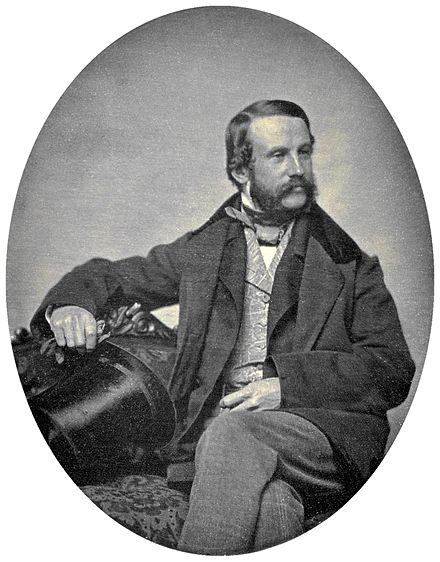
440px-Henry_Jacob_Bigelow_c1854


Dr. Henry Jacob Bigelow

(1818 – 1890)

Aug 14th

1852 Saturday  Oakes A went to see Dr Bigelow

He agrees with Dr Swan that the blood

comes from the lungs and that he must leave the

shop and be very quiet.  Returned from

Boston to night.  Mrs Stevens came here in

the Cars  Mrs Witherell A L Ames & Mrs

S Ames called

Oakes Angier saw a doctor in Boston today about his bad cough and bloody sputum.  He went to a Dr. Bigelow, who could have been either of two well-regarded medical men: Jacob Bigelow or his son, Henry Jacob Bigelow. The son, only a decade older than Oakes Angier himself, was a Harvard grad who was becoming famous for his role in introducing ether into the operating room. Without the modern diagnostic equipment to which we 21st century readers have become accustomed, Dr. Bigelow was nonetheless able to give an informed opinion about Oakes Angier’s pulmonary condition. If the doctor used the word “consumption,” Evelina didn’t write it down.

The illness was serious and Oakes Angier was ordered to ” leave the shop and be very quiet.” Rest and fresh air, in other words, were the treatment. If diagnostic ability was limited, treatments were even more so. Oakes Angier would have to go away and rest and hope for the best.

Back in Easton, the women of the family gathered in the sitting room or parlor to hear what the Boston physician had said, and perhaps to take a look at Evelina’s new bonnet. We can imagine that each member had a notion of what should happen next: where Oakes Angier should go, how he might travel, and what needed to be done to get him ready. In all likelihood, however, the decision on what to do would be decided by Oakes Angier’s father.


August 8, 1852

51m0N6OXmoL

St. Mary’s Cathedral, Fall River, Massachusetts

Sunday

Aug 8th  Have been to meeting came home with

Mr Ames at noon, and returned again

Lavinia Williams came home to Joshuas with us […]

Lavinia returned home  Mr Whitwell preached

Since meeting have written a letter to Mrs

Louisa J Mower & Mrs S Stevens


As shovel-making led the industry of Easton in 1852, so textile manufacturing led the commerce of nearby Fall River. Surely, some of the cloth that Evelina cut and sewed came from the busy textile center that lay about 25 miles to her south.

Fall River is situated at the mouth of the Taunton River, the head of Mount Hope Bay, and (before the construction of the modern interstate put it underground) alongside the swiftly flowing Quequechan River, whose steep drop gave Fall River its name as well as the power to run the mills that lined its banks. Considered “the best tidewater privilege in southern New England,”* Fall River was an important industrial entity for much of the 1800’s. Bustling with bales of cotton and bolts of printed cloth, the city was accessed at mid-century by the Old Colony Railroad line and the Fall River Steamship Line, two entities that would soon merge.

The work force employed to support this industry consisted mostly of immigrants, initially Irish and, after the Civil War, Portuguese. They needed a place to live and a place to worship. The former was supplied by triple-decker tenements, the latter by a succession of churches. The Catholics quickly outgrew the first church built for them in 1840 and thus on this date in 1852, a cornerstone was laid for a new, major church for the congregation. By December, 1855, The Cathedral of St. Mary of the Assumption was duly consecrated and opened for worship. In 1983, St Mary’s was added to the National Register of Historic Places.

We might wonder if any Catholics or others from Easton ever visited St. Mary’s. We can be pretty sure that Evelina and her family never darkened its threshold. On this day, of course, they attended their own Unitarian Church and listened to their beloved Reverend Whitwell.


* “Fall River,” Wikipedia, accessed August 5, 2015

July 23, 1852

il_570xN.416155936_i0fm

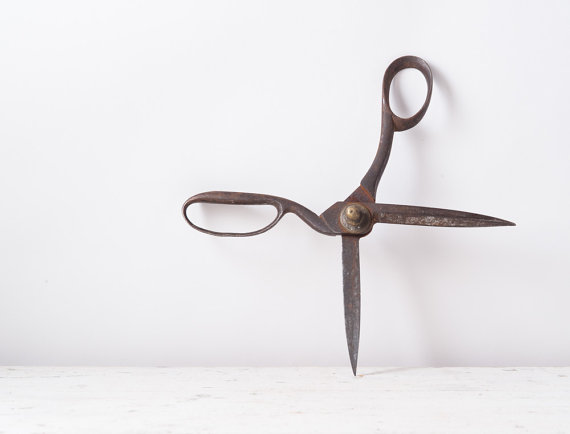
19th century tailor’s shears*

July 23d  Friday  Have cut the skirt & sleeves

& cape to my traveling dress and 

have set Mary to work on the skirt

and I have taken the sleeves

Mrs Stevens has sent me the lining

but not the trimming  Julia Mahoney

is at work at Olivers  Mr Torrey

and Abby called this morning

Evelina was back in good humor today. The thermometer was going down and she had a new project to work on. Shears in hand, she cut out the pieces for her new traveling dress, and probably the lining, too. Designed with a cape to fit over the shoulders, it would be a very fashionable outfit. She didn’t yet have the trimming she needed, and the dress would take longer to sew than she wished, but it would be finished in time for a trip she didn’t even know she would have to make.

Col. John Torrey, the widower of Evelina’s late sister Hannah, came to call.  As we have noted in earlier posts, Mr. Torrey lived in the village of North Easton in a building – a boarding house of sorts – whose spare rooms he rented out. Through Rev. William Chaffin’s history of the town, we learn that Mr. Torrey was a controversial character. Listed as a trader in the town census, and a one-time colonel of the local militia, he was considered laughable by some. Another local character, an erudite shovel-worker named James Adams, wrote a mock-heroic poem about him, the “derisive and scathing”* verses of which are lost. Yet Evelina appeared to enjoy her brother-in-law’s company and brand of humor, and she was devoted to his daughters Abby and Melvina.

*William Chaffin, History of Easton, Massachusetts, 1886, pp. 764-765


*Image courtesy of etsy.com

April 23, 1852

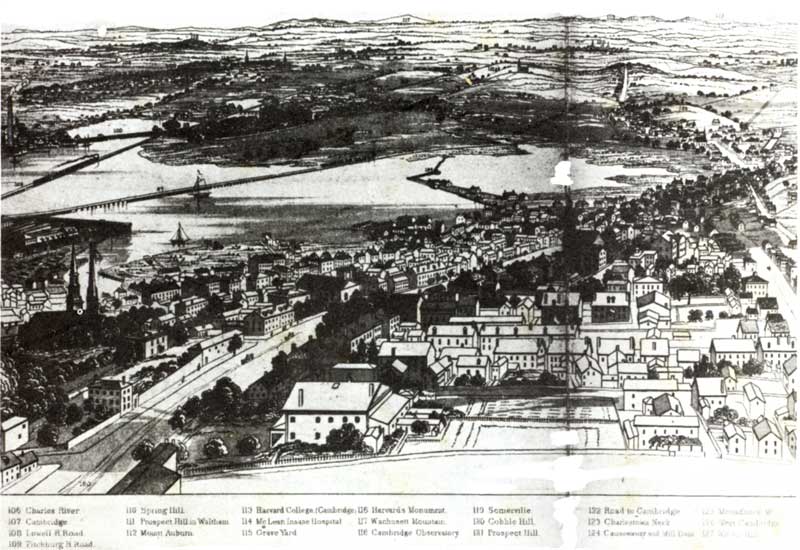
Boston, early 1850s, partial panoramic view

 Partial view of Boston and Cambridge from the Bunker Hill Monument, early 1850s*

1852

Friday April 23d  Went to Boston with Mrs S Ames

Called on Mrs Stevens did not stop with

her more than 15 minutes. Went to Mr Orrs

at night  Julia is there with her babe she

grows nicely and Julia is quite smart

I was about a great deal and was very

much fatigued but had a good […]

comfortable day

Evelina had not been out of Easton for more than two months.  Her last trip to Boston had been in the middle of February, when she’d traveled in with her son Oliver (3) and shopped for prints for the parlor.  That was before the fire at the shovel shop. With so much time having elapsed, she must have been eager to get to the city again.

She traveled into town with her sister-in-law, Sarah Lothrop Ames. They may have called together on family friend Mrs. Stevens, but they likely went their own ways afterwards. As usual, Evelina stayed with the family of Robert and Melinda Orr, where she visited their daughter Julianne Orr Harris (Mrs. Benjamin Winslow Harris) and her new baby, Mary, at whose birth Evelina had been present. Both mother and daughter seemed healthy.

Boston was probably bustling at this time of year, trees at the bud and the air cold but promising. The partial view of the city in the illustration above, made about this time, shows a city that was growing west and south. Between 1840 and 1850, its population had grown from 93,383 people to 136,881. By 1860, the count had reached 177,840. In this vista, railroads are visible, and a Back Bay sits ready to be completely filled..

The view was captured from the top of the Bunker Hill Monument, itself a recent feature of the landscape. Replacing an earlier monument also dedicated to the Revolutionary War battle in Charlestown, it was completed in 1842 and dedicated in 1843. Antiquarian Samuel Gardner Drake (and one of the founders of the New England Geneaological Society) published the panorama in his The History and Antiquities of Boston  in 1856 .


*Partial image of Panorama of Boston and Cambridge from top of Bunker Hill Monument, from The History and Antiquities of Boston, published in 1856 by Samuel Gardner Drake

September 18, 1851

1851_Fillmore_Boston_MA_USA_GleasonsPictorial

*

Thurs Sept 18  Went to Boston with Oliver & wife

& Helen to the railroad celebration.  In company

with Mr Orrs family went to see the regatta & about

nine Returned and dined at Mr Orrs with Mrs

Witherell Emily Mrs S Ames & Helen  Mrs Stevens

&c  Afternoon went out shopping with them  All

except Mrs Witherell spent the night at Mr Orrs

Evelina traveled to Boston today to join the crowds at the Great Railroad and Steamship Jubilee.  President Fillmore, Senator Daniel Webster and dignitaries from Canada as well as the United States had arrived the day before. Speeches were made and congratulations went all around for the new “railroad communication” between the two countries. On this, the second day of the festivities, races were held, one a “grand excursion in Boston Harbor” in which cutters from both countries raced; Canada won.

The Ameses attended a regatta out at Hull, near Point Alderton (better known today as Point Allerton.) It must have been interesting for the usually land-locked Evelina to be at the shore; she rarely got to see the ocean, as her trips to Boston were typically spent in the retail center of the city.It was to that retail center that she and other ladies in her party went in the afternoon. Time to shop.

Also on this date, some 200 miles southwest of this railroad jubilee, in another thriving retail and business center, a new newspaper was born. The New York Times was founded and sold for 2cents a paper.


Reception of President Fillmore at the Boston and Roxbury lines by the municipal authorities, 1851

September 3, 1851

Trunk

Wednes Sept 3d  Alson came this morning & brought

Orinthia and staid to dinner and carried Mrs Stevens

home with him  Orinthia has been packing her clothes

Mrs Stevens stiched three more collars for me & Mrs

Witherell two that are for Frank.  Abby Torrey called

this afternoon &c and on her return Orinthia & I went

to the store  Pauline passed the afternoon with Helen

Orinthia Foss was packing her clothes, getting ready to return home to Maine. What prompted the departure isn’t clear. Did she lose her job, or was she called home on family matters? She would return to North Easton eventually, but did she know that when she left?  How did she feel about leaving this town where she had lived for six months? How did Evelina feel about the loss of her young friend, even temporarily?

Orinthia wasn’t the only one with a trunk to be packed. Oliver Ames (3), too, was a day away from departure and had a trunk into which his mother – and others, perhaps – were placing his new collars and mended shirts. Last minute sewing was still going on, but by this time the trunk would have been nearly full of the clothes that Oliver would need for a term at college.

That Oliver was going away to study at Brown was just shy of miraculous.  At 20, he was old to be going, for one thing; in the nineteenth century, the average students were teenaged, like Fred Ames at Harvard. But more than that, his father Oakes had not wanted him to go. According to one 19th century acquaintance of Oliver, Oakes “had inherited some measure of that Puritanical contempt for the liberal arts.” After completing prep school, Oliver had been directed to work at the factory, “to learn the trade of shovel-making. But the desire for a higher education remained strong, and when at the end of his five years apprenticeship he had mastered the trade, his father yielded to his solicitations, and allowed him to enter Brown University.” * Oliver had earned his ticket out.

* Hon. Hosea M. Knowlton, “Address,” Oliver Ames Memorial, 1898, pp. 98-99


September 2, 1851

Cloth

Tuesday Sept 2d  Again this morning sat down quite early to 

sewing for Oliver cut him out 5 dickeys & finished 

one that was cut last autumn.  Mrs Stevens stiched

2 of them.  Mrs Stevens Pauline & self passed the

afternoon with Mrs Witherell  The weather is

very unpleasant & cold and this evening it rains

hard

The northeast wind of yesterday brought no good weather with it.  The ladies stayed indoors and sewed clothes for Oliver (3), only breaking stride enough to move in the afternoon to the other part of the house to do more of the same. Most likely, Sarah Witherell sewed with them.

Evelina noted today that she worked on dickeys, or shirt fronts, for her son.  She finished one that she had cut out almost a year earlier, which begs the question: Where had she kept it all that time?  Where did she store the fabric, thread and trim for her multiple projects? She had a workbasket, certainly; any sewing woman in that time and place would have had one.  But a workbasket was just that, a basket, or a box.  It might hold a thimble, scissors, needles, a bodkin, an emery bag, plus “tapes, and buttons, and hooks and eyes, and darning cotton, and silk winders, and pins, and all sorts of things,* but it wouldn’t hold bolts of cloth or unfinished, flounced skirts. The yards of fabric and dickeys-in-progress, the aprons to be hemmed and the chemises to be sewn together, would be stored elsewhere. Where?

Perhaps Evelina had shelves in a corner closet to hold her projects, or maybe she laid claim to a particular chest of drawers in the sitting room. When she was working on large projects, such as the cover for the lounge she made earlier in the summer, perhaps the piece simply lay out in one of the rooms until completed. Was she tidy or messy? How did she manage? She may have wished for a room that could be just hers for her projects.  With that large family, and all the houseguests they welcomed, an extra room wasn’t likely to be available.


* Susan Warner, The Wide, Wide World, p. 40


August 31, 1851

28041868_121522694550

*

Sunday Aug 31st  Went to meeting and at noon Henrietta & Mrs

Stevens came home with us.  Mrs Stevens came with 

us from church at night and Alson carried Orinthia

home  Mrs Stevens & self called at Mr Torreys

The boys went to Dr Swans & Augustus’ to call on 

Miss Eddy who is stopping there  Oliver & wife & George

and family to Mr Lothrops & Pauline went into to stay

with Helen & talk about Warren


Socializing continued today after church, with Evelina welcoming her sister-in-law Henrietta Williams Gilmore and a mutual friend, Mrs Stevens, back to the house. She and the latter went to call on Col John Torrey while the Ames sons rode south to Dr. Caleb Swan’s to call on a Miss Eddy, who must have been special to warrant all three boys coming to visit.

Not forgetting that the Lothrop family had just been through the loss of Sarah Ames’s brother Clinton Lothrop, houseguest Pauline Dean called on young Helen Angier Ames, niece of the deceased.  Evelina was certain that Pauline only went to talk about a new love interest, however. Oliver Jr and Sarah Ames, meanwhile, went with another brother, George Van Ness Lothrop, and his wife Almira to call on their parents and their brother’s widow.

George Van Ness Lothrop, a North Easton son who had moved west a decade earlier, was, in 1851, serving his adopted state of Michigan as State Attorney General. Active in Democratic politics and a general counsel of the Michigan Central Railroad for nearly three decades, he ran unsuccessfully for U.S. Representative and U.S. Senate. He was a great supporter of Stephen Douglas, which would certainly have put him at odds with his brother-in-law, Oliver Jr., who was a Lincoln man. In 1885, he was appointed by Grover Cleveland to be U.S. Minister to Russia.

He died in 1897, and was honored with a road in his name in Grosse Pointe, Michigan, just outside of Detroit.

* George Van Ness Lothrop (1817-1897)