April 10, 1851


photo

1851

April 10th Thursday  This day is Fast but no one would

think it by the way I have spent it.  I have

moved the bed from the dark bedroom and 

put it in Franks chamber and moved his

cot into Oakes & Olivers chamber for a few

weeks Oakes A Lavinia Orinthia & Susan went

over to the Methodist meeting house to a sing & called

on Ellen H took her with them.  Weather Pleasant

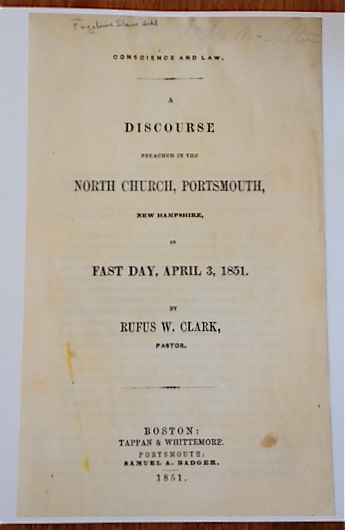
For nearly 275 years, Fast Day was a published holiday in Massachusetts and other New England states (like New Hampshire, above, which celebrated Fast Day on April 3.)   A religious practice brought over from England by the Puritans, the original Fast Days were pious rites of repentance and supplication marked by abstinence and day-long prayer in church, “a day set apart that all might join in the prayer to the Almighty for strength and wisdom”.*  Any calamity, misfortune, drought or disease, regardless of season, might prompt a church leader to call for fasting.

Dating from about 1622, the earliest Fast Days were under the purview of the local clergy, but the practice eventually became widespread enough to become the domain of the state governments.  And where once they were observed on an ad hoc basis as the need for divine intervention arose, Fast Days gradually became a single, annual holiday, usually observed in early April right before spring planting. Over the years, it became a more secular observance and by the latter part of the 19th century, “Not much fasting is done and less praying.”*  In 1894, the governor of Masschusetts abolished the practice of Fast Day and substituted a new holiday, “Patriots’ Day,” in honor of the 1775 Battles of Lexington and Concord and the anniversary of the first bloodshed of the Civil War at a skirmish in which four Massachusetts militiamen died.

Evelina’s entry in her diary proves that Fast Day was anything but a day of prayer and supplication at the Ames’s. Instead, this temperate day in early April marked the start of spring cleaning. Evelina and Jane and perhaps others began upstairs, moving furniture around in order to clean and refurbish two or three of the bedrooms. Much would be disrupted before they were through.

The temporary upshot was that Frank Morton Ames moved into the bedroom shared by his two older brothers. This rearrangement of their sleeping quarters brought the three brothers together in dormitory fashion, yet each maintained his own personal agenda. Tonight, Oakes Angier headed out to a sing at the Methodist meeting house right in the village, taking along a small coterie of females: Cousin Lavinia, sister Susie, the boarding teacher, Orinthia and their mutual friend, Ellen Howard.  Spring was in full swing.


*New York Times, April 20, 1896


April 9, 1851

Wagon

1851

April 9th Wednesday  This day has been a busy one but I can

scarcely tell what I have done but have been about

many things.  Lavinia came this afternoon with her

father He was going to North Bridgewater and

came this way to bring her.  They were here […]

to tea They have all gone to the assembly to

night at Lothrops Hall I believe it is the last

dance for the present A[u]gustus gone to Boston. Pleasant

We all have days that zoom by unaccountably; we get to the end of them and wonder what we did.  Evelina had one of those days today; she could “scarcely tell” how she passed the time.  She probably dealt with various household chores: mending, sweeping, overseeing Jane McHanna, perhaps stirring something on the stove or straightening up a clutter of periodicals in the sitting room.  With three sons and a daughter under her roof, she certainly passed part of the day tending to their needs and conversing with them over small matters. She saw her husband out the door and perhaps urged him not to forget to come home for tea. She may have popped next door to check on Sarah Lothrop Ames, who remained ill in bed.

Her niece Lavinia Gilmore stopped over, having been carried from the Gilmore farm to the village by her father, Alson Gilmore. Did they travel in a farm wagon or a carriage? After tea, Lavinia and her male cousins went to the dance at Lothrop Hall, the last of the season.  Formal socializing for the young set would have to wait until next fall.


March 13, 1851

mens_fashion_1856

1851  March 13  Thursday  This forenoon worked on an old pair of 

pants for Oliver  They needed a great deal of 

repairing and I worked on them untill two Oclock

This afternoon & evening spent at Alsons with Oliver 

& wife, Wm Reed & wife, Mrs Whitwell, A[u]gustus & J. Pool

& wife passed a very pleasant afternoon.  I knit on

Susans Angola yarn stocking.  It has stormed

quite hard all the afternoon, got there about five Oclock

Did the Ames men dress like the gentlemen in this 1850’s illustration?  Oakes Ames, as we know from stories his appalled friends told, did not dress so well. But his sons might have aspired to be fashionable. Certainly Oliver (3), whose old pants Evelina mended today, might have wished for such an outfit, one that befitted a man with his eye on college.

It’s doubtful that the pants Evelina sewed today came out looking like those in the fashion plate.  As accomplished a seamstress as she was, the men’s pants she was most familiar with were working pants, the ones her sons wore to the shovel shop everyday. It took her several hours to repair this pair. Then, not willing to let her hands be idle, she carried a knitting project to her brother Alson’s, perhaps traveling there with her brother-in-law, Oliver Jr. and his wife Sarah Lothrop Ames. The Gilmores were having a little gathering.

Alson and Henrietta Gilmore seemed to be socializing a great deal this month.  Last week they held a dance that the Ames sons attended, this week they had friends in for tea, and sometime before that they had sent their nineteen-year-old daughter, Lavinia, into town to stay with the Ames family for a week. What was going on? Did this increased social activity stem from cabin fever or was it mere coincidence? Were the Gilmores working to find a husband for Lavinia?

The Angola yarn that Evelina knitted into a stocking for little Susie is something of a mystery ingredient. Does any reader know about this yarn?

March 7, 1851

photo

1851

March 7th  Have been giving my rooms a thorough sweeping

& dusting which took me all the forenoon

This afternoon worked on an old shirt of Franks

Am putting new wristbands & bosom into it.

This evening Oliver, Frank & Orinthia have gone to

Alsons to a party.  Orinthia would not go to the dancing

school last night on account of something Frank said & had to be urged

to go to Alsons to night  Augustus not here   Pleasant

Some entertainment today for the young people: a party at Alson and Henrietta Gilmore’s house out in the country.  What was the occasion?  Was it a casual get-together, a spur-of-the-moment gathering, perhaps extending from the assembly of the night before?  Had Lavinia Gilmore or her brother Francis asked for the party, or had it been planned by their parents?  Were they hoping to promote their daughter’s eligibility for marriage?  Was there method to the gathering, or was it just for fun?

Orinthia Foss, the young schoolteacher boarding with the Ameses, was included in the festivities, although she apparently went with some reluctance.  It seems that Frank Morton Ames had teased her in some fashion, hurting her feelings or insulting her the day before. Frank could be a handful, according to William Chaffin, who wrote that Frank “needed more discipline than Oakes [Angier] or Oliver [3].”   Frank was a seventeen year old youth, after all, with more energy than wisdom, probably competing with his older brothers for respect and attention, and letting his mouth do his thinking.

Another younger sibling came to North Easton today.  William Leonard Ames, fourth son of Old Oliver, “came this morning from New Jersey,” according to Old Oliver’s daily record.  In New Jersey, William Leonard ran an ironworks operation, a related family business that had recently failed. According to extensive research by industrial scholar Greg Galer, William Leonard and his eldest brother, Oakes Ames, were at odds over the handling of the demise of the business.  Oakes had “engineered the bankruptcies of these operations for his financial gain,”* while William had barely managed to walk away.  As a result, the two brothers were not on good terms.  Evelina doesn’t mention William’s arrival.  She sticks to her sewing, new wristbands for Frank.

* Greg Galer, Forging Ahead, p. 6.

February 22, 1851

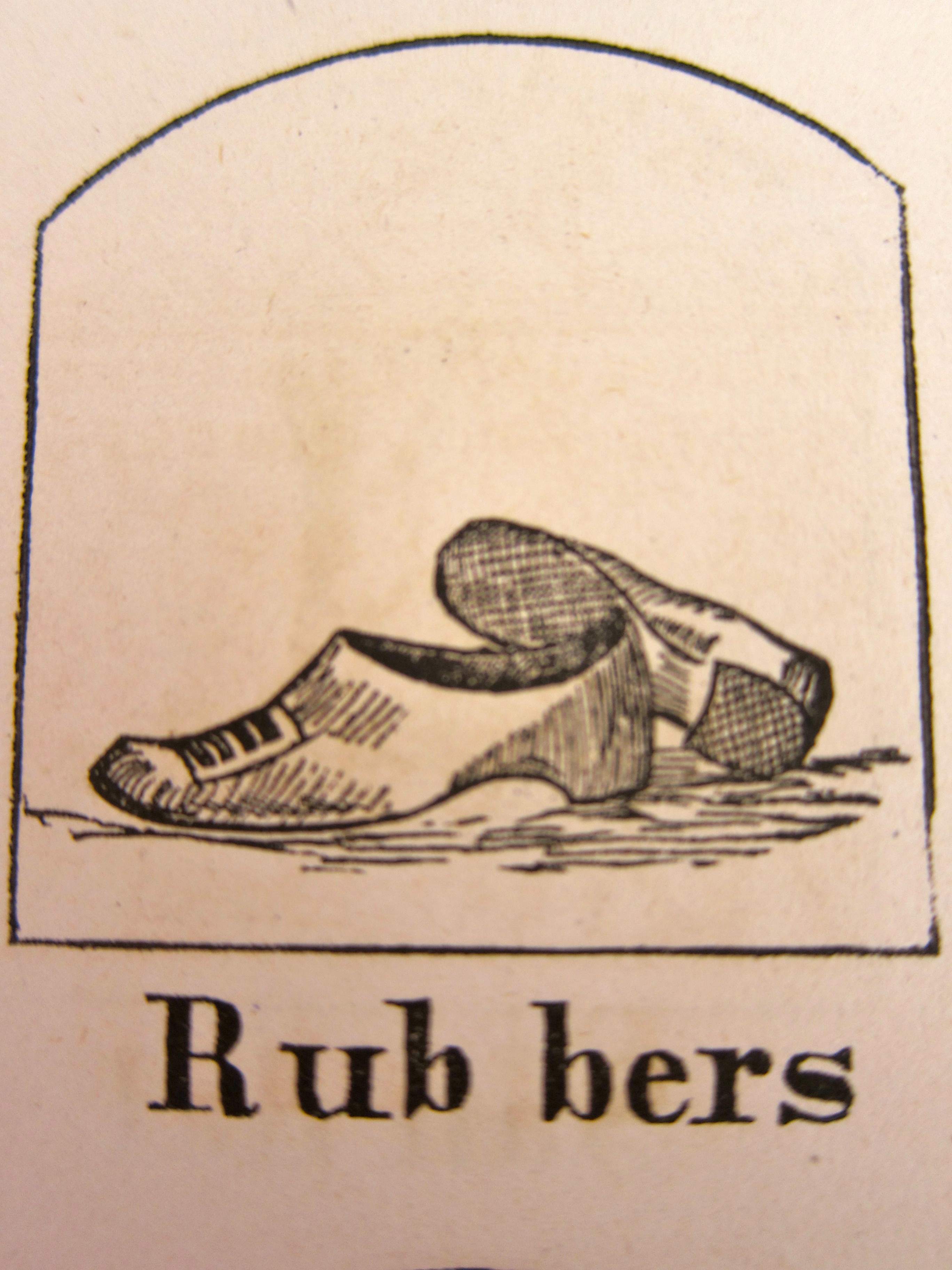
Rubbers

Feb 22nd  Saturday  This morning sat down to sewing

quite early to work on Susans apron.  Mr Torrey called 

to see about Augustus having his tenement.  Augustus

has engaged Mr Wrightmans house for the present.

Lavinia & myself passed this afternoon at Mr Torreys.

Called at the store, met Mrs. Peckham & Miss

Georgianna Wheaton there  Miss Foss came to night.  Mr

Ames has been to Boston brought Susan Rubbers.

Cleared off pleasant to night

In his journal today, Old Oliver noted that “It’s pretty muddy now,” which explains why Oakes Ames returned from Boston with overshoes, known as rubbers, for his daughter.  Probably everyone in the household donned rubbers during this late winter wetness.

Evelina negotiated the streets just fine, it seems, as she and her niece traveled the short distance to the center of town to call at the company store and at her brother-in-law’s house.  Their mutual nephew, Augustus Gilmore, had decided not to rent from Col. Torrey and would be settling his family instead at a Mr. Wrightman’s house.  And at the end of the day, a new person entered the domestic scene.  Miss Orinthia Foss, the new schoolteacher, arrived from Maine.

February 22 is a date that people acknowledged in 1851 in a manner similar to the way people do in 2014, because it’s George Washington’s birthday.  In this year of Evelina’s diary, President Washington had only been dead for a little over fifty years.  People were alive who could still remember him; Old Oliver was one of them.  Old Oliver was born in 1779, while the Revolutionary War was being fought.  He was two years old when the British surrendered at Yorktown, and eight years old when representatives of the new states assembled in Philadelphia to write a constitution.  George Washington was elected to head that convention and became the country’s first president in 1789, when Old Oliver turned ten.  When Washington died in 1799, beloved and mourned, Old Oliver was a twenty-year old bachelor just making his way in the world.  Much about that world would change over Old Oliver’s lifetime, but the reverence that citizens of the United States felt for their first leader would hold strong.

February 21, 1851

Bed

1851  Feb 21  Friday  It stormed so hard & so dark that Mr & Mrs

Whitwell spent last night with us & returned

home about 8 Oclock this morning  Lavinia &

myself have been sitting quietly sewing.

Susan is all engaged making Labels for the shop

has cut quite steady all day.  Helen brought her work in, and staid two

or three hours but I could not prevail on her to stop to tea

Bridget has hired a bed & bedstead

The family business, O Ames and Sons (as it had been known since 1844 when Old Oliver handed over two-thirds of the reins to his sons Oakes and Oliver Jr.) was just that: a family business.  The Ames men all had rolls to play in its operation, from manufacturing to sales to management.  On this day in 1851, it appears that an Ames female had a roll to play, too.  Little eight-year old Susie Ames spent the day making labels for the shop.  Presumably, this meant she was cutting out printed labels to be affixed to individual shovels.  Did she sit at a table in the kitchen or the dining room, paper and scissors in hand?  Was she paid for this effort, or was this just a rainy day game for her?  Who thought this up?

While Susie wielded scissors, the women wielded needles, of course.  Evelina and her niece, Lavinia Gilmore, kept each other company as they sewed and were joined for a few hours by Helen Ames from next door.  Although Lavinia, aged 19, lived in the country and Helen, aged 14, lived in town, the two young women, distantly related by marriage, were friends.

Lavinia was in town visiting her aunt Evelina.  Last night, Mr. and Mrs. Whitwell stayed over, unable to return home because of bad weather.  A new servant, Bridget, had just ordered a bed and bedstead for herself. In a two-family house already filled with ten people, not including servants, where did everybody sleep? People surely doubled up; Oakes Angier and Oliver (3), for instance, shared a bedroom and probably a bed. Although this practice, too, was disappearing, many houses of the period still kept beds in their parlors; apparently the Ames did this, so perhaps that was where the Whitwells spent the night.

The difference between a bed and a bedstead was simply that the former included only the mattress and linens (also known as bedding), while the latter was the frame on which to put the mattress.  This verbal distinction was beginning to disappear at the time, but it was still useful in an era when some people – servants, particularly – only had bedding on which to sleep.  A mattress could be rolled up and moved around, a wooden frame could not.  Bridget showed hope or confidence in her place in the household when she ordered a bedstead as well as a bed.

February 20, 1851


images-1

Feb 20th  Thursday  This morning sat down to sewing quite

early with Lavinia.  worked for Susan and she

sewed some with us  Sent George after Mr & Mrs

Whitwell about one Oclock.  Mr Whitwell attended 

the funeral of James Wells child  Commenced 

raining quite hard & this evening is very dark

The boys & Lavinia & Susan have gone to the 

dancing school at Lothrop Hall

The Thursday evening assemblies, or dancing school, continued. On this occasion, Oakes Angier, Oliver (3) and Frank Morton took their cousin, Lavinia Gilmore, and little sister, Susie, with them.  How exciting for Susan to go along to watch the young men and women dance; probably exciting for Lavinia, too.  She was at the marriageable age of nineteen and, in the manner of the day, was probably hoping to marry soon.  Getting off the farm for a week to stay with her aunt Evelina in the village of North Easton was an opportunity to socialize and perhaps meet someone special.  Did anyone ask her to dance?  Did her male cousins watch out for her?  Did she like what she wore?

Elsewhere in Easton life was not so light-hearted.  Reverend Whitwell officiated at a funeral for the infant son of James and Celia Wells.  James and his brother John, for whom the little boy was named, worked at the shovel factory.  They were originally from Maine.

And, being February, the weather took a dive for the worse.  The young people’s ride home from Lothrop Hall must have been disagreeably wet.  Mr. and Mrs. Whitwell, who had evidently stayed for tea after the funeral, were unable to get home and had to spend the night at the Ames’s house. Young George Witherell was spared the challenge of carrying them back to the parsonage in the dark, windy downpour.

February 19, 1851

Farm

Feb 19  Wednesday  A[u]gustus & wife came this morning in

the stage  We had our breakfast about six Oclock

and I had my morning work most done

We went to Mr Torreys to make a call met Alson

and Lavinia coming.  Alson went back to the poor

farm & Lavinia went with us to Mr Ts  Alson came

here to tea.  Augustus has engaged Mr Torreys

tenement if he concludes to take it   Beautiful weather.

Breakfast at six a.m., at work by seven.  That was the way it was done in the small industrial town of North Easton. By the time Augustus and Hannah Lincoln Gilmore arrived, the men of the house were at the factory and Evelina had washed the dishes, dusted the parlor and instructed Jane McHanna on the menu for dinner and  tea, probably adding additional directions on finishing up the ironing or some other piece of housework.

Off she went, then, to the home of her old brother-in-law, Col. John Torrey, with their mutual nephew, Augustus, only to meet her brother (and Augustus’s father,) Alson Gilmore, en route.  Alson had brought one of his daughters, Lavinia Eveline Gilmore, into town for a visit with the Ameses.  Evelina was fond of her niece, so the visit promised to be pleasant.

Alson soon drove off.  Evelina said he was headed to the “poor farm,” which may have been a jest expressing her opinion of the old family place or perhaps an expression of concern over the economics of the Gilmore homestead.  Or Alson may actually have been on an errand to an Almshouse located in the center of Easton*, near the church that the family attended.  Perhaps Alson was in search of temporary laborers for his farm, although why he would need help in the middle of winter is questionable.  Maybe he had an official role in its oversight.

Many towns had poor houses where the indigent lived; Worcester, Massachusetts established one in the late 1830s in alarmed response to a rising influx of immigrants.  Some citizens were afraid of the diseases that immigrants might be bringing with them, so part of the impetus for setting up a poor farm or poor house or Almshouse, as they were also known, was to establish a discrete site for new arrivals, pending further inspection.

Incidentally, today was an anniversary that probably went unnoticed in the Ames family.  On this date in 1810, a baby named Angier Ames was born.  He was the fourth son of Old Oliver and Susanna Angier Ames, coming along after Oliver Jr. and before William Leonard.  He only lived to be fifteen months old, dying in the summer of 1811 of an unrecorded cause.  Old Oliver wrote no record of this child; did he think of him on this day, some forty years later?

*A shout-out to Frank Mennino, Curator of the Easton Historical Society, for his capable sleuthing about the “poor farm.”  As he pointed out to me, the Almshouse can be identified on an 1855 map of the town. Thank you, Frank!