January 27, 1852

TMM03FOOD10_a_237278c

1852

Jan 27  Tuesday.  Mrs S Ames & Frederick were to dinner  had a roast

goose.  This afternoon Mr & Mrs Whitwell, Mr & Mrs

John Howard & Miss Jarvis    Mrs Witherell Augustus

& Hannah came this evening    Frederick went after the

ladies. Oliver & George carried them all home this

evening.  Baked some tarts in the other house stove

Have sewed but very little  Mr Wm Brown was also here.

Quite a sociable day for the Ameses, full of company.  Midday dinner was attended by Sarah Lothrop Ames and her son Frederick. (The absence of Oliver Jr. and Helen Angier Ames suggests that the former might have been away on business while the latter had returned to school.) Fred, like Oliver (3), was home from the Ivy League; their conversation at the dinner table probably provided some fresh subject matter. Perhaps they entertained family members with a modified description of life on campus.

Evelina served a roast goose (that Jane McHanna had cooked), a dish that normally denoted a special occasion such as Christmas or New Year’s. Were they serving it in anticipation of Oliver (3)’s 21st birthday, or was it just a whim? Either way, serving roast goose on an odd weekday signified wealth behind the larder.

Sarah Josepha Hale offered a recipe for roast goose in her popular household guide, The Good Housekeeper, suggesting that it be stuffed and roasted on a spit over a “brisk” fire for at least two hours. Otherwise, she had a qualified opinion of the dish:

“Geese seem to bear the same relationship to poultry that pork does to the flesh of other domestic quadrupeds; that is, the flesh of goose is not suitable for, or agreeable to, the very delicate in constitution. One reason doubtless is, that it is the fashion to bring it to table very rare done; a detestable mode!”*

Mrs. Hale would likely have approved of the baked tarts, however, that Evelina served for tea later in the day to the Whitwells and others.  It’s a happy note that Sarah Witherell ventured over at the very end of the day; she must have been feeling better after the extraction of her teeth some days back.  She was comfortable enough to let Evelina’s nephew Augustus and his wife Hannah see her face, which had been swollen for days.


*Sarah Josepha Hale, The Housekeeper’s Guide, 1841, p. 52


January 19, 1852

d44daf6476649bfb638e3038c8f2221c

Fashion illustration from Godey’s Lady’s Book, 1850


1852

Jan 19th Monday  Susan washed the dishes and after doing

my usual mornings work commenced sewing some pieces

of fur that was taken off my cloak for Susan a muff

to carry to school.  Finished it before dark and in

the evening made over her best muff and it looks

as well if not better than when new. feel very well

satisfied with my days work  Very cold.


The snow continued today. According to Old Oliver Ames, “it snowd all last night + more than half the day to day and it was a verry cold storm – it did not snow fast any part of the time and all that has come now will not measure more than 6 inches on a level. it drifted considerable and is dry + light.”*

Susan Ames probably would appreciate the muff that her mother was making for her to keep her hands warm.  She already had one for “best” to wear to church, but this one would be for everyday. Made from recycled pieces of fur off her mother’s cloak, Susie would be making quite a fashion statement for a nine-year-old school child, most of whose classmates would likely have worn mittens.  Even Meg and Jo March had to walk to their jobs without muffs, holding instead warm popovers fresh from the oven to keep their fingers from numbing up.

At day’s end, Evelina was “very well satisfied” with the muffs she had reworked.  The household today appears to have been running well which would have amplified Evelina’s happy mood. Jane McHanna must have worked some magic to get the laundry done despite the snow storm.

*Oliver Ames, Journal, Stonehill College Archives, Arnold Tofias Collection

January 13, 1852

images-1


Jan 13 Tuesday  Have not done much work to day

can scarcely tell what I have been doing  Have

been trying to fix Susan some work to learn her to sew

Have got out an apron and commenced a stocking

for her to knit.  This afternoon called on Mrs Richards

Holmes, Torrey Savage & Hannah  Spent the evening with

Augustus and wife at Olivers.  Mrs Witherell been to Dr Washburns

& had her teeth out.  Mrs S Ames George & Emily went with her.  Father

& Oliver dined here & the others when they came back from Bridgewater

This was not Sarah Witherell’s best week. Limping from a bad burn on her foot, she kept an appointment with a dentist, Dr. Nahum Washburn, to have her teeth pulled. Dr. Washburn had his office in Bridgewater, in an historic building known as “the Tory House.”  It was the same office that Evelina had been to several months earlier to have her own teeth worked on.

Modern historian Jack Larkin has noted that “[h]undreds of thousands of Americans had at least some of their teeth badly rotted, a source of chronic pain and foul breath to many, with extraction its only cure […] Dentistry, which most rural American physicians practiced, was by far the most effective form of surgery; extraction was a decisive and relatively safe procedure (although infection always posed some risk).”*

While Sarah Witherell suffered today, her family united to support her. Her children and sister-in-law accompanied her to the dentist’s office.  Evelina (with Jane McHanna in the kitchen, of course) fed the entire family, which made for twelve around the dining table. Old Oliver, whose midday meal was usually prepared by Sarah Witherell, came over from the other part of the house. The Ameses from next door were there, too. Everyone came together for Sarah Witherell.

Evelina managed to socialize today, too.  She called on various friends and relatives around town, perhaps sharing the news of poor Sarah’s painful dentistry.


*Jack Lardin, The Reshaping of Everyday Life, 1988, pp. 92 – 93

January 12, 1852


 Plate

Jan 12 Monday  Susan washed the dishes this morning

and I went to work on my plants making some frames

for them and was to work on them and about the

house all the forenoon.  This afternoon have been

mending pants for Oakes Angier.  Have put a new

pocket into one pair  Jane washed and has been to see

Mrs Savage  Carried Augusta’s cake over to her and

Called a few minutes on Mrs Sarah Ames  Very cold


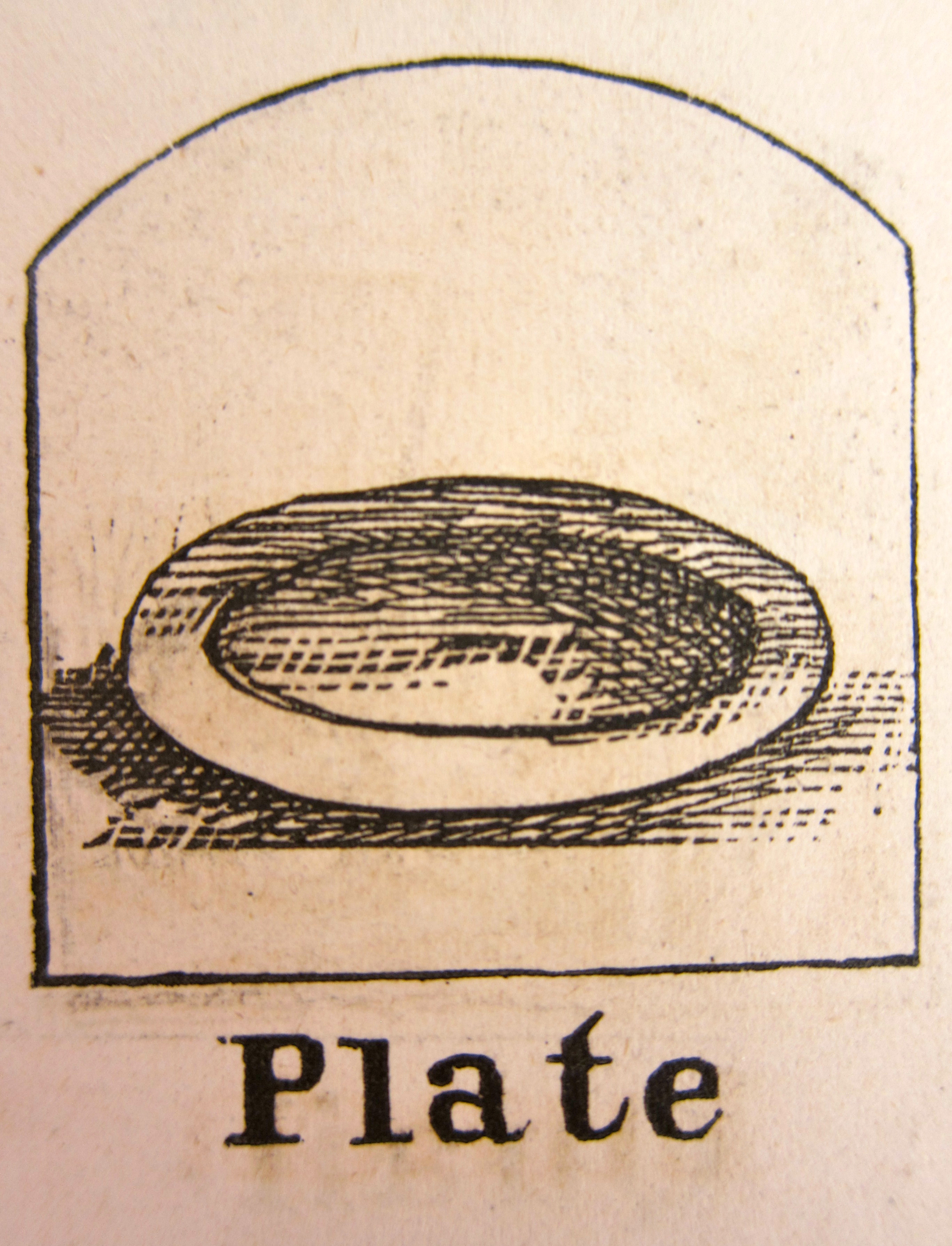
After breakfast each morning, a stack of dishes awaited washing in the Ames kitchen, numbering approximately seven plates, seven cups, seven saucers, 14-21 pieces of cutlery, various serving platters and bowls and serving spoons, plus the pots and pans used in preparation.

Hot water would be boiled and poured into a bucket or perhaps a basin set inside a dry sink. Using a cake of homemade soap, either chipped into the water or swirled by hand, Susie Ames or Jane McHanna or Evelina herself from time to time, washed each item with a washrag, rinsed the piece in a separate pan of clean water and placed it on a rack to dry or be wiped dry with a dish towel. The chore could take 30 to 45 minutes, and had to be repeated at dinner and tea.  It wasn’t as convenient as hand-washing dishes today – no liquid soap, no faucet spray – and it certainly wasn’t like loading the dishwasher.

Inventors, in fact, were trying to develop a machine that would wash dishes; the first such patent was filed in 1850. It wasn’t until 1886, however, that a wealthy woman named Josephine Garis Cochrane would make the first successful dishwashing machine. She didn’t wash dishes herself, but her servants did and often chipped the ceramic plates in the process.  Impatient with the damage, as well as the length of time it took to wash all the dishes after the many dinner parties she gave, she decided to make a machine to do the work.

Mrs. Cochrane  contrived a wire rack shaped for various specific dishes to fit inside a wheel inside a copper boiler. “A motor turned the wheel while hot soapy water squirted up from the bottom of the boiler and rained down on the dishes.”* The dishwasher was born. It went on to be displayed at the 1893 Columbian Exposition in Chicago, where it won a prize.  The Garis-Cochrane Company was formed and manufactured dishwashers until bought by KitchenAid, which in turn is owned by Whirlpool.

All this was a far cry from nine-year old Susie Ames washing up the breakfast dishes, plate by plate.


* Wikipedia, “Josephine Cochrane”, January 10, 2015

January 5, 1852

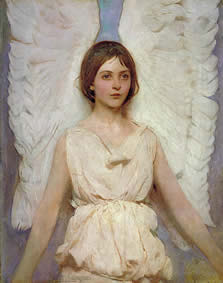
Abbott H. Thayer, Angel, 1887, oil Smithsonian American Art Museum Gift of John Gellatly

Abbott H. Thayer, Angel, 1887, oil
Smithsonian American Art Museum
Gift of John Gellatly


/52

Monday Jan 5 th

Another stormy Monday and we have not been 

able to put our clothes out  Susan washed the

dishes this morning and Jane has done the rest

of the work.  I have finished Susans hood and 

it looks very nice  Mrs Witherell came from

Boston to night  Mr Witherell died about six

yesterday morning


Old Oliver was keeping track of the stormy weather, noting that “it raind + snowd all last night. the snow fell about 2 inches deep + is a snowing now wind north east but it does not blow so hard as it did yesterday. it snowd untill about 3 O clock but was cloudy all day.” One imagines that he had his face close to the window panes of his sitting room – or accounting office, perhaps – as the snow fell outside.

Sarah Witherell returned from Boston in that same snow and wind, having managed to reach her father-in-law’s bedside before he passed away. She would gather her children and return to the city for the funeral.

Evelina, meanwhile, sewed and supervised household chores. “Another stormy Monday” meant that wet laundry was dried in the kitchen and around the house, near heat registers and the air tight stove that helped keep Evelina’s plants from freezing. Parts of the house were draped with white sheets and garments, the floors or carpets wet beneath them. Susie Ames helped some by doing the dishes, a chore that was becoming her regular responsibility. Jane McHanna, of course, bore the lion’s share of the work, with the laundry and “the rest.”


January 2, 1852

Tea


1852

Jan 2d Friday  Seated myself quite early this morning to work

on Susans hood & finished item about ten Oclock

then ripped my old blue hood and washed the

lining & turned the outside have got it nearly done

We all went into the other part of the house to tea

Mr & Mrs Oliver & Helen there  Frank has a sore

ankle as [sic] does not go to the shop  Dr Swan called there

to see Helen & left Jane some medicine

The family gathered for tea today in “the other part of the house,” meaning that Evelina, Oakes, and their children, Oakes Angier, Frank and Susan went into the southern half of the shared house where Old Oliver and his widowed daughter, Sarah Witherell, lived with her two children, George and Emily. Joining them was the family next door: Oliver Ames, Jr, his wife Sarah and their daughter, Helen Angier Ames, who made an appearance despite being home from school with a cold. Other than missing Oliver (3) and Frederick Lothrop, the sons who were off at college, the group was a normal configuration for a gathering at the homestead.

Evelina’s grandson, Winthrop Ames, would one day describe such a family gathering from less than a decade later, by which time daughters-in-law and grandchildren had arrived:

“Supper, always called Tea, at seven, was the sociable occasion. It usually consisted of cold meats, hot biscuits, preserves and cakes – an easy menu to expand for unexpected guests.  Every week at least, and usually oftener, one household would invite the others and their visitors to tea; and the whole Ames family might assemble, even infant children being brought along and tucked into bed upstairs.  Fifteen or twenty was not at all an unusual gathering.”*

The family was as tightly-knit as any of Evelina’s knitted worsted hoods.

One other note about today’s entry: Dr. Swan left some medicine off for Jane McHanna, the servant, who had been ailing for much of the fall and winter. What did she suffer from?

* Winthrop Ames, The Ames Family of Easton, Massachusetts, privately printed, 1937, p.128


December 29, 1851

1_f5848b408e8936030e8b62e01d05ba09

Thomas Valentine Sullivan (1800-1859)

Monday Dec 29th  Have been at work about the house all

day  Helped Susan wash the dishes this morning

cleaned the dining room swept & dusted the

parlour & sitting room chambers entry &c  This

evening have spent in Olivers quilted the lining

to Susans hood  Helen has a bad cold and has

come home  It has cleared off very pleasant

It was an average Monday at the Ames’s house. Jane McHanna washed clothes and linens in big tubs in the kitchen while Evelina swept and dusted all around the house.  Susie Ames worked, too, helping her mother with the breakfast dishes.  After the chores and meals were over, Evelina visited next door with some sewing in hand.

In Boston, however, the day was more noteworthy. An iconic American institution – so familiar to most of us in the 21st century that it seems to have always existed – was formed today. Borrowed from London, where the original organization had been founded six years earlier, a Young Men’s Christian Association was formed at the Old South Church. The “Y” was born in the U. S. A.

The driving force behind the creation of an American YMCA (another had just opened in Canada) was Thomas Valentine Sullivan, a sea captain who had chosen to spend his retirement working as a missionary on the Boston waterfront. According to the Y’s own history, Sullivan noted a “need to create a safe ‘home away from home’ for sailors and merchants.”*  Young men who found life on the street too dangerous or unsavory could take refuge at the Y for “Bible study and prayer.”*

Among her dishrags and dustmops, Evelina wouldn’t have known about Capt. Sullivan and his new work. Yet the small, hopeful gathering at the Old South Church would grow into a major, caring resource for millions of people.


*http://www.ymca.net


December 26, 1851

Stove

Dec 26th Friday  Mr Scott has been here to day and

painted the back entry chamber & stairs leading to my

room & Janes bedroom,  I have been knitting the border

to Susans hood and sewed it together ready for the 

lining  It is a bitter cold day  Augustus called this 

evening to get the direction for things to get me

tomorrow  Came down stairs after I went to bed and

made a fire in the air tight so that my plants should not

freeze


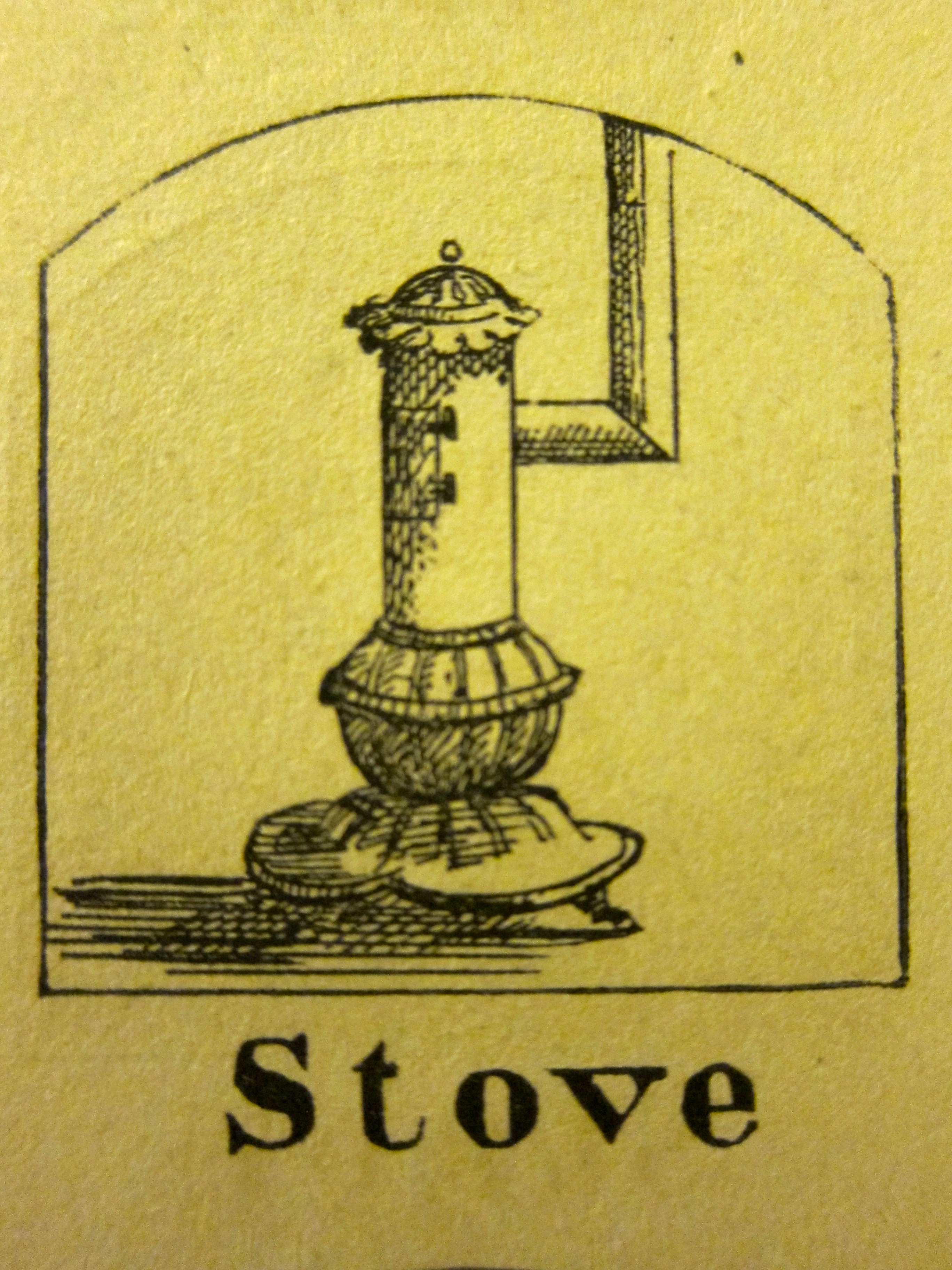
With the wind out of the north “[i]t was a cold day all day,” noted Old Oliver.  So “bitter cold” was it that after bedtime, Evelina slipped downstairs in her nightgown to check on the indoor plants. Determined that they “should not freeze,” she lit a fire in the “airtight” to keep them warm.

The airtight was another word for stove, in this case a coal stove. People often used the words stove and furnace interchangeably, so the air tight that Evelina speaks of may be the same furnace that is often lit by one of the servants. As was customary in many New England homes, it would have been allowed to burn down every night and started fresh each morning. Yet this evening was too cold to risk Evelina’s herbs and other plants being killed off, so the stove was kept going over night.

The presence of this and perhaps other stoves in the house tells us that the Ameses no longer burned wood fires in the original fireplaces, a transition in heating technology that had happened since the 1830s over most of industrialized New England. The change had provided a better, more even heating system, but at a cost. Many lamented the loss, for “the hearth had been the warm, bright center of the household, the provider of cooked food, heat and light and a symbol of the family’s shared life.”* Others, however, of whom Evelina was likely one, cheered for the added warmth and convenience of the furnace.

Jack Larkin, The Reshaping of Everytday Life, New York, 1988, p. 141

December 25, 1851

Turnstile


Dec 25th Thursday  The Irish are expecting to have a great

time to day Jane went to the meeting house about

eight but the priest did not come she stoped an

hour. Carried my knitting into Olivers awhile this

forenoon. This afternoon have been to mothers

with Mr Ames & Frank as they were going to West

Bridgewater.  Finished knitting the front & back of

my hood  Made a present to Lavinia of Turnpike Dividend $800

Christmas Day! But as Evelina points out, the Irish Catholics in town would be celebrating, but the Ames family wouldn’t. Jane McHanna left the house to attend a Christmas mass for which, unfortunately, the priest was either late or didn’t show up at all.  Jane returned home to prepare dinner. Evelina, meanwhile, visited Sarah Lothrop Ames next door, knitting in hand.

After dinner Evelina rode along with her husband and youngest son as they went on an errand to West Bridgewater.  They dropped her off to see her mother at the family farm. There may have been some recognition of the holiday in this gesture, although Evelina makes no mention of gift-giving, with one significant exception. Evelina gave an $800 dividend to her niece Lavinia Gilmore.

The dividend came, somehow, from proceeds from the Taunton and South Boston Turnpike, a road that had run through part of Easton since the early 1800s, between “‘Taunton Green, so called, to the Blue Hill Turnpike,'” according to town historian William Chaffin.* Its origin was controversial and involved a long-standing disagreement with the Town of Raynham, but its impact on the Gilmore family was generally positive, as various Gilmores, including Evelina’s father and brother, served as toll-gate keepers. As Chaffin points out, however, “[t]he toll-gate naturally became unpopular.” It was closed in October of 1851.

How Evelina came to possess $800 from the road is unclear. Was this a regular dividend that Evelina received, or was the family compensated for the road’s discontinuance? That Evelina passed this money on to her niece, however, is a clear demonstration that for all her economical instincts, Evelina was capable of great generosity.


*William L. Chaffin, History of Easton, Mass, 1866, pp. 454 – 458.

December 22, 1851

100793

*

Monday Dec 22d  Washed the dishes with Susan, made

the beds &c and then went to work on the hour glass

table got it made about the middle of the afternoon

Mr Ames went to Canton this afternoon  Mrs Mc

Hanna to Mr Savages  Spent the evening at 

Augustus  Went with Oakes Angier in the sleigh

as he was going to Mr Whitwells  They went this

afternoon to the funeral of Lewis Keith

Domestic chores and neighborhood errands reigned on this winter solstice, the darkest day of the year. Jane McHanna did laundry, little Susie helped wash dishes, and Evelina made the beds. Evelina had a special project, too, that she worked on: an hourglass table she was making to give to her nephew, Edwin Gilmore, and his bride-to-be, Augusta Pool.  She made major progress on it, but what was it?  Does any reader know about the design and/or purpose of an hourglass table?

In the afternoon, after the midday dinner, family members rode out in various directions. Under a cold, cloudy sky, Oakes Ames went north to Canton, to the family works there or perhaps to the Kinsley’s. Oakes Angier drove a sleigh south to the minister’s house in order to attend the funeral of a local farmer, Lewis Keith.  Evelina rode along with her son but stopped to visit her nephew, Augustus Gilmore.  Jane McHanna, meanwhile, went out on foot to see William and Hannah Savage, who lived in the village.  Mrs. Savage was poorly.

Did anyone tell a ghost story tonight after dark fell? Such tales were customary for some families at winter solstice.  On her way home from her nephew’s, was Evelina able to see Orion in the night sky through the clouds?

*Image courtesy of http://www.dreamviews.com