August 4, 1852

Thread

1852

Wedns Aug 4th  Sewing circle met at the other part

of the house  Had an unusually large number

About 30 beside the gentlemen that came

to the second table.  My family all had tea

there  After tea all went into the gardens

and into Olivers to hear Helen play

Horatio and another man came from Salisbury

Sarah Witherell hosted the monthly Sewing Circle, to which people turned out in “an unusually large number.” Everyone would have known about the death of Sarah’s son back in May, and by showing up on this occasion, they likely were paying respect to a woman they probably admired. In her quiet, dignified way, Sarah had done so much for others that others now wanted to do something for her.  They may also have been demonstrating respect for her father, Old Oliver. Sarah was probably grateful for the outpouring and for the hostessing assistance she would have gotten from her visiting cousin, Almira Ames.

Old Oliver may or may not have been on the premises for tea. According to his daily record, on “the 4th Horatio + Mr Morse his traveling agent came here + went away the next day.”* Evelina doesn’t mention Horatio (Sr., probably) but as we know, they weren’t close.

After the busy gathering at Sarah Witherell’s, family and guests toured the gardens – of both houses, presumably – and then moved into the house next door to hear Helen Angier Ames, only daughter of Sarah Lothrop Ames and Oliver Ames Jr., play piano. Perhaps even Old Oliver, Horatio and Mr. Morse were part of the appreciative crowd.

This is the first entry that tells us that Helen Angier Ames played the piano, and it’s significant. Owning a piano or, more likely, a pianoforte was “the ultimate ‘badge of gentility’.”** Because “less than one in a hundred” households in the country owned such an instrument, those that did could be reckoned to be high up on the social scale. Owning a piano distinguished “‘decent people’ from the lower and less distinguished”, according to the standards of the time.


*Oliver Ames, Journal, Stonehill College Archives, Arnold Tofias Collection

**Jack Larkin, The Reshaping of Everyday LIfe: 1790-1840, New York, 1988, p. 143


August 2, 1852

Rain

Aug 2d 1852

Monday  Was about house most of the forenoon and this

afternoon have been to work on my traveling

dress again had to let out the front & widen

the arm it was so tight  Helen spent the

afternoon here  Mrs G & Mrs S Ames called

in the furnace neighborhood and coming home 

got caught in a heavy shower

Evelina and her father-in-law, Old Oliver, had a different perspective on the afternoon’s rainfall. She called it “a heavy shower,” while he wrote that it was “a small shower.”* Because her female relatives, Almira Ames and Sarah Lothrop Ames, “got caught” in it and probably arrived home soaked, Evelina would have seen the rainfall as torrential. Old Oliver, on the other hand, would only have considered the rain in terms of the measure of water it delivered, whether he was indoors or out. From his dual position as farmer and shovel manufacturer, he considered today’s rainfall as modest. As often happened, the two in-laws differed on details.

While the rain fell in Easton, important politics were getting underway about a thousand miles to the west. In Iowa and Missouri on this date, elections to the 33rd session of the U.S. House of Representatives were being held. It was the beginning of the campaign season, something that might sound familiar to today’s readers. Between them, these two states (which, except for California to the far west and Texas to the far south, were perched on what was then the frontier between the eastern states and the western territories) would send nine representatives to Washington, the majority of them Democrats.

As we have mentioned previously, this 1852 election would be won by the Democrats, in sufficient strength to sound the death knell of the old Whig party. From its ashes would rise the new Republican party.


*Oliver Ames, Journal, Stonehill College Archives, Arnold Tofias Collection


July 29, 1852

stock-illustration-20625662-woman-on-death-bed-friend-at-bedside-1862-magazine

Thursday July 29th  Julia has been here again

to day worked for me untill about

three and cut Mary a dress  Mrs G

Ames Mrs S Ames Helen Emily & self

have passed the afternoon at Mr B

Algers coming home  Dr Wales stoped

the carriage & asked me to go there and watch with his wife

Evelina and her dressmaker sewed for hours today, presumably working on Evelina’s new traveling outfit but also cutting out a dress for the maid, Mary. In the late afternoon, Evelina joined the visiting Almira Ames, sister-in-law Sarah Lothrop Ames and two nieces, Helen Angier Ames and Sarah Emily Witherell at the home of the Algers in Easton.

Ephraim Wales, a young doctor in town, evidently crossed paths with Evelina as she, and probably some of the other ladies, traveled home after their call on the Algers. Dr. Wales wanted Evelina to watch with his wife, Maria. Maria must have been ill or possibly even in labor.  Subsequent records don’t reveal why a doctor wanted Evelina to tend to his wife. But it does seem that Evelina was becoming the go-to care-giver in various homes. She was clearly generous with her time, and her bedside skills must have been excellent.

July 8, 1852


IMG_7790

1852

July 8th Thursday  This forenoon cut out a night dress

from Mrs Ames pattern and was busy in my 

chamber made some cake & ginger snaps and 

baked them in Mrs Witherells oven  This

afternoon Mrs Witherell S Ames & A Ames were

here & Helen & Emily  The gentlemen came to 

tea  Mrs Augustus Gilmore passed the evening

This was a hot day for baking, but Evelina nonetheless made “cake & ginger snaps” in her sister-in-law’s brick oven. No doubt she served some of the goodies later in the day when the Ames clan gathered for tea. There didn’t seem to be any special occasion for the tea, except that a cousin, Almira Ames, was visiting. Rather, it was perhaps Evelina’s turn to entertain the family. As Evelina’s grandson, Winthrop Ames, later pointed out, “[e]very week at least, and usually oftener, one household would invite the others and their visitors to tea; and the whole Ames family might assemble…”*

Ginger snaps were pretty standard fare at such occasions. Evelina baked them regularly. In recipes from that time, they’re often referred to as hard gingerbread. Sarah Josepha Hale includes a “receipt” for them in The Good Housekeeper from 1841:

Rub a half a pound of butter into a pound of flour; then rub in half a pound of sugar, two table-spoonfuls of ginger, and a spoonful of rose water; work it well; roll out, and bake in flat pans in a moderate oven. It will take about half an hour to bake. This gingerbread will keep good some time.**


Winthrop Ames, The Ames Family of Easton, Massachusetts, 1937, p. 128

**  Sarah Josepha Hale, The Good Housekeeper, 1841, p, 99


July 4, 1852

imgres-1

July 4 Sunday  Have been to meeting  Orinthia & Lavinia

came home with us at noon  Orinthia had a 

toothache and did not return in the afternoon

Since meeting Alson & wife came up and brought Lavinia

for her to go to Boston tomorrow  Mr Ames called with Orinthia

and self to see the rock they are splitting for the shop and we all

walked down to see the new shop  Mr Clark of Norton preached two

excellent sermons  Oakes A & Helen went to E. Bridgewater

Oakes Ames “came home from N. York”* today, having been there on shovel business; he was the company salesman. After church was over he, Evelina, and her friend, Orinthia Foss, walked down to the shovel shop to see the progress on the new stone building, the Long Shop. They checked out rock that was being split.

“[T]his was a fair cool day wind south west and a drying day…” according to Old Oliver.  It was probably perfect for haying, but it was Sunday, so no one went out to the fields. It was also the Fourth of July, but again, being Sunday, the celebration was postponed.  Fireworks would be held the next day.

Modern historian Jack Larkin describes the importance of the Fourth of July in the American calendar:

“Despite its notably awkward timing for a nation so agricultural – it came in the midst of haying in the North, corn and cotton cultivation elsewhere – Americans made the Fourth their most universal holiday. In ‘fifty thousand cities, towns, villages and hamlets, spread over the surface of America’ citizens observed rituals that varied little, firing cannons, watching parades of prominent citizens and listening to endless orations in town commons and courthouse squares. Americans probably seized their national day with particular relish because it was the only sanctioned way of taking a break from the intensive labor of midsummer…”**

And just as we read yesterday of the beginning of a courtship between Frank Ames and Catharine Copeland, so today we readers may be privy to the genesis of yet another courtship.Evelina writes that Oakes Angier Ames drove his cousin Helen Angier Ames to E. Bridgewater, but doesn’t say why. Perhaps Helen was visiting a friend from school who lived there: Catherine Hobart. This Catherine, too, was destined to become part of the family as Oakes Angier’s wife. Was this their first meeting?


Oliver Ames, Journal, Stonehill College Archives, Arnold Tofias Collection

**Jack Larkin,The Reshaping of Everyday Life, 1988, p. 275


June 24, 1852

4185604807_e27afcf530_b

Modern image of Mount Hope Cemetery, Boston


1852 Thursday

June 24th  Carried Mrs Patterson to Bridgewater.

Helen & Susan went with me. Dined at Mr

Burrells, Orinthias boarding place  got there about

twelve left there about two & went to Dr Washburns

He filed my eyetooth to make it even with the 

others  Went into the cemetery and in Orinthias school

a short time & home by Alsons stoped with Lavinia a 

few moments.  Alsons wife had gone to Boston


With her niece, Helen, and daughter, Susie, Evelina drove Mrs. Patterson to her home in Bridgewater. This was the last appearance of Mrs. Patterson in the diary, so we may assume that she didn’t work at the Ames residence any more this year. Most likely, she had been hired for spring-cleaning only, yet her brief tenure with the Ameses had a lasting impact. She was efficient enough to make Evelina dissatisfied or otherwise unhappy with the work of her regular servant, Jane McHanna, the result of which was the latter’s dismissal.

While in Bridgewater, Evelina accomplished various errands, the most pleasant of which was probably dinner at Orinthia’s “boarding place.”  The least pleasant had to be the appointment with Dr. Washburn, where the dentist filed down one of her canine teeth “to make it even with the others.”

Evelina went into the local cemetery, too, perhaps to visit a specific grave. Interesting to note that on this exact same day in the Boston area, another cemetery was receiving attention. In Roslindale, Mount Hope Cemetery – a new, rural-type graveyard in the mold of Mount Auburn – was dedicated.

On the way home, Evelina stopped at the family farm and had a quick chat with her niece Lavinia.


June 11, 1852

Coffeepot


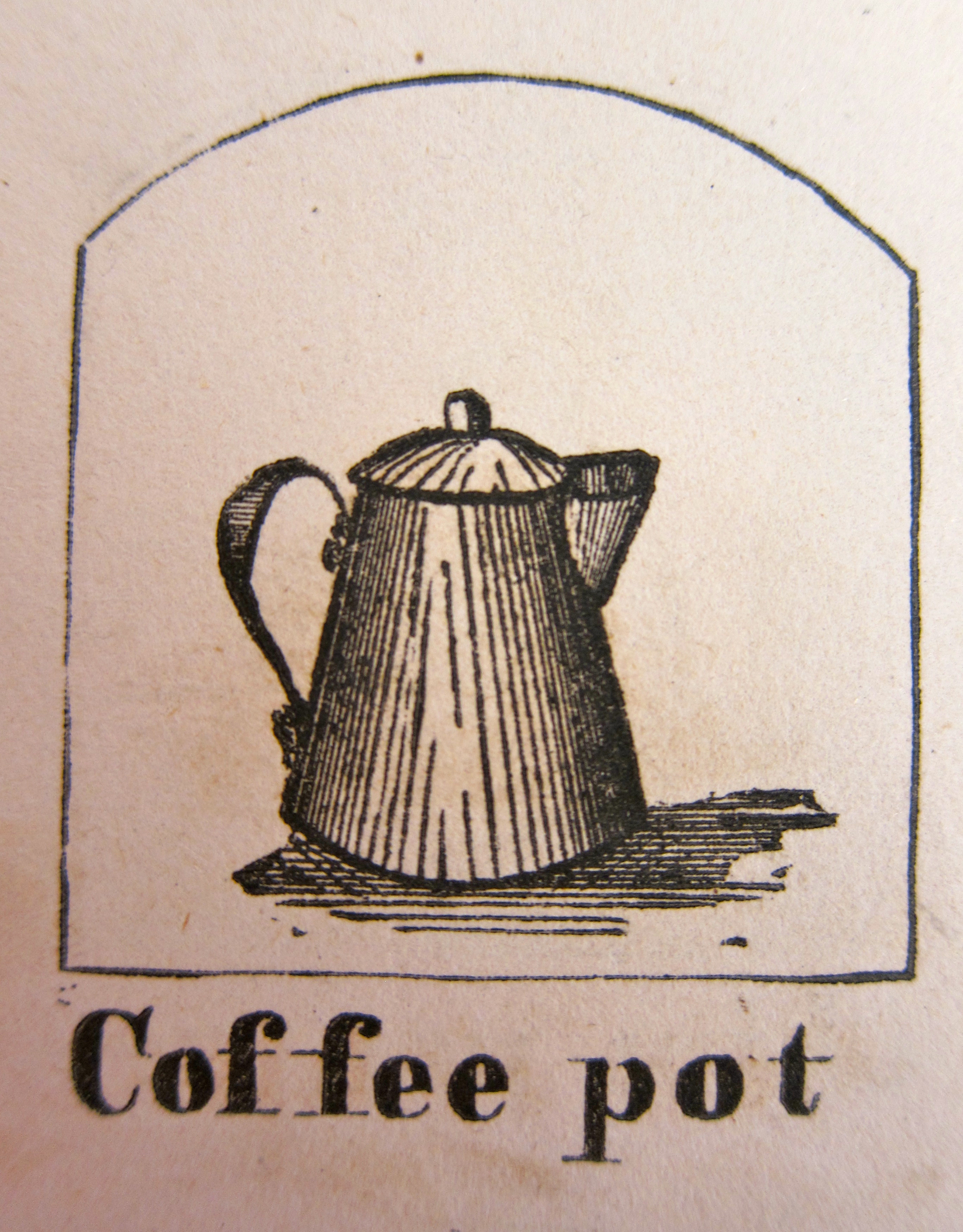
June 11th Friday  This morning had quite a fuss with

Jane about her coffee & beef &c and cannot put

up with such work and to night have engaged

a new girl  Helen & self carried Mr & Mrs

Orr to the Stoughton cars this afternoon […]

We went to the shops this morning & called

on Augustus Abby & Mrs Witherell


A red letter day for Evelina: She fired Jane McHanna. In Evelina’s mind, Jane’s work had fallen off – particularly when compared to the accomplishments of Mrs. Patterson – and today, after a “fuss” about breakfast, Jane had to go. Their relationship had ever had its ups and downs; today it ended.

The kerfuffle between Evelina and Jane must have been observed, or overheard, by houseguests Robert and Melinda Orr. Perhaps their presence influenced Evelina’s decision to dismiss Jane, Evelina wanting to exhibit higher standards of domestic efficiency than Jane was used to producing. However it came about, the result was that Jane would go. Evelina found a replacement by nightfall, but would Jane be equally lucky?  A lone woman without means, could she find a new position quickly?

The morning’s upset may have lingered in Evelina’s mind throughout the day, but she continued to entertain her Boston guests according to the means at her disposal. Besides calling on various family members, they walked around the shovel works, a tour which would have interested Robert Orr.  He lived in Boston, but his family in Bridgewater and elsewhere had worked with iron for many years.

In the afternoon, Evelina and her niece Helen Angier Ames “carried” the Orrs to the railroad stop in Stoughton and bid them goodbye. It was one month ago today that George Witherell died.

June 1, 1852

Mathew_Brady_-_Franklin_Pierce_-_alternate_crop

Franklin Pierce (1804-1869)

Photograph by Matthew Brady

1852

Tuesday June 1st  Have been to Boston with

Mrs Witherell Mrs S Ames Helen & Emily

Called at Mr Orrs the first place met

the other ladies at half past nine at Mr

Daniells & Co.  Was trying to get a bonnet

most all day at last got materials for a lace 

one  Went to Doe & Hasletons about my consol

Mrs Norris met us at half past two

Most of the Ames females decamped North Easton today and went into the city.  Even Sarah Witherell, dressed in black, rode into Boston to go shopping. Were her sisters-in-law hoping to cheer her up with an outing?

While Evelina and “the other ladies” went about Boston “most all day” in earnest pursuit of bonnets, furniture and more, a group of politicians was gathered in Baltimore some 400 miles south. The Democrats were holding their national convention for the nomination of their next presidential candidate.  Among the ten to twelve gentlemen in the running were Senators Lewis Cass of Michigan, Daniel S. Dickinson of New York, Henry Dodge of Wisconsin, Stephen A. Douglas of Illinois and Sam Houston of Texas, Governor Philip Allen of Rhode Island, former Secretary of State James Buchanan, and former Senator Franklin Pierce of New Hampshire. The latter, a dark horse candidate, was chosen.

Franklin Pierce would win the next election and serve as President from 1853 through 1857. Known as “Handsome Frank,” a sociable fellow with a difficult personal life and a probable addiction to alcohol, Pierce was an accomplished politician and fierce opponent of abolition. Once in office, he signed the inflammatory Kansas-Nebraska Act, then failed to be renominated for a second term. His purported response was “There’s nothing left to do but get drunk.”

After the Democrats’ gathering, another presidential convention would shortly be held in the same Baltimore hall, the Maryland Institute for the Mechanical Arts.  This time, the Whig Party would meet and nominate Gen.Winfield Scott, hero of the Mexican-American War.  Scott was the candidate that the Ames men would support.  The Ames women couldn’t vote, of course.

May 30, 1852

OLYMPUS DIGITAL CAMERA

Alson Gilmore  (1798 – 1888)*

 1852

May 30  Sunday  Have been to church as usual  Mr Briggs

of Boston gave us two very excellent sermons

Alson mother & Helen came home with us

at noon.  Augusta has gone home on a 

visit and is going to Foxboro before she returns

Have been reading since meeting and 

called in Olivers and on Mrs Witherell


Evelina’s older brother, Alson Gilmore, turned 54 years old today. He was a farmer – a good one – in the southeastern section of Easton.  He had inherited the property from his father Joshua, probably when the older man passed away in 1836. By that time, older brothers had moved away or passed on, so even as the fourth of five sons, Alson was the heir who took over from his father.

Other than being a productive farmer, Alson was not the most high-profile man in town,  His eldest son, Alson “Augustus” Gilmore, a perennial moderator for town meetings, was more active in civic matters, and his second son, Edwin Williams Gilmore, matured to become the outstanding entrepreneur of a hinge factory. His third son, Francis E. Gilmore, would, in time, take over the family farm as his father had. Alson’s daughters, Rachel, Lavinia, Helen and Hattie, would live theirs lives in Easton, too, two of them marrying.

Alson did play a civic role now and again. For fifteen years, he served as clerk for the Taunton- North Purchase Company, a complicated affiliation based on a seventeenth century acquisition of land that became the towns of Norton, Easton and Mansfield.** He was a selectman for one term in 1849-1850 and also was one of the last treasurers of a toll road that ran between Boston and Taunton, a road that was close to his property. That turnpike, unpopular at best, had only recently closed down.

On occasion, Alson Gilmore ran up against the Ames clan.  His sister may have been been married to one of its most popular and powerful members, but that didn’t prevent Alson from disagreeing with them in a divisive argument over church politics in the 1830s. Alson had been on the side of preserving the familiar Congregational service and Calvinist beliefs, while the Ameses had argued for Unitarianism. With one or two other parishioners, Alson had been threatened with having to bear the cost of paying the minister, Luther Sheldon, while the controversy wore on. In Chaffin’s words, “the situation was very peculiar,”* and ultimately, it was resolved to no one’s complete satisfaction.

With Evelina, Alson shared the responsibility for looking after their elderly mother. It was a duty they both took seriously. He seems to have been a decent man.

Image of Alson Gilmore courtesy of the Easton Historical Society

** William Chaffin, History of Easton, Massachusetts, 1886, pp. 19 – 38

**Ibid., p. 354.

May 23, 1852

Preach

Sunday May 23d  Mr Rogers of Canton preached to day

I did not like him any better than Mr Whitwell

Alson Mother & Helen came home with us

at noon.  Oakes A carried Miss Foss to the 

sing and home  Ellen H & Rebecca White went

with them  Mr Ames & self made a long call

at Mr Swains  Mr Rogers made a short call

as he was going to church

Robert P. Rogers, the Unitarian pastor from Canton, led the service in Easton today, presumably switching places with the regular minister, William Whitwell, as the clergy often did in those days. Rogers was only twenty-seven or twenty-eight years old; his post in Canton was his very first.  As yet unmarried, and certainly younger and less seasoned than Mr. Whitwell, Rogers did not impress Evelina. He paid her the compliment of making “a short call” before church, but she was partial to the Whitwells.

Young Mr. Rogers would soon leave Canton for a pulpit in Gloucester where he would serve as minister for the remainder of his ministerial life.  He must have done well there, or they wouldn’t have kept him around for so long. Decades later, however, Mr. Rogers would return to Canton to live out his last days.

Between and after today’s services, folks were moving around town quite a bit. Old Oliver noted that it was “some cloudy” but also “pritty warm,” so it was pleasant to visit.  The dry roadbeds, though dusty, would have been relatively smooth. Evelina brought her brother and mother home after the morning service, Oakes Angier carried three young women to a sing after church, and Evelina and Oakes went over to see John and Ann Swain in the late afternoon. Everyone socialized.