June 26, 1852


  • hentzcl

Caroline Lee Hentz

(1800 – 1856)

1852

June 26th Saturday  Was assisting Hannah about house

most of the forenoon  Made pies & cake baked

in the small new tins  Have been mending

this afternoon and finished Marcus Warland

by Mrs Caroline Lee Hentz

Mr Ames brought home 1/4 lb black sewing

silk from Boston  I have a bad cough

Although her “bad cough” presaged an oncoming cold, Evelina managed to accomplish many domestic tasks today. Perhaps the best part of the day, however, came after the choring, baking and mending. She finished reading Marcus Warland; or, The Long Moss Spring. Tale of the South. by Caroline Lee Hentz.

Caroline Lee Hentz was an immensely popular novelist, “well known and much esteemed.”* In the 1850s, the Boston Library listed her as one of the three top writers of the day. A major literary figure, now largely forgotten, Mrs. Hentz described herself as a “Northerner who traveled and worked throughout the South for nearly thirty years.”** Though born and raised in Lancaster, Massachusetts, only fifty-odd miles from North Easton, Caroline and her teacher husband spent married life in various Southern states, opening and closing schools as they went along. They lived in Chapel Hill, North Carolina; Covington, Kentucky (across the Ohio River from Cincinnati, where they met Harriet Beecher Stowe); Alabama; Georgia; and Florida.

Unlike Mrs. Stowe, Mrs. Hentz was an apologist for slavery. In the Introduction to Marcus Warland, she wrote:

“We believe, if the domestic manners of the South were more generally and thoroughly known at the North, the prejudices that have been gradually building up a wall of separation between these two divisions of our land would yield to the irresistible force of conviction.”*** She believed not only that the institution of slavery was essential to the South’s livelihood, but that blacks were a lesser race who needed to be looked after. She was hardly alone in the latter belief.

After Mrs. Stowe’s Uncle Tom’s Cabin was published to both huge acclaim and vehement dissent, Mrs. Hentz penned a rebuttal novel entitled The Planter’s Northern Bride.  It came out in 1854 and found a wide audience. We can imagine that Evelina might have read it out of curiosity.

But today, while Evelina reclined with Marcus Warland, her old father-in-law was dependably keeping his eye on the sky and his finger to the wind.  The weather entry for today read “the 24 – 25 + 26 were fair cool days for the season + windy drying days wind north west + west most of the time.”**** This bode well for haying.

Anonymous, Southern Quarterly Review, circa 1851, quoted by Karen Tracey, Plots and Propsals, University of Illinois, 2000.

** “Caroline Lee Hentz,” Wikipedia, accessed June 24, 2015

*** Caroline Lee Hentz, Marcus Warland, 1852, p, 2

****Oliver Ames, Journal, Stonehill College Archives, Arnold Tofias Collection
 

June 25, 1852

hand-sewing-color-grown-cotton-pajama-pants-for-a-toddler

1852

June 25 Friday  Worked about house all the forenoon 

but can scarcely tell what I was doing but

know I wasnt idle. This afternoon have

been mending different articles Hannah

mended the stockings.  I hope she is going 

to be a pretty good girl.  Mr Whitwell called

Called at Edwins this evening  Augustus & wife

Edwin & Elisha Andrews gone to Alsons


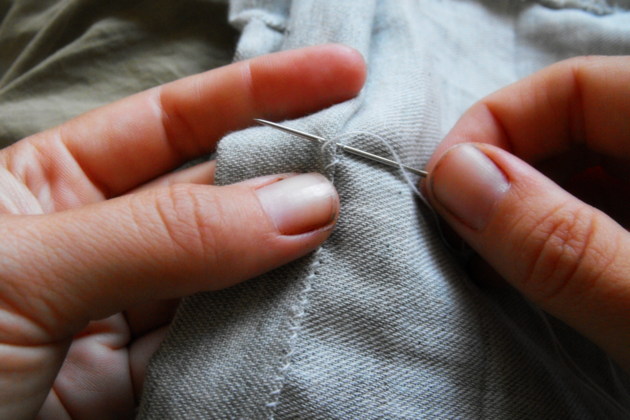
New servant Hannah Murphy was “pretty good” today helping Evelina mend the family stockings. Mending was never Evelina’s favorite duty.  She often put it off, preferring instead to head for the garden or slip next door to chat with one of her sisters-in-law. But what she seemed to prefer most of all was to sew. Cutting cloth for a new dress, or refashioning a waist in an old one, finding just the right trim for her sleeves, or making multiple buttonholes, such was her passion. Evelina loved to sew.

If Evelina had lived today rather than in the 19th century, would sewing still have been her favorite occupation? Freed from her domestic obligations as a 19th century housewife, and no longer in the thrall of the patriarchal laws and mores of the day, what could she have accomplished?  She was so tactile that it’s hard to imagine her abandoning her needle, or not using her hands. Might she have become a textile artist? A craftsperson? Or had a career in fashion?

We know that Evelina was hardworking; as she herself points out, “I wasnt idle.” Whatever career we might imagine for her to excel in, she would have committed to it as surely as she did to her domestic agenda in the 1850s. Yet the fantasy of transporting Evelina to the 21st century ultimately falls flat.  She was too much a creature of her own time and place, as we all tend to be, and not unhappy with her lot in life – even while mending.


June 21, 1852

images-1

1852 Monday  June 21st  Mrs Patterson & Hannah washed and 

I worked in the garden untill about ten

and was about house until two or three

Oclock  Catharine Middleton here sewing

Father has given me another jawing about

my leaving some old coats on the grass


Here in the early 21st century, a dictionary of slang defines “jawing” as being saucy or speaking disrespectfully. Not so in the 1850s, when “jawing” was slang for moralizing, or giving a lecture.  “Father Ames,” as he was known to the Ames wives, gave Evelina “another jawing” today, this time about her “leaving some old coats” outside on the lawn.  She or Mrs. Patterson or Hannah Murphy must have washed the items and left them out to dry in the sunshine without hanging them on a line.  Perhaps the women had run out of clothespins. But Old Oliver would have been concerned about possible damage to the grass, which was already vulnerable due to drought. Or perhaps he was just cross.

Old Oliver described this Monday as “a fair warm day wind south west.”  What he didn’t mention was that it was summer solstice, the longest day of the year. The earth in its orbit tilted its northern hemisphere closest to the sun at around 7:30 in the morning.  If Oliver knew it, he didn’t care, or just didn’t record it. He was watching the ground and planning to cut the hay.


June 18, 1852

servants


June 18 Friday Have to be around with the new girl

to show her which hinders a great deal about

my sewing  Mrs Holmes & Richardson came this morning

to get some plants and I worked a long while

in the garden and did not sew but very little 

before dinner  Abby & Miss Gurney passed

the afternoon here and carried home plants


It’s hard to tell if Hannah Murphy or Catharine Middleton, both new to the household, is “the new girl” whom Evelina accuses of hindering her sewing. After firing Jane McHanna, Evelina had to train someone new, a process for which she evidently had limited patience. She would have preferred to be working on her own projects; such was one consequence of letting Jane go.

The plus side was that Evelina had the opportunity to establish expectations and guidelines for the new servants. If she would take the time to train them, she might get excellent help around the house. She certainly hoped that the new girls would work out better than Jane had.

If the continued hot weather didn’t help her mood, at least it didn’t keep Evelina out of her flower beds. Her garden had seemed neglected of late, but the plants were growing just fine and she had many to give away. Her niece Abby Torrey and a friend, Miss Gurney, visited for a few hours and went home with a few flowers, as did Mrs. Holmes and Mrs. Richardson earlier in the day.

June 14, 1852

FullSizeRender

June 14th

1852 Monday  Am 43 this day quite an old woman

Julia Mahoney came to work on my dresses

Hannah Murphy commenced working for me

this day & Mrs Patterson is here and it

has been about as much as I can attend to

to wait upon the rest  If I had two or 

three more it would be all I could attend to


Hannah Murphy, replacing the departed Jane McHanna, donned an apron this morning and “commenced working.”  Mrs. Patterson was still on the premises and the three women proceeded with the Monday chores, laundry included. Evelina was very busy tending to it all.

Yet today was Evelina’s birthday and she felt old.  We in the U.S. might scoff at the notion that 43 feels old; our current life expectancy for females is 81.  In Massachusetts in 1850, however, it was no more than 45. Who knew how long Evelina would live?  While she had the hopeful example of her hardy, octogenarian mother to emulate, she also would have remembered her two older sisters, both dead in their thirties. She may have considered the possibility that, like her mother, she could live to an advanced age. In fact, she would live to be 73; on this birthday, she had thirty more years in front of her.

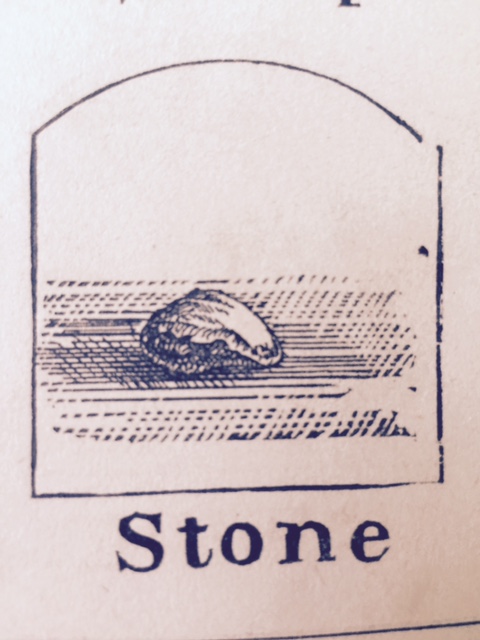
At the shovel factory, Oliver Ames took his mind off his concern for the crops and focused instead on the arrival of Clark S. Manchester, who “came here to day from Fall River to build our stone shop.”* Mr. Manchester, 37 years old, was a native of Little Compton, Rhode Island, who had only recently moved to Fall River with his wife and two children. His expertise with stone work had led him to the Ameses, or they to him.

So the new building began, on the west side of Shovel Shop Pond. This location was different from the original and recently rebuilt factory, which sat at a lower edge of the pond in order to maximize the drop in water level. Water still powered the factory machines, and the new location to the west would still rely on water power from “just above where the Queset entered Shovel Shop Pond.”** But different from the old factory, this new Long Shop would accommodate a modern steam engine, a huge advance in technology. A new era in production was waiting to begin, and the stone buildings would reflect the change.

Oliver Ames, Journal, Stonehill College Archives, Arnold Tofias Collection

** Gregory Galer, Forging Ahead, 2002, p. 250