May 16, 1852

lclapp-1

1852

Sunday 16th May Mr Whitwell preached a funeral sermon

and very good  At noon mother Henrietta

and self spent at Mr Whitwells  After meeting

Mr Ames Susan & I rode to Mr Clapps made

quite a long call  he has but a very few 

flowers in blossom, pansys were very pretty

Have engaged a trellis of him

The last formal recognition of the death of fourteen year old George Witherell took place in the Unitarian church this Sunday when the minister “preached a funeral sermon.”  Different from the ritual text that probably defined the graveside service just three days earlier, the sermon was presumably a collection of thoughts about death in general and the death of the young man in particular.  Reverend Whitwell knew the family well and, being an articulate and thoughtful wordsmith, must have offered the family some personal comfort and consolation.

Evelina appeared to be recovering her strength. With her husband and daughter, she rode to Stoughton after church to visit Lucius Clapp, where they made “quite a long call.” Evelina discussed flowers and a trellis. Was this trellis ordered in place of the one at the front door that was being built only ten days earlier?  Or was this a new trellis entirely, designed perhaps for the garden?  Was this the year of the trellis?

One imagines that Oakes Ames offered less direction about the trellis than his wife.  What he might have preferred to discuss with Lucius Clapp was their shared interest in the Whig party, or their mutual respect for temperance.  According to one nineteenth century historian, Mr. Clapp was a “kind-hearted”* man with a “modest and retiring nature.”* His politics were informed and liberal:

Formerly a Whig, Mr. Clapp has been identified with the most progressive political creeds. He was one of the original Free Soilers, and chairman of the first Free-Soil meeting held in Stoughton. Since its organization he has supported the Republican party. He has been [a] member of school committees several years, and selectman of Stoughton seven years, and now (1883) holds that position. He has always been pronounced in advocacy of temperance, and has been connected with every movement for the betterment and advancement of his native town. He is an attendant and supporter of the Methodist Episcopal Church.”*

Mr. Clapp and Mr. Ames would have had much to talk over.


*D. Hamilton Hurd, History of Norfolk County, Massachusetts, 1884, pp. 424-425

May 2, 1852

IMG_0157 (1)

Frontispiece, Breck’s Book of Flowers, 1851

Sunday May 2d

1852 Have been to church and at noon went

into Mrs Howards with Mother & Henrietta

After meeting went with Oakes A & Mrs

S Ames to call on Mrs Perkins at Mr Kimballs

also called at Mr Nahum Williams

Mrs Kimball has her garden laid out quite

prettily but the walls are too narrow I think

Evelina was almost as interested in other people’s gardens as she was in her own. After church, she and her son, Oakes Angier Ames, and sister-in-law,  Sarah Lothrop Ames, made a few calls around the neighborhood. The day “was cloudy + fair by turns,”* and as they visited, Evelina was able to see what others were doing in their yards.

The group stopped at the home of John and Lusannah Kimball, whose garden Evelina judged to be pretty, certainly, but “too narrow.” Perhaps Mrs.Kimball was building a perennial border, as opposed to the central bed configuration that Evelina used. Taste in gardening design was changing, with the latest ideal illustrated in Joseph Breck’s popular new book on flowers. Was this the look that Evelina was aiming to achieve in her yard?

The whole family seemed to be out and about, at least for the ride to and from the meeting house. The usual group, representing all three Ames households, was in attendance.  It would be the last Sunday ever for this particular ensemble.  In only two weeks, the Ameses would be back at church for a funeral for one of their own.

*Oliver Ames, Journal, Stonehill College Archives, Arnold Tofias Collection


April 9, 1852

images-1

April 9th Friday  Have made the skirt of my Delaine

dress and Orinthia has been sewing on her own

clothes most of the day  I have done but very

little sewing this spring.  Have had some one staying

here for the last few weeks and have been upon the

go a great deal of the time.  Abby came about four

this afternoon and spent the evening

Evelina was trying to catch up on her sewing today, admitting that she had been distracted by “someone staying” at the house for several weeks. She had been “upon the go” with visits from her sister-in-law Amelia Gilmore, her mother, and her former boarder, Orinthia Foss. As a consequence, her sewing had suffered. It was time to get busy.

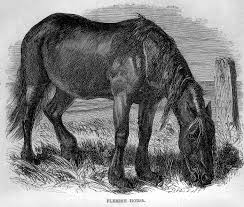
Her father-in-law, Old Oliver, was busy, too. After noting that“it was cloudy all day wind north east + snowd a little,” he went on to report the purchase of several animals.  “[W]e bought 12 pigs to day that weighd 2041 lb at 7 ½ cents a lb – paid 143=00 cents for them [and] we bought a black hors[e] to day of Mr Feild of North Bridgewater which he cald 5 years old for 125$ if he proves good we are to pay 25$ more for him”

A few days ago it was oxen, today it was pigs and a horse.  Old Oliver was filling the barn.


April 7, 1852

images-2

Five Dollar Gold Piece, 1850

1852

April 7th  Mother is 80 years old this day and notwithstanding

the snow banks have been down to see her and made

her a present of a five dollar gold piece.  She is

not very smart to day but is generaly very well and

capable for one of her years.  Orinthia Abby & Augusta

went with me and we have had a very pleasant visit

Augustus stoped the evening here  Helen came

home this afternoon with her father.

Evelina’s mother, Hannah Lothrop Gilmore, turned 80 years old. She was the grandmother of Oakes Angier, Oliver (3), Frank Morton and Susan Eveline Ames – among other grandchildren –  and first cousin-once-removed of Sarah Lothrop Ames. She was born in Bridgewater in 1772, the fifth child and only daughter of Daniel and Hannah (Howard) Lothrop.  Her mother died soon after she was born and her father remarried two times more and had six additional children.

In 1789, at age 17, Hannah married Joshua Gilmore of Easton. They had a large family, too, producing eight children, of whom Evelina was seventh. By this 80th birthday in 1852, Hannah was a widow with only three offspring still alive. As we have seen, she lived on a farm with a son, Alson Gilmore, but often visited her daughter, Evelina.

Beyond these genealogical facts, little is known of the life of Hannah Lothrop Gilmore. When she was barely twenty, however, and already a mother of her first baby, John, she walked on a trail one day with her husband in an area of Easton known at the Great Cedar Swamp. Town historian William Chaffin recorded the tale:

“There was then no road through Cedar Swamp. Trees were however felled, and on these by hard work pedestrians at certain seasons could pick their way through from Easton to Raynham, or return.

“In 1792 […] Raynham had petitioned the Court of General Sessions for Bristol County to require Easton to build a road through the swamp to connect the two towns. The advantages of such a road were obvious. But Easton stood aghast at the prospect of incurring the expense of building a causeway such a distance and in such depths of mire.  The difficulty is illustrated by the fact that as Joshua Gilmore was going on the footpath through the swamp one day with his wife, carrying a little child in his arms, Mrs. Gilmore was speaking of the difficulty of the passage, and her husband replied that some day the child would ride through the swamp in a carriage; and the idea struck her as so essentially preposterous that she had a hearty laugh over it. However, the Court of Sessions did not, it would seem, share her skepticism, for it ordered Easton to construct the road.”*

The road, known then as the Turnpike Road or Street, was built, and Hannah Gilmore lived to ride it in a carriage.

*William L. Chaffin, History of Easton, Massachusetts, 1886, pp. 454-455

March 31, 1852

Thread

1852

March 31st Wednesday  Have been to the sewing circle

at Mr Harrison Pools.  Mrs S Ames & Augusta

went and we took Orinthia with us from Mrs Howard

Mother Henrietta Lavinia Rachel Mrs Nahum & Horace Pool

& Ann Pool were there   It rained very fast as we were

coming home  I left two shirts to be made that I

put in the circle last fall

The Sewing Circle was back.  Female parishioners from the Unitarian Church had begun once again to meet on a monthly basis to sew. Like other sewing circles around the country, they met for fellowship, guidance from the local clergy, and the sewing of clothes and linens for one another or others. They hadn’t met – officially, anyway – since December.

On this weekday the group met at the home of Mary and Harrison Pool in southeastern Easton. From North Easton came Evelina, Sarah Lothrop Ames, and Augusta Pool Gilmore, the young bride who was returning to the area of town where she had grown up. The women stopped en route at Nancy and Elijah Howard’s to pick up Orinthia Foss. Hostess Mary Pool, who had three young children underfoot, welcomed them. Others who attended included Evelina’s mother, Hannah Lothrop Gilmore; Henrietta Williams Gilmore, Lavinia Gilmore, Rachel Gilmore Pool, Lidia Pool, Abby Pool and Ann Pool. It was a veritable family reunion.  Except for Orinthia Foss, every women present was related by blood or marriage to at least one other woman there.

Such a gathering must have been good amusement, with less formality than the social calls that some of the women had paid the day before. But spirits may have been dampened by the “very fast” rain that pummeled the carriages when the meeting ended and the women returned home.

March 17, 1852

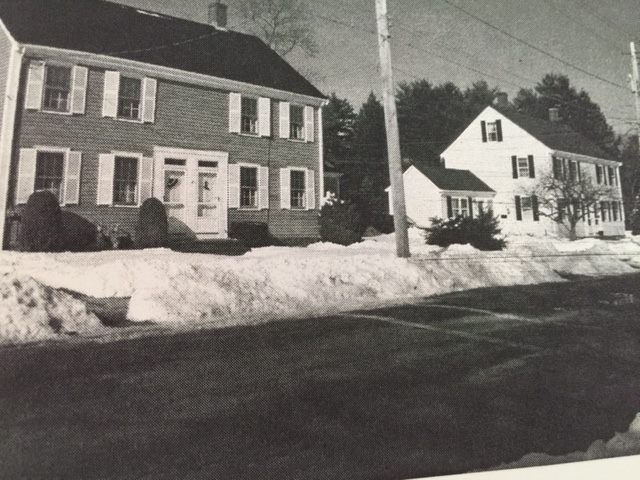
 IMG_0085Modern photograph of two private homes on Oliver Street in Easton, originally built in 1852 as part of the temporary structure for the shovel factory.*

March 17

1852  Wednesday.  Passed the day at Mothers with Amelia

and Susan   Carried Augusta to her fathers

and afternoon she and Rachel came down

to see us  Miss Foss closed her school Sat.

Came to Mothers this morning and to

night came home with us.  Carried cloth

and cut out a bleached shirt  Amelia worked

on the sleeves.

Evelina spent a pleasant day with her mother and several relatives. Her friend Orinthia Foss came to stay for a time. Evelina’s father-in-law, Old Oliver Ames, was completely focused on the rebuilding of the shovel shops. He seemed pleased to report:

“this was a cloudy day wind northeast. + in the afternoon it was cold + chilly. the roof is on the stone shop + the windows are in + the down stream end finisht- + the piece from that to the water shop is up + the roof shingled + the walls are boarded – one hundred + eight feet of the handeling shop is up and part of it clapboarded. the polishing shop is up and the roof shingled and the sides boarded + partly clapboarded the hammer shop is up + the sides + ends boarded and the roof and two thirds sleighted”**

This is one of the longest entries that Old Oliver ever wrote in his journal. He was clearly proud of the progress that had been made in the two weeks since the fire that destroyed almost all. The factory would soon be back on its feet, and planning for more permanent stone buildings could move forward. The wooden buildings that went up so fast would have another use after the stone buildings were erected, that of housing for some of the shovel workers. They would be moved from the original site by the pond and become residences. As you can see from the illustration, some of them are still used today.


* Image taken by Gregory Galer, Forging Ahead, MIT, 2001, Figure 50

** Oliver Ames, Journal, Stonehill College Archives, Arnold Tofias Collection

February 28, 1852

image059

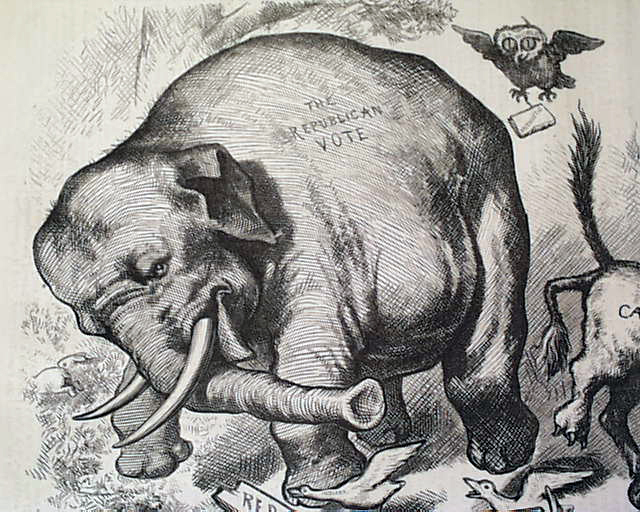
Thomas Nast’s first rendition of the Republican party’s symbol, early 1870s

1852

Feb 28th Saturday  It has been a stormy uncomfortable 

day  Mother is quite unwell & rather homesick

Mrs Witherell spent two hours here this

forenoon  I have finished the flannel

skirt that I commenced Jan 30th and put

a cape top to an old one  Mr Ames has

been to Boston as usual says the slab will be here Monday

Evelina stayed indoors today, sewing, of course, but also tending to her elderly mother, who seemed fretful and “unwell.” The whole town was subjected to what modern weather forecasters would call ” a wintry mix.”  According to Old Oliver, the day began “a snowing this morning wind south east but the snow is dry – it snowd + haild untill about 4 O clock + than began to rain + raind pritty fast untill some time in the night when it cleard of[f] with the wind north west and + cold and the wind blew verry hard”*

In another section of the country also known for its harsh winters, this date in history (plus two years) marks the genesis of our country’s Republican party. According to political historian Robert Remini, “[o]n February 28, 1854, a number of Free-Soilers, northern Whigs and antislavery Democrats met in Ripon, Wisconsin, and recommended the formation of a new party to be called “Republican.”**  Several months later, on July 6, after Congress passed the controversial Kansas-Nebraska act, the nascent group met again in Jackson, Michigan, where they “formally adopted the new name and demanded the repeal of the Kansas-Nebraska and Fugitive Slave Acts and the abolition of slavery in the District of Columbia.”

It wouldn’t take long for the Ames men, former Whigs, to join the new political party.

*Oliver Ames, Journal, Stonehill College Archives, Arnold Tofias Collection

Robert Remini, The House: The History of the House of Representatives, 2006, p. 150  

(NB: A source cited in Wikipedia in February, 2015, says that the date for this meeting in Ripon was March 20)

February 27, 1852

Tea kettle


Feb 27

1852  Friday  this morning I invited Mrs Lothrop here

but she went to Mrs Jason Howards to spend the day

came here this evening  Mrs S Ames & Fred dined

here  Mrs & Mr Horace Pool  Mrs W Williams  Abby

Edwin & wife Oliver & wife & Fred & Mrs Witherell

were here to tea  All came unexpectedly.  Had 

a very pleasant visit from them.

Many folks came to call today.  Sarah Ames Lothrop and her son, Frederick Lothrop Ames, joined the Ameses for midday dinner. (Although Oliver (3) had returned to Brown, Fred hadn’t yet gone back to Harvard.) A real crowd arrived “unexpectedly” for tea.  Sarah and Fred returned, bringing Oliver Ames Jr. with them. Sarah Ames Witherell came in from the other part of the house, resulting in all three sisters-in-law being together. Newlyweds Edwin and Augusta Gilmore walked over from their nearby home, and old Mrs. Gilmore – Evelina’s mother – was already on the premises. The family gathered.

From farther away came Horace and Abby Avery Pool, uncle and aunt to the bride, Augusta.  A Mrs. W. Williams arrived, as did Abby Torrey, Evelina’s niece. Abby’s head must have been full of the previous evening’s entertainment, that of Willard Lothrop’s visit and trance. It’s likely that some of this evening’s conversation turned on spiritualism.  One wonders what Oakes and Oliver Jr. thought of the topic.

Perhaps Evelina served some ginger snaps or currant cake from Tuesday’s baking. The tea itself could have been one of any number of types. Lydia Maria Child published her opinion on the subject: “Young Hyson is supposed to be a more profitable tea than Hysons; but though the quantity to a pound is greater, it has not so much strength. In point of economy, therefore, there is not much difference between them. Hyson tea and Souchong mixed together, half and half, is a pleasant beverage, and is more healthy than green tea alone.  Be sure that water boils before it is poured upon tea  A tea-spoonful to each person, and one extra thrown in, is a good rule.  Steep ten or fifteen minutes.”*

*Lydia Maria Child, The American Frugal Housewife, 1846


February 26, 1852

seance-circle-2


Feb 1852

Thursday 26  Mrs Solomon & Mrs Willard Lothrop spent

the afternoon here.  Willard & Abby Torrey

came this evening  He went into a trance

and preached  told Abby she was a sympathetic

medium  Mother & self had a nice quiet

time in the forenoon  Mrs Witherell

came in awhile  Altered some dickeys

After a quiet morning of sewing, Evelina and her mother were entertained at the end of the day by an unusual event in the Ames parlor.  Willard Lothrop, self-proclaimed Spiritualist, visited at the Ames home where he “went into a trance and preached.”  If it wasn’t a seance, it was close. Lothrop believed he could communicate with the departed. Was there a particular person from the past – a Gilmore relative, for instance – whom Lothrop was trying to reach?

According to historian William Chaffin, “modern Spiritualism” developed in upstate New York around 1848, and spread from there. As noted previously, Easton produced its own adherents who “displayed mediumistic powers,” including Willard Lothrop. “Circles were held.  There were knockings and table-tippings and experiments in the production of musical sounds, etc.  It was not found necessary to import trance speakers, for native talent in that direction was soon developed.”** Abby Torrey, Evelina’s twenty-one year old niece, was in the parlor, too, for this session. Lothrop reached out to her, believing that she had a gift for spiritual telepathy.

Meanwhile, the previous day’s thaw “turnd cold last night + froze the ground up rough”* Carts, wagons and carriages had bumpy roads to traverse.

*Oliver Ames, Journal, Stonehill College Archives, Arnold Tofias Collection

** William L. Chaffin, History of Easton, Massachusetts, 1866, p. 370


February 18, 1852

Hoof


1852

Wednesday 18 Feb  Augusta Emily Susan & self have

spent the day at Rachels.  Mother Henrietta & Lavinia

were there  Had a pleasant visit.  Went to

carry mother home with Charley had some trouble

with him about starting it was so cold.  Mrs Solomon

Lothrop & son Willard came to Alsons this afternoon 

Made two dickeys for Mr Ames and cut out two more


Just like the day before,”this was a fair day wind north west + cold”* as Old Oliver, family patriarch, noted in his daily journal. It was so cold that one of the family horses, Charley, didn’t want to leave the premises. But Evelina needed to take her elderly mother, Hannah Lothrop Gilmore, back to the family farm, so Charley was harnessed up and made to trot out. Evelina and her mother probably didn’t enjoy the frigid temperatures, either, but at least they could cover themselves with blankets or robes.

Evelina spent most of the day in the company of female relatives at the home of her niece, Rachel Gilmore Pool, who lived near the Gilmore farm.  Her daughter, Susan, and niece, Emily Witherell, were with her, as was new bride Augusta Pool Gilmore.**  Rachel’s unmarried sister, Lavinia, was there, along with their mother, Henrietta.  It was a multi-generational gathering of women from ages 9 to 79.

The women must have spent some time sewing as they all sat together, for Evelina managed to complete two dickeys, or shirt fronts, for her husband. The companionship would have made the handiwork fun to do.

*Oliver Ames, Journal, Stonehill College Archives, Arnold Tofias Collection

**Rachel Gilmore Pool was married to Augusta’s brother, John Pool, while Augusta Pool Gilmore was married to Rachel’s brother, Edwin Gilmore. One family’s sister and brother married a neighboring family’s brother and sister.