April 3, 1852

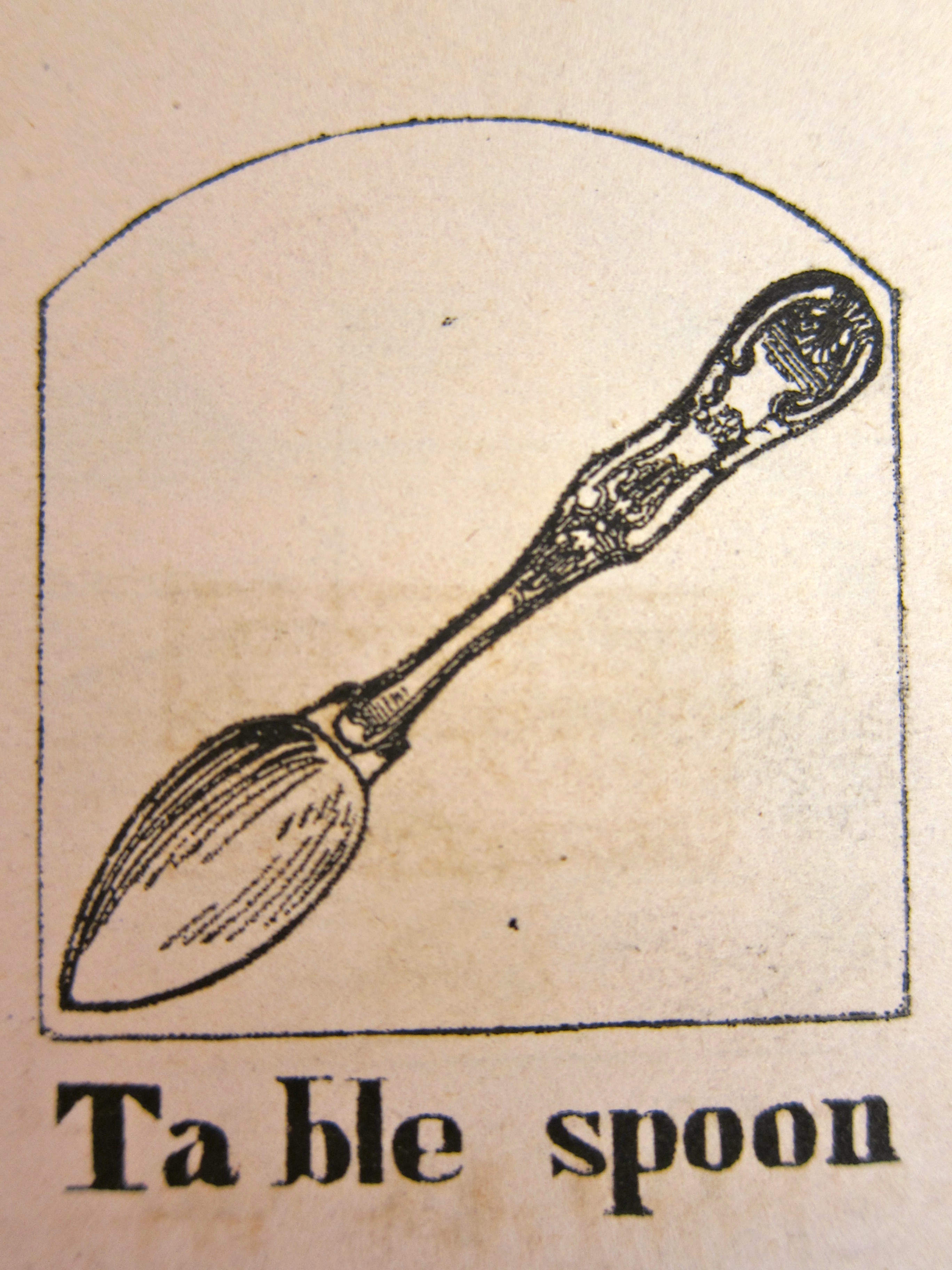
Tablespoon

1852

March [sic] 3rd Saturday  Have made a ribbon head

dress for sister Amelia  Orinthia & self went into

Edwins this noon for some fish chowder.  She gave us

some platters and a great iron spoon to eat with and we

had to wait upon ourselves. We excused her knowing

she was a young housekeeper and knew no better.  She

ought to come here and learn politeness  Called on Mrs

Brett.  her babe is nearly two weeks old. she is not very

comfortable  Called on Abby  Hannah & Mrs J. C. Williams

Young neighbor Augusta Pool Gilmore invited Evelina and Orinthia Foss to midday dinner. This was a sweet gesture, perhaps intended to thank Evelina for her many kindnesses in welcoming Augusta to the village. The young bride may have been excited to debut her skills as a hostess.

However well-meant the invitation was, Augusta still had a lot to learn about entertaining. Evelina, a matron who had welcomed many guests to her dinner table over the years, saw much to judge wrong and in her diary took a snide swipe at the young woman. She criticized Augusta’s faux pas in laying out the wrong cutlery and failing to serve them properly.

While Evelina forgave Augusta her missteps, because the young bride “knew no better,” she also condescendingly noted that Augusta needed to spend time with the Ameses to “learn politeness.” Such scorn was perhaps exacerbated by the presence of Orinthia, who was always looking for ways to laugh. Innocent, inept Augusta was an easy target.

Evelina’s natural empathy returned in the afternoon. She visited other friends and called on another young woman in the neighborhood, Eveline Brett, who was doing poorly after having given birth.
March 28, 1852

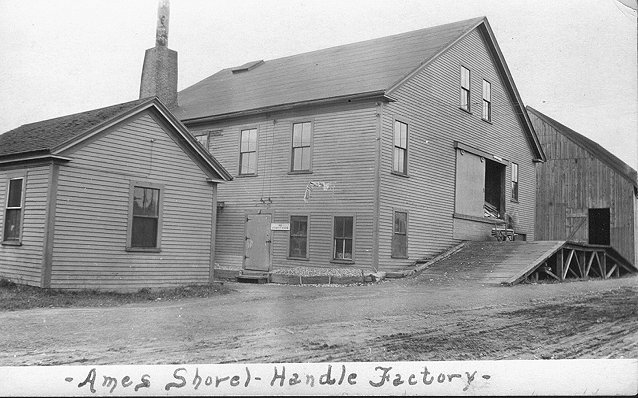
Ames-Shovel-Handle-2

Ames Shovel Handle Factory, Oakland, Maine*


March 28 Sunday  Went to church this morning and

at noon called at Mrs Wm Reeds with Henrietta

Hannah came at noon but was faint and

I carried her home and got back to church about

the time the services were over  After went down

to the new shops with Mrs W, S Ames Augusta Orinthia

found Mr. Ames, Oliver & Cyrus L there returned by Edwins

and all called there  Mr Ames & self went to Augustus’ this evening

The new shops were up, and various family members rode by to see them after church. No more “dismal ruin”, as reported by Evelina only three weeks earlier. Risen like a phoenix from the ashes of the old shops, the shovel works were about to begin operations in new, if temporary, quarters.

It was a large group that gathered to consider the new buildings. Evelina, who had missed the afternoon service in attending to her ailing niece, Hannah Lincoln Gilmore, nonetheless rode back from church to the site. Accompanying her were her sisters-in-law, Sarah Witherell and Sarah Ames; another niece, Augusta Pool Gilmore; and sometime boarder and frequent companion, Orinthia Foss.  At the site, by accident or design, they found Oakes Ames and his brother, Oliver Ames Jr., and Cyrus Lothrop, a brother of Sarah Lothrop Ames who often resided with his sister. The group must have marveled at the swift reincarnation of the shovel works.

Perhaps a celebratory spirit inspired the crowd to assemble en masse at the nearby home of newlyweds Augusta and Edwin Gilmore.

*Image of Ames Shovel Handle Factory, Oakland, Maine courtesy of the Oakland Maine Area Historical Society. Included to illustrate what the rebuilt shovel factory could have resembled.

March 27, 1852

north-bridgewater-mass-1844-sm

1852

March 27  Sat  Have been mending again to day and painted

some spots in the back entry chamber  Mrs Witherell

& Mrs Lovell from Bridgewater came to see Mrs Witherell

& spent the day.  Mrs Lovell called on Hannah.

Mrs S Ames came in soon after dinner and staid

most of the afternoon  We called to see Mrs

Witherell & Lovell  Have read in the papers this

evening

Sarah Ames Witherell, Evelina’s sister-in-law, had visitors today from Bridgewater. Sarah’s mother-in-law, Lydia Witherell, and a Mrs. Lovell called. Mrs. Witherell was a recent widow, more recent even than her daughter-in-law, Sarah, who had been widowed three years earlier. Where Sarah’s late husband, Nathaniel Witherell, Jr. had died in October, 1848, his father, Nathaniel Witherell, Sr., had passed away in January of this year. Sarah and her two children, George and Emily, had traveled through a snowstorm to attend the funeral.

The Mrs. Lovell who came to call may have been Emeline Perry Creasy Lovell,  wife of Reverend Stephen Lovell, former resident of Easton and one-time pastor of the recently defunct Protestant Methodist church in Easton. But the clergyman and his wife possibly lived in Boston, too, so this Mrs. Lovell “from Bridgewater” may have been someone else. Yet her extra visit to see Hannah Lincoln Gilmore, who was still ailing, suggests that this Mrs. Lovell was familiar with at least some of the residents of North Easton.

While this visiting was going on, Evelina stayed on her side of the house with her other close sister-in-law, Sarah Lothrop Ames.  How did it work to have two separate social conversations going on under one roof, one on each side of divided parlor walls? One imagines that Evelina and Sarah Ames were curious about the nature of the call in “the other part of the house.”

March 26, 1852

imgres


1852.

Friday March 26  Mrs S Ames returned from Boston last

night, had unpleasant weather for two days.  She called

at Mr Orrs found them all well. Julia is there

yet with her little one  Mrs S Ames & Witherell

called on Mrs Elizabeth Lothrop and invited me

to go with them but I felt it more my duty to call

on Mrs Swain, did so, and was prevailed upon to 

spend the afternoon & evening.  She has weaned her

babe, has been quite unwell but is now better

Two young women closely connected to Evelina recently weaned their babies. Hannah Lincoln Gilmore, wife of Evelina’s nephew Augustus, had just weaned her seven month old son, Willie. Ann Swain, wife of the head clerk of the shovel works, John Swain, had done the same with her five month old boy, John.

Weaning was an anxious time for both babies and mothers, although in this circumstance it appears the babies came through the ordeal better than their mothers, at least at first. Both Hannah and Ann had been unwell during the process. Evelina, in her attentive way, had spent time with the two young mothers while they ailed. As a practiced mother who had nursed and weaned five babies of her own, she may have offered advice and provided significant comfort to the younger women.

In Boston on this day in 1852, far from the concerns of the nursery, a new house of worship, the Temple Ohabei Shalom, the first synagogue in Boston, was consecrated. Although the temple, built on Warren Street, is no longer standing, we know that was architecturally handsome and well-appointed. It could seat 400 worshipers and also offered an area for a Hebrew School, a meeting room, and a bath, known as a mikveh.* A temple by the same names exists today on Beacon Street in Brookline.

Although Easton now has a synagogue, the Temple Chayai Shalom, it did not have one, nor did it have a visible Jewish community, in 1852.


* Jim Vrabel, When in Boston, Boston, 2004, p. 160

March 12, 1852

192_600_Red_Doll_Bed

1852  

March 12th Friday.  Spent most of the forenoon about

the house gave the sitting room a thorough

sweeping  This afternoon & evening have

spent at Mr Torreys  Amelia came home

with me.  Called to see Hannah in bed

almost sick with the canker & has weaned her babe.


Poor Hannah Lincoln Gilmore, wife of Alson Augustus Gilmore and mother of two little boys, 3-year old Eddie and 7-month old Willie, had been feeling poorly for more than a week.  Her complaint was canker sores, a common enough ailment but one that struck her unusually hard. As Evelina points out, Hannah was “in bed almost sick.”

As most of us know, a canker sore is a benign but painful sore located inside the mouth and lips or at the base of the gums. Known medically as aphthous stomatitis, a canker is not contagious and has no cure. It is often caused by stress; perhaps Hannah’s recent efforts to wean Willie had set them off. A canker sore can last from seven to ten days, and can be painful enough to make talking and eating difficult. Hannah must really have felt crummy.

Meanwhile, at the shovel shop, reconstruction was continuing.  Old Oliver noted that “the 12th + 13th were both good fair days for our work.”*

*Oliver Ames, Journal, Stonehill College Archives, Arnold Tofias Collction


March 9, 1852

OLYMPUS DIGITAL CAMERA

19th century oil lantern

1852

March 9th  Tuesday  This morning finished putting

the sitting room chamber in order

Mrs Witherell came in with her work

for an hour or two. I sent for Hannah

Augusta & Abby this afternoon.  Abby

came in this evening  Augustus called  his

wife has the canker and was not able to come


Today “was a fair good day + pritty warm,” * accommodating weather for the carpenters working on the shovel shops. According to modern town historian, Ed Hands, the repair would be rapid enough to allow a resumption of manufacturing “in less than three weeks.” But what happened to the shovel makers during the hiatus? Were they kept on payroll? Or were they given unpaid furlough?

What happened to Patric Quinn? An Irish immigrant with a young wife and two small children, he was the watchman who had dropped his lantern into the varnish on the night of March 2d. He started the fire. Was he injured? Was he held accountable?  Did he stay on payroll? He and his wife Elisa, who sometimes did sewing for Evelina, remained in North Easton. They lived on Elm Street in one of the workers’s houses.

At the Ames compound, Evelina put the sitting room and parlor back in order. She and her sister-in-law, Amelia Gilmore sat and sewed.  They were joined for a time by Sarah Ames Witherell who was followed by young Abbey Torry and Augusta Pool Gilmore. Hannah Lincoln Gilmore was too sick to attend.


*Oliver Ames, Journal, Stonehill College Archives, Arnold Tofias Collection

**Edmund C. Hands, Easton’s Neighborhoods, 1995, p. 163

March 5, 1852

charred-wood-texture_61-1902

Charred Wood

1852

March 5th Friday  Have been mending pants most all

day that were worn at the fire  Lavinia

went to Augustus’ this forenoon and Augusta

went this afternoon.  Mr Scott & Holbrook have 

finished painting the entry and chamber

got through about four Oclock.  I was in

Olivers about an hour this afternoon.  This 

evening received another letter from Harriet Ames


The women of Easton had work to do, too, in recovering from the factory fire.  Surely Evelina wasn’t the only housewife in North Easton who had to repair or clean clothes worn by their husbands, brothers or sons the night of March 2. Needles were out and laps were full as women all over town tended to the rips, tears and soot. Conversation probably centered on the fire as they worked.

The day itself was cloudy and cold, the smell of the charred buildings dampened by a light snow that fell overnight. Yet the cleanup continued. As the men worked at the site, hauling timbers and shoveling up debris, their blackened soles left ashy footprints in the snow, footprints that quickly turned into grime. Many a man was made to wipe or remove his shoes before entering his house for midday dinner.

Evelina stayed focused on her domestic responsibilities. Mr. Scott and Mr. Holbrook were back on task in her parlor, painting and papering, and finished up at the end of the afternoon. Evelina spent some time next door with Sarah Lothrop Ames, and got a letter from cousin Harriet Ames, with whom she had been corresponding lately. And perhaps under her direction, her niece Lavinia and niece-in-law Augusta were looking after their sister-in-law, Hannah Lincoln Gilmore, who was laid low with a mouth infection and a weaning baby. Fire or no fire, life was moving forward.


March 4, 1852

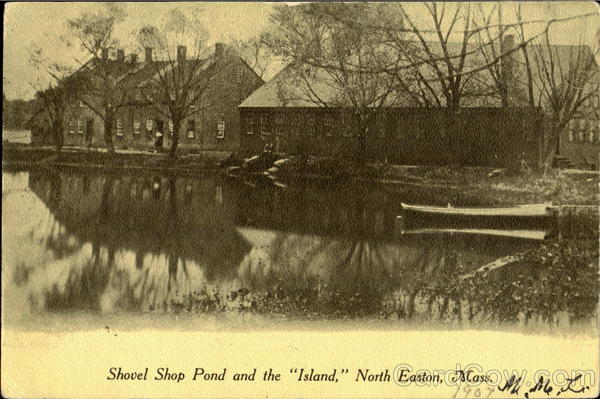
Shovel Shop Pond And The Island North Easton, MA

Replacement buildings on a section of the Ames shovel complex

1852

March 4 Thursday  Scott & Holbrook are setting glass at

the shop to day  They have the front entry partly

painted  I carried my work into Edwins this

forenoon  mended O Angiers shop coat  This afternoon

have been to Mr Torreys with Augustus & Lavinia

Called a few moments on Hannah  She has a 

sore mouth and is weaning her child

Evelina addresses her day calmly, as always keeping her distance from the goings-on at O. Ames & Sons. Most other residents of North Easton were still reeling, no doubt, from the huge fire that had burned down a majority of shovel factory buildings over the night of March 2. The sun was shining and the wind was out of the north west, pushing around remnant smoke still rising from the ruins of the complex of wooden buildings. Shovel shop employees had no regular job to go to and the owners had some serious decisions to make, fast.

Clean-up from the huge fire was underway, probably by the labor of the very men whose factory jobs had been temporarily eliminated. The men who had been painting and papering at the Ames’s house, for instance, were co-opted to set glass at the shop, suggesting that new panes of glass – the originals probably having been blown out by the fire – were going into the windows of the one or two buildings that had survived.

As town historian Ed Hands points out, “the Ames family and the neighborhood rebounded quickly.”*  Old Oliver and his sons Oakes and Oliver Ames Jr. made a two-fold decision. The first was to create temporary structures to house the manufacturing so that shovel making could resume as quickly as possible.  The second was to create “new, permanent stone shops,”* sturdy, nonflammable structures that could outwit any new fire.

There was insurance money to cover at least some of the rebuilding. Sources differ on the amount of damage that the fire inflicted, but suggest it was between $30,000 and $40,000. The amount of insurance coverage is also uncertain. Old Oliver “states that there was $3,000 worth of insurance on the buildings”** but, according to industrial historian Greg Galer, it’s likely that the Ameses had increased insurance coverage on the factory back in November, 1851. Whatever the actual dollar cost was, “[t]he company bounced back quickly from the devastation, and seemingly without significant financial trauma.”**

*Edmund C. Hands, Easton’s Neighborhoods, Easton, 1995, p. 163

** Gregory Galer, Forging Ahead, MIT, 1989, p. 249


January 29, 1852

Teeth

1852

Jan 29th Thursday  Mrs Witherell Oliver 3rd & Fred & George went

to Bridgewater this morning for Mrs Witherells temporary

set of teeth.  Father & Mrs S Ames & Emily here to dine

Mrs S Ames came about half past eleven and spent

the rest of the day.  Have written a letter to Harriet

Ames [of] Burlington.  Went after mother in a sleigh to night

Augustus & wife spent the evening Three evenings this week


Sarah Ames Witherell traveled to Bridgewater today to pick up a “temporary set of teeth” to replace the real ones that had been pulled out earlier this month. It turned out that they weren’t ready, so she had to return home without them. As before, she was accompanied by several family members including her son George Oliver Witherell and two of her nephews, first cousins and good friends Oliver (3) and Frederick Lothrop Ames, who were still home on a recess from college.

Evelina, meanwhile, fed midday dinner to all the family members who stayed behind in Easton.  Sarah’s daughter, Emily, didn’t go with her mother this time; unlike Oliver and Fred, she and Susie Ames may well have been back in school. Evelina may have been feeling the strain of so much company.  She notes that her nephew Augustus and his wife, Hannah Lincoln Gilmore, had come to call “Three evenings this week.” Augustus, who did a lot of work for Oakes and Oliver Jr., often made himself at home at the Ames’s.

Harriet Ames of Burlington, Vermont, to whom Evelina wrote today, was a spinster cousin. Her mother was the widow of Old Oliver’s brother, John.*

*not the same John Ames who manufactured paper in Springfield

January 27, 1852

TMM03FOOD10_a_237278c

1852

Jan 27  Tuesday.  Mrs S Ames & Frederick were to dinner  had a roast

goose.  This afternoon Mr & Mrs Whitwell, Mr & Mrs

John Howard & Miss Jarvis    Mrs Witherell Augustus

& Hannah came this evening    Frederick went after the

ladies. Oliver & George carried them all home this

evening.  Baked some tarts in the other house stove

Have sewed but very little  Mr Wm Brown was also here.

Quite a sociable day for the Ameses, full of company.  Midday dinner was attended by Sarah Lothrop Ames and her son Frederick. (The absence of Oliver Jr. and Helen Angier Ames suggests that the former might have been away on business while the latter had returned to school.) Fred, like Oliver (3), was home from the Ivy League; their conversation at the dinner table probably provided some fresh subject matter. Perhaps they entertained family members with a modified description of life on campus.

Evelina served a roast goose (that Jane McHanna had cooked), a dish that normally denoted a special occasion such as Christmas or New Year’s. Were they serving it in anticipation of Oliver (3)’s 21st birthday, or was it just a whim? Either way, serving roast goose on an odd weekday signified wealth behind the larder.

Sarah Josepha Hale offered a recipe for roast goose in her popular household guide, The Good Housekeeper, suggesting that it be stuffed and roasted on a spit over a “brisk” fire for at least two hours. Otherwise, she had a qualified opinion of the dish:

“Geese seem to bear the same relationship to poultry that pork does to the flesh of other domestic quadrupeds; that is, the flesh of goose is not suitable for, or agreeable to, the very delicate in constitution. One reason doubtless is, that it is the fashion to bring it to table very rare done; a detestable mode!”*

Mrs. Hale would likely have approved of the baked tarts, however, that Evelina served for tea later in the day to the Whitwells and others.  It’s a happy note that Sarah Witherell ventured over at the very end of the day; she must have been feeling better after the extraction of her teeth some days back.  She was comfortable enough to let Evelina’s nephew Augustus and his wife Hannah see her face, which had been swollen for days.


*Sarah Josepha Hale, The Housekeeper’s Guide, 1841, p. 52