June 28, 1852

Haymaking

1852

Monday June 28th  Have been about the house at

work most of the day  Swept most of the 

house except the parlour.  washed the

front stairs and have the house in pretty

good order  Mrs S Ames came in with her 

work and stoped an hour or two something

unusual for her  Hannah came to spend 

the evening but I had gone into Edwins and

she went in to see Mrs Witherell


Either Evelina felt better this morning, or her habit of working simply wouldn’t let her be idle. In the course of the morning, she swept most of the rooms and washed the stairs while her servant – Hannah Murphy, most likely- did the laundry and prepared the midday dinner. In the afternoon, Evelina at last sat down. Sarah Lothrop Ames came over – “something unusual for her” – and they visited and sewed together. Evelina was usually the one who went next door, not the other way around. In the evening, Evelina even felt well enough to go across the street to see Edwin and Augusta Gilmore.

The highlight of the day, however, had to be the commencement of haying. Old Oliver reported that “this was a fair warm day wind south west + verry dry We begun haying to day.”*  The calendar may have indicated that summer had barely begun, but everyone knew that fall and winter lay ahead. That hay would be essential. And now that haymaking had begun, perhaps Old Oliver would be less irritable with his family members.


Oliver Ames, Journal, Stonehill College Archives, Arnold Tofias Collection
June 25, 1852

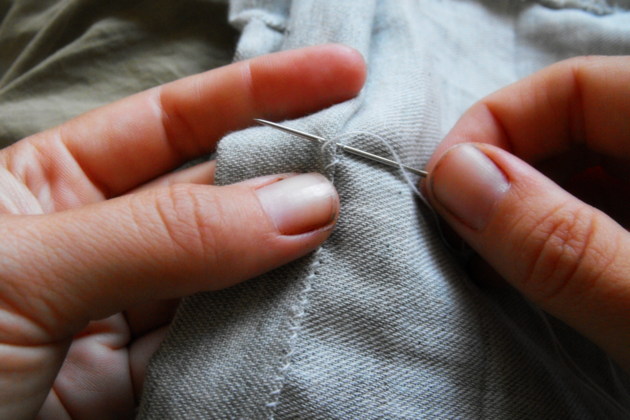
hand-sewing-color-grown-cotton-pajama-pants-for-a-toddler

1852

June 25 Friday  Worked about house all the forenoon 

but can scarcely tell what I was doing but

know I wasnt idle. This afternoon have

been mending different articles Hannah

mended the stockings.  I hope she is going 

to be a pretty good girl.  Mr Whitwell called

Called at Edwins this evening  Augustus & wife

Edwin & Elisha Andrews gone to Alsons


New servant Hannah Murphy was “pretty good” today helping Evelina mend the family stockings. Mending was never Evelina’s favorite duty.  She often put it off, preferring instead to head for the garden or slip next door to chat with one of her sisters-in-law. But what she seemed to prefer most of all was to sew. Cutting cloth for a new dress, or refashioning a waist in an old one, finding just the right trim for her sleeves, or making multiple buttonholes, such was her passion. Evelina loved to sew.

If Evelina had lived today rather than in the 19th century, would sewing still have been her favorite occupation? Freed from her domestic obligations as a 19th century housewife, and no longer in the thrall of the patriarchal laws and mores of the day, what could she have accomplished?  She was so tactile that it’s hard to imagine her abandoning her needle, or not using her hands. Might she have become a textile artist? A craftsperson? Or had a career in fashion?

We know that Evelina was hardworking; as she herself points out, “I wasnt idle.” Whatever career we might imagine for her to excel in, she would have committed to it as surely as she did to her domestic agenda in the 1850s. Yet the fantasy of transporting Evelina to the 21st century ultimately falls flat.  She was too much a creature of her own time and place, as we all tend to be, and not unhappy with her lot in life – even while mending.


May 25, 1852

6089c8280037ff67c6d0be6ce3396045

Tuesday May 25th   Hannah Maccomber spent the day

Miss Kinsley  Billings & Scovill called about eleven

a very short call.  Hannah & sister called for a 

few moments  We have cleaned the sitting room

& bedroom  Mrs Patterson did the greater part

Mr Scott has finished painting the dining room

and put a coat of green paint between the

shelves in the sitting closet  Abby came after tea

Evelina managed to entertain visitors today even as spring cleaning cantered along in her half of the house. Her sister-in-law Hannah Lincoln Gilmore, and Hannah’s sister Elizabeth Lincoln, dropped by “for a few moments” to say hello. Hannah, being a housewife herself, knew enough to keep the visit short. Hannah and Elizabeth were “old shoe,” as the saying goes, and Evelina probably felt no compunction to impress them or be other than what she was: a housewife in the throes of cleaning.

The other surprise visit would have been less easy to accommodate. No doubt Evelina was pleased to see Miss Lucy Kinsley of Canton and her two young friends, especially after being so well entertained by the Kinsley family only a week earlier. Yet Evelina might have wished that the young ladies had come to call at another time when her home had been been more presentable.  Perhaps, too, the young ladies might have wished to catch a glimpse of the handsome Ames sons, who were more than likely at the shovel works. The awkward timing and mutual, if slight, disappointment of the call may explain its “very short” nature.

Mrs. Patterson did the lioness’s share of labor in cleaning the sitting room and bedroom, even as Mr. Scott finished the dining room and painted some closet shelves. Evelina worked alongside them both, when she wasn’t called away, and managed to oversee their work and plan ahead as well. It could be that the extra energy she was using to put her home in order was, in one respect, a way to channel her grief for her nephew, so recently deceased. Her body was busy all day long, getting things done, and her mind occupied with domestic necessities. All this may have helped her sleep at night.


May 6, 1852

images-1

Queen of the Prairie

1852 May

Thursday 6th Worked in the garden a short time and

about nine went to the shovel shops with Hannah

and her sister  They spent the afternoon here and

Augusta.  Edwin came to tea  Mr Brown,

Olivers room mate, came to night.  We ladies rode

to Mr Clapps, bought Queen of the Prairie for 37 cts

Warm sunshine sent Evelina outdoors for much of the day. She gardened after breakfast, then broke away at nine a.m. to go over to the shovel shops with her niece, Hannah Lincoln Gilmore, and Hannah’s sister, Sarah Lincoln. What were the ladies doing at the factory? Evelina wouldn’t have gone there on her own volition.

The Lincoln sisters, originally from Hingham, spent much of the day with Evelina.  They were joined by Augusta Pool Gilmore, whose husband Edwin Williams Gilmore later came to tea. “We ladies” traveled to the home of Lucius Clapp, another fine gardener with plants to sell, where Evelina purchased a Filipendula rubra, or Queen of the Prairie. Clapp was a well-respected citizen of Stoughton, described by a contemporary historian as “one of the representative farmers of this progressive age.” *

Oliver (3), meanwhile, was briefly home from Brown University.  His roommate, a Mr. Brown, came to North Easton for a visit. It was a full table at tea time.

D. Hamilton Hurd, History of Norfolk County, Massachusetts, pp. 424-425


April 30, 1852

135555850

1852

Friday April 30th  Worked in the garden awhile this

morning  Mr Scott has grained the cook

room  Rachel dined here & was intending to 

spend the day but Mrs Packard came to Edwins

and she went back there  Mrs Lincoln

passed the afternoon & Augustus to tea  Abby

spent the day, was away awhile with Mrs

Clapp after some flowers.  Hannah gone to Boston


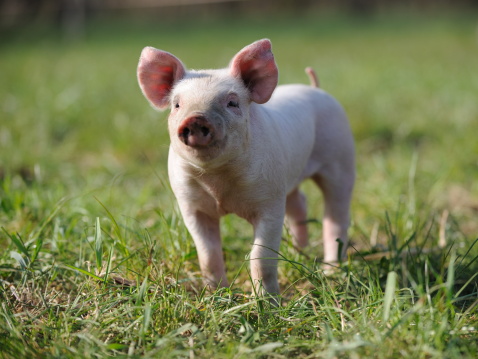
The last day of the month was “a fair day + the warmest we have had this spring …,”* according to Old Oliver Ames, who also noted that he “killed 4 shoats to day.”

A shoat is a newly weaned pig that typically  weighs in at about thirty pounds. It wasn’t unusual to find a farmer thinning a litter of pigs (also known as a drift of pigs) at this time of year, for different reasons. Many farmers bought shoats at this time of year to fatten up over the summer and slaughter in the fall. For reasons known only to himself, Old Oliver chose to slaughter four of his young pigs rather than sell them. Perhaps the shoats in question were unpromising specimens, or perhaps the Ames family was ready for a little fresh pork.

In the first part of the 19th century, the word “shoat” was also used as a pejorative slang term, intended to describe someone as fairly useless. To call someone a shoat was to say that he or she was dispensable and unimportant.

*Oliver Ames, Journal, Stonehill College Archives, Arnold Tofias Collection

April 29, 1852

images-1

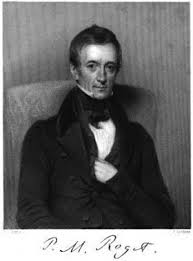
Peter Mark Roget

(1779 – 1869)

1852

Thurs April 29 Baked twice in the brick oven.

Mince pies, cake bread &c   Mr & Mrs 

Kinsley with their family made quite a long

call  They are very pleasant.  After they left went

to Mr Torreys  Augustus, wife & her sister  Augusta

& Rachel there, brought home some rose slips

The aroma of baking filled the Ames house today as Evelina produced pies, cakes, bread and more. Or should we say that the smell, or the scent, or the fragrance, or the odor of baking bread was apparent to anyone who stepped into the house? Roget’s Thesaurus would offer us any one of those synonyms for the word aroma.

The first edition of Roget’s Thesaurus was published on this date in 1852. Peter Mark Roget, a British physician, inventor and theologian, began to compile synonyms as a young man as one way of combatting the depression that plagued him for much of his life.  Beginning the work in 1805, not long after he had completed his medical studies, he spent nearly fifty years bringing the publication to fruition.  The first edition had approximately 15,000 words; it has been continually expanded, updated regularly ever since.

The Kinsleys of Canton came to visit in the afternoon and, no doubt, they could smell the fresh baked bread. Lyman Kinsley was an iron trader who had many dealings with the Ames family; within the decade, his business would be owned by the Ameses and overseen by Frank Morton Ames. That was in the future, however. On this day, he, his wife, Louisa, daughter Lucy and younger sons, perhaps, all came for “quite a long call.”  Evelina enjoyed their company, but after they left she bounced right out of the house to go into the village to visit relatives and bring home rose slips. The garden!


April 25, 1852.

Lilac_bush-2edq3ho

Sunday April 25th  A very pleasant day and have

all been to meeting.  Came home at noon

with Hannah & sister and Susan, all returned

in the afternoon.  After meeting called at

Olivers to see Mr & Mrs A Lothrop and rode to

Mr Manley to speak for some plants

Augustus & Hannah rode with us as far as

Mr Swains  Emily & Susan went also to Mr Manlys

Lilacs, a fragrant favorite for gardeners and civilians alike, were among the plants that Evelina selected at Edwin Manley’s today. In the 19th century, many a New England farmhouse featured lilacs close to the door, as American poet Walt Whitman famously describes in When Lilacs Last in the Dooryard bloom’d, his elegy for Abraham Lincoln:

…In the dooryard fronting an old farm-house near the white-wash’d palings,

Stands the lilac bush tall-growing with heart-shaped leaves of rich green,

With many a pointed blossom rising delicate, with the perfume strong I love,

With every leaf a miracle – and from this bush in the dooryard,

With delicate-color’d blossoms and heart-shaped leaves of rich green,

A sprig with its flower I break…

Today after church, the sermons and small social obligations dispensed with, Evelina thought about her flower beds. The day was “fair” and “some warmer,”* so with niece Sarah Emily Witherell and daughter Susan Eveline Ames, she rode up to visit her go-to gardener “to speak for some plants.”  Mr. Manley indicated he would bring the plants by the next day.  Evelina wouldn’t have been able to plant anything today, it being the Sabbath, but she could imagine where she would put the plants, and how they would look, the anticipation of which added to her delight.

*Oliver Ames, Journal, Stonehill College Archives, Arnold Tofias Collection


April 22, 1852

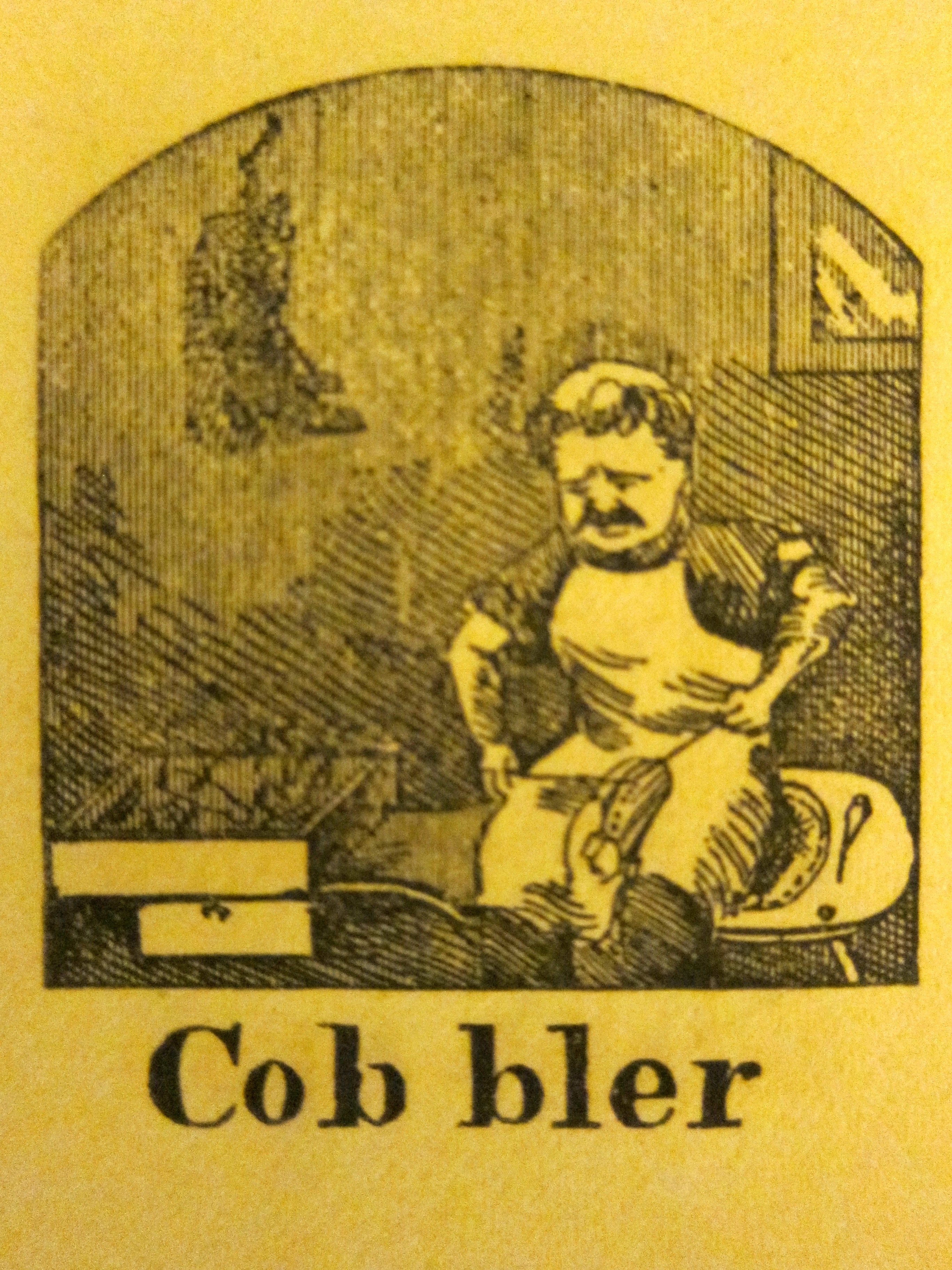
Cobbler

1852

Thursday April 22  Worked a very little in the garden

not very pleasant but looks more like fair weather

Sewed a little on my black silk dress

Called with Augusta on Hannah & her sister

Sarah, Abby and at Willard Lothrop, Sampsons

A Pratts Holmes and at the store.  afterwards at

Olivers & Edwins carried a pr shoes to mend

A little sewing, a little gardening, and a great deal of socializing filled the hours of Evelina’s day today. After being pretty well pent up by several days of stormy weather, Evelina was ready to go out.

With her niece-in-law, Augusta Pool Gilmore, she called on another niece-in-law, Hannah Williams Gilmore. There they met Hannah’s sister, Sarah Lincoln, who was visiting from Hingham. They went on to see yet another niece, Abby Torrey, then to the homes of Willard Lothrop (one of Easton’s most active spiritualists), Joel and Martha Sampson, and others.

The Sampsons were a younger couple from Maine with five little children aged eight and under, including three-year-old twins. Joel Sampson worked at the shovel shop and was evidently devoted to Oakes Ames. Twenty years later, on hearing of Oakes’ death, “Joel Sampson, teamster and farmer of the company came home when he heard the sad news, threw himself upon his sofa and announced to his wife that the head and soul of the business was dead, that every thing would go to smash now, and told her to make ready to go back to their old farm and home in Maine, as it was no use to live here any more.”**

Throughout her travels today, Evelina carried a pair of shoes to be mended. In an area of the country well known for its shoe manufacturing, there must have been a good cobbler somewhere in town.


* Oliver Ames, Journal, Stonehill College Archives, Arnold Tofias Collection
**William Chaffin, “Oakes Ames,” p. 2

April 17, 1852

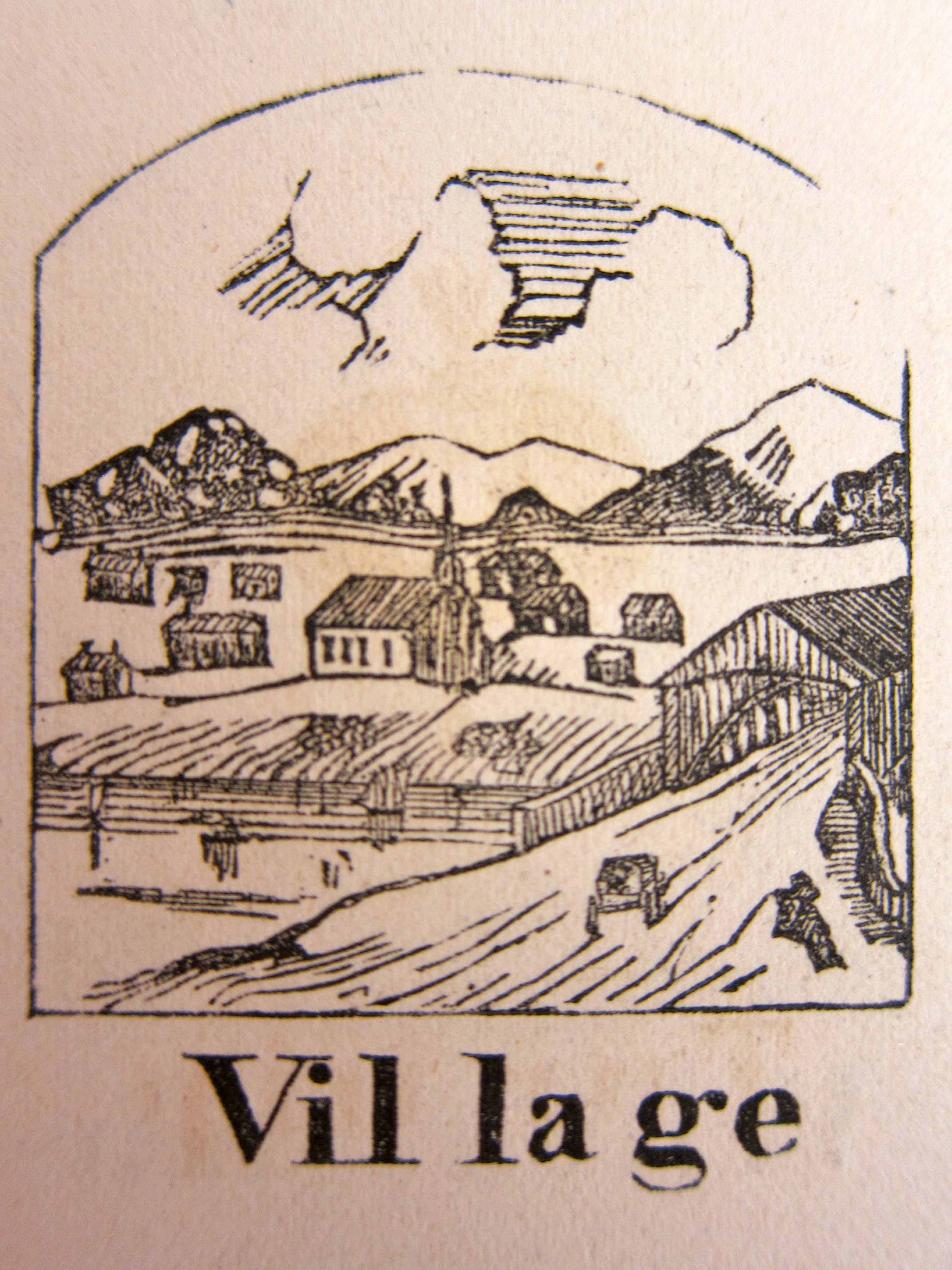
Village

1852

April 17  Saturday  Julia was at work here a year ago to day

has improved very much in dress making since then

I have my black silk nearly finished.  The Delaine

all done except the sleeves & buttons, am waiting

to go to Boston to get the trimmings.  This afternoon 

have been altering some old dresses for Susan

Hannah called to get me to go up by the school

house and select a place for a house for them

Mrs Witherell went with me  A beautiful pleasant day

Sewing continued today, with Julia Mahoney again on hand to assist with Evelina’s new dresses, one of black silk, the other of a light wool they called delaine. The finished projects would have to wait for trimmings to be fetched from Boston. Evelina meanwhile refashioned some old dresses for her daughter, for “[e]very season there was a great remaking of old garments to bring them up to date.”*

The bad weather of the past two days disappeared and was replaced by fair skies. Despite continued cold temperatures, Evelina was finally drawn outside on a fun errand. Invited by her niece, Hannah Lincoln Gilmore, and accompanied by her sister-in-law, Sarah Ames Witherell, she went to the local school house to look at some property that her nephew, Alson Augustus Gilmore, and Hannah, his wife, were considering.  They had been renting rooms from Col. John Torrey, but now were planning to build a house.

Everyone in North Easton lately seemed to be wielding a hammer. It was spring.


*Winthrop Ames, The Ames Family of Easton, Massachusetts, p. 127


April 16, 1852

 women sewing*

1852

April 16th Friday.  Julia here again to day and we have

been to work on my dresses  Mrs S Ames & Witherell

helped some time this afternoon and we have

got along nicely  Hannah & Augusta called

Augusta brought her work and Hannah finished

Susans stocking.  Susan has the other stocking about

half done.  The first pair that she ever attempted to knit.

Stormy again to day.

The day before had rained “pritty fast” all day long, and today opened in much the same vein, with “snow squals + rain + a high wind.”***  The women stayed indoors and focused on fashion.  Dressmaker Julia Mahoney came over to work on new outfits for Evelina. Sisters-in-law Sarah Ames and Sarah Witherell helped for a time, too, both of them as accomplished at sewing as Evelina. They all “got along nicely,” a phrase that suggests good progress was made on Evelina’s dresses, although the women’s sociability quotient was also probably pretty high.

Others joined the hum.  Nieces-in-law Hannah Gilmore and Augusta Gilmore, a younger set of eyes and hands, arrived with work in hand. Hannah helped her little cousin, Susie Ames, knit a pair of stockings.

The sewing of new dresses – as opposed, say, to the mending of men’s shirt fronts – was the favorite expression of the women’s collective talent with needle and thread. As Winthrop Ames noted, “An immense amount of sewing went on in every family.”** We’ve certainly learned that from Evelina’s diary.  In 1852, they still made their own dresses. “[T]he materials and trimmings, after much consultation about their style and quality, were made up in the house with the help of the town seamstress and pictures from the fashion magazines.”

Things would change. By the start of the Civil War, the Ames women began to have their dresses made up in Boston. But on this day in North Easton, needles flew.


*Image courtesy of nhdsewingmachine.weebly.com

** Winthrop Ames, The Ames Family of Easton, Massachusetts, p.126

*** Oliver Ames, Journal, Stonehill College Archives, Arnold Tofias Collection