September 5, 1851

Pentax Digital Camera

*

Friday Sept 5th  Expected to be alone to day and was in

hopes to do some sewing but about ten Oclock

concluded to invite Mrs Latham (who came yesterday

to Father Ames,) to tea and all from the other part

of the house.  Jane made a great fuss about getting

tea having some short biscuit to make and I

got very nervous.  Mrs S Ames staid awhile but

went home to tea


The house on Main Street was relatively empty today.  Son Oliver had left for college and friends Pauline Dean and Orinthia Foss had departed as well.  Her husband Oakes and other sons, Oakes Angier and Frank Morton, were at work and little Susie was at school.  How quiet the house must have seemed, even with the sounds from the factory ringing from across the road. Evelina sat down in solitude to sew and found she wanted something more.

A little tea party was what was needed, she “concluded,” although her servant, Jane McHanna, evidently disagreed.  Jane probably had her own agenda of tidying up after yesterday’s whirlwind of departures and so “made a great fuss” about the extra work. Jane’s irritation ran counter to Evelina’s hopes, and some kind of verbal tussle must have ensued. No wonder that Sarah Lothrop Ames, who had come over from next door, didn’t stay around.

The party must have happened, however, else Evelina would have written otherwise. Jane prepared the meal. Late in the afternoon, family from the other part of the house and their guest, Mrs. Latham, were treated to tea and “short biscuit” and, perhaps, other refreshments.

Short bread or short biscuit or short cake – all names for the same, crumbly finger food – was a typical offering at tea parties, and simple enough to make that many cooks wouldn’t even need a recipe, or “receipt.” Using some of the butter that Evelina had bought just one week earlier, Jane McHanna would have followed a process similar to that described by Lydia Maria Child in her book The American Frugal Housewife:

“When people have to buy butter and lard, short cakes are not economical food. A half pint of flour will make a cake large enough to cover a common plate.  Rub in thoroughly a bit of shortening as big as a hen’s egg; put in a tea-spoonful of dissolved pearlash; wet it with cold water; knead it stiff enough to roll well, to bake on a plate, or in a spider.  It should bake as quick as it can, and not burn.  The first side should stand longer to the fire than the last.”


*http://britishfoodhistory.wordpress.com/2012/06/10/shortbread/


September 3, 1851

Trunk

Wednes Sept 3d  Alson came this morning & brought

Orinthia and staid to dinner and carried Mrs Stevens

home with him  Orinthia has been packing her clothes

Mrs Stevens stiched three more collars for me & Mrs

Witherell two that are for Frank.  Abby Torrey called

this afternoon &c and on her return Orinthia & I went

to the store  Pauline passed the afternoon with Helen

Orinthia Foss was packing her clothes, getting ready to return home to Maine. What prompted the departure isn’t clear. Did she lose her job, or was she called home on family matters? She would return to North Easton eventually, but did she know that when she left?  How did she feel about leaving this town where she had lived for six months? How did Evelina feel about the loss of her young friend, even temporarily?

Orinthia wasn’t the only one with a trunk to be packed. Oliver Ames (3), too, was a day away from departure and had a trunk into which his mother – and others, perhaps – were placing his new collars and mended shirts. Last minute sewing was still going on, but by this time the trunk would have been nearly full of the clothes that Oliver would need for a term at college.

That Oliver was going away to study at Brown was just shy of miraculous.  At 20, he was old to be going, for one thing; in the nineteenth century, the average students were teenaged, like Fred Ames at Harvard. But more than that, his father Oakes had not wanted him to go. According to one 19th century acquaintance of Oliver, Oakes “had inherited some measure of that Puritanical contempt for the liberal arts.” After completing prep school, Oliver had been directed to work at the factory, “to learn the trade of shovel-making. But the desire for a higher education remained strong, and when at the end of his five years apprenticeship he had mastered the trade, his father yielded to his solicitations, and allowed him to enter Brown University.” * Oliver had earned his ticket out.

* Hon. Hosea M. Knowlton, “Address,” Oliver Ames Memorial, 1898, pp. 98-99


August 26, 1851


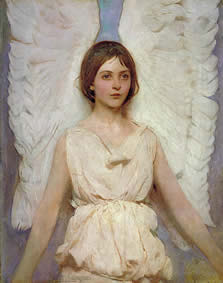
Abbott H. Thayer, Angel, 1887, oil Smithsonian American Art Museum Gift of John Gellatly

Abbott H. Thayer, Angel, 1887, oil
Smithsonian American Art Museum
Gift of John Gellatly


Tues Aug 26th  Clinton Lothrop died about ten Oclock

last night  Has been sick a long time with

the Typhus fever  Mrs Witherell & I made the

shroud for him  Mrs Mitchell went to Taunton

to get Bonnets &c for Mrs Lothrop

Rebecca White came after Pauline this morning

Alson here to Dinner and tea is drawing stones for

Edwins cellar.  Oakes A and Frank returned this evening


Dewitt Clinton Lothrop finally died.  He had been suffering from typhus, “an acute infectious disease caused by the parasite Rickettsia prowazekii, transmitted by lice and fleas [,and] marked by high fever, stupor alternating with delirium, intense headache and dark red rash.”* It’s not the same disease as typhoid fever, although the two conditions have some similarities. Clinton, as he was known, had probably been bitten by a flea.

One of nine sons of Howard and Sally Lothrop, Clinton was a brother of Sarah Lothrop Ames. While most of his surviving brothers had moved away from Easton in pursuit of their own lives, Clinton was the duty son who had stayed home with his parents. Only 26 years old and married with two small sons, he had tended the family farm.

Evelina and Sarah Witherell quickly prepared a shroud for the body, while Harriett Mitchell rode off to Taunton to find mourning clothes for the young widow, Elizabeth Howard Lothrop (or for the mother, Sally Williams Lothrop.) That no one had purchased the mourning clothes before now suggests that, despite the probability of death, everyone had hoped that Clinton would recover.

It was a busy day for Evelina.  Besides helping sew the shroud, she saw her friend Pauline Dean depart to visit elsewhere in Easton and welcomed her brother Alson to midday dinner. Alson was working nearby, helping his son, Edwin Williams Gilmore, build a house.  Jane McHanna washed clothes, and she and Evelina probably continued to set the house to rights after a weekend of guests. Oakes Angier and Frank Morton returned home from their fishing trip.

* Craig Thornber, Glossary of Medical Terms Used in the 18th and 19th Centuries, http://www.thornber.net

August 25, 1851

il_570xN.69597337

*

Monday Aug 25  Did not wash this morning on account 

of having so much company  Warren left in the stage

cousin Jerry went to Mr Thesis with Oakes Angier

and Frank on their way fishing.  Alson dined here.

We Ladies all called at Mr Torreys & on Elisha

at the Boot shop.  Mr & Mrs & Miss Kinsley & Miss

Billings from Canton were here to tea – came

about 6 Oclock went to the shop with them

Another Monday and for the second time that summer, washing day got deferred.  Tidying up from “having so much company” took precedence over routine. The young relatives, Jerry and Warren Lothrop, left in the morning.  Another visitor, Pauline Dean, remained.

Oakes Angier and Frank Morton Ames left to go fishing, a trip they had deferred from last week. They had waited then for the imminent death of Dewitt “Clinton” Lothrop, which hadn’t happened.  Clinton, though deathly ill with typhus, was hanging on. The boys decided to wait no further, and departed.

Evelina and “We Ladies” – which could only mean Pauline and probably niece Lavinia – went to see Col. John Torrey in the village and called on Elisha Andrews at the boot factory. Elisha, who was 27 years old and single, had started up the factory with Augustus Gilmore and Oakes Angier Ames. In recounting the visit to the boot shop in her diary, Evelina underlined Elisha’s name. Why? The visit was significant in some way; perhaps one of the women – Lavinia? – was romantically interested in Elisha.

More socializing continued late in the day when the Kinsley family visited.  Lyman Kinsley, his wife Louisa, daughter Lucy Adelaide and a Miss Billings (a niece of Louisa, most likely) came for tea. Mr. Kinsley ran an iron and machine shop in Canton, an enterprise that the Ameses would eventually own. After tea, they all walked over to the factory.

* Currier and Ives, “Starting Out,” print, ca. 1852

August 17, 1851


Marriage

Sunday 17 Aug  Went to meeting all day  At noon I went

with Henrietta to Mr Whitwells passed a very

pleasant intermission  Mother was at meeting

went home with Mrs Curtis  Orinthia came

home having a severe toothache  Frank carried

her back to Mr Howards and staid untill

nearly ten  It is very dark & stormy to night

has stormed all day.  Margaret Norton married.

As on so many other Sundays, the Ames family went to church.  Evelina stayed for both services and spent the intermission with her sister-in-law, Henrietta Williams Gilmore at the parish house. Eliza Whitwell, the minister wife, no doubt offered them a cup of tea and other refreshments. Evelina’s mother probably sat with them, too, before leaving for the Gilmore farm.

Old Mrs. Gilmore and her daughter-in-law, Henrietta, may have been privy to a marriage ceremony later in the day, when a servant of the Gilmores named Margaret Norton was married. Before the Civil War, it was customary for marriages to take place at home. As historian Jack Larkin has noted, “Most American couples were wed by a clergyman at the home of the bride, in […an] informal ceremon[y] of republican simplicity.”* But Margaret, besides having no home of her own, was from Ireland and thus probably Catholic. She may have been obliged by Catholic practice to marry in the church, possibly the new church that had just been built.

Orinthia Foss did not have such a pleasant day. She came down with a “severe toothache” and had to go home.  Frank Morton Ames offered his services as driver and stayed out late, his mother noted. Lively young man that he was, he wasn’t inclined to turn in early. Was it the stormy weather or the company of Ellen Howard and Orinthia that held him at the Howards’s house? Did Evelina wait up for him?  Or did his father wait up for him?  How did that go?

*Jack Larkin, The Reshaping of Everyday Life: 1790 – 1840, New York, 1988, p. 63.


August 16, 1851

Tub

Sat 16th Aug  Have been to work on my white loose dress

that Julia cut out some time since and it is ready for

the washtub  Frank and Oliver came from Bridgewater about

three and brought home Charles Mitchell & Sister Harriet

Mr Brett two Miss Tolmans from New Bedford Jane & William

Howard & Orinthia came & went to the shop about 5 Oclock

The party at Robbins Pond in Bridgewater may have ended, but the festive mood continued.  Oakes Angier Ames headed into Boston, but his brothers Oliver (3) and Frank Morton returned from Bridgewater with their Aunt Harriett and her brother-in-law, Charles Mitchell and, perhaps, others. At the same time or maybe just a short while later, Orinthia Foss and a spill of friends to whom Evelina had been introduced only a few days earlier arrived and went to the factory.

Why this sociable group visited the shovel factory at the end of the day is a mystery. Were they delivering the Ames brothers back to work? Were they visiting someone else there? Did Oakes or Oliver Jr. find it amusing? Was Old Oliver privy to this after-party?

Evelina, meanwhile, was working on her wardrobe and was ready to put a new dress into the washtub.  She might have looked up from her sewing to see the young people drive by.


August 15, 1851

Vintage Ames Shovel

Vintage Ames Shovel

Friday 15th Aug  Julia here to work to day cutting me

a purple loos dress & cutting a pink french

calico for Susan.  Made a childs waist to it.

Oakes Frank & Oliver went this afternoon

to Robbins pond in E Bridgewater to a party.

Oakes A is to go from there to Boston tomorrow

I have passed the afternoon at Mr Peckhams

had a pleasant visit

Robbins Pond, where the Ames sons and their Aunt Harriett went today for a party, is in Bridgewater and is known today for its bass fishing.  Who hosted the party there in 1851 isn’t known, but all the Ameses, including Evelina, were invited.  Evelina declined, however, suggesting yesterday that she might enjoy herself too much if she went. She went to call on the Peckhams instead.

On a much more serious note, today marks the one year anniversary of a terrible accident at the shovel factory. According to Old Oliver, an employee named William Loftis “was hurt so bad yesterday by leting a shovel catch in the polishing wheel that he dyed.” Loftis was an illiterate laborer in his late twenties. Like the Middleton and Maccready families with whom he lived, he had immigrated from Ireland.

Old Oliver seemed to blame Loftis for getting caught in the machinery, perhaps through inattention or carelessness. He doesn’t suggest that the factory was at all at fault, or that the machinery could be reconfigured in a way to make it less dangerous. As far as Old Oliver and most factory owners at the time were concerned, employment carried a certain level of risk, risk that was assumed by any man who received a pay check.

It’s doubtful that the Ames family was indifferent to the fate of William Loftis, however. It’s likely that Evelina or one of her sisters-in-law sewed a shroud for the body for a proper burial. Knowing Oakes Ames’s instinctive kindness to strangers and employees, he probably would have reached out to Loftis’s family. The absence of a widow and children, however, suggests that Loftis was simply buried and simply forgotten.


August 14, 1851

IMG_2478

Thursday 14th  Worked about house awhile and then went

to sewing & fixing some work for Ellen cut a 

chimise for self &c. Charles Mitchell brought

Sister Harriet and Johnny from Bridgewater

Harriet has gone back to attend a party 

at Robbins pond tomorrow.  We all have an

invitation but I think I had best not go though

it would give me pleasure

Evelina put out some fabric today for the new girl, Ellen, to cut into pattern pieces. She noted that her sister-in-law, Harriett Ames Mitchell, came over briefly from Bridgewater with her middle child, John Ames Mitchell, but soon went back to prepare for a party.

Although his birthday went unmentioned in the diary, Frank Morton Ames, the third child of Evelina and Oakes Ames, turned 18 today. Taking his place in a patriarchal society behind two bright older brothers, Frank had to vie for recognition almost from the beginning. Like Oakes Angier and Oliver (3), Frank attended local and boarding school, in the latter case Andover, and had just completed his schooling the year before Evelina took up her diary.

Unlike Oakes Angier and Oliver (3), Frank was a troublemaker “who needed more discipline.”  According to historian William Chaffin, Frank and a friend once sneaked out of their respective homes, took a horse and buggy to a dance in Canton, and returned “very late.” When Oakes Ames learned about it, he and the other father, William S. Andrews, took their sons down to the shop where they “were horsewhipped in the presence of the workmen.”  As Chaffin notes, “Discipline was apt to be severe in those days.”*

One of the pleasures of Frank’s life was his participation in the local militia, a company of which was formed in 1852.  Again he had to stand behind a brother, in this case Oliver (3), who was made captain while he was appointed quartermaster, but eventually Frank made major. He resigned that position in 1860, by which time he was married and living in Canton.  Neither he nor his brothers served in the Civil War.

Frank would go on to have checkered success in several fields away from the shovel factory. With his brothers, he worked to rebuild his father’s reputation.  Despite the severity of treatment he had experienced from his father, he remained devoted to Oakes’s memory.

* William Chaffin, “Oakes Ames 1804-1873”, private publication


August 10, 1851

il_570xN.520777977_foe3

*

1851

Aug 10th Sunday  As usual have been to church to day

Mr Whitwell preached.  Went to the

methodist meeting house to a sing at 5 Oclock

got sick of it and went home at recess.

Oakes A Oliver & Helen Ames went with Orinthia to the

sing and carried her home.  Frank went from 

the sing and carried Ellen H & Louisa Swan to 

ride

Her sons clearly enjoyed music, but Evelina’s appreciation was perhaps not up to theirs, if her reaction to today’s musical gathering is any indication. That, or the singing wasn’t very good.  She “got sick of” the sing at the meeting house and left when she could. Perhaps she was just ready to be at home at the end of a long, hot Sunday and already anticipated the choring and sewing ahead of her tomorrow. She may have had a good book waiting for her.

Oakes Angier, Oliver (3) and Frank Morton were regular attendees at the sings; they enjoyed the music.  They also enjoyed the company of a circle of friends who attended the sessions, including Ellen Howard and Louisa Swan. Frank Morton was the son who drove Ellen and Louisa home, while Oakes Angier and Oliver (3), along with their cousin Helen Angier Ames, drove Orinthia back to the Howard house.

Ellen Howard was the tenth of Elijah Howard’s twelve children (by three wives.) Small wonder that the Howards were willing to board Orinthia Foss for a time; Nancy Howard was quite used to setting many places at what must have been a capacious dining room table. Ellen Howard ended up marrying George Withington, a Unitarian minister who came to town about this time. He ultimately left the ministry and served for many years as Easton’s town clerk.

Louisa Swan was the daughter of Dr. Caleb Swan, who had eleven children by his three wives. Louisa never married; she eventually left Easton for Vermont, where she lived with her sister Ruth who was married to U. S. Senator Justin S. Morrill.

* Currier & Ives,The Morning Ride,”  1859

August 4, 1851

9999008697-l

[No entry]

Evelina made no entry today in her diary, for reasons we’ll never know.  Too hot? Too cross? Too busy? Too much laundry? We can only guess.

Instead of commentary, we’ve posted an image of the Ames family tree familiar to many Ames descendants, especially those who own copies of Winthrop Ames’s 1937 family history, The Ames Family of Easton, which includes a fold-out version of this illustration.  The tree features the lineage of the two Ames brothers who stayed in North Easton: Oakes and Oliver Jr., but doesn’t include the other sons and daughters of Old Oliver and Susannah who also produced issue: Horatio, William Leonard, Sarah Witherell and Harriett Mitchell.

Some readers have asked for clarification on who was who within the family. What follows is a list of the children and grandchildren of Old Oliver and Susannah.  More information about this group and their descendants can be found in a detailed family geneaology produced by William Motley Ames and Chilton Mosely Ames in the late 1980s.

Old Oliver and Susannah’s children and their children in birth order:

Oakes Ames and Evelina Gilmore Ames had five children:

Oakes Angier, Oliver (3), Frank Morton, Henry Gilmore (d. young) and Susan Eveline Ames

Horatio Ames and Sally Hewes Ames had three children:

Susan Angier, Horatio Jr., and Gustavus Ames

Oliver Jr. and Sarah Lothrop Ames had two children:

Frederick Lothrop and Helen Angier Ames

William Leonard Ames and Amelia Hall Ames had seven children:

William Leonard Jr., Angier, Oliver, John Hall, Amelia Hall, Fisher, and Herbert M. Ames

William Leonard Ames and Anna Pratt Hines had one child:

Oakes Keene Ames

Sarah Angier Ames and Nathaniel Witherell, Jr. had three children:

George Oliver, Sarah Emily, and Channing Witherell (d. young)

Harriett Ames and Asa Mitchell had three children:

Frank Ames, John Ames, and Anna Mitchell

Two other children of Old Oliver and Susannah, Angier Ames and John Ames, died without issue.