The New Year

What is a diary as a rule? A document useful to the person who keeps it. Dull to the

contemporary who reads it and invaluable to the student, centuries afterwards, who treasures it.

Sir Walter Scott


January 1, 2015

Dear Readers,

If you’re like me, you have treasured the 1851 diary of Evelina Gilmore Ames. Some of you have even participated with comments that have added depth to the consideration of a time gone by. Your additions have enhanced the small tale of a Yankee housewife who marked her modest days with regular notations of dresses sewn, flowers planted and fruits preserved, who wrote of short trips into Boston, visits to the family farm, and errands of mercy into the homes of sick neighbors.

Without meaning to, Evelina preserved a picture of life from antebellum New England, a life that has disappeared and evolved into a world she’d be hard-put to recognize. Her children, grand-children, and great-grandchildren have lived and died. Her house itself is gone, though the grander dwelling of her in-laws, Oliver, Jr. and Sarah Lothrop Ames, still stands proudly next door. Automobiles drive where oxen carts and horse carriages moved, and the significant architecture of certain stone buildings in the center of the village memorializes relatives she loved. The very factory whose noisy production of world-famous shovels led the local economy for decades moved away more than sixty years ago. She couldn’t have imagined it.

Yet some things remain the same. People are still people, solicitous or mean, content or down-hearted, eager or indifferent. The true characters we read about in the pages of her diary are recognizable and familiar to us in their essential humanity. We can find ourselves and our own families somewhere in these pages; we all behave so similarly. In Easton, Massachusetts, many descendants of the people Evelina wrote about still live. Last names like Ames, Gilmore, Randall, Tisdale and others can be found in the local telephone book (which itself is in danger of becoming as obsolete as Evelina’s tin stove.)

Evelina continued to keep a diary after 1851, but only the 1852 diary is extant. Her journals from the Civil War period have been lost. We’ll just have to treasure the one that remains. And so, ahead of us is the last available year of Evelina’s tiny aperture on the Ames family of old.

Thank you for reading!


Sarah Lowry Ames

(wife of John S. Ames III, great-great-great-grandson of Oliver and Susanna Angier Ames)


December 30, 1851

SwedishRunnersC

*

Tuesday Dec 30th  This forenoon worked about the house

again. Have put the drugget down in the 

parlour and dusted the room thoroughly.

Made Susan the second pair of sleeves to her blue

cotton & wool Delaine  Finished the letter to Lucy Norris

Commenced knitting the border to the bottom of my hood

It is a beautiful warm sunny day like the spring of the year


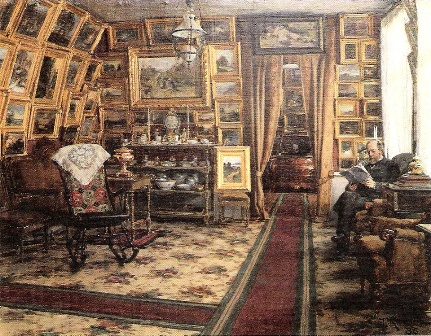
Nor surprisingly, the carpet that Evelina used in the house was inexpensive. Drugget, as it was known, was “a sort of cheap stuff, very thin and narrow, usually made of wool.”**  Drugget is an English term for “a coarse fabric having a cotton warp and a wool filling,” ** the kind of quick carpeting one might have found in a first class railway carriage. It probably had a design or a border printed on it.

Evelina has written here and elsewhere of putting carpeting down, taking it up and outside to clean, and putting it down again. She has written of stitching the carpeting together, which suggests that she may have used drugget runners side by side to make an over-all covering for her parlor floor. She may have been more conventional, though, and placed the drugget as runners on top of an area rug, or on top of a bare floor. Whatever she did, the work was repetitive and dusty.

It’s a shame that Evelina spent so much time indoors today when the weather was “fair warm + pleasant,” as Old Oliver reported. She herself made note of its similarity to spring; she should have known it wasn’t going to last.


** Wikipedia, “Drugget”, as of December 26, 2014


Scandinavian Room with drugget runners “Bibliotekarien Segersteen i sitt hem,” 1886, by Johan Fredrik Krouthen, Courtesy of http://www.burrows.com


December 29, 1851

1_f5848b408e8936030e8b62e01d05ba09

Thomas Valentine Sullivan (1800-1859)

Monday Dec 29th  Have been at work about the house all

day  Helped Susan wash the dishes this morning

cleaned the dining room swept & dusted the

parlour & sitting room chambers entry &c  This

evening have spent in Olivers quilted the lining

to Susans hood  Helen has a bad cold and has

come home  It has cleared off very pleasant

It was an average Monday at the Ames’s house. Jane McHanna washed clothes and linens in big tubs in the kitchen while Evelina swept and dusted all around the house.  Susie Ames worked, too, helping her mother with the breakfast dishes.  After the chores and meals were over, Evelina visited next door with some sewing in hand.

In Boston, however, the day was more noteworthy. An iconic American institution – so familiar to most of us in the 21st century that it seems to have always existed – was formed today. Borrowed from London, where the original organization had been founded six years earlier, a Young Men’s Christian Association was formed at the Old South Church. The “Y” was born in the U. S. A.

The driving force behind the creation of an American YMCA (another had just opened in Canada) was Thomas Valentine Sullivan, a sea captain who had chosen to spend his retirement working as a missionary on the Boston waterfront. According to the Y’s own history, Sullivan noted a “need to create a safe ‘home away from home’ for sailors and merchants.”*  Young men who found life on the street too dangerous or unsavory could take refuge at the Y for “Bible study and prayer.”*

Among her dishrags and dustmops, Evelina wouldn’t have known about Capt. Sullivan and his new work. Yet the small, hopeful gathering at the Old South Church would grow into a major, caring resource for millions of people.


*http://www.ymca.net


December 25, 1851

Turnstile


Dec 25th Thursday  The Irish are expecting to have a great

time to day Jane went to the meeting house about

eight but the priest did not come she stoped an

hour. Carried my knitting into Olivers awhile this

forenoon. This afternoon have been to mothers

with Mr Ames & Frank as they were going to West

Bridgewater.  Finished knitting the front & back of

my hood  Made a present to Lavinia of Turnpike Dividend $800

Christmas Day! But as Evelina points out, the Irish Catholics in town would be celebrating, but the Ames family wouldn’t. Jane McHanna left the house to attend a Christmas mass for which, unfortunately, the priest was either late or didn’t show up at all.  Jane returned home to prepare dinner. Evelina, meanwhile, visited Sarah Lothrop Ames next door, knitting in hand.

After dinner Evelina rode along with her husband and youngest son as they went on an errand to West Bridgewater.  They dropped her off to see her mother at the family farm. There may have been some recognition of the holiday in this gesture, although Evelina makes no mention of gift-giving, with one significant exception. Evelina gave an $800 dividend to her niece Lavinia Gilmore.

The dividend came, somehow, from proceeds from the Taunton and South Boston Turnpike, a road that had run through part of Easton since the early 1800s, between “‘Taunton Green, so called, to the Blue Hill Turnpike,'” according to town historian William Chaffin.* Its origin was controversial and involved a long-standing disagreement with the Town of Raynham, but its impact on the Gilmore family was generally positive, as various Gilmores, including Evelina’s father and brother, served as toll-gate keepers. As Chaffin points out, however, “[t]he toll-gate naturally became unpopular.” It was closed in October of 1851.

How Evelina came to possess $800 from the road is unclear. Was this a regular dividend that Evelina received, or was the family compensated for the road’s discontinuance? That Evelina passed this money on to her niece, however, is a clear demonstration that for all her economical instincts, Evelina was capable of great generosity.


*William L. Chaffin, History of Easton, Mass, 1866, pp. 454 – 458.

December 21, 1851

Toasted rice blancmange


Sunday Dec 21st  My cough and cold is much better but not

well enough for me to go to meeting  Oliver is sick

with the rheumatism there was no one to meeting

from there  All the rest went.  I spent the forenoon

in making ice cream, blanc mange &c  have written

a letter to Brother John & wife.  About 8 Oclock went

into the office with Mr Ames   Mr Swains brother came 

in awhile  Checked over our account since May

A “pritty cold,” quiet Sunday, which Evelina spent productively. She missed church; her cold was better, but her cough wasn’t.  Next door, her brother-in-law Oliver Ames, Jr., was ill with rheumatism.

Evelina had some milk or cream on hand that she needed to use up, so she made not one but two dairy desserts: Ice cream, which seems ill-calculated to please on such a cold day, and blancmange, which was also served chilled.  Blancmange is a traditional, simple dessert made with milk, flour and sugar, poured into a mold to set. Sometimes used medicinally for sore throats, it was a popular treat in the 19th century.

Once the desserts were put away in the coldest area of the house (the shed? the buttery?), Evelina went to her desk and wrote a letter to her oldest brother, John Gilmore, and his wife, Eliza.  She hadn’t seen them since their brief visit back in June.

In the evening, Evelina walked across the yard to the office, where her husband and his brother usually met in the evening to go over the day’s business. On this occasion, however, with Oliver, Jr., under the weather, Oakes Ames was likely there by himself. Husband and wife sat together in rare, private companionship before being joined by an acquaintance.


December 19, 1851

Coal

Dec 19th Friday  After breakfast went to making

my citron made quite a long job of it nearly two before it

was all done had about 14 or 15 lbs  The coal

affected Jane so much that she nearly fainted 

and had to go to bed & I had to get dinner

After I got through with the citron I put

the things back into the store room from the

shed chamber & put it in order  Spent eve at Olivers

Coal was the fuel of choice at the Ames compound, but it had some negative aspects (beyond its environmental impact, a more modern concern.) Dust and smoke from burning coal was noxious, its particulates containing toxins like lead, mercury and arsenic.  Yet much of America was turning to coal for fuel to support the growth of manufacturing and the expanding rail traffic, and to replace the use of wood in homes.

While working in the kitchen making candied citron, Jane McHanna was overcome by the coal smoke and smell.  She went to bed to recover, leaving Evelina at the stove to finish up and make dinner. No doubt Evelina was concerned for the health of her servant, but no doubt she was somewhat peeved to be doing Jane’s job again.

Citron, meanwhile, was the fruit of choice for fruitcake.  Not as familiar to us nowadays as it was in 1850, it was cooked and candied and used for special baking.  Both Evelina and Jane would have known how to cook it down.


December 11, 1851

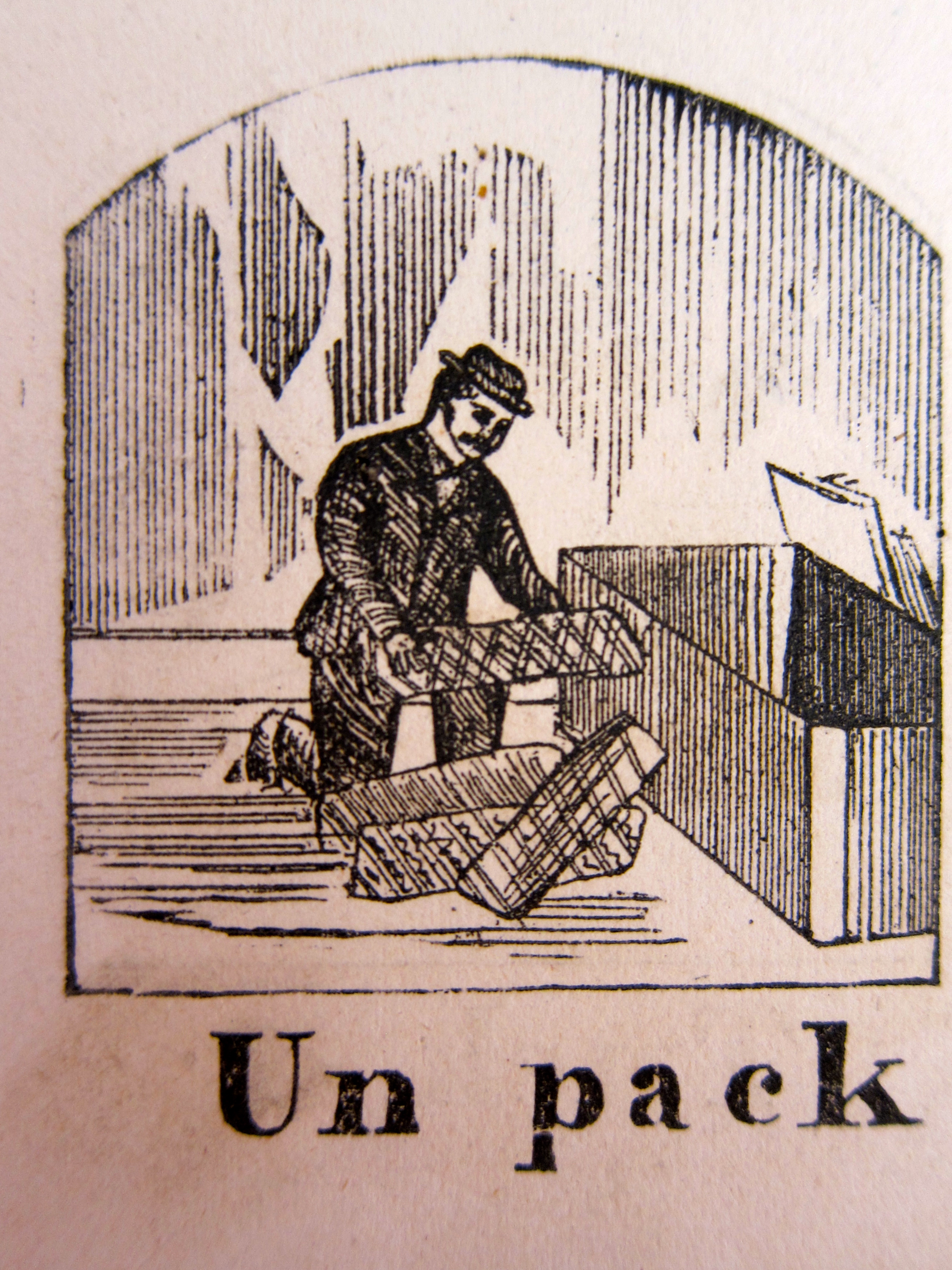
Unpack

Dec 11th Thursday.  Have had a bad head ache and

very bad cold  Called into the other part of the

house with Mrs S Ames.  Mrs Witherell had bound

the quilt that we quilted yesterday  Mrs R Pool

called & I went into Edwins house with her.  She & her

husband have spent the day at Augustus  I varnished

store room stairs & porch.  Mr Ames came from New York

Mr Clarke put the inside windows in sitting room

Both Evelina and Old Oliver noted that Oakes Ames “came from New York” today after having been away eight days. He was probably glad to be home; he confessed late in his life that he didn’t enjoy travel. And family dynamics, if they had altered at all in his absence, would have reverted to normal once his “stalwart and rugged”* self returned to his own place as the head of the household.

Evelina’s cold, which had been hovering since Sunday, finally landed with vehemence, although Evelina continued to be up and around. She sat with both sisters-in-law, Sarah Ames and Sarah Witherell, and went over to Edwin Gilmore’s new house with her niece (and Edwin’s sister) Rachael Gilmore Pool. In addition to socializing, Evelina varnished her porch and storeroom stairs. The strong smell from the varnish wouldn’t have helped her “bad head ache,” at all; in fact, it probably made it worse. What was she thinking? Was she too economical to let Mr. Scott complete the job? And did she know that she was spreading her cold everywhere she went?

*William L. Chaffin, Oakes Ames, 1804/1873, Easton Historical Society, North Easton, 1996, p. 1


December 8, 1851


381-1233891708GdW7


Dec 8th Monday.  Another unpleasant windy day

and we could not put our clothes out

Alson came after Mother this afternoon

and it has cleared off quite pleasant.  he is

better but is not able to work yet.  I have been

cutting out some cotton flannel for Jane to work on

last week she worked for herself.  It is three

weeks since she has been able to work much

Another Monday morning with weather too “unpleasant” to hang the wash out to dry. It rained in the morning, and “took the snow all of[f]” according to Old Oliver. The newest servant, Mary, possibly with the help of the still-recovering Jane McHanna, must have resorted to hanging wet articles over various registers around the house to dry.

Besides the weather being crummy, Evelina’s husband, Oakes, was still away; her brother Alson, though improved, couldn’t yet work his farm; her servant, Jane McHanna, hadn’t fully recovered from an illness of three weeks running and she, herself, was coming down with a cold. Evelina’s week was off to a poor start; she must have been anxious by this time to have her husband return home. On the bright side – perhaps – she saw her mother, Hannah Lothrop Gilmore, return to the family farm, where the elderly woman was always the most comfortable.

The weather “cleared off” in the afternoon, bringing back the sunshine. Did the full moon that night cheer Evelina up with its wintry light or keep her awake worrying about various domestic aggravations?


December 5, 1851

tumblr_mbsy6tKaeV1r5pmqlo1_r1_1280

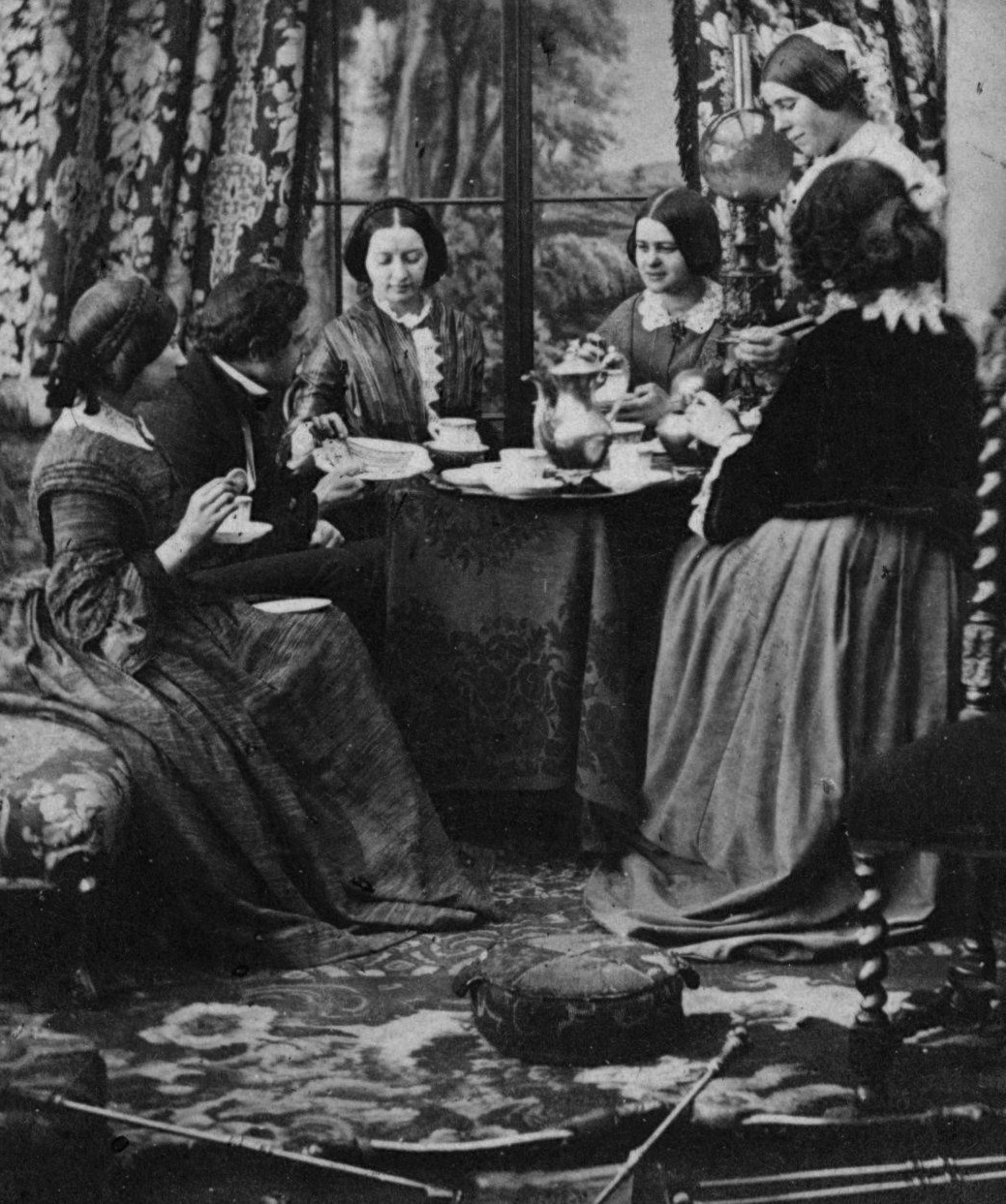
Unidentified group having tea


Dec 5th Friday  As usual this morning after being in

Boston felt tired & lazy did not get my

room in order very early.  Before it was

cleaned Mrs S Ames came in and we chatted

awhile.  Went into Edwins to get Mr Scott

to paint the porch & thus the forenoon passed

Have passed the afternoon in father Ames

with Mrs J R Howard her sister & Mrs Whitwell

With her husband away, and only her four nearly-grown children to look after, Evelina chose to relax this morning rather than make her bed, tidy up and get to her chores and sewing. “As usual,” she felt lethargic after her Boston shopping trip, but uncharacteristically, she didn’t try to overcome this lazy spell. An early morning visit from Sarah Lothrop Ames gave her some excuse to take it easy and hang out, as we might say today.

Most of the rest of her day was spent socializing.  In the afternoon Evelina went to the other part of the house to visit with sister-in-law, Sarah Ames Witherell, and other ladies who had gathered: Eliza Whitwell, Caroline Howard and the latter’s sister.  The women may simply have sat and chatted, teacups in hand, but Evelina, perhaps, had some sewing or mending at the ready as she visited.

The one piece of business that Evelina managed to do today was walk down the street to the new house being built by her nephew, Edwin Williams Gilmore, to track down Mr. Scott, a painter who was working there. He and another painter, Randall Holbrook, came over in the afternoon and began working for her. The presence of painters at Edwin’s house suggests that it was nearing completion.  Perhaps Edwin was getting ready to move in, if he hadn’t already.


December 4, 1851

Clerk

Dec 4th  Thursday.  Returned from Boston to night

Have got the greater part of the things

I wanted.  could not suit myself in all.

Mother spent yesterday with Augustus & to day

at Mr Torreys returned here this evening

Left Mr Orrs this morning did not dine there

it takes so much time  Julia is at home

It is three weeks [entry ends here]


After seeing her husband off on his business trip to New York, Evelina spent yesterday and today shopping in Boston. She seemed satisfied with her purchases, though she confessed that she “could not suit myself in all.” Was she buying cloth or ribbon or other fashion accessories, or decorative items for the refurbished parlor, or foodstuffs for the pantry? It was early December, a time in our own culture when we modern folks are apt to be out (or online) shopping for Christmas presents. Evelina may have been buying Christmas gifts for her family, although that is unlikely, as the Ameses barely recognized Christmas, let alone celebrated it.

Although public opinion in New England was changing, a poor opinion of Christmas prevailed among the Yankees of Evelina’s generation, and certainly of Old Oliver’s. It was based on a Puritan tradition that considered Christmas as “an emblem of popery.”  Yankees “were strongly influenced by the traditions of Calvinism and the routine of the established Congregational church, honoring a certain stoicism, hard work, and stern independence.”  Instead of Christmas, “Thanksgiving was the most important day of the year.”* That would change.

But Evelina must have caught the train back to Stoughton, or the stage home to Easton, empty-handed of the kind of Christmas plunder that her favorite author, Charles Dickens, so famously described.


*Jane Nylander, “Our Own Snug Fireside,” 1993, New Haven, p. 8