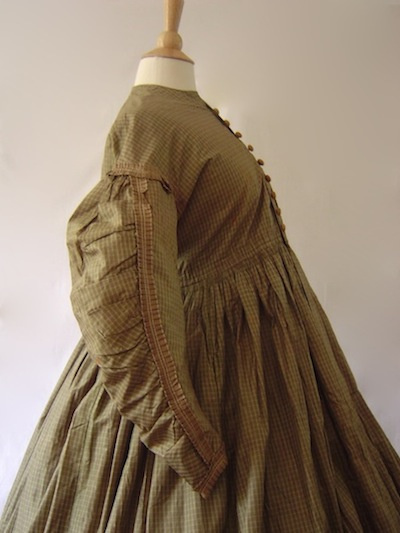
June 19, 1851

Barrel

June 19th Thursday  Weeding in the garden untill past

nine  Heat my grease and made a barrel

of soap.  poured the grease in hot and potash

cold with a little hot water and it has come well.

This afternoon have cut the sleeves for my stone

colour borage dress and have worked some on

the hair cloth cover for the lounge.  Harriet

come into my chamber for an hour or two.

Bridgett here. 


This was a fine June day for working out of doors.  Old Oliver noted in his journal that “We mowed back of Kellys to day,” describing a piece of land north of their house near the ponds.

At the house, or rather, in the yard, Evelina and probably Jane McHanna made soap. As their mothers had done before them, they boiled animal fat (of which they had plenty on hand) in an iron kettle over an open fire. When ready, they “poured the grease […] hot,” into a barrel and added potash, a generic term for lye, a product that was typically obtained from wood ashes. The Ames weren’t burning wood at the house anymore, though, so where and how Evelina got her potash is uncertain. Any thoughts, readers?

Evelina had made soap before and was confident in the process. “It has come well.”  However, she and countless other housewives would soon find that this skill was no longer necessary as commercial soap became available. After the Civil War, especially, manufactured soap would gradually replace homemade soap, except in the remote pockets and far reaches of the migrating frontier.

Some 750 miles to the west of Easton, in fact, in the bustling river town of Cincinnati, a candlemaker named William Procter and a soap-maker named James Gamble had been manufacturing soap for about fourteen years. Besides wanting to make a good product, they wanted to sell it to a broader market. Using the animal fats from the nearby “Porkopolis” slaughterhouses and fronting the Ohio river, they had both material and transportation right at hand. Their enterprise would succeed. Homemakers like Evelina would no longer need to stand over a hot kettle to make soap.




June 17, 1851

DSCF1590small

1851 June 17th  Worked untill about nine Oclock in

the flower garden  Then cut the tick to the mattress

a[nd] basted it ready to make  Jane was ironing and 

I assisted about dinner  After dinner made three button

holes in Mrs S Ames dress.  Went to Mr

Wm Reeds to tea with Mr Ames, Oliver & wife

Mrs W, Mitchell & Mr & Mrs Whitwell & Alson & wife


Gardening, sewing, ironing and cooking made up today’s housework at the Ames’s home on Main Street.  Buttonholes, too, which could be challenging, were a particular specialty of Evelina; many people brought her their buttonholes.  The fact that Sarah Lothrop Ames took her buttonholes to Evelina rather than to a hired dressmaker underscores Evelina’s talent in this department.

William and Abigail Reed must have enjoyed Evelina’s company on Sunday between services, for they invited her back to a small tea party.  The whole Ames family was invited, in fact, and then some. Minus Old Oliver, and the young people, naturally, siblings Oakes, Oliver Jr., Sarah Witherell, and Harriett Mitchell, with wives Evelina and Sarah Ames, gathered at the old professor’s home for a “cuppa.” Reverend William Whitwell and his wife, Eliza, went too, as did Alson and Henrietta Gilmore. That was a good crowd for a 19th century parlor.

Tea was generally the most sociable meal of the day.


June 15, 1851

Burning_Bush_Dictamnus_Fraxinella_Seeds

June 15 Sunday  Have been to meeting all day.

At noon went with Alsons wife & Rachel to

Mr William Reeds had a very pleasant call

Since meeting walked with Mr Ames & Susan 

up to the fly away pond and home by

Edwin Manlys to see his flowers  he has 

fine plants in blossom, among others the

Fraxinella  It sprinkled some and we called

at Mr Peckhams & saw Mrs Washburn

The weather over the past week was so mild that, despite the occasional sprinkle, folks were outdoors as much as possible. Evelina made all kinds of social calls today.

At the intermission between services, she went calling with a sister-in-law from the Gilmore side of the family: Henrietta Hall Gilmore, wife of Alson.  Henrietta was Alson’s second wife, his first having died young, and mother of six of his seven children, including Lavinia, of whom we have seen much this past spring. With Henrietta was someone named Rachel, who was possibly Henrietta’s daughter or another niece with the same name. The ladies called at the home of William and Abigail Reed.  Mr. Reed, older than Evelina by a generation, was a former teacher at Milton Academy and a graduate of Harvard’s Divinity School, although he never settled in a particular parish.  An acting Justice of the Peace, Mr. Reed was well known and well liked.

This afternoon after church, Evelina, Oakes and their daughter walked the road to Fly Away Pond and on to Edwin Manley’s garden.  There the Fraxinella, also known as Burning Bush, caught Evelina’s eye.  More for her garden?


* Fraxinella, seedempire.com

June 14, 1851

Evelina Gilmore Ames

Evelina Gilmore Ames

June 14 Saturday

This is my birth day and it is very pleasant

weather.  Worked in the garden awhile in the

morning then baked in the brick oven.  Made

brown bread sponge & cup cake pies &c.

This afternoon have been to North Bridgewater

and paid Howard & Clark 16 dollars for bed

stead & lounge 50 cts for Castors.  Emily gave

me a box & Harriett a pr of Elastics


The diarist herself celebrated a birthday today, number 42.  She was born in 1809 on a farm in the southeastern quadrant of Easton, not far from the Raynham town line.  She was the seventh of eight children. Her parents, Joshua and Hannah Lothrop Gilmore, named her Evelina Orville after the heroine of Fanny Burney’s popular novel, Evelina, or the History of a Young Lady’s Entrance Into the World. In the book, pretty, fictional Evelina, after various comic travails, wins the heart of handsome, rich Lord Orville; did the real Evelina’s parents hope for similar material success for their youngest daughter?

In birth order, Evelina’s brothers and sisters were John, Arza, Daniel, Alson, Hannah, Rhoda, and Joshua Jr.  By the time Evelina reached 40, only John and Alson, and their mother, were still living. Evelina’s siblings carried mostly family names, meaning that Evelina’s name was a departure. Her grandson, Winthrop Ames, noted in 1937 that “Evelina, in its later form of Evelyn, has been a favorite female first name since Evelina Orville Ames first introduced it into the family when she married Oakes Ames in 1827.”*

As a eighteen-year old bride, Evelina moved to North Easton, right into the Ames homestead, a portion of which had been made over to accommodate the newlyweds. Still living at home at that point were most of her siblings-in-law: Oliver Jr., William Leonard, Sarah Angier Ames (aged 13 and, obviously, not yet married to Nathaniel Witherell), John Ames and Harriett Ames (who was only eight years old.) What a full dinner table they must have had!

The next quarter century flew by, as the years do, full of arrivals and departures.  Her children came into the world, even as family members on both sides departed it.  Only now, it seems, did Evelina lift her head from the home-making tasks that were always at her elbow to consider ways to fill the rare discretionary time that began to open up to her.  Flower gardening became one pleasant elective; writing in a diary was possibly another.


*Winthrop Ames, The Ames Family, 1937

June 9, 1851

imgres

*

June 9th Mon,  Another cold stormy day  have a fire in the

furnace  Ann had gone & I made the fire

Jane has washed her clothes & put them out

in the suds to let the rain rinse them  I have 

worked about home all the forenoon.  Swept &

 dusted the parlour partially, and the front entry

Sitting room &c.  Was invited into Olivers this afternoon

Did not go untill after tea

Servant Jane McHanna borrowed the rain again this Monday and let it rinse the soapy clothes that she placed outdoors.  Evelina did housework most of the day and even had to start up the coal fire in the furnace, a task she neither enjoyed nor did well.  Ann Orel, the young Irish woman who worked for Sarah Witherell, usually did that job.

Being a “cold stormy day,” Evelina did no gardening.  She probably looked out the window at her flower beds and saw the rain pelt her tender young plantings.  She couldn’t have known that even as she gazed out at the bad weather, her favorite author, Charles Dickens, was giving a speech in front of the Gardeners Benevolent Institution in London on the topic of gardening.

“I feel an unbounded and delightful interest in all the purposes and associations of gardening,” he began. “Probably there is no feeling in the human mind stronger than the love of gardening.[…]at all times and in all ages gardens have been amongst the objects of the greatest interest to mankind.” The Gardeners Royal Benevolent Society, which began in 1839,  still exists in the UK today. It’s a charity dedicated to helping horticulturalists in need.

Evelina had no such resource to turn to, had she needed the help.


* Logo of the Gardeners Royal Benevolent Society 

May 27, 1851


VFC021712-26

1851

Tues May 27th  My beadstead was brought this

forenoon  It is very pretty but much to large shall

have it made shorter.  Have had the center table

lowered & new castors put on it.  Put straw carpet in

Franks chamber and it is ready for him to come back

into.  Have not sewed any to day I seem to have been

busy but have not accomplished much for a long while

Pleasant weather  Mr Ames went to Canton this 

afternoon

Redecorating continued.  Not only had things been cleaned and painted or papered, but new furniture was being brought in, and old furniture reconfigured.  Casters, beloved of Victorian housewives, were put in place so that furniture could be rolled for better cleaning.

What prompted Evelina’s burst of refurbishment? New wallpaper, new carpet, new furniture. Did she do some redecorating every spring or was this a departure from the norm? It may be that the new expenditures were relatively recent and stemmed from the increasing prosperity of the Ames shovel business as well as a contemporaneous, burgeoning access to material goods that had once been scarce. In other words, with American manufacturing on the rise,  Evelina and Oakes – and Sarah Lothrop and Oliver Jr. – could now afford and obtain desirable textiles, furnishings and decorative items for their homes.  They went to Bridgewater, Boston and New York, and bought.

One thing was certain. Evelina wouldn’t have proceeded with any of this without Oakes’s approval.  Implicit in her purchases was his consent, tacit or enthused.  For a man who spent nothing on his personal appearance, it’s interesting to understand that he would spend money on decorating his house. It’s also curious to wonder what Old Oliver might have thought about the upgrading at the old family homestead.


May 26, 1851

maternity_5

Monday May 26  After washing the dishes this morning sit

down to work on the carpet for the sitting

room chamber and had but just got seated

when Augustus & wife & her brother & wife from

east Boston came. Hannah staid here while 

the others went to the shop  They left about 

ten Oclock.  Have put the carpet down and 

room ready for the new bedstead.  School commenced


Housework and laundry, presumably, went on as usual today except for a social interruption in the morning.  Augustus Gilmore and his wife, Hannah, stopped in with Mr. and Mrs. Lincoln, Hannah’s brother and his wife. Evelina described them as coming from East Boston, although Hannah had grown up in Hingham. After some brief socializing with his aunt, Augustus took his in-laws across the street to show them the shovel factory.

Hannah Gilmore didn’t accompany her husband, probably because she was about seven months pregnant. She and Evelina sat together in the parlor or sitting room, perhaps using the opportunity to discuss female matters, perhaps not. Such conversations were not considered polite, but surely two mothers together in a room could share information without being intrusive or indelicate. Given that Hannah was already the mother of a two-year old boy, Eddie, Evelina may have shared some tips on raising sons. Certainly, Evelina was a woman to whom younger women turned for advice and companionship.

The day must have been a fine one; school recommenced, carriages were out and about and, most exciting of all, Old Oliver reported that he “began to plant our corn.”  It was a time to sow.


May 20, 1851

Play

1851

Tuesday 20th  Washed the front entry windows

& front chamber and put the room in order, have

not been idle but cannot see much that I have done.

Have ripped the pieces of the carpet that formerly

belonged in the parlour and have it already for the 

sitting rooms  Susan runs wild with the other 

children.  I do hope after house cleaning is over that

I shall attend to her better and make her sew.

Rain this evening

Spring cleaning continued today with window washing and carpet rearrangement, the latter a seemingly endless task. Evelina, thrifty housewife that she was, reused old pieces of carpet in new places. The parlor got the newest and best carpet while the less formal sitting room got the recycled floor covering. By ripping, cutting, cleaning and placing, she did the recycling herself.

If Evelina was all about working, her daughter Susan was all about playing. Running “wild with the other children” probably felt pretty good to the nine-year old girl, who was enjoying a week of no school.  Her mother might have wished to make her sit and sew, but the fresh air and companionship of friends from the village was too much fun for Susie to resist.

In this diary entry, Evelina expressed something close to dismay. She didn’t feel she was accomplishing much, either in her housekeeping or in her management of her daughter.  Part of this feeling might have stemmed from memories of her own childhood on a farm where everyone, young or old, had chores and responsibilities. There was always work to be done, and playing instead of working was a rare option. Perhaps Evelina looked at her carefree daughter with puzzlement and guilt.  Susie should be working and it was probably Evelina’s fault that she was playing instead.


May 19, 1851

330px-Mainelupin

May 1851

Monday 19th  Orinthia left here to commence her school in

No 2 district  I shall miss her very much

this morning had to wash the dishes and clean 

the sitting room &c which she has done for

some time.  Afterward worked in the garden

untill noon, planted some Pansy & Lupin seeds

Called in Olivers awhile  We have a gardener

commenced work to day.  Pleasant weather

Orinthia Foss left today to board with another family.  She had lived with the Ameses since February when she arrived from Maine to teach a small group of students in North Easton. Evidently, she had done her job well, and as a consequence had been hired by the school superintending committee to teach elsewhere in town. She would be missed by the Ames family, as she had made herself at home there, helping Evelina with sewing and chores and joining in various social activities with the Ames sons. Evelina especially would miss her, and not just because Orinthia had been so helpful in the house. The two had become good friends.

So, all by herself, Evelina worked in the garden this morning, planting pansy and lupin seeds. Pansy, also known in the 19th century as “heart’s ease,” was relatively easy to plant and grow. Lupin, on the other hand, was (and still is) trickier.  Though “found, frequently, in large masses,” “this fine perennial”, according to Joseph Breck in his 1851 Book of Flowers, is “very difficult, even impossible, to transplant, with success.” Seed, and seed alone, must be used. Evelina needed her green thumb today.

That said, Evelina wrote in her diary that a gardener had “commenced work to day.” Who hired him, and what was his job?  Was he hired just for the flower beds? Did he also work for Sarah Witherell, or next door for Oliver Jr. and Sarah Lothrop Ames? Whatever his job, he wasn’t going to be as much fun to work with as Orinthia had been.


May 16, 1851

330px-Carpet_beater

1851

May Friday 16th  We have been working in the chambers again

to day  I have put a straw carpet down in the 

dark bedroom chamber and moved the bed from

the sitting room chamber into it.  Have taken

the carpet from the sitting room chamber and

cleaned the room.  Orinthia & I have been working

in the garden awhile this afternoon Susan past

the afternoon at Mr Torreys

The tail end of spring cleaning was going on as carpets were laid back down and furniture rearranged. Imagine the energy it took for Evelina, Jane McHanna and, maybe, Orinthia Foss to move furniture, take up carpet, beat carpet, clean floors, put carpet back down and move furniture back into place.  The men didn’t help them with this, as the men all had their own work.  The women did this housework themselves.

Many will recognize the household “appliance” pictured in the illustration.  It’s a rug beater, used to thwack the dust out of carpet as it hung out-of-doors being aired.  Until Bissell’s carpet sweeper appeared in the 1880’s, and the electric vacuum cleaner came around the turn of the century, this is how rugs were cleaned.

The garden probably looked pretty good to Evelina and Orinthia after the dust and dirt of the morning. A different kind of soil. The women must have planted some things that Evelina picked up yesterday on her trip to Mr. Manley and Mr. Clapp in Stoughton.  Her garden was taking shape.