September 30, 1851

IMG_0004

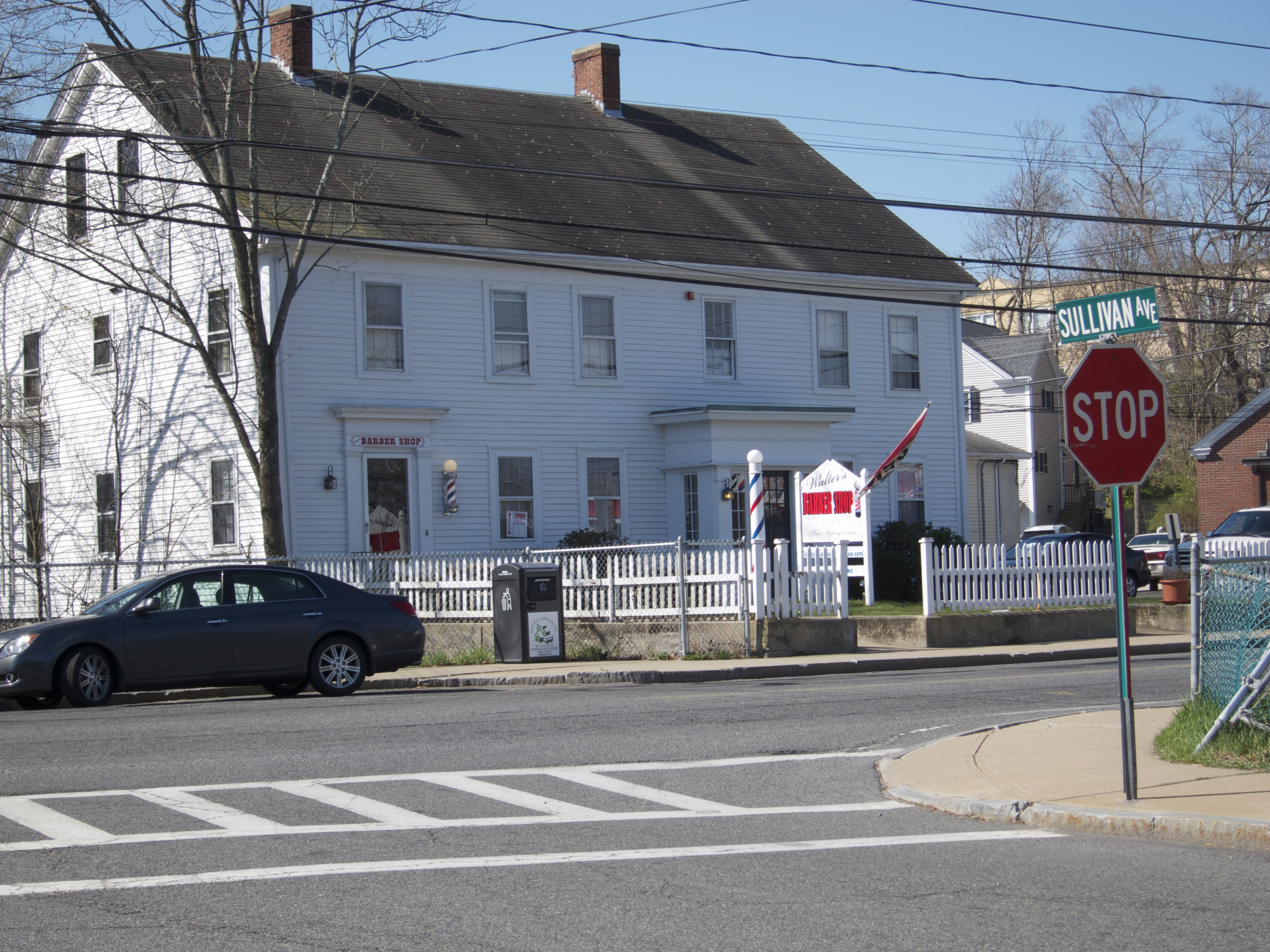
21st century view of apartment building owned by Col. John Torrey, which Augustus Gilmore and his young family moved into in 1851

Sept Tuesday 30  Augustus family left this afternoon for

their new place  his wife went this forenoon

and put down two ca[r]pets and put up two beds

I went about four Oclock and helped her

untill night   passed part of the evening in

the other part of the house  I have been to 

work a very little on my dresses and so

has Ellen  Helen left this morning for school in Boston

It was “a fair day + pritty warm”*, so folks who had stayed inside yesterday because of the rain were able to be out and about today. Evelina must have felt better, too, as she helped her nephew’s wife, Hannah Lothrop Gilmore, set up housekeeping in their new quarters in the village. Practiced mothers, they probably kept their eyes on Hannah’s small sons as they worked.

Helen Angier Ames, fourteen-year-old daughter of Sarah Lothrop and Oliver Ames Jr., left for Boston this morning.  She was going to a new school, the third one this year. Clearly she, or her parents, had had difficulty settling on the right situation. Perhaps this one would be the charm. We don’t know which academy or seminary she was headed to; there were probably several schools to chose from. The Auburndale Female Seminary was one that was established about this time (today is exists as Lasell College) though we have no indication that this was the one, among many, that the Oliver Ameses would have settled on for their daughter.

The Girls High and Normal School started up around the mid-19th century as well.  It was focused on training young women to become teachers, and thus was unlikely to be the institution that Helen Ames went to.  Helen didn’t need to be trained to make a living.  A smaller, private outfit was likely to have been the place for her.

* Oliver Ames, Journal

September 27, 1851

333_EOA_484_-_1850_20_H1a

 $20 Gold Piece, 1850

Sat Sept 27  Have been very busy to day but can

scarcely tell what I have done have been working

about house most of the time  Have bought

Mrs Mitchells beaureau and to night it has

come and it looks better than I expected  agreed

to pay her 18 dollars but shall give her 20 for it

Mr Ames carried back the chairs to Bigelows

and bought me one at Courrier & Trouts for […] 25 Dols

William Chaffin, Unitarian minister and town historian, once described Evelina as “very economical.”* He claimed that she mended her husband’s pants so that he wouldn’t have to spend money on new ones. Some Ames descendants and others knowledgeable about the family history also consider Evelina to be the personification of Yankee frugality. She sewed tucks into dresses, reused old pieces of carpet, made her own soap and kept careful household accounts. She mended coats, upholstered a lounge for the parlor and roped relatives and friends into helping her make shirts for all the men in her house. She did work that she could have paid others to do for her. Was she being cheap or was work a habit with her? Or both?

Evelina could and did spend money, as last week’s flurry of shopping in Boston demonstrates. She bought dress fabric, chairs for the parlor and new wallpaper. And today, only one week later, she paid her sister-in-law, Harriett, $2 more for a chest of drawers than the price they had agreed upon. The gesture was generous, and underscores the possibility that Evelina was not quite the cheapskate that family tradition has allowed.

As the acquisition of the used “beaureau” shows, Evelina was having a burst of redecorating. What had set this off? The shovel shop was doing well, obviously, so they could afford to buy new things. Beyond having the means, what encouraged her to make these alterations? Was she being encouraged by her husband? He seemed to be right there with her at the store.  Was Oakes’s participation prompted by an easy complacency about his wife’s spending or a shared enthusiasm for the new purchases? Was an influx of wealth changing the way they lived?

* William Chaffin, Oakes Ames, private publication, Courtesy of Easton Historical Society

September 20, 1851

Train

Sat Sept 20th  Was out shopping all day purchased a number

of articles among the rest a Cashmere & french print

dress paper for my parlour brought home two chairs

from Bigelowes  We all returned home this evening

Frank came to Stoughton after us & rode back

on the stage.  Went into Olivers awhile this evening.

Have had a great deal of trouble with my feet while

I have bee[n] gone & to night they are very sore.

The Boston spree continued for most of the day as Evelina walked and shopped for everything from fabric to wallpaper to furniture.  She and Oakes brought their purchases home on the train (or “in the cars” as they might have said) to Stoughton. It was, finally, time to return to North Easton.  Son Frank Morton Ames met them at the depot with a carriage – or wagon –  but rode home by himself on the local stagecoach. The conveyance he brought to the group getting off the train was, perhaps, too crowded with goods from town to fit everyone in.

Perhaps not wanting to let go of the many sensations that three exciting days in the city had produced, Evelina went next door to Oliver Jr and Sarah Lothrop Ames’s house. They had returned the day before, and so missed the fireworks. Surely they compared notes on their experiences at various events at the Railroad and Steamship Jubilee.  They may have compared blisters and sore shanks, too.  They did much walking and standing during their junket, and Evelina at least was feeling the effects. Her feet hurt.

Meanwhile, never having bothered to go into town for the celebration, Old Oliver was moving ahead on improvements for the shovel shop.  In his journal he noted that “this was a fair day wind south west and quite warm we put in the bottom stone for the floom at the great pond to day and the 5 foot one on the east side of it.” A flume for the factory was going in at Great Pond.

September 19, 1851

5209548721_5943a65d99_z

Friday Sept 19  Mr Ames went into Boston also Frank

We went to Mr Daniels store to see the procession

They were an hour and a quarter passing and we

were very much fatigued we were in the store about

four hours  We returned to Mr Orrs and dined

In the evening Mr Ames & self Mr Norris Emily & Helen

Mr Wm Harris & sister walked to see the illuminations

Oliver & wife returned home & Frank

The Railroad and Steamship Jubilee concluded today in Boston with a huge parade around the city that moved from School Street through Haymarket Square, down Merchants Row, State and Washington Streets toward Tremont, Park, and the Boston Common. There the procession traveled between a line of schoolchildren, then went along Beacon Street and turned toward Boylston, where they finished. The “civic procession” featured not just the requisite brass bands, waving pennants, dignitaries on horseback, carriages of officials, and marching men. It also offered something new: one whole marching division of selected representatives of industry, intended to showcase the thriving manufacturing of the greater Boston area. Were the Ames shovels included?

Evelina and various family members saw the parade from a shop on Washington Street. They stood for hours, first waiting, then watching as the parade rumbled by. The store owner, Mr. Daniels, was certainly kind to let the group stay for four hours. Perhaps he sold Ames shovels?

An afternoon banquet followed on the Boston Common under a special pavilion. This the Ameses did not attend (nor were they likely to have been invited – their railroad days were yet ahead of them.) The featured after-dinner speaker was Edward Everett, a minister, past president of Harvard, former U. S. Representative and one-time Governor of Massachusetts.  With all those qualifications, he was nonetheless best known for his oratory. In 1863, he would be the featured speaker at the dedication of the Gettysburg Battlefield. On this occasion in Boston, Everett spoke about ” The Beneficial Influence of Railroads.” His fitting summation to the three day celebration of the modern railroad was topped only by the evening display of illuminated buildings around the city and fireworks over Boston Harbor.

Evelina, Oakes, and a group of relatives and friends saw those “illuminations.” How memorable the whole day must have been, and how “fatigued” Evelina must have felt by the time her head hit the pillow.

September 12, 1851

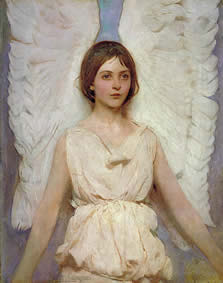
Abbott H. Thayer, Angel, 1887, oil Smithsonian American Art Museum Gift of John Gellatly

Abbott H. Thayer, Angel, 1887, oil
Smithsonian American Art Museum
Gift of John Gellatly

Friday Sept 12th  Mrs Stevens Susan & self have been to

Foxboro and a sad visit we have had.  Mr Edson

Carpenter buried this afternoon his only daughter

and we attended the funeral at the meeting 

house. Called there this morning & then

went to Mr Jones found Mrs Jones very unwell

and no help & Mr Jones away but about twelve

he returned & put up our horse.  Very hot

In 1851, an eight-mile road, give or take, ran north and west from North Easton to Foxborough by way of Mansfield. It was on that road that Evelina, her daughter Susan and guest Mrs Stevens traveled on this date to attend the funeral of a child, the only daughter of Edson and Mrs. Carpenter. After the hot journey, their horse – was it the speedy mare Kate? – needed to be stabled, and watered, presumably, while they attended the service.

Why they went and what the Ames’s attachment to Edson Carpenter was we don’t know.  Mr. Carpenter was a store-keeper in Foxborough, where he had built his own commercial block only four years earlier. Like other merchants in the town, he was affiliated with the straw industry, straw being a popular commodity for summer bonnets and the like. In fact, beginning in the 1840s, his store was “where straw braid and bonnets were received in payment for goods.”*

But as Evelina noted, he buried a child today, and it was “a sad visit” for all. The continuing hot weather wouldn’t have helped anyone’s spirits. The women must have had a solemn, hot drive back to Easton.

* Foxborough’s Centennial Records, 1878, p. 75

September 7, 1851


Ames Home and Office, North Easton, Massachusetts ca. 1852 - 1862

Ames Home and Office, North Easton, Massachusetts
ca. 1852 – 1862

*

Sunday 7th  Have been to meeting all day  Mother

Mrs Stevens & I went to Mr Whitwells at

intermission Mrs Whitwell made a cup of tea

for us, brought mother home with us from meeting

at night  Mr Ames & I called at Mr Swains

Mr & Mrs Peckham are to leave tomorrow for

Taunton & the children & Mrs Metcalf  Thursday

The weather is very warm  Gave Mrs Stevens

some cuff pins it being her birth day.

Despite today’s heat, Evelina and her guest Mrs Stevens, and others of the Ames family, presumably, attended both morning and afternoon sessions of church. When the last service was over, they carried Evelina’s 79-year-old mother, Hannah Lothrop Gilmore, to North Easton to stay for a few days.

An important transition was taking place this week at the shovel works.  John Peckham, former clerk, and his family were leaving for Taunton.  His place in the Counting Office was being taken by John Swain, whom Oakes and Evelina went to visit late in the day.  Swain and his wife, Ann Meader Swain, probably hailed from Nantucket.  They had connections in North Easton, but the move to a new abode was still a big change for the young couple. Oakes, with his wide-armed jocularity and Evelina with her easy, approachable manners, must have made the Swains feel welcome.  Over the years, their friendship would solidify.

Many decades later, when Ann Swain was the only one of the foursome still alive, she told historian and minister William Chaffin about the special relationship between John Swain and Oakes Ames:

“…[H]er husband had his regular salary supplemented by an addition from Mr. Ames. Mr. Swain did more or less work for him, besides the regular office work when he was head clerk. Mr. Ames was not very methodical and his transactions for the day in Boston, jotted down in a notebook rather hastily, would sometimes be in a tangle when he came to the office in the evening (office work in those days always going on in the evening), and he would say to Mr. Swain, ‘Come, John, you help me straighten out these things.’ In common with all the persons who served him Mr. Swain had a strong affection for Mr. Ames.”**


*Ames Homestead with Counting Office on far left.  Residence demolished in 1951.

**William Chaffin, Oakes Ames, private publication                                   


September 5, 1851

Pentax Digital Camera

*

Friday Sept 5th  Expected to be alone to day and was in

hopes to do some sewing but about ten Oclock

concluded to invite Mrs Latham (who came yesterday

to Father Ames,) to tea and all from the other part

of the house.  Jane made a great fuss about getting

tea having some short biscuit to make and I

got very nervous.  Mrs S Ames staid awhile but

went home to tea


The house on Main Street was relatively empty today.  Son Oliver had left for college and friends Pauline Dean and Orinthia Foss had departed as well.  Her husband Oakes and other sons, Oakes Angier and Frank Morton, were at work and little Susie was at school.  How quiet the house must have seemed, even with the sounds from the factory ringing from across the road. Evelina sat down in solitude to sew and found she wanted something more.

A little tea party was what was needed, she “concluded,” although her servant, Jane McHanna, evidently disagreed.  Jane probably had her own agenda of tidying up after yesterday’s whirlwind of departures and so “made a great fuss” about the extra work. Jane’s irritation ran counter to Evelina’s hopes, and some kind of verbal tussle must have ensued. No wonder that Sarah Lothrop Ames, who had come over from next door, didn’t stay around.

The party must have happened, however, else Evelina would have written otherwise. Jane prepared the meal. Late in the afternoon, family from the other part of the house and their guest, Mrs. Latham, were treated to tea and “short biscuit” and, perhaps, other refreshments.

Short bread or short biscuit or short cake – all names for the same, crumbly finger food – was a typical offering at tea parties, and simple enough to make that many cooks wouldn’t even need a recipe, or “receipt.” Using some of the butter that Evelina had bought just one week earlier, Jane McHanna would have followed a process similar to that described by Lydia Maria Child in her book The American Frugal Housewife:

“When people have to buy butter and lard, short cakes are not economical food. A half pint of flour will make a cake large enough to cover a common plate.  Rub in thoroughly a bit of shortening as big as a hen’s egg; put in a tea-spoonful of dissolved pearlash; wet it with cold water; knead it stiff enough to roll well, to bake on a plate, or in a spider.  It should bake as quick as it can, and not burn.  The first side should stand longer to the fire than the last.”


*http://britishfoodhistory.wordpress.com/2012/06/10/shortbread/


September 3, 1851

Trunk

Wednes Sept 3d  Alson came this morning & brought

Orinthia and staid to dinner and carried Mrs Stevens

home with him  Orinthia has been packing her clothes

Mrs Stevens stiched three more collars for me & Mrs

Witherell two that are for Frank.  Abby Torrey called

this afternoon &c and on her return Orinthia & I went

to the store  Pauline passed the afternoon with Helen

Orinthia Foss was packing her clothes, getting ready to return home to Maine. What prompted the departure isn’t clear. Did she lose her job, or was she called home on family matters? She would return to North Easton eventually, but did she know that when she left?  How did she feel about leaving this town where she had lived for six months? How did Evelina feel about the loss of her young friend, even temporarily?

Orinthia wasn’t the only one with a trunk to be packed. Oliver Ames (3), too, was a day away from departure and had a trunk into which his mother – and others, perhaps – were placing his new collars and mended shirts. Last minute sewing was still going on, but by this time the trunk would have been nearly full of the clothes that Oliver would need for a term at college.

That Oliver was going away to study at Brown was just shy of miraculous.  At 20, he was old to be going, for one thing; in the nineteenth century, the average students were teenaged, like Fred Ames at Harvard. But more than that, his father Oakes had not wanted him to go. According to one 19th century acquaintance of Oliver, Oakes “had inherited some measure of that Puritanical contempt for the liberal arts.” After completing prep school, Oliver had been directed to work at the factory, “to learn the trade of shovel-making. But the desire for a higher education remained strong, and when at the end of his five years apprenticeship he had mastered the trade, his father yielded to his solicitations, and allowed him to enter Brown University.” * Oliver had earned his ticket out.

* Hon. Hosea M. Knowlton, “Address,” Oliver Ames Memorial, 1898, pp. 98-99


August 23, 1851

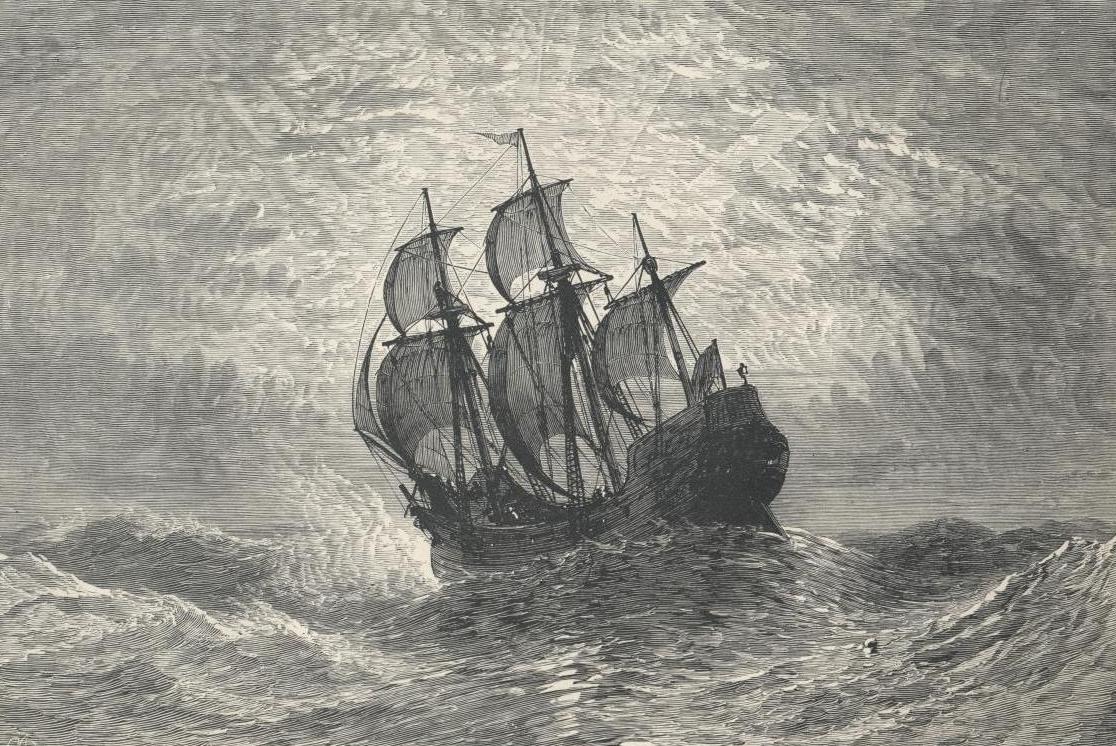
Mayflower

The Mayflower

Sat 23d Aug  The two Mr Lothrops went to the shop after

breakfast and I baked Cake & ginger snaps in

Mrs Witherells oven  This afternoon I went with

them to Mothers to tea, called at Mr Seba Howard

and took Orinthia with us and brought her here

at night  The Miss Tolmans are still at the 

Howards  Evening Mrs Mitchell came in.  Pauline

passed the afternoon in the other part of the house

Even in the hot weather, baking had to be done.  After breakfast, Evelina saw cousins Warren and Jerry Lothrop head off with the men to the shovel shop.  Pauline Dean, another guest, didn’t accompany them, but neither did she hang around the kitchen with her hostess. She spent part of the day, at least, in the other part of the house. By herself, Evelina baked cake and ginger snaps.

In the afternoon, once again laden with company, Evelina went down to the Gilmore farm with the young Lothrop men to visit Evelina’s elderly mother. Hannah Lothrop Gilmore was probably pleased to get a visit from these two male relatives. How closely related Mrs. Gilmore was to Warren and Jerry is uncertain; the Lothrop clan was extensive, and had been settled in Plymouth and Bristol Counties (and on into Maine) for generations.

What is certain is that if “cousin” Jerry and Warren were related to Evelina through the Lothrop line, they were also probably related to Sarah Lothrop Ames, as the two women themselves were second cousins. Evelina’s grandmother, Hannah (Howard) Lothrop, and Sarah’s grandmother, Betty (Howard) Lothrop, were sisters.*  They were descended from John Alden and Priscilla Mullins of Mayflower fame.

On the way home, Evelina picked up her young friend, Orinthia Foss, who ended up spending the night.  Where did everyone fit? How did everyone sleep?

* Winthrop Ames, The Ames Family of Easton, 1937, pp. 230-231


August 21, 1851

PINEAPPL-h

*

Thurs 21st Aug  This morning sat down to work quite early

finished my purple morning dress and 

Susans pink print that was made over

Pauline is not willing that I should work

much  She has had the offer of marriage

from a Mr Stowe of Concord Mass & the same

is an offer from John Reed, an old man of

70 years  She is very fascinating  Mrs Witherell

& Mitchell went to Boston for paper for parlour

Evelina had a houseguest who wasn’t interested in sewing, but that didn’t prevent her from finishing two dresses she’d been working on. She was caught up with the romantic dilemma of her friend, Pauline Dean, who was considering two offers of marriage. Evelina’s daily life was so far from being romantic that she found Pauline’s tales “very fascinating.”

We don’t know much about Pauline Dean, except that she corresponded with Evelina and visited periodically. We don’t know where or how Pauline lived, but we can surmise that she was originally from the Easton area. She was familiar with the town and several of its inhabitants; perhaps she was related to one of the Dean families in the area.

While Evelina and Pauline visited, sisters Sarah Witherell and Harriett Mitchell went into the city in search of wallpaper. Sarah was looking to replace the wallpaper she had only recently put up in her parlour; she didn’t like it or the way it had been hung. The wallpaper in the illustration above is circa 1845 and demonstrates the prevailing ornate taste of the time.

Adelphiapaperhanging.com