August 28, 1851

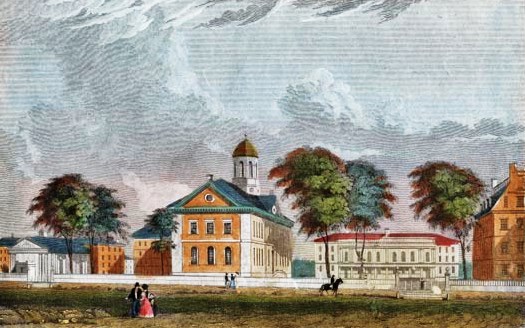
17 Alexander Jackson Davis (American architect, 1803-1892),  Harvard University, Cambridge, Mass. 1850

*

Thursday Aug 28th  Have done but very little sewing to day.

Mrs Fullerton Abby & Malvina here to tea.  Mr & Mrs

Whitwell called.  Mr Whitwell walked up and sent

Mr Tilden with a carriage for his wife.  Mrs Hyde

Mrs James Mitchell & Mrs Watson came from E Bridgewater

& Mrs Watson & Peckham to the other part of the house

to tea. Alson here to dinner & tea

Frederick left for Cambridge this morning

There was much socializing in North Easton today, but it paled in importance when compared to the departure of Frederick Lothrop Ames for college. Though only 16 years old, Fred  was entering Harvard College as a sophomore, making him a member of the class of 1854.

A notable nineteenth-century commentator would arrive at Harvard just after Fred had graduated.  Henry Adams, Class of 1858, would have this to say about the college in Cambridge before the Civil War:

“Harvard College, as far as it educated at all, was a mild and liberal school, which sent young men into the world with all they needed to make respectable citizens, and something of what they wanted to make useful ones. Leaders of men it never tried to make. Its ideals were altogether different. The Unitarian clergy had given to the College a character of moderation, balance, judgment, restraint, what the French call mesure, excellent traits, which the College attained with singular success, so that its graduates could commonly be recognised by the stamp, but such a type of character rarely lent itself to autobiography. In effect, the school created a type, but not a will. Four years of Harvard College, if successful, resulted in an autobiographical blank, a mind on which only a water-mark had been stamped.”**

Was Fred Ames stamped by his time at Harvard? He certainly appreciated his years there, and became “warmly interested in everything that pertained to the welfare of Harvard, as evinced by his well-known liberal gifts to several of its departments.”***


* Alexander Jackson Davis, “Harvard University,” Cambridge, Massachusetts, 1850

** Henry Adams, Education of Henry Adams

*** Harvard “Report for Class of 1854,” 1894

August 17, 1851


Marriage

Sunday 17 Aug  Went to meeting all day  At noon I went

with Henrietta to Mr Whitwells passed a very

pleasant intermission  Mother was at meeting

went home with Mrs Curtis  Orinthia came

home having a severe toothache  Frank carried

her back to Mr Howards and staid untill

nearly ten  It is very dark & stormy to night

has stormed all day.  Margaret Norton married.

As on so many other Sundays, the Ames family went to church.  Evelina stayed for both services and spent the intermission with her sister-in-law, Henrietta Williams Gilmore at the parish house. Eliza Whitwell, the minister wife, no doubt offered them a cup of tea and other refreshments. Evelina’s mother probably sat with them, too, before leaving for the Gilmore farm.

Old Mrs. Gilmore and her daughter-in-law, Henrietta, may have been privy to a marriage ceremony later in the day, when a servant of the Gilmores named Margaret Norton was married. Before the Civil War, it was customary for marriages to take place at home. As historian Jack Larkin has noted, “Most American couples were wed by a clergyman at the home of the bride, in […an] informal ceremon[y] of republican simplicity.”* But Margaret, besides having no home of her own, was from Ireland and thus probably Catholic. She may have been obliged by Catholic practice to marry in the church, possibly the new church that had just been built.

Orinthia Foss did not have such a pleasant day. She came down with a “severe toothache” and had to go home.  Frank Morton Ames offered his services as driver and stayed out late, his mother noted. Lively young man that he was, he wasn’t inclined to turn in early. Was it the stormy weather or the company of Ellen Howard and Orinthia that held him at the Howards’s house? Did Evelina wait up for him?  Or did his father wait up for him?  How did that go?

*Jack Larkin, The Reshaping of Everyday Life: 1790 – 1840, New York, 1988, p. 63.


June 17, 1851

DSCF1590small

1851 June 17th  Worked untill about nine Oclock in

the flower garden  Then cut the tick to the mattress

a[nd] basted it ready to make  Jane was ironing and 

I assisted about dinner  After dinner made three button

holes in Mrs S Ames dress.  Went to Mr

Wm Reeds to tea with Mr Ames, Oliver & wife

Mrs W, Mitchell & Mr & Mrs Whitwell & Alson & wife


Gardening, sewing, ironing and cooking made up today’s housework at the Ames’s home on Main Street.  Buttonholes, too, which could be challenging, were a particular specialty of Evelina; many people brought her their buttonholes.  The fact that Sarah Lothrop Ames took her buttonholes to Evelina rather than to a hired dressmaker underscores Evelina’s talent in this department.

William and Abigail Reed must have enjoyed Evelina’s company on Sunday between services, for they invited her back to a small tea party.  The whole Ames family was invited, in fact, and then some. Minus Old Oliver, and the young people, naturally, siblings Oakes, Oliver Jr., Sarah Witherell, and Harriett Mitchell, with wives Evelina and Sarah Ames, gathered at the old professor’s home for a “cuppa.” Reverend William Whitwell and his wife, Eliza, went too, as did Alson and Henrietta Gilmore. That was a good crowd for a 19th century parlor.

Tea was generally the most sociable meal of the day.


June 11, 1851

images

June [11]  Wednesday  Mended

Oakes Angiers coat put on new

buttons  Then made the button holes in 

the waist of Mrs Sarah Ames dress. Cooked

a calfs head for dinner  This afternoon

about three Mrs Witherell, Mitchell & Miss

Eaton & self went to call on Mrs Whitwell.

Called at Mr Wm Reeds  Mrs Reed was from

home.  Called at Dr Swans.  Bridget here.

A[u]ugustus gone to Boston.


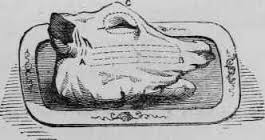
Evelina’s activities today were quintessentially nineteenth-century.  She mended her son’s coat, made button holes for her sister-in-law, rode out in the carriage with her other sisters-in-law to call on the parson’s wife, and served a calf’s head for dinner.

Perhaps there is a reader out there who has been served calf’s head, or cooked it.  Most 19th century cook books carried a “receipt” for it, right next to recipes for calf’s feet, sheep’s head, and roasted sweetbreads.  Calf’s head could be roasted or boiled; the recipe below from Mary Peabody Mann’s 1858 Christianity in the Kitchen opts for the latter.  What follows is not for the squeamish:

To Dress a Calf’s Head

Soak the head for ten minutes in lukewarm water, powder it well with rosin, dip it into a large quantity of scalding water, and holding it by the ear, scrape off the hair with the back of a knife.  When clean, take out the eyes, cut out the tongue, remove the jawbone with teeth, saw lengthwise through the skull without injuring the brains, which must be carefully taken out, and put for a few hours into lukewarm water, to disgorge, [that is, to rinse out the blood.]

Make a stock by putting into the brazing pan two or three carrots and onions, six cloves, a pint of cream, a bouquet of parsley, thyme, and bay-leaves, and after stirring this together for twenty minutes over the fire, add a pint of water.  When this is warm, mix a quarter of a pound of flour with a gallon of water, slice a lemon, add a quarter of a pound of salt, and lay the calf’s head into the stock.  Let it be entirely covered, else the uncovered part will have a dark look, and simmer it gently till it is tender.


May 25, 1851

Cemetery


25 May Sunday  Have been to church all day. Went to Mr

Whitwells at noon with Mother and Mrs Whitwell

made us take a cup of tea Also Mrs Elijah Howard & Miss

Louisa H.  Had quite a spirited chat about Mr

Wm Reed & Mr Dean. After meeting Mr Ames & Oliver

& wife rode to the burying grounds  Cannot 

feel reconciled to having it where it is. Oakes A Susan

& Orinthia went to a sing & Oakes carried Orinthia home.


A cup of tea and good, “spirited chat” among the women during intermission brightened Evelina’s Sunday.  Who were Mr. Reed and Mr. Dean that they evoked such consideration from the female population?  There were several men of either name who lived in Easton at the time.

When church was over, Evelina, Oakes, Oliver Jr. and Sarah Lothrop Ames drove together to look at the new cemetery in South Easton. Created by the Easton Cemetery Corporation, it was one of almost thirty graveyards in the town.  For reasons lost to history, this newest burial-ground had been deemed desirable and consequently established by men well-known to the Ameses, including Elijah Howard and Dr. Caleb Swan.  Perhaps their intention had been to create at burial place that would be tended to as time passed, as many smaller, family graveyards throughout the town were not. Perhaps they were responding to personal inclinations to group Unitarians together for eternity.

Whatever the thinking behind the new burial-ground, Evelina was dubious.  Did she look at it and think she and Oakes might be buried there someday?  Did she wish instead to be buried near her son Henry, wherever that was? Or did she think of another graveyard where her father and certain siblings were buried? Little could she imagine that twenty-five years hence, the Village Cemetery of North Easton would be created behind a Unitarian Church that hadn’t yet been built, both projects funded by Oliver Jr, and that there she, her husband, and all her children would eventually be laid to rest.


May 2, 1851

1528

Globe Amaranth

1851

May 2nd Friday.  Susan started with several other children

about 6 Oclock maying and did not get back

untill half past nine.  They went over three miles

to the “West Shire”  I made cake & ginger snaps to

bake with Mrs Witherell. Jane made some pies and 

bread.  Mr & Mrs Whitwell and Mrs William Reed

called. Afterward planted some globe seed and 

carried my stockings to mend in the other part of the house

Today’s good weather gave Susie Ames and her friends the opportunity they missed yesterday. Leaving early in the morning, they walked west to deliver May baskets to friends and family, or perhaps even to strangers. It sounds as if the children walked a long way on their little legs. Readers in Easton, where exactly is the “West Shire?”  By the Bay Road?

Baking was in order today. Evelina and her sister-in-law Sarah Witherell baked cake and ginger snaps, while Jane McHanna prepared the usual pies and brown bread. Did the children get any ginger snaps when they returned home? Certainly, Reverend and Mrs. Whitwell would have been offered some to eat, as would Abigail Reed, wife of the Reverend William Reed. Guests who dropped in, whether or not they were expected, were always offered refreshments such as tea and fruit or biscuits. Cider was a common refreshment, too, but not at the Ames’s house; it was too close to alcohol.

Once the guests had departed, Evelina went out to her garden and began to plant globe seed. Did she have a specific plan in mind for the garden, or was her planting haphazard and spontaneous? If she consulted any of the publications she read, like The Massachusetts Ploughman, or the ladies’ periodicals, she probably found suggestions for arranging her flower beds.


April 13, 1851

200px-First_Unitarian_Church_in_1886

*

1851

April 13th Sunday.  Have been to church all day Frank

staid at home in the morning Mrs G Ames went

with us to meeting all day and liked Mr Whitwell

I staid at noon with Mother most of the time

Called at Mr Whitwells with Louisa Howard

Mrs Dr Deans & Mrs H Pool. Mrs Whitwell

has no help now & is not very well. rather cold

On this cold spring day, the Ames family, minus Frank Morton, went to church with Almira Ames, widow of Oakes’s cousin George Ames.  Perhaps Almira joined Evelina and her mother during the midday intermission when many women were welcomed into the parsonage by Eliza Whitwell, wife of the minister. Eliza was under the weather but still was under a social obligation to open her house to fellow Unitarians who could not get home and back during the pause between the morning and afternoon services.

Mrs. Dr. Deans, otherwise known as Hannah (Wheaton) Deans, wife of Dr. Samuel Deans, was also present at the Whitwell’s.  The “Dr.” title in front of her name didn’t mean that Hannah was a physician; far from it. It meant that she was married to a physician.  She was a daughter of old Daniel Wheaton who lived out on the Bay Road.

Evelina often admired Rev. Whitwell’s sermons but seldom related their content. In these tumultuous months following the enactment of the Fugitive Slave Law, did Mr. Whitwell ever speak about slavery or abolition? We know that other Unitarian ministers were quite vocal about abolishing slavery.  On this same Sunday in Philadelphia, three hundred miles to the south, Rev. William H. Furness gave a discourse on the Fugitive Slave Law, speaking from the pulpit with all the authority that his robed position could give him.  A graduate of Harvard and friend of Ralph Waldo Emerson, Furness was, like William Whitwell, an accomplished theologian.  He was also a passionate abolitionist; was Reverend Whitwell?


*First Unitarian Church of Philadelphia, ca. 1886

February 21, 1851

Bed

1851  Feb 21  Friday  It stormed so hard & so dark that Mr & Mrs

Whitwell spent last night with us & returned

home about 8 Oclock this morning  Lavinia &

myself have been sitting quietly sewing.

Susan is all engaged making Labels for the shop

has cut quite steady all day.  Helen brought her work in, and staid two

or three hours but I could not prevail on her to stop to tea

Bridget has hired a bed & bedstead

The family business, O Ames and Sons (as it had been known since 1844 when Old Oliver handed over two-thirds of the reins to his sons Oakes and Oliver Jr.) was just that: a family business.  The Ames men all had rolls to play in its operation, from manufacturing to sales to management.  On this day in 1851, it appears that an Ames female had a roll to play, too.  Little eight-year old Susie Ames spent the day making labels for the shop.  Presumably, this meant she was cutting out printed labels to be affixed to individual shovels.  Did she sit at a table in the kitchen or the dining room, paper and scissors in hand?  Was she paid for this effort, or was this just a rainy day game for her?  Who thought this up?

While Susie wielded scissors, the women wielded needles, of course.  Evelina and her niece, Lavinia Gilmore, kept each other company as they sewed and were joined for a few hours by Helen Ames from next door.  Although Lavinia, aged 19, lived in the country and Helen, aged 14, lived in town, the two young women, distantly related by marriage, were friends.

Lavinia was in town visiting her aunt Evelina.  Last night, Mr. and Mrs. Whitwell stayed over, unable to return home because of bad weather.  A new servant, Bridget, had just ordered a bed and bedstead for herself. In a two-family house already filled with ten people, not including servants, where did everybody sleep? People surely doubled up; Oakes Angier and Oliver (3), for instance, shared a bedroom and probably a bed. Although this practice, too, was disappearing, many houses of the period still kept beds in their parlors; apparently the Ames did this, so perhaps that was where the Whitwells spent the night.

The difference between a bed and a bedstead was simply that the former included only the mattress and linens (also known as bedding), while the latter was the frame on which to put the mattress.  This verbal distinction was beginning to disappear at the time, but it was still useful in an era when some people – servants, particularly – only had bedding on which to sleep.  A mattress could be rolled up and moved around, a wooden frame could not.  Bridget showed hope or confidence in her place in the household when she ordered a bedstead as well as a bed.

January 30, 1851

Flames

Jan 30th  Thursday  Mended Mr Ames pants which

took me most of the forenoon, read some to Mother.

Spent this afternoon at Olivers with mother & Mr

Whitwell.  They sent the carriage for Mrs Whitwell

but it was so cold that she did not come.  Mr Ames

took tea with us & Mr Ames Oliver Jr C Lothrop & 

Helen played cards I commenced a stocking of the yarn

Mrs Foss gave me.  A bitter cold day & quite windy.

A great fire in Taunton

“A verry bad day to go out in,” noted Old Oliver in his journal today.  Eliza Whitwell refused to leave her home several miles away to join the Ames ladies in the afternoon, even though her husband was there.  The carriage – did it belong to Old Oliver, or Oliver Jr, or to the family in general?  Whoever owned it, its likely driver was Michael Burns, an employee of Old Oliver who looked after the horses and carriages.

While Michael drove to and from the parsonage in the howling cold, various family members gathered next door at Oliver and Sarah Lothrop Ames’s house for tea. Oakes and his son Oliver (or possibly his brother Oliver – unclear) played cards – probably whist – with Cyrus Lothrop and Helen Ames.  Cyrus was an unmarried brother of Sarah Lothrop Ames who lived with Sarah and Oliver, Jr. for many years. Helen was their only daughter; their son, Fred, was probably away at Phillips Exeter Academy on this occasion.  Evelina knitted and kept her mother company.

In nearby Taunton, Massachusetts, Evelina reported, the furious wind contributed to a “great fire.”  The histories of that period don’t mention this fire, so perhaps it was not as great as Evelina thought.  That, or it paled in comparison to the larger fires that Taunton suffered in 1838 and 1859.*  Fire, naturally, was the dread of every homeowner and municipality; towns and cities in the 19th century (and before) were pock-marked by periodic burnings, its citizens haunted by the loss of life and property that fires engendered. The fire on this day in Taunton would have been made especially difficult by the frigid air and icy wind.

*Information obtained from Old Colony Historical Society, Taunton, Massachusetts

January 22, 1851

Chillblains

Chillblains

1851 Jan 22 Wednesday  Commenced working on the sack again this

morning quite early.  Went to Elisas about ten

to get her to make a dress for Susans doll staid

untill twelve and left her to finish it

Got ready to go to the sewing Circle at Mr Whitwells

But it commenced snowing very fast which prevented

our going.  This evening have finished Susans sack

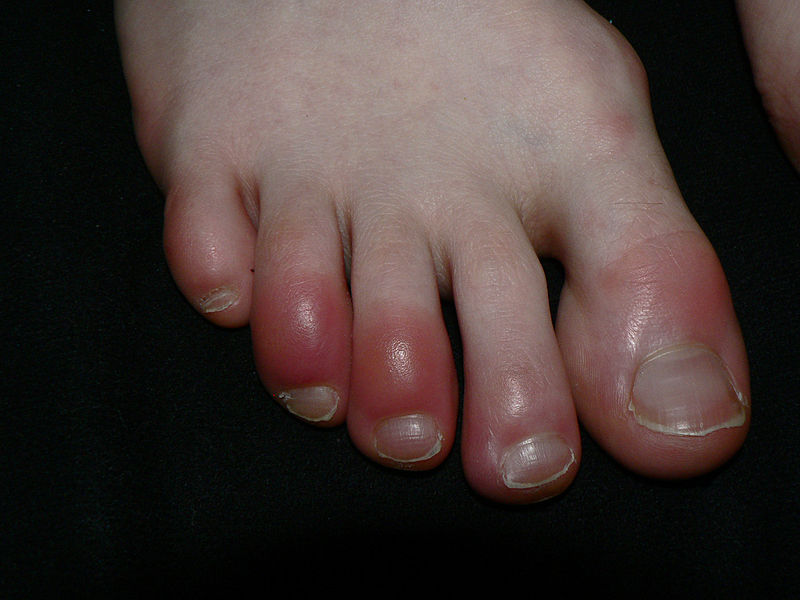
Oliver poor fellow sits here almost crying with the chillblains

Evelina finished sewing a sack (a kind of apron) for her daughter that she’d been working on for several days, and turned to another ongoing project, doll clothes.  At mid-morning she left the house and went to Elisa and Patric Quinn’s home along Stoughton Road (today’s Elm Street).  Elisa was a dressmaker while Patric was employed at the shovel factory.  Like so many employees in that period, they had emigrated from Ireland.  Elisa was going to help Evelina finish two dresses for Susie’s new doll.

Leaving the little dresses in Elisa’s capable hands, Evelina returned home for midday dinner, just before snow began to fall.  She and her sisters-in-law had planned to go to the monthly meeting of the Sewing Circle, held this afternoon at the parsonage where the Whitwells lived, but poor visibility put an end to their travel.  The ladies stayed home.

Oliver Ames (3), Evelina and Oakes’ middle son, was suffering from chillblains, an unsightly and uncomfortable affliction of extremities: toes, fingers and ears.  Cousin to frostbite, chillblains are an itchy, painful inflammation brought on by exposure to moist cold air.  Some say it’s caused by too-rapid warming of skin and tissue after exposure to cold.  Different treatments were offered: poultices, soaking or rubbing with salt.  Lydia Maria Child, author of The American Frugal Housewife, offered a specific remedy:

“The thin white skin, which comes from suet, is excellent to bind upon the feet for chillblains.  Rubbing with Castille soap, and afterwards with honey, is likewise highly recommended.  But, to cure the chillblains effectually, they must be attended to often, and for a long time.”

It appears that Oliver (3) was in for several days of discomfort.