April 11, 1852

article-2606221-1D23CB0C00000578-490_964x613


Sunday April 11th  Mr Whitman of E Bridgewater preached

He gave us two good sermons but he is very dull and

I was very sleepy. Came home at noon  Alson & wife

came to Augustus’ After meeting went into Edwins

Augustus & E Andrews came there.  Susan staid

at home from everything  It has been very pleasant

In the tradition of their Puritan ancestors, Evelina and her family did not celebrate Easter. No hidden eggs or little bunnies or even new bonnets appeared in the Unitarian homes of Easton on Easter Sunday, 1852. Many of the Catholic families in town, however, would have celebrated this significant Christian holiday, further underscoring the strong cultural differences between the new Irish and the old Yankees of Massachusetts.

Other parts of the country celebrated this holiest of Christian remembrances. It was the German community of the mid-Atlantic states, better known as the Pennsylvania Dutch who, some say, introduced the Easter bunny to America in the 1700s. The rabbit and the egg were symbols of the Germanic fertility goddess Eostre, whose pagan festival was eventually taken over by early Christians as a celebration of Christ’s death and resurrection.

It being Sunday, the Ameses went to meeting, at least, for both an afternoon and a morning service. Reverend Whitwell, the usual minister, was replaced today by Mr. Whitman from East Bridgewater who was, unfortunately, “very dull.” Evelina struggled to stay awake.


March 28, 1852

Ames-Shovel-Handle-2

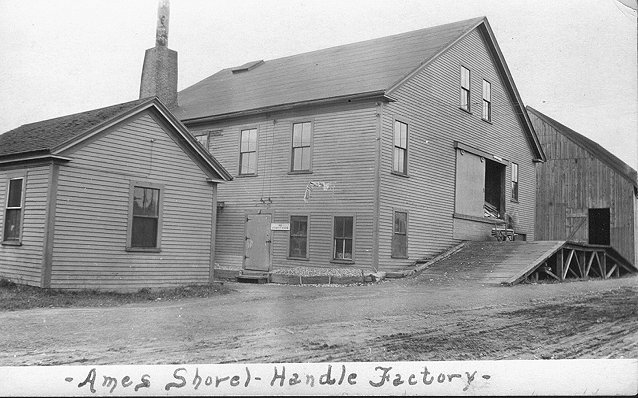
Ames Shovel Handle Factory, Oakland, Maine*


March 28 Sunday  Went to church this morning and

at noon called at Mrs Wm Reeds with Henrietta

Hannah came at noon but was faint and

I carried her home and got back to church about

the time the services were over  After went down

to the new shops with Mrs W, S Ames Augusta Orinthia

found Mr. Ames, Oliver & Cyrus L there returned by Edwins

and all called there  Mr Ames & self went to Augustus’ this evening

The new shops were up, and various family members rode by to see them after church. No more “dismal ruin”, as reported by Evelina only three weeks earlier. Risen like a phoenix from the ashes of the old shops, the shovel works were about to begin operations in new, if temporary, quarters.

It was a large group that gathered to consider the new buildings. Evelina, who had missed the afternoon service in attending to her ailing niece, Hannah Lincoln Gilmore, nonetheless rode back from church to the site. Accompanying her were her sisters-in-law, Sarah Witherell and Sarah Ames; another niece, Augusta Pool Gilmore; and sometime boarder and frequent companion, Orinthia Foss.  At the site, by accident or design, they found Oakes Ames and his brother, Oliver Ames Jr., and Cyrus Lothrop, a brother of Sarah Lothrop Ames who often resided with his sister. The group must have marveled at the swift reincarnation of the shovel works.

Perhaps a celebratory spirit inspired the crowd to assemble en masse at the nearby home of newlyweds Augusta and Edwin Gilmore.

*Image of Ames Shovel Handle Factory, Oakland, Maine courtesy of the Oakland Maine Area Historical Society. Included to illustrate what the rebuilt shovel factory could have resembled.

March 23, 1852

SurvChain

 Gunter’s Chain**

March 23

1852 Tuesday. Alson and wife dined here and spent

the afternoon at Edwins  He has been running

out lines for Edwin & Melvin Randall  Orinthia

went home with them.  Was at tea in Edwins

& this evening with Augusta at Augustus’

Augustus has gone to New York.  Susan is staying

there to night went just after dinner.  Oliver & wife

went to Boston this morning   Rained untill early night.

The Gilmore clan was moving around today. Evelina’s nephew, Alson “Augustus” Gilmore, was headed for New York City on business for his boot company or the Ames shovels, or both. Evelina’s brother (and Augustus’s father), Alson Gilmore, and his wife, Henrietta Williams Gilmore, had midday dinner at the Ames house. Alson was in the village helping another son, Edwin Williams Gilmore, and an Easton man, Melvin Randall, run out lines.

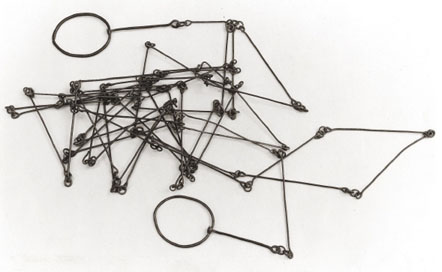
The phrase “running out lines” is open to interpretation (ice fishing is a possibility!), but the most likely meaning is that ground was being measured, perhaps for the new factory buildings soon to be built. A running measure is the cumulative distance in a straight line from a fixed point. The standard instrument used to get a running measure, at least in the 18th and 19th centuries, was a Gunter’s chain. It was used in conjunction with a compass and a transit (for establishing straight lines) to measure ground.

Invented by an English clergyman and mathematician, Edmund Gunter, around 1620, the Gunter’s chain “played a primary role in mapping out America.”** The Army Corps of Engineers would have owned such chains in bulk. The chain’s 100 lines measure 4 poles, or 66 feet, or 22 yards, depending on how you care to count it. Eighty chains equal one mile.

The Gunter’s chain, however, helpful as it was, was apt to be hand-made and thus subject to variation. It was eventually replaced by the more accurate surveyor’s tape.

By the way, for those readers who follow the game (or watch Downton Abbey), the length of a cricket pitch is exactly one chain.

*Thank you, Frank Mennino, for your assistance on today’s blog.

**Image from Colonial Williamsburg, courtesy of http://www.history.org

March 21, 1852

9291031-apples-are-stored-in-the-cellar-to-keep-fresh

1852

March 21 Sunday  Have all been to meeting except

Susan who is not very well  George carried

Amelia home at noon  I had a very pleasant

visit from her of nearly two weeks.  Orinthia

called with me into Edwins after church & we

helped ourselves to apples from the cellar.  Augusta

sent us one filled with sand and cheese.

Called at Mr Whitwells at noon & at Mrs J Howard a moment

Spring had arrived; Amelia Gilmore left the Ames’s home and hospitality and headed back to her own quarters in southeastern Easton. George Oliver Witherell, 14-year old son of Sarah Ames Witherell, obligingly carried her home in a carriage during the intermission at church. Evelina, meanwhile, visited with the Whitwells and the Howards.

After church Evelina and Orinthia went to the home of Edwin and Augusta Gilmore and helped themselves to “apples from the cellar.” That the young couple still had apples from the previous fall suggests that the harvest had been good and the storage arrangements even better. We presume that Evelina and Orinthia took the apples with the permission of the Gilmores; Augusta sending over a barrel “filled with sand and cheese,” corroborates that. But why is a barrel with cheese also filled with sand? Any thoughts, readers?


March 20, 1852

faces


from The Philosophy of Laughter and Smiling , 1877

1852

March 20th Saturday  Have cut and basted a purple print

apron for Susan of a pattern that Lavinia

brought from Mary  Abby & Edwin & wife were

here to tea  Orinthia dressed in Franks clothes

and paraded around here awhile.  Send for Mrs

Witherell & Mrs S Ames to see her  We have had

a pretty lively time  Orinthia brought over

Edwin & wife.

The ladies laughed today.  After sewing for hours, breaking only for midday dinner, Evelina and her young friend Orinthia Foss laid down their needles to have tea. Orinthia got it into her head to put on nineteen-year-old Frank Morton Ames’s clothes “and paraded around.” She donned his shop pants, perhaps, and shop coat over one of his white muslin shirts. Evelina and her guests were so amused at the sight that they called in Sarah Ames and Sarah Witherell to see the fun. Cross-dressing was a novelty for these women, and Orinthia’s daring act generated hilarity.

All things considered, these women were probably due for some laughter.  It was the first day of spring, and everyone had been pretty well cooped up for months, excepting the occasional trip into town. More recently, they had suffered through a major fire. Some innocent amusement was a good release.

Evelina’s favorite author, Charles Dickens, knew all about laughter: “It is a fair, even-handed adjustment of things, that while there is infection in disease and sorrow, there is nothing in the world so irresistibly contagious as laughter and good humor.”**

While the women amused themselves at home,  the best-selling novel of the 19th century was published in book form today, in Boston.  We’ll soon find Evelina reading Uncle Tom’s Cabin.


* Clockwise: “The Giggling Laugh, excited by Boisterous Fun and Nonsense.” “The Obstreperous Laugh, instigated by Practical Jokes or Extreme Absurdities.” “The Hearty Laugh of the Gentler Sex.” “The Stentorian Laugh of the Stronger Sex.” “The Superlative Laugh, or Highest Degree of Laughter.“ From The Philosophy of Laughter and Smiling, George Vesey, 1877. Courtesy New York Historical Society, courtesy of CABINET: The Art of Laughter, Issue 17, Spring 2005

**Charles Dickens, A Christmas Carol

March 16, 1852

130705-A-DS407-001

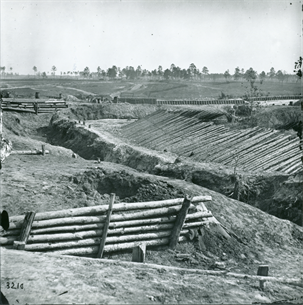
Defensive breastworks dug by Army Corps of Engineers outside of Petersburg, Virginia during the Civil War – probably using Ames shovels

March 16th

1852 Tuesday  Sewed on my waist very quietly

with Amelia this forenoon and this afternoon

have been into Edwins  Julia Pool came

there & tomorrow is going into Boston  Mrs S

Ames was there and this evening Mrs Witherell

Amelia is in fine spirits and am having

a very pleasant visit from her.

A quiet day was this, and “not verry cold.”*  Evelina and her sister-in-law, Amelia Gilmore, sat and sewed for hours and visited with Augusta Pool Gilmore, Sarah Lothrop Ames and Sarah Ames Witherell.  The reconstruction of the shovel shops continued.

Although Evelina was unlikely to have known it, today happened to be the 50th anniversary of the founding of the Army Corps of Engineers. Officially organized  by President Thomas Jefferson on this date in 1802, the Corps was headquartered at West Point, where it established and led the military academy until after the Civil War. For many years, West Point was the major engineering school in the country.

In addition to its oversight of West Point, the Corps was tasked for much of the 19th century with exploration of America’s vast lands and waterways. As the country moved westward, the Corps surveyed road and canal routes.  During the Civil War, it built bridges, railways, forts, batteries and roads – often using Ames shovels.

In 1852, in particular, the Corps was focused on waterways.  In Detroit, one group of engineers conducted and published a survey of the Great Lakes. In Utah, an engineer named Lieutenant James W. Gunnison, for whom the Gunnison River is named, explored the Salt Lake area and spent time with the Mormons. He published a report entitled, “The Mormons or Latter-Day Saints, in the Valley of The Great Salt Lake. A History of their Rise and Progress, Peculiar Doctrines, Present Condition, and Prospects, Derived from Personal Observation During a Residence Among Them.”

A year later, Gunnison and several members of his team would be massacred by Indians from the Pahvant Ute tribe.  Gunnison’s widow, Martha, always believed that the Mormons were the actual perpetrators. The Army Corps of Engineers kept right on going, continuing its work and eventually expanding its original mission to include flood control, dam construction, and environmental cleanup.


Oliver Ames, Journal, Stonehill College Archives, Arnold Tofias Collection

March 15, 1852


PENTAX Image


1852

March 15th Monday  Gave the sitting room & entry

a thourough sweeping & dusting and then

went to sewing.  Susan washed the dishes

Amelia & self carried our work into Edwins but did 

not stop to tea, are invited there tomorrow.  We called

at Mrs Bucks  She has 41 schollars and 5 or 6 boarders


After “considerable rain” over night, Monday broke “cloudy in the morning but fair + warm in the afternoon and in the evening there was some rain + it grew colder [.] Mr Arnold came to day to sleight the hammer shop”* Thus wrote Old Oliver.

After Sunday’s respite, work on the rebuilding of the shovel shops picked right back up.  A slate roof was going up on the hammer shop, thanks to the expertise of John Arnold, a local man who had done roofing for the Ameses before.  Old Oliver seemed pleased.

At the Ames home, Amelia Gilmore continued her visit with Evelina. Once the morning chores were complete, with Susie washing dishes and trusted Jane McHanna doing the laundry, and midday dinner consumed, Evelina and Amelia walked across the way to visit Augusta Pool Gilmore, carrying their sewing with them. They must have spent several hours there, but didn’t stay for tea. Instead they headed home, stopping off to see another neighbor, Polly Buck.  Evidently, Mrs. Buck was running a private school with day students and boarders. One imagines that the ruckus there might have been equivalent to the bustle of workers at the building site.


*Oliver Ames, Journal, Stonehill College Archives, Arnold Tofias Collection

March 10, 1852

Handkerchief

1852

March 10th  Wednesday  Early part of the day

was sewing on a waist or rather cutting

it out and getting it to fit.  Augusta

came in this afternoon but as Amelia

& self were invited into Olivers she went

with us and Edwin.  Mr Ames came to tea

Amelia trimmed some pocket handkerchiefs

for me that Mrs Ames got in New York

The rebuilding of the shovels shops was moving along well. They “put the roof on the stone shop to day,”* according to Old Oliver, who watched each day’s progress carefully. It had been a full week since fire had destroyed most of the factory buildings. The response and reconstruction had been immediate!

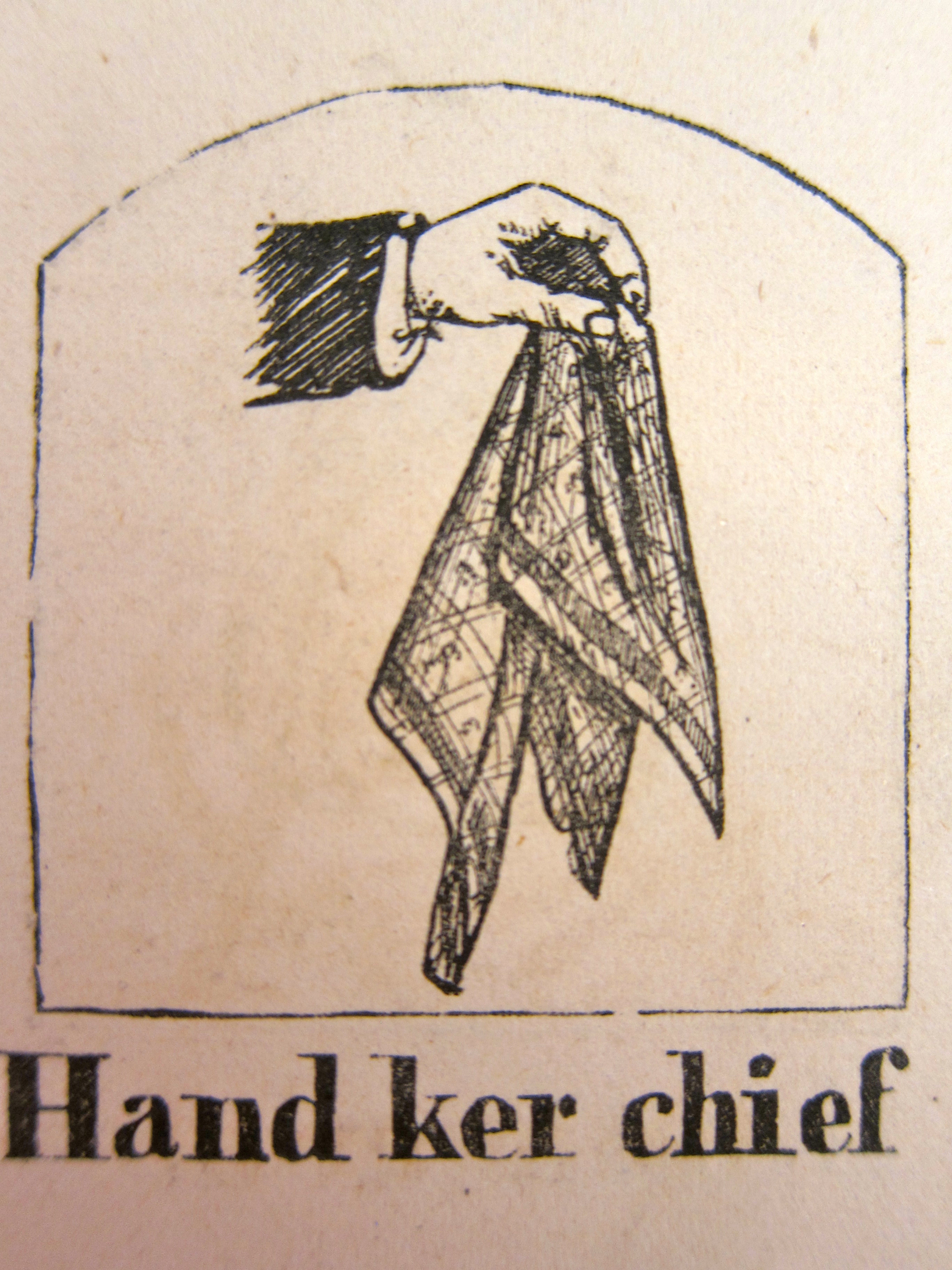
Amelia Gilmore, the widow of Evelina’s younger brother, Joshua Gilmore, Jr., was visiting for several days.  She undertook the hemming of some handkerchiefs – essential components of a lady’s outfit – that Almira Ames had brought Evelina from New York City. The purpose of a handkerchief, a personal item dating back to antiquity, was primarily hygenic, used to wipe one’s nose or brow and cover one’s cough. In a time of contagious diseases such as tuberculosis, cloth handkerchiefs were essential.  Their ubiquity necessitated their incorporation into the fashion profile.

Late in the day, the two went next door to Oliver Jr.’s and Sarah Lothrop Ames’ home for tea.  Oakes Ames went, too, and the newlyweds, Augusta and Edwin Gilmore, tagged along.


*Oliver Ames, Journal, Stonehill College Archives, Arnold Tofias Collection


March 6, 1852

Whitewash

1852

March 6th Saturday  Mr Scott whitewashed the parlour

& sitting room chamber this morning and I

varnished the front entry oil cloth.  Lavinia

came at eleven and Augusta this afternoon

Alson came after Lavinia and stopt to tea

Charles Pool came up and carried Edwin

and Augusta home to stay till Monday

I have been to work on a stiched pink apron

for Susan

A full moon shone down on North Easton this night, highlighting the charred ruins of the shovel factory.  Before it rose, however, Old Oliver took the opportunity of “a fair day”* to travel to Bridgewater, quite probably on shovel business.  He and his sons were developing plans to rebuild the factory, and some help for that would be found in Bridgewater.

Evelina’s way of coping after the devastating fire appears to have been to keep the domestic front moving smoothly. Redecorating continued, social calls were made and enjoyed, and sewing continued without a blink of an eye. Daughter Susan would soon have a new pink apron.

Years later, Evelina and Oakes’s grandson, Winthrop Ames, would credit his grandmother and other Ames wives with exerting a positive influence on his male ancestors. “They made the homes, reared the many children, saved their husbands’ money, encouraged their undertakings, and steadied them in failure and misfortune,”** he said. Evelina’s evident steadiness during this challenging period is one such instance of positive influence. Oakes Ames had come home from the fire “more cheerful” than Evelina had expected; she seems to have behaved with equal optimism. Though naturally sanguine, Oakes’ bright outlook and ability to cope in the aftermath must also have been bolstered by his wife’s unflappable focus on home and (redecorated) hearth. Together, they maintained continuity.

Charles Pool, Augusta’s eldest brother, drove up from southeastern Easton today and fetched his sister and her husband, Edwin Williams Gilmore, “home to stay” for a few days. Perhaps this visit had been prearranged, or perhaps it was an effort by the young couple to get out of the way of remnant smoke and disruption from the fire.

*Oliver Ames, Journal, Stonehill College Archives, Arnold Tofias Collection

**Winthrop Ames, The Ames Family of North Easton, Massachusetts, 1937, p. vi.


March 4, 1852

Shovel Shop Pond And The Island North Easton, MA

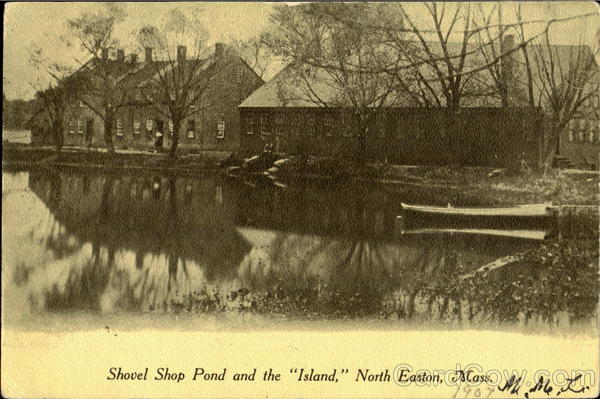
Replacement buildings on a section of the Ames shovel complex

1852

March 4 Thursday  Scott & Holbrook are setting glass at

the shop to day  They have the front entry partly

painted  I carried my work into Edwins this

forenoon  mended O Angiers shop coat  This afternoon

have been to Mr Torreys with Augustus & Lavinia

Called a few moments on Hannah  She has a 

sore mouth and is weaning her child

Evelina addresses her day calmly, as always keeping her distance from the goings-on at O. Ames & Sons. Most other residents of North Easton were still reeling, no doubt, from the huge fire that had burned down a majority of shovel factory buildings over the night of March 2. The sun was shining and the wind was out of the north west, pushing around remnant smoke still rising from the ruins of the complex of wooden buildings. Shovel shop employees had no regular job to go to and the owners had some serious decisions to make, fast.

Clean-up from the huge fire was underway, probably by the labor of the very men whose factory jobs had been temporarily eliminated. The men who had been painting and papering at the Ames’s house, for instance, were co-opted to set glass at the shop, suggesting that new panes of glass – the originals probably having been blown out by the fire – were going into the windows of the one or two buildings that had survived.

As town historian Ed Hands points out, “the Ames family and the neighborhood rebounded quickly.”*  Old Oliver and his sons Oakes and Oliver Ames Jr. made a two-fold decision. The first was to create temporary structures to house the manufacturing so that shovel making could resume as quickly as possible.  The second was to create “new, permanent stone shops,”* sturdy, nonflammable structures that could outwit any new fire.

There was insurance money to cover at least some of the rebuilding. Sources differ on the amount of damage that the fire inflicted, but suggest it was between $30,000 and $40,000. The amount of insurance coverage is also uncertain. Old Oliver “states that there was $3,000 worth of insurance on the buildings”** but, according to industrial historian Greg Galer, it’s likely that the Ameses had increased insurance coverage on the factory back in November, 1851. Whatever the actual dollar cost was, “[t]he company bounced back quickly from the devastation, and seemingly without significant financial trauma.”**

*Edmund C. Hands, Easton’s Neighborhoods, Easton, 1995, p. 163

** Gregory Galer, Forging Ahead, MIT, 1989, p. 249